OrbitalHub

Where curiosity reaches escape velocity.

Domain is for sale. $50,000,000.00 USD. Direct any inquiries to contact@orbitalhub.com.


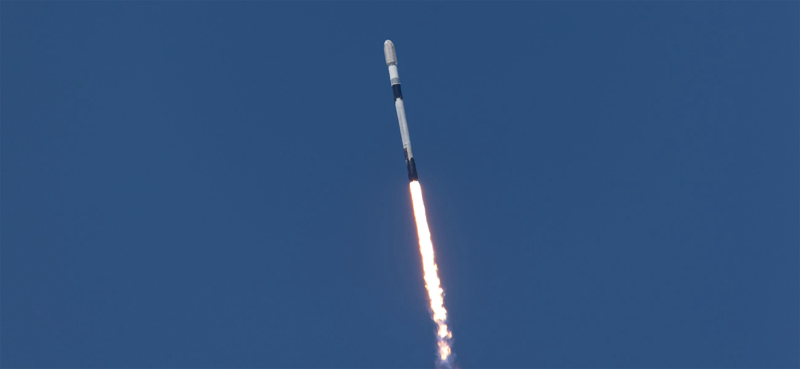
Falcon 9 ascends against a deep blue sky over Vandenberg, the bright plume trailing straight down from the booster as it climbs out of the lower stage of the atmosphere.


A Falcon 9 lifted off from Space Launch Complex 4E at Vandenberg Space Force Base at 11:32 a.m. PT on Thursday, October 1, 2026, carrying 130 satellites and hosted payloads into a sun-synchronous orbit on SpaceX’s eighteenth dedicated rideshare mission. It was one of three Falcon-family flights SpaceX flew that day, sandwiched between the Crew-13 astronaut launch from Florida in the morning and a National Reconnaissance Office Falcon Heavy from the Cape that night, and the size of the manifest made it the most diverse single launch of the year so far.

Transporter missions are SpaceX’s standing answer to the question “where do smallsats go?” The SmallSat Rideshare Program sells slots on quarterly Falcon 9 flights to SSO for as little as $350,000 per payload for up to 50 kg, with the cadence locked far enough in advance that customers can plan a satellite around a specific quarter instead of buying a dedicated rocket. The eighteenth such mission brought the program’s all-time tally past 1,800 payloads delivered to orbit, per SpaceX’s official mission page, a number that captures how the commercial smallsat industry is built as much on shared buses and shared launches as on the satellites themselves.

The first stage that flew Transporter-18 had already done this twice. It was the booster’s twenty-fifth flight, with a previous log that included NROL-126, Transporter-12, SPHEREx, NROL-57, USSF.366, and fourteen Starlink flights. Seven minutes and thirty-two seconds after liftoff it touched down on Landing Zone 4 at Vandenberg, returning to the same pad complex from which it had departed a few minutes earlier, in the kind of same-pad turnaround that has become routine for the West Coast booster fleet. Residents of Santa Barbara, San Luis Obispo, and Ventura counties may have heard one or more sonic booms as the booster came back through the denser lower atmosphere.

Inside the fairing, the manifest ran from cubesats to hosted payloads to two reentry vehicles and four orbital transfer vehicles that will deploy 41 of the 130 payloads at a later time. That architecture is the quiet structural innovation of recent rideshare flights: instead of forcing every customer into the same orbital plane on the same timeline, SpaceX has absorbed the role of mission manager. The OTV providers (D-Orbit, Exolaunch, Maverick Space Systems and others) now offer “deploy on a different day, at a different altitude” as a service to the payload builders. The Falco trade Via Satellite’s coverage of Transporter-18 describes a manifest where, for example, Tomorrow.io’s two weather satellites and Satellogic’s four optical Earth observation satellites ride along on the same Falcon 9 but can be dropped into different local times of day on station by their respective OTVs.

Several of the 130 payloads were firsts for their operators, which is what made Transporter-18 worth covering as a single story rather than as a pile of separate launches. Planet Labs flew the prototype satellite for Project Suncatcher, the joint effort with Google to test how Google machine-learning models and Google Tensor Processing Units behave when run in orbit rather than on the ground. Planet was the largest single customer on the flight, and in addition to the Suncatcher prototype it also flew the second Tanager methane-tracking satellite (Tanager being the methane mapper Planet developed with the CarbonMapper coalition), plus 18 SuperDove imagers manifested by SEOPS. StarCatcher flew Protostar, billed as a first-of-its-kind power-beaming node designed to demonstrate transferring electrical power between two free-flying spacecraft using optical links; a separate payload from Cowboy Space called Reason-1 is testing high-power laser energy transfer from low Earth orbit down to a ground receiver. Two demonstrations of moving watts around with light, on the same rocket, a few hours after the first ground-to-orbit ML inference test.

Starfish Space sent its first Otter servicing vehicle. It will run a NASA mission under the Small Spacecraft Propulsion and Inspection Capability acronym (SSPICY), and the flight is the company’s first operational satellite. CesiumAstro sent Element, its first full satellite built on the company’s own phased-array antennas, software-defined radios and onboard processors; Unseenlabs sent a pair of next-generation radio-frequency monitoring satellites, one to add capacity to its first-generation constellation and a BRO (BRO-32) to expand RF detection coverage across sea, land and space. Dhruva Space integrated LEAP-2, its second commercial mission, hosting multiple in-orbit demonstration payloads including units from Sodern ArianeGroup and the India-based Satleo Labs TAPAS-1.

The mission also carried two reentry vehicles from Varda Space Industries, continuing the company’s program of returning pharmaceuticals manufactured in microgravity, and the eight-satellite IRIDE Eaglet II cluster for Italy’s national Earth observation constellation. Constellation refreshes dominated the rest of the manifest: four ICEYE synthetic-aperture radar satellites, four Satellogic optical satellites, five Sateliot IoT nodes, two GHGSat methane monitors manifested by SFL Missions, and Tomorrow.io’s two weather satellites. According to the SpaceWatch.Global launch report and the NASASpaceFlight mission preview, the deployment sequence began at T+54 minutes and 22 seconds with the NASA-manifested Sprite cubesat and ran for the next hour through 89 individually sequenced deployments, with SpaceX confirming the deployment sequence had concluded at 3:41 p.m. ET.

What makes Transporter-18 worth thinking about beyond the manifest is the layering of three different kinds of space activity on the same rocket. There are constellation refreshes, which are now a steady, repetitive part of the smallsat industry the way cellular tower upgrades are a steady part of the telecoms industry. There are first-of-kind demonstrators: the Project Suncatcher ML-in-orbit prototype, the StarCatcher and Cowboy Space optical power-beaming tests, the Starfish Otter servicing mission. Their operational lifetimes may or may not turn into recurring revenue depending on what the data shows. And there are hosted payloads and secondary slots that let a university lab or a small country’s space agency get a satellite into orbit for the price of a rideshare ticket, which is what turns a quarterly launch cadence into infrastructure for everyone who builds the future of space hardware.

The next Transporter flight will not be far behind. Rideshare customers now plan their satellites around a known quarterly cadence from Vandenberg and the Cape, and a mission profile with 130 payloads, an OTV captain, and a twenty-fifth-flight booster is no longer an exception to the rule. It is what a normal Falcon 9 launch looks like in late 2026, and the question worth watching is not whether the next rideshare can carry this much, because the manifest will only grow. It is whether the long tail of secondary payloads can keep its quality bar as the cadence accelerates, and whether the experimental demos like Suncatcher and Protostar turn into recurring programs that share the same quarterly rocket on its own.
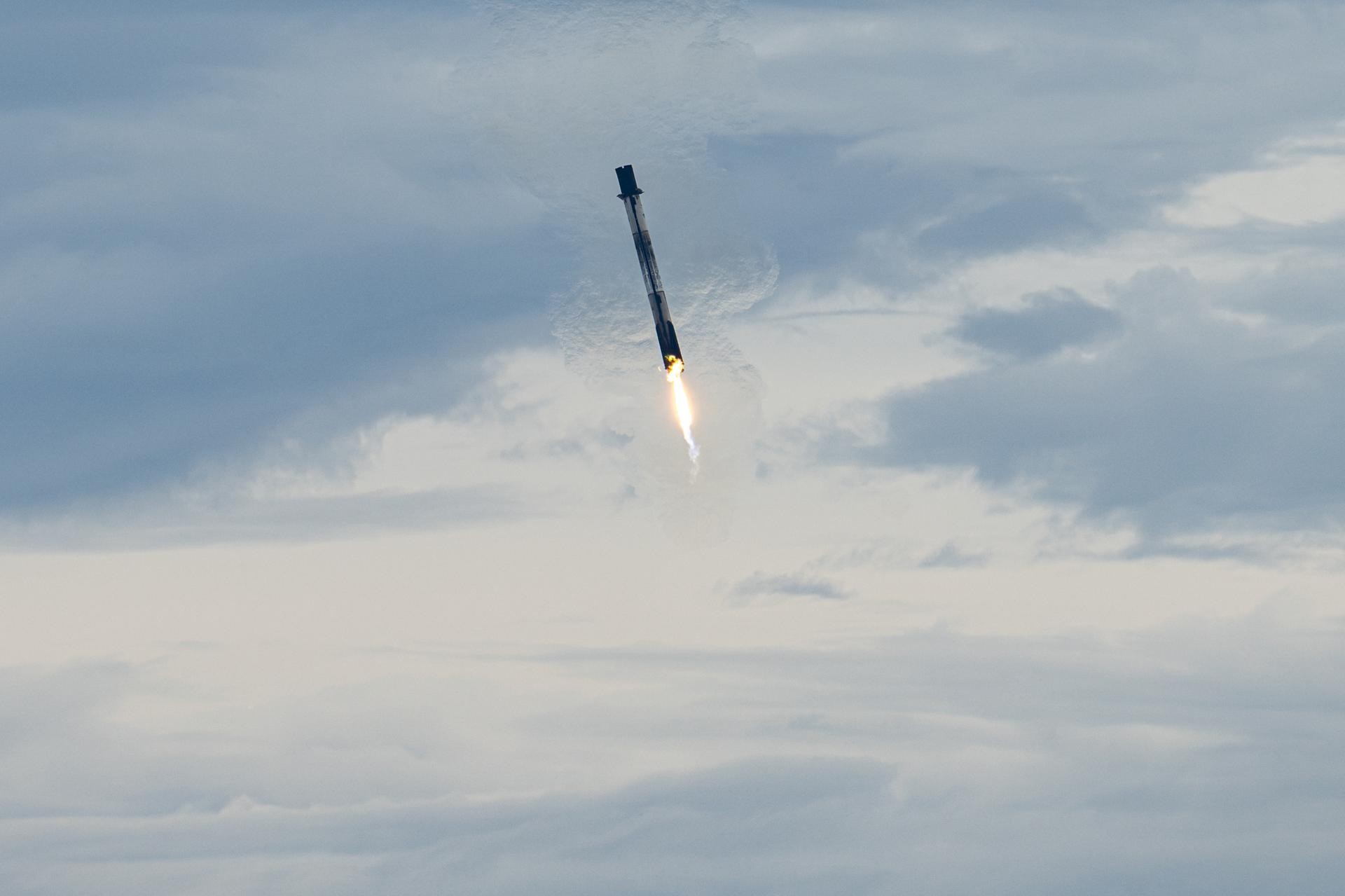


A SpaceX Falcon 9 first stage descends toward Landing Zone 40 at Cape Canaveral Space Force Station on October 1, 2026, after separating from Dragon Grace carrying the four Crew-13 astronauts.

Image source: NASA Image and Video Library. Photograph by NASA, public domain.


Crew Dragon Grace docked to the forward port of the International Space Station’s Harmony module at 7:05 PM Eastern time on Thursday, October 1, completing the fastest launch-to-ISS-docking transit in the history of U.S. human spaceflight. The four Crew-13 astronauts — NASA’s Jessica Watkins and Luke Delaney, Canadian Space Agency astronaut Joshua Kutryk, and Roscosmos cosmonaut Sergey Teteryatnikov — arrived at the orbital outpost seven hours and fifty-five minutes after their Falcon 9 lifted off from Cape Canaveral, with the spacecraft traveling 263 miles above the northeastern Pacific Ocean at contact. A welcome ceremony at the station’s hatch followed at 8:45 PM Eastern.

The fast-rendezvous profile is the headline. Most Crew Dragon flights to the ISS take 24 to 28 hours and complete roughly eighteen orbits before contact; the typical transit requires Dragon to make a series of calculated engine burns to gradually raise its orbit to match the station’s altitude and phase. The Crew-13 profile completed the same work in fewer orbits by setting Dragon’s initial orbit to a period slightly shorter than the station’s, allowing Dragon to catch up faster — a more propellant-intensive but faster approach. Spaceflight Now noted in pre-launch coverage that the choice of profile depends on orbital geometry at launch time, and that the specific 11:10 AM Eastern launch window was selected in part because it put the ISS in the right relative position to support the short rendezvous. NASA’s launch-day release called the transit the fastest launch-to-docking by a U.S. spacecraft in ISS history; the previous mark was set on Crew-4 in 2022 at roughly seventeen hours.

The booster that lofted Grace into orbit made its own contribution to SpaceX’s reusability ledger. B1101 returned to Cape Canaveral and touched down at Landing Zone 40 less than eight minutes after launch — the seventh landing at LZ-40 and SpaceX’s 664th Falcon booster landing overall. The booster was on its third flight: it had previously launched the Starlink 6-88 mission and Crew-12 in February 2026. B1101’s reuse profile, plus the use of a previously-flown Crew Dragon capsule, continues to be one of the structural arguments SpaceX makes for its pricing. Recent Dragon crew rotation flights cost NASA approximately $288 million per mission, or roughly $72 million per seat. Boeing’s Starliner was priced at roughly $90 to $99 million per seat under its original contract.

The flight carried more than just crew to orbit. Grace (tail number C-213) had flown before — she was the same Dragon that flew NASA’s SpaceX Crew-4 mission in April 2022, the mission on which Watkins made her first trip to space. SpaceX’s design certification for Crew Dragon, last reviewed against the manifest in 2024, allows each capsule to be reflown up to fifteen times across its service life. The Crew-13 mission flew with no public announcement of any hardware change to the capsule. The SpaceX contract for the flight did, however, expand: in a May 2026 announcement, NASA formally added six more Dragon commercial crew missions to its Commercial Crew Program manifest, replacing flights that had originally been awarded to Boeing’s Starliner. That addition, combined with a separate $946 million contract for three flights, means SpaceX now holds contracts for all remaining NASA ISS crew rotation missions through the station’s planned retirement around 2030.

The single-source-of-supply arrangement is not what NASA’s planners wanted. The original Commercial Crew Program was structured to fund two providers — SpaceX and Boeing — so the U.S. would not be wholly dependent on a single company for crew transport. That redundancy is now absent because of Boeing’s 2024 Crew Flight Test failure. In February 2026, NASA formally classified that failure as a “Type A mishap,” the agency’s most serious category, after multiple propulsion anomalies during transit — most notably a string of helium leaks in the service module and the failure of five of eight reaction-control thrusters in quick succession. NASA returned the vehicle uncrewed and brought the test crew home on a Dragon in March 2025. Boeing’s next Starliner mission is currently targeted as an uncrewed cargo flight no earlier than the fourth quarter of 2026, but Boeing’s own SEC filings describe NASA discussions as having an “uncertain” outcome.

Once aboard the ISS, Crew-13 will join Expedition 75 alongside the crew already on station. The handover will play out over the next week, after which Crew-12 — NASA’s Jessica Meir and Jack Hathaway, ESA’s Sophie Adenot, and Roscosmos’s Andrey Fedyaev — will board Dragon Freedom for the trip back to Earth. Watkins, Delaney, Kutryk, and Teteryatnikov are then expected to stay aboard through approximately next March and April, rotating through Expedition 75 and 76 as the station hands off twice during their stay. Their science agenda includes biology, materials science, Earth observation, and human physiology studies — including work that will feed into the cardiovascular, bone-density, vision, and immune-function research programs that inform Artemis-era lunar surface planning.

One piece of context that isn’t in NASA’s release but does change how the mission should be read: Grace is, according to a separate secondary-outlet report published today, the fifth and final Dragon capsule SpaceX has built. The company is not planning to construct another. The implication for ISS operations is significant — every operational NASA crew rotation to the station through 2030 will use one of those five Dragons, including a capsule that has been aloft for some of its life cycle. NASA’s Commercial Crew Program and Boeing’s recovery of Starliner will both be factors in how that plays out, but the operational constraint is set: there are five Crew Dragons, and there will be no more.

The next major event in the Crew-13 timeline is the handover, which is expected to take about a week and concludes when Crew-12 departs. NASA’s next crewed launch of any kind is currently scheduled to be the second lunar-flyby Orion mission, in late-stage processing at Kennedy. Crew-14 has not yet been publicly assigned.

For the moment, though, the four Crew-13 astronauts are aboard. Hatch opened at approximately 8:45 PM Eastern. The welcome ceremony was broadcast on NASA TV.


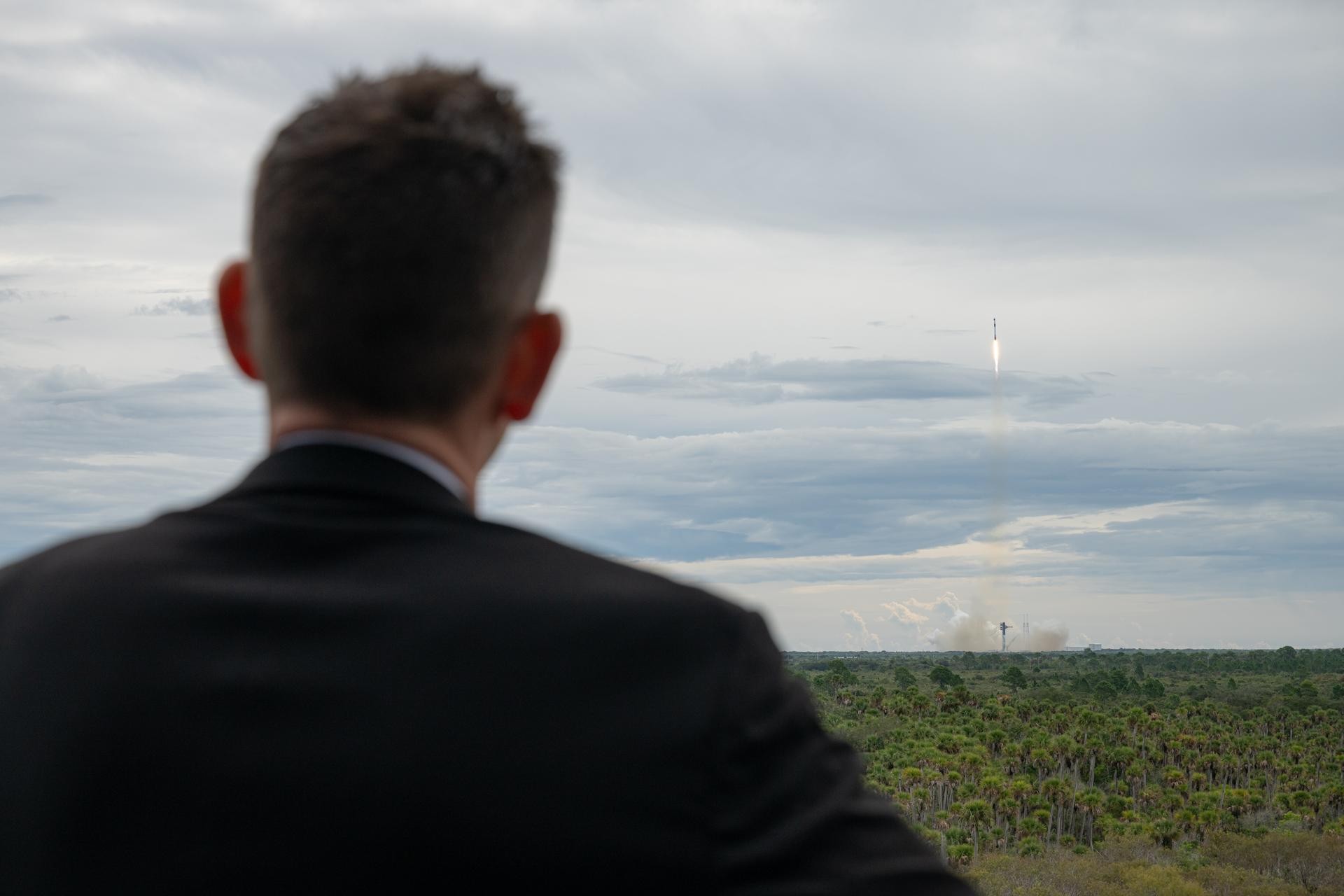
A NASA official watches as a SpaceX Falcon 9 climbs into cloudy skies over Cape Canaveral on October 1, 2026, carrying the four Crew-13 astronauts toward the International Space Station.

Image source: NASA Image and Video Library. Photograph by NASA/Joel Kowsky, public domain.


A SpaceX Falcon 9 lifted off from Space Launch Complex 40 at Cape Canaveral Space Force Station at 11:10 AM Eastern time on Thursday, October 1, carrying four astronauts on NASA’s Crew-13 mission to the International Space Station. About seven hours and fifty minutes after launch, Crew Dragon Grace is expected to dock autonomously to the forward port of the station’s Harmony module at approximately 7:00 PM Eastern. NASA’s launch-day release described the planned transit as a record-setting flight duration for any U.S. spacecraft heading to the station.

The four crew members are Jessica Watkins and Luke Delaney of NASA, Joshua Kutryk of the Canadian Space Agency, and Sergey Teteryatnikov of Roscosmos. Watkins commands the mission and is flying her second spaceflight, becoming the first NASA astronaut to fly twice on a SpaceX Dragon. Delaney pilots in his first spaceflight; Kutryk and Teteryatnikov are mission specialists, each also on a first flight. The launch was originally targeted for September 12 and was delayed by a propellant oxidizer leak discovered on the Dragon before that attempt. The crew entered final quarantine on September 17 and waited out the slip until the October 1 window, which weather officials rated at 70 percent go.

This is the thirteenth NASA Commercial Crew rotation flight, and the twenty-first time a Crew Dragon has carried a crew to orbit. The mission will run approximately six months, ending with a Pacific Ocean splashdown no earlier than March 2027. Once aboard, the four crew members will join Expedition 75 alongside Anil Menon of NASA and Pyotr Dubrov and Anna Kikina of Roscosmos, who are already on the station. After a brief handover, NASA’s SpaceX Crew-12 mission — astronauts Jessica Meir and Jack Hathaway of NASA, Sophie Adenot of ESA, and Andrey Fedyaev of Roscosmos — will return to Earth, restoring the station to a seven-person complement.

The crew backgrounds are deliberately diverse. Watkins is a geologist who previously flew on SpaceX Crew-4 in 2022; her second flight makes her the first NASA astronaut to ride a Dragon twice. Delaney is a former U.S. Navy aviator; Kutryk is a Royal Canadian Air Force fighter pilot; Teteryatnikov is a Russian submariner. Kutryk’s flight is a small but real first: he is the first Canadian to fly as part of NASA’s Commercial Crew Program. The earlier Canadian on a Dragon was Mark Pathy, who flew privately on Axiom Mission 1 in 2022.

NASA announced the crew assignments on April 23, 2026. The pairing of an experienced commander with three first-time flyers, including two from agencies that have not previously flown on Commercial Crew, is consistent with how NASA has used early-rotation flights to broaden the program. A Roscosmos backup crew member, Harutyun Kviryan, was assigned to the mission and remains in crew-support rotation on the ground.

The science planned for the six-month expedition leans heavily on microgravity biology. The crew will work with human stem-cell-derived tissues, an area of research NASA has invested in heavily in the last several expedition cycles, with the goal of building disease models and pharmaceutical testbeds that are hard to assemble on Earth. The crew will also work with a mostly autonomous plant-growth system to test crop production outside dedicated growth facilities — an effort aimed at the longer question of feeding crews on deep-space missions. Two additional threads continue work from earlier expeditions: studies of how blood-flow regulation responds to microgravity, and a hand-held diagnostic device intended to give crews more autonomy on long flights.

The mission comes at a transitional moment for the U.S. human-spaceflight program. NASA’s commercial crew cadence has settled into a roughly twice-yearly rhythm, and Crew-13 is the third operational mission of 2026. At the same time, the agency is preparing for the next test of its deep-space crewed vehicle: Orion, which flew its second crewed mission in April. Crew-13’s fast rendezvous profile reflects improvements in Dragon’s on-orbit phasing software and ground-control procedures; the previous record for a U.S. crewed launch-to-ISS-docking transit was set on Crew-4 in 2022 at roughly seventeen hours.

The launch comes three days after SpaceX’s first orbital Starship flight on September 28. NASA’s launch administrator, Jared Isaacman, framed the back-to-back events in his remarks at Kennedy Space Center. He called Crew-13 “another demonstration of America’s unmatched capability in human spaceflight,” and credited the agency and SpaceX teams for the launch. Dr. Lori Glaze, NASA’s associate administrator for the Human Spaceflight Mission Directorate, tied the mission into the broader exploration narrative: the ISS is “sustaining our presence in Earth’s orbit and sharpening the tools we’ll take forward to the Moon and Mars.”

Docking is scheduled for 7:00 PM Eastern. NASA’s live arrival coverage begins at 5:20 PM Eastern for the rendezvous, docking, and hatch-opening sequence, after which the four astronauts will change out of their spacesuits, transfer cargo, and open the hatch into Harmony. The handover period between Crew-13 and Crew-12 is expected to run roughly a week, with Crew-12’s return targeted for later in October.

The Crew Dragon capsule flying this mission is named Grace. That name is not on NASA’s standard naming rotation for Crew Dragon; it was applied for this specific vehicle. The choice has not been widely discussed publicly, but the spacecraft’s flight record makes the name appropriate: Grace flew this mission after a propellant leak in late August forced a multi-week delay, and the recovery from that delay is what the crew and ground teams are credited with in NASA’s launch-day release.

Once Crew-13 is aboard, the station will continue its mixed program of microgravity research, maintenance spacewalks, and visiting-vehicle traffic through the spring of 2027. NASA’s next crewed flight of any kind is expected to be the second lunar-flyby mission of the Orion program, currently in late-stage processing at Kennedy. Crew-14, the next operational Crew Dragon rotation, has not yet been publicly assigned.


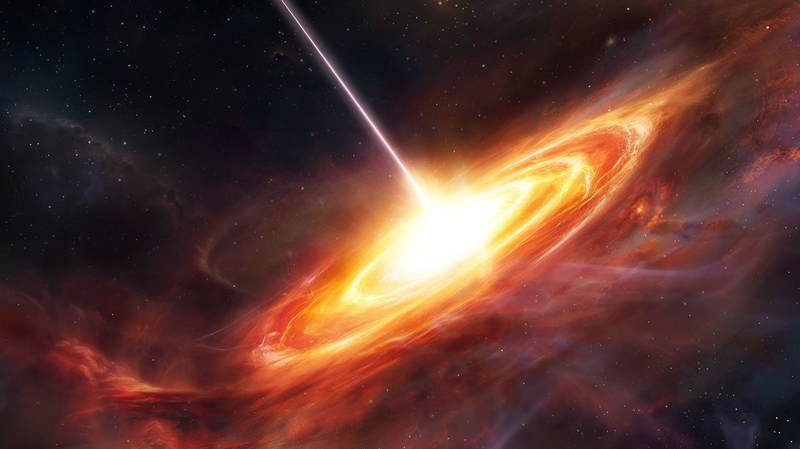
Artist's concept of a quasar: a brilliant white core surrounded by a glowing spiral disk of gas and dust, with a narrow jet of light extending upward.


On 6 July 2026, a team led by the European Space Agency reported that Euclid, a wide-field infrared space telescope launched in July 2023, had catalogued 31 of the oldest quasars ever documented. Two of them broke the redshift record outright. The most distant, named EUCL J172902.75+641018.1, sits at a redshift of z = 7.77, meaning the light that just reached us left when the universe was about 670 million years old, roughly 5 percent of its current age. The runner-up, EUCL J125308.55+705432.3, clocks in at z = 7.69. Both names and numbers come straight from the ESA release and the new paper in Astronomy & Astrophysics, led by Daming Yang of Leiden University, also covered by Universe Today and Astronomy magazine.

For scale, the previous redshift record for a quasar was z = 7.64, set in 2021. Euclid broke that bar twice in the same data set.

Quasars are not just bright. They are unreasonably bright. They run on the gravitational energy of matter falling onto supermassive black holes at the centers of galaxies. The disk of in-falling gas and dust is heated by friction and tidal forces to millions of degrees, and radiates more energy than every star in the surrounding galaxy combined. When you find a quasar at z > 7, you are not just finding a bright dot. You are finding evidence that a black hole of a billion solar masses or more already existed when the universe was younger than its present-day span allows for under the simplest models of growth.

That is the source of the quiet excitement around this kind of result. The “seed” black holes that became today’s supermassive monsters must have formed quickly and grown fast. Finding them when they were already radiating as quasars places hard constraints on the formation channels that can deliver a million- to billion-solar-mass object so early. Every additional z > 7 quasar adds a new anchor point.

The second reason this matters is methodological. Euclid was not designed to chase the earliest quasars. It was selected and built to image billions of galaxies across most of the sky, in order to chart the effect of dark energy on the universe’s expansion rate. That the same data set, plus a relatively small amount of follow-up spectroscopy, turned up the two most distant quasars ever found is the kind of bonus payload a wide-field survey delivers almost by accident. NASA, which contributed the near-infrared detectors and sits on the science team, is framing these finds as a preview of what its Nancy Grace Roman Space Telescope will do at higher resolution when it launches later this decade.

Euclid launched on a SpaceX Falcon 9 from Cape Canaveral on 1 July 2023. It settled into a halo orbit around the second Sun-Earth Lagrange point, about 1.5 million kilometers from Earth, where its thermal environment stays stable. The mission carries two instruments: a visible-light imager (VIS) and a near-infrared photometer and spectrometer (NISP). For the quasar hunt, what matters is NISP’s three near-infrared filters (Y, J, H), which together reach out to about 2 micrometers.

The trick for finding high-redshift quasars is simple in principle. As the universe expands, light from distant objects is stretched to longer wavelengths. A quasar that emitted visible light when the cosmos was 670 million years old arrives at Earth as near-infrared light. By selecting sources that are bright in the infrared Y, J, and H bands but vanishingly faint in visible light, you isolate candidate ancient quasars from the much larger population of nearer, red stars.

That is exactly what Euclid’s early data sets (the Early Release Observations from May 2024 and the Quick Data Release 1 in March 2025) have been collecting since routine science operations began in late 2023. The new study, summarized in the ESA release, started with a much larger pool of candidates drawn from these releases, then narrowed them down using ground-based spectroscopy at facilities including Keck, Magellan, and the Large Binocular Telescope, plus archival data from other observatories. Of the candidates that survived the cuts, 31 sit at high enough redshift to count as the oldest known quasars, and 12 of those are older than 770 million years post-Big-Bang. Two fall inside the first 670 million years.

The two record-holders are ten to a hundred times fainter than the famous z = 7.5 quasars found by ground-based surveys in the past decade, which is precisely the reason they had escaped detection until now. Euclid’s wide area is what makes it possible to find rare needles in a haystack: a small telescope pointed at a tiny patch of sky cannot see them, but a one-square-degree imager can sweep enough volume to make faint objects common enough to catch.

Redshift is a direct measurement of how much the universe has expanded since the light left its source. The relationship is not linear, because cosmic expansion accelerates, but a useful short-hand for objects at cosmological distances is: divide the speed of light by the Hubble constant to get a rough distance, then correct for expansion. For z = 7.77, the light-travel time works out to a little over 13 billion years. The physical distance to the quasar today is much larger, because the intervening space has been stretching the whole way.

For a supermassive black hole to power a quasar at that brightness so early, models generally require the seed object to be either a roughly ten-thousand-solar-mass “direct collapse” black hole, or a stellar-mass seed that has been fed at the maximum possible rate (the Eddington limit, where radiation pressure balances gravity and accretion cannot go faster). Real observations keep finding that black holes at z > 7 sit at or near the Eddington limit, which is itself a clue about how gas gets delivered to them in the early universe.

Euclid’s near-infrared setup is what unlocks the detection. At a redshift of 7.77, the rest-frame ultraviolet emission lines that astronomers use to identify quasars (such as the Lyman-alpha line at 121.6 nanometers) are stretched to roughly 1.06 micrometers, well within NISP’s range. The visible-light emission is redshifted beyond 0.6 micrometers and falls into NISP’s J and H bands. Euclid takes both visible and near-infrared images of every part of its survey, which means the same patch of sky has both the color information needed to flag candidates and the morphological information needed to distinguish a point-like quasar from an extended host galaxy.

The catalog is preliminary. Of the 31 confirmed quasars, roughly the top third have detailed spectroscopic measurements already, and the remainder are still awaiting deeper spectra. The lead author, Daming Yang at Leiden University, expects follow-up observations with JWST to push the redshift record further and to measure the masses of the central black holes directly.

Quasars at z > 7 are also useful as back-lights. Light from a background quasar passing through foreground gas clouds leaves absorption lines imprinted on the quasar spectrum, which is how astronomers map the gas between galaxies. Euclid has found many back-lights that future quasar-absorption-line studies will use.

The bigger picture is that Euclid is roughly three years into its nominal six-year mission. The dark energy mapping it was built for, which will use weak gravitational lensing and baryon acoustic oscillations to pin down the equation-of-state of dark energy, is the headline science. The early-universe quasars are a side benefit. We have about three more years of survey data to go before the nominal mission end, and the team’s spectroscopy is still catching up to the imaging. The second Euclid data release is scheduled for late June 2026 and the first full public catalog in October 2026, which means the survey area that the next quasar search can draw from roughly doubles.

Euclid is now an established finding machine. Whatever the next catalog delivers, it will be the result of more pixels across more sky, not a change in strategy.


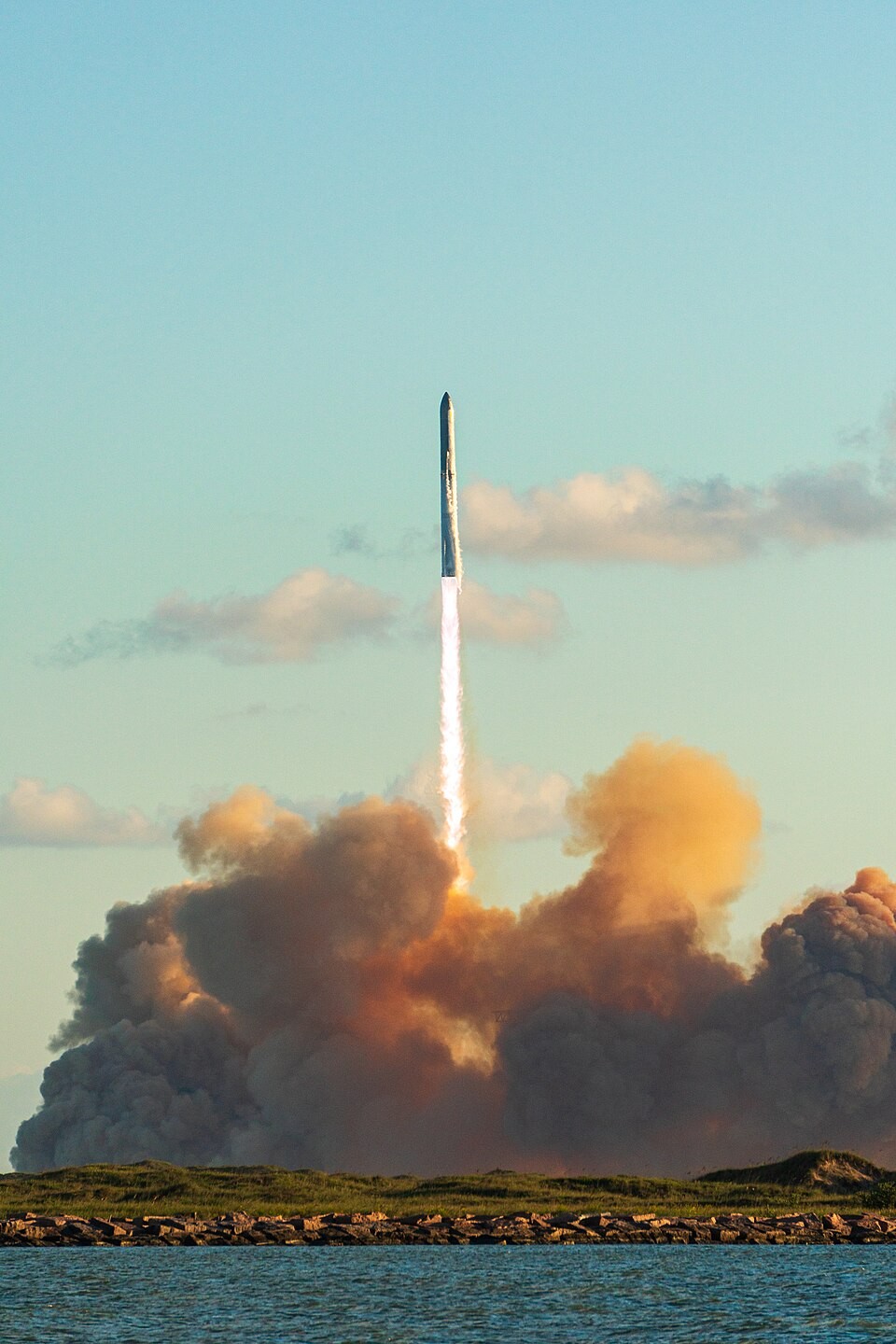
A SpaceX Starship lifts off from Starbase, Texas on a previous test flight; today's Flight 14 followed the same launch profile.

Image source: Wikimedia Commons. Photograph by Shujianyang, CC BY-SA 4.0.


A SpaceX Starship lifted off from Starbase in Boca Chica, Texas at 7:48 AM local time on Monday, September 28, and reached orbit for the first time on its fourteenth flight test. After a clean stage separation and a controlled splashdown of the Super Heavy booster in the Gulf of Mexico, the Starship upper stage completed its first orbital-insertion burn and deployed 26 Starlink V3 satellites into low-Earth orbit on a mission that SpaceX had earlier characterized as a step from developmental flight testing into operational service.

The launch was the first of the Block-3 vehicle series to fly with operational payload, and the first time a Starship vehicle has carried a Starlink batch into orbit. Three of the 26 satellites carry cameras intended to image the Starship heat shield while the upper stage is in orbit, extending the kind of data that an earlier camera-equipped batch gathered during a 2025 reentry test.

The countdown proceeded through propellant load on the booster and the ship, Raptor chill, and a final GO poll at T-30 seconds. Liftoff was at the opening of the day’s launch window. NPR, reporting live, described the 33 Raptor engines on Super Heavy as igniting together at the start of the climb. Max-Q, the moment of peak aerodynamic stress on the vehicle, cleared without incident. About two and a half minutes after launch, Starship separated from Super Heavy in the hot-staging sequence the company has used on the most recent flights, with the booster immediately turning back toward the Gulf of Mexico and the ship’s Raptor engines continuing the climb toward orbit.

Two anomalies shaped the early portion of the flight. First, SpaceX’s mission management decided during the climb that one of the six Raptor engines on the ship had failed during ascent, and the team weighed, for roughly twenty-two minutes, whether to continue to orbit. By the time Starship’s second-stage burns were scheduled to start, SpaceX confirmed it was safe to do so. Second, when Super Heavy began its boostback burn a few minutes after separation, only 26 of the 28 candidate engines relit — a partial relight rather than the full set SpaceX had planned to use. The landing burn that followed was also a partial relight: 11 of 13 engines fired. The booster nonetheless completed its boostback, descent, and landing burn sequence and executed a controlled soft splashdown in the Gulf of Mexico at roughly T+8 minutes, ten seconds after launch. SpaceX had deliberately planned an offshore splashdown for this flight rather than a return-to-launch-site catch, in part because the booster was being used to test upgraded software and hardware before the company re-attempts a tower catch on a later mission.

The ship’s first milestone after separation was a coast phase through the upper atmosphere. At T+25 minutes and 28 seconds the ship began its orbital-insertion burn; nineteen seconds later the burn ended and Starship was in a sustained orbit for the first time in the program’s history. About nine minutes after the insertion burn, the payload deployment sequence started and the 26 Starlink V3 satellites began releasing from the ship over the following half hour. The three camera-equipped satellites will spend their operational lifetime photographing Starship’s heat shield from a vantage point just behind the vehicle’s planned reentry trajectory, providing imagery that SpaceX says it will use to refine its reusable-heat-shield program.

The mission profile extended further than a suborbital hop. SpaceX had originally planned a roughly ten-hour mission with six orbits at an altitude around 170 miles, but reduced the flight plan during ascent to a shorter three-hour profile. The trade reflected, in the company’s judgment, the right margin for a vehicle running one engine short on its upper stage. After roughly nine hours in orbit, the ship is expected to perform a deorbit burn over the Pacific, descend through the atmosphere, and execute a controlled splashdown in the ocean. NPR noted that no earlier Starship flight had reached orbital velocity, which is roughly 17,500 miles per hour; today’s flight is the first vehicle in the line to do so.

Starship Flight 14 is the second flight of a Block-3 vehicle and the first of the year from Starbase. The booster, Booster 21, completed its full-duration static fire at Massey’s Test Site on August 28 after a qualification campaign that included the post-Flight-13 investigation into the landing-burn dynamics and an extended cryogenic proof sequence in mid-summer. The ship, Ship 41, completed a six-engine static fire on August 21 and a single-engine deorbit-burn simulation test two days earlier. Both vehicles were integrated, stacked, and rolled to OLP-2 ahead of the launch attempt.

The flight is also the first operational mission carrying Starlink satellites to use a Starship vehicle rather than a Falcon 9. SpaceX has been the dominant operator in commercial launch for the past several years using Falcon 9, but the larger V3 Starlink satellites only fit inside Starship’s fairing. NPR reported that SpaceX completed the final Falcon 9 launch of a Starlink batch from Florida last month and intends to move V3-class launches to Starship going forward. The shift matters to SpaceX’s plans for the constellation: in filings to the Federal Election Commission ahead of its IPO in June, the company called Starship’s launch cadence and reusability material to its growth strategy.

The flight is also material to NASA’s Artemis program. SpaceX is under contract to develop a Starship-derived Human Landing System for Artemis III, currently targeted for late next year. The Artemis III profile includes docking Starship with an Orion capsule in lunar orbit and transporting astronauts to the surface. NASA’s Administrator, Jared Isaacman, congratulated the SpaceX team on today’s milestone on social media; in earlier remarks, the agency has framed a successful first operational Starship flight as one of the gating milestones for the lunar landing timeline, alongside the unrelated second crewed Orion flight that lifted off in April.

Three of the satellites that lift with Starship today are designed to spend their working lives photographing the heat shield of the very vehicle that released them. That unusual arrangement — test instrumentation riding inside operational payload — has become a theme of the program. Cameras flew on earlier V2 Starlink satellites in 2024 and 2025 for similar purposes; SpaceX said the data from those missions was the basis for several heat-shield design changes that shipped on Block 3. Today’s cameras will, in turn, feed back into Block-4 hardware.

If the Pacific reentry and splashdown at the end of the mission go as planned, Flight 14 closes out a flight that began developmental flight testing and ended with operational payload deployment. The next ship in line, Ship 42, completed chopstick-catch tests at the tower in mid-September and remains weeks from flight readiness; the next booster, Booster 22, is also still in qualification. SpaceX has not announced a date for Flight 15, but company statements earlier in the year suggested it would follow within roughly two months of today’s flight, with a Falcon-class Starlink batch and a Super Heavy tower catch among the items on the next mission’s checklist.


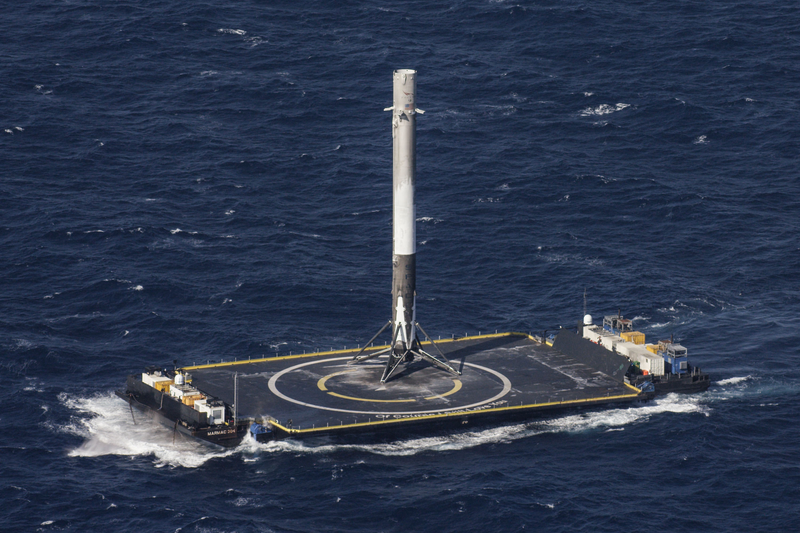
A Falcon 9 first stage stands upright on the deck of an autonomous drone ship in open ocean, seen from the air with tugs alongside.


On 22 August 2026 at 07:25 UTC, a Falcon 9 climbed off Space Launch Complex 4E at Vandenberg carrying 29 Starlink satellites. By the time the second-stage Merlin 1D Vacuum cut off over the south Pacific, the autonomous spaceport drone ship Of Course I Still Love You had caught a Block 5 booster on its ninth flight and pushed the vessel’s successful landing tally to 220 out of 228 attempts (Wikipedia, ASDS landings history, accessed 22 August 2026). The numbers look routine because they are routine. That is the point.

Reusable orbital rockets stopped being an experiment years ago and quietly became a load-bearing column of the global launch industry. The most-flown Falcon 9 first stage, B1067, has now flown 36 missions and is certified to keep going to 40 (Wikipedia, List of Falcon 9 first-stage boosters, accessed August 22 2026). A drone ship named for a science-fiction vessel is on track to record its 230th catch sometime this autumn. The launch industry has changed more in this decade than in the previous five, and the change looks, from one Starlink mission to the next, almost boring.

Cost per kilogram to low Earth orbit is the cleanest single number in the launch industry, and it has collapsed. The Space Shuttle ran near $54,500 per kilogram on the OIG baseline in 2012 dollars (NASA OIG IG-12-002, 2012). Falcon 9’s standard price sits near $67 million for an expended mission of about 22.8 tonnes to LEO — roughly $2,900 per kilogram on the list (SpaceX, Falcon User’s Guide, April 2020; Wikipedia, Falcon 9 Block 5). On a reused mission the airframe cost amortizes across the flight count, and the marginal kilogram price drops further.

The mechanism is not a bigger rocket. It is reuse of the most expensive stage. Industry analyses put the manufacturing cost of a Falcon 9 first stage at roughly 60 percent of the rocket’s total price (Wikipedia, List of Falcon 9 first-stage boosters, citing Everyday Astronaut estimates). Propellant for one Falcon 9 launch is under one percent of the vehicle price on SpaceX’s own figures. When the first stage can be reused, the marginal cost of another flight is dominated by propellant, inspection, and a small amount of refurbishment.

The Tsiolkovsky equation, Δv = v_e × ln(m_0 / m_f), describes how much velocity change a stage can deliver, where v_e is the exhaust effective velocity, m_0 the initial mass, and m_f the burnout mass. The economic equivalent, what rocket accountants sometimes call reuse leverage, looks like cost_per_flight ≈ fixed_cost / flights + marginal. Improvements in the denominator compound quietly.

The recoverable first stage began as a SpaceX research project funded out of company revenue after 2011 (Wikipedia, SpaceX reusable launch system development program). Early Falcon 9 flights tried to land on parachutes; the stages disintegrated on re-entry. The first successful propulsive landing came on Falcon 9 Flight 20 in December 2015, when a Full Thrust first stage set down on Landing Zone 1 at Cape Canaveral. Eighteen weeks later, on 8 April 2016, the same autonomous drone ship Of Course I Still Love You that would later log 220 catches recorded its first stage, the CRS-8 booster. By March 2017 SpaceX had reflown a landed first stage; by October 2017 the cadence was settling in.

Block 5, the current variant, debuted in May 2018 aboard Bangabandhu-1, and from the start it was engineered for at least 10 flights without major refurbishment. The certification staircase since then has been a study in disciplined risk: 10 flights in 2021 (B1051), 15 flights by 2023, then 20, and now 40 per booster. Each step followed a deep-dive inspection of a representative stage — B1058 and B1060 for the 20-flight certification — before SpaceX approved the next tier. B1067, which first flew in 2021, hit 36 flights in 2025 and is now the operational record holder.

Of the 694 Falcon family launches logged by 22 August 2026, 626 were Block 5 missions; 625 succeeded (Wikipedia, Falcon 9 Block 5). There has been one in-flight failure since the 2015 CRS-7 mishap — the Starlink Group 9‑3 second-stage anomaly — for a family success rate of 99.57 percent. Booster recovery is now standard, except when milestones roll over. On 22 August OCISLY hit landing 228, success 220. Just Read the Instructions, used briefly for Cape launches, logged 157. A Shortfall of Gravitas, the Atlantic drone ship, hit 166. The math: 650 successful Falcon 9 first-stage landings, 13 nominal failures, in 663 attempts.

Block 5 is not Block 4 with longer life. It is a structural rewrite aimed at thermal survival and rapid turnaround, and three components did most of the work.

First, the base heat shield at the bottom of the interstage was thickened and mounted on a stronger structure so a returning stage can absorb repeated supersonic heating without cracks propagating into the propellant tanks. Skin temperature during a boost-back re-entry peaks at roughly 1,500 K for a few tens of seconds; the aluminum-lithium alloy tanks survive only a finite number of these cycles, which is why certification life is a count, not a calendar span.

Second, the four hypersonic grid fins at the top of the stage were changed from aluminum to titanium alloy (Ti-6Al-4V) so they no longer deform visibly after each flight and can be reused without machining or replacement.

Third, the four landing legs switched from a deployable hydraulic mechanism with many moving parts to a carbon-fiber composite assembly that folds flush against the stage, removing the pins and seals that had been a top refurbishment item.

The Merlin 1D engine at the heart of the stage had to learn ten flights without major service at the same time. It runs on the gas-generator cycle with a pintle injector — the same architecture as the Apollo Lunar Module descent engine — and feeds from a single-shaft dual-impeller turbopump originally designed by Barber-Nichols. Sea-level thrust is rated at 845 kN, dry mass 470 kg, thrust-to-weight ratio near 184, and chamber pressure about 9.7 MPa. Specific impulse runs around 282 seconds at sea level and 311 seconds in vacuum per the published Falcon User’s Guide (SpaceX, April 2020). Those are modest numbers next to staged-combustion or ion engines, but they are the right trade for a reusable booster that has to be inspected, refurbished, and reflown in weeks.

Re-entry burn and landing burn use three-engine and single-engine restarts, so the Merlin 1D has to reignite in vacuum after separation and then reignite again on the way down. Cold-gas nitrogen thrusters handle fine attitude control between burns, which is what allows a Block 5 to land on a 91-by-52-meter drone ship sitting in swell at the edge of the open Pacific.

Reuse has eaten the launch industry in a way the engineers of the 1970s would have recognized but probably could not have predicted. Within SpaceX, the next step is full reusability with Starship, where the second stage also returns — a much harder problem because orbital velocity is near 8 km/s, more than four times the ~1.7 km/s a returning first stage survives. Outside SpaceX, the cadence pressure is starting to bend competitors: Blue Origin’s New Glenn has demonstrated its first-stage landing; Rocket Lab plans to recover Neutron’s booster; Stoke Space is targeting full reuse of a small launcher; China’s LandSpace has caught fairings and is testing full booster recovery. Reusability is no longer a fringe technology. It is the floor now. B1067 will eventually retire, and SpaceX will already be counting the flights of its replacement.