OrbitalHub

Where curiosity reaches escape velocity.

Domain is for sale. $50,000,000.00 USD. Direct any inquiries to contact@orbitalhub.com.

Archive for the Space Exploration category

October 8, 2026

Bennu formed where fire met ice

Posted by


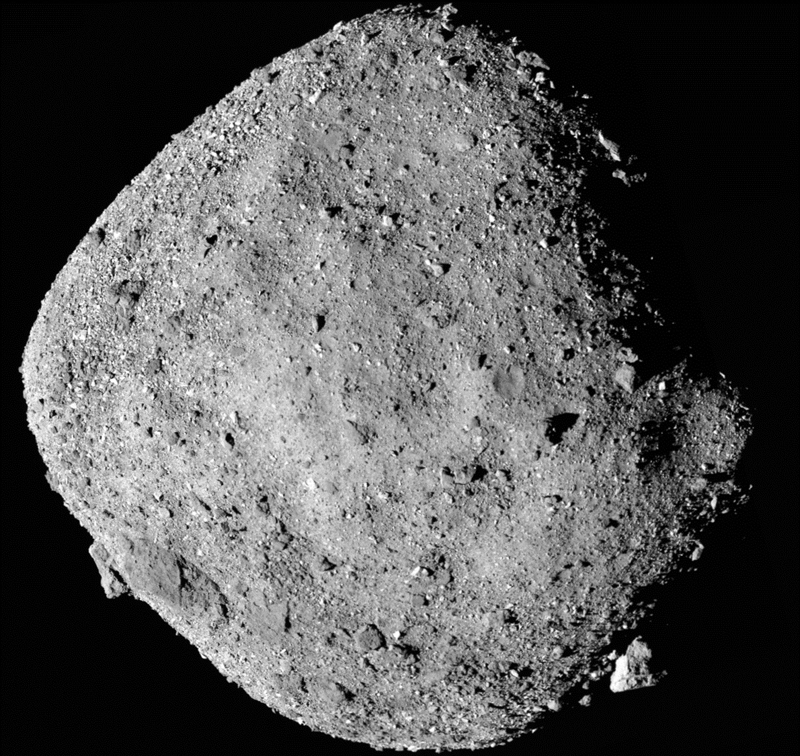
A diamond-shaped asteroid, Bennu, photographed against black space by NASA's OSIRIS-REx spacecraft from a range of 24 kilometres, showing a rubble-pile surface covered in boulders of various sizes


Half a gram of asteroid dust, split among three transition metals, has rewritten where Bennu came from. A team led by Maria Schönbächler at ETH Zurich reports on 23 September 2026 in Science Advances that Bennu, the near-Earth asteroid visited by NASA’s OSIRIS-REx spacecraft between 2018 and 2021, did not assemble in the cold outer reaches of the young solar system the way most researchers assumed. It assembled instead near the water-ice line, in the narrow band where temperatures were cold enough to freeze water vapour into solid ice and warm enough inside to keep it as a gas. The work leans on isotopes of iron, titanium and chromium measured in five Bennu sample portions at ETH’s isotope geochemistry lab, and it points to a culprit for the unusual chemistry: Jupiter, which grew large enough, fast enough, to filter coarse material out of the dust disk before Bennu’s parent body could form.

Source: NASA/Goddard/University of Arizona Bennu mosaic on Wikimedia Commons (public domain).

Bennu’s chemistry has been a quiet puzzle for most of the past decade. Earlier sample studies, including the joint OSIRIS-REx and Hayabusa2 preliminary results, had placed it in a family of carbon-rich objects whose closest meteoritic relatives on Earth are the rare CI chondrites: carbon-rich, water-bearing, and chemically the closest match in the meteorite collection to the Sun’s own composition, with very little thermal alteration since the solar system’s birth. What no one had pinned down was where in the protoplanetary disk that fingerprint had been laid down.

The old model put Bennu-class objects far out in the disk, beyond where most comets form, where accretion was slow and hydrated minerals could survive undisturbed. The new isotope measurements turn that on its head. Iron and titanium are distributed so well throughout the Bennu material that the parent object cannot have been a single coarse clump; it must have been built from fine dust mixed across the disk, with ice acting as a glue that bound fine particles into larger aggregates on the cold side of the water-ice line.

The phrase Schönbächler uses for the result is direct: Bennu is a hybrid. It does not clearly match either the inner or the outer solar system. It bears characteristics of both regions, because it was assembled in the specific transition zone where material from both sides met, according to the ETH Zurich announcement.

To anchor that conclusion, the team compared Bennu against the other carbon-rich sample-return target in the modern catalogue: Ryugu, the asteroid Hayabusa2 visited in 2019. The two objects share an isotopic fingerprint with each other and with the CI chondrites, all distinct from the rest of the meteorite collection and from other sampled asteroids. The authors frame the open question as a population question: if Bennu and Ryugu both formed in the same zone, what is that zone producing that sends objects to near-Earth orbits, and are these two a coincidence or a sample of a broader pattern?

That question hands the baton to the next sample-return missions. China’s Tianwen-2 arrived at the quasi-satellite Kamoʻoalewa this summer and is expected to return a sample in 2027. Japan’s MMX mission, scheduled to launch from Tanegashima in October 2026 on an H3, is set to bring back material from Phobos in 2031; Phobos is itself a possible captured asteroid, and a Phobos sample with a Bennu-like signature would extend the snow-line zone picture to the Mars system. The next-mission parallel was also flagged in Space.com’s coverage.

The water-ice line is not a feature of the finished solar system; it is a feature of the protoplanetary disk, the rotating torus of gas and dust around the young Sun. Inside the line, water vapour stays in gas form. Outside it, water freezes onto dust grain surfaces as ice. In standard models the boundary sits somewhere near the present-day orbit of Jupiter, roughly five astronomical units out, and that distance matters because the disk’s solid inventory changes composition sharply there: inside the line, rocky dust; outside, ice-coated dust; and right at the boundary, a transition layer where ice can sublimate, migrate inward as vapour, and recondense.

The new analysis proposes that this transition layer was the assembly site for Bennu, Ryugu, and the CI chondrites, with Jupiter acting as an active filter rather than background. The gas giant formed within roughly one million years of the Sun’s birth, and its gravitational influence quickly became a barrier in the disk. Coarse, clumpy material could not easily cross Jupiter’s orbital neighbourhood; fine dust could, routing around Jupiter from multiple radial directions and arriving well mixed. The result is an unusually homogeneous feedstock for planetesimals forming in the transition zone near the snow line, and that homogeneity is what the Bennu isotope data see.

The team’s mechanism also explains two aspects of the sample. The first is water. Bennu’s parent body incorporated enough ice that, when it was later broken up and the fragments were warmed by the Sun, hydrated minerals appeared in the regolith in the proportions the OSIRIS-REx analysis measured. Ice from just outside the snow line can sublimate as the disk evolves, drift inward as vapour, and recondense inside the line, so a transition-zone planetesimal ends up with both rocky and icy inputs. The second is the chemical match to the Sun. Fine dust, mixed by the disk’s turbulence and routed around Jupiter, ends up with a bulk composition close to the pre-solar nebula because it has not been sorted into coarse and fine reservoirs. Bennu samples that average composition better than any other available asteroid material.

For the broader picture, the implication is that the asteroid belt is not the only reservoir of primitive material in the inner solar system. Near-Earth asteroids like Bennu and Ryugu may be sampling a specific radial slice of the early disk that the main belt, with its heavy thermal and collisional processing, has blurred out. If planetary migration can scatter snow-line objects into near-Earth orbits, then the Bennu sample is not a quirk of one asteroid but a window onto a specific formation environment that the meteorite collection only hints at.

What is striking about the result is how much depends on a small measurement. The five Bennu sample portions, totalling a fraction of a gram, were analysed for isotopic ratios of three elements at a single laboratory over months. None of that is large-scale geophysics or a flagship space telescope survey. It is the kind of bench-scale work that historically has rewritten meteorite science, and it has now done so for an asteroid whose sample exists on Earth only because a NASA spacecraft flew for two and a half years to a rock the size of a small mountain, picked up its surface with a robotic arm, and parachuted the result home.

The Bennu story is not finished. Sample analysis at laboratories around the world is ongoing, with new allocations going out in waves as the OSIRIS-REx curatorial team works through the 120 grams that came back. Schönbächler and her collaborators flag the open question directly: are other asteroids in the same isotopic family, and how widespread is the snow-line zone fingerprint across the inner solar system? That question will not be answered by Bennu alone. It will be answered by what comes back from Kamoʻoalewa, then Phobos, then whatever the next generation of sample-return missions chooses to visit.

For now, the picture is this: Bennu is chemically the closest match in our sample collection to the mixture of elements the Sun itself inherited. Its formation was not a quiet outer-disk story; it was a product of a specific radial neighbourhood in the young solar system, with Jupiter acting as the gatekeeper that kept coarse material out and let fine dust through. The fact that we have a piece of it in a laboratory in Zurich, three years after it fell out of the Utah sky, is a measure of how much of the early solar system can be reconstructed from a sample small enough to lose between your fingers.
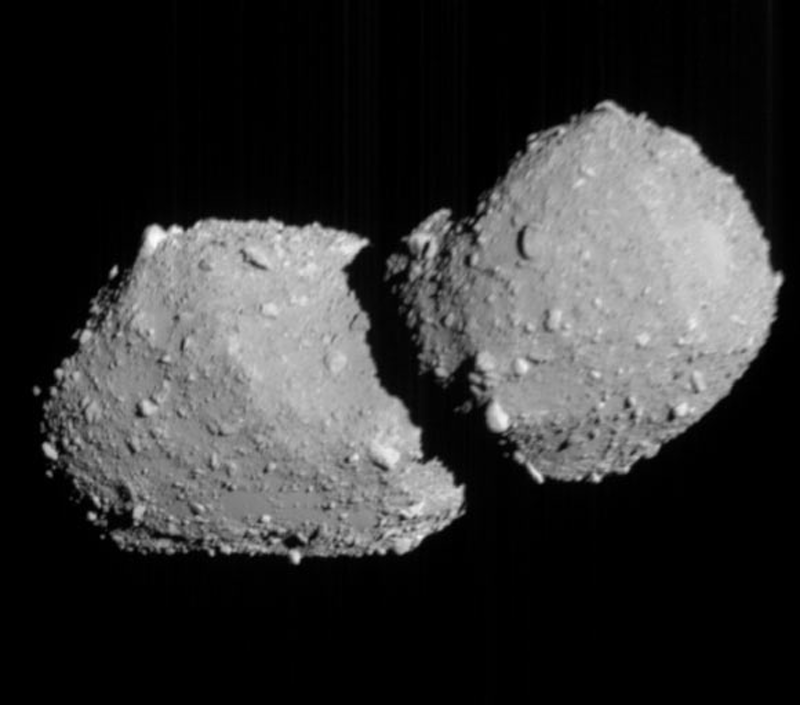


ONC-T image of asteroid Torifune captured by Hayabusa2 on July 5, 2026, showing the two-lobed contact-binary shape from a distance of roughly 800 kilometers.


On the evening of July 5, 2026, a 600-kilogram box of solar panels and instruments zipped past a peanut-shaped rock 450 meters across at roughly five kilometers per second. The flyby lasted about as long as the time it took you to read this sentence. The spacecraft was JAXA’s Hayabusa2, on a deliberate dash past near-Earth asteroid 98943 Torifune, also known by its provisional designation 2001 CC21. By the time anyone on Earth saw a single pixel of the encounter, the spacecraft was already several thousand kilometers beyond the asteroid, never to swing back (JAXA, July 6, 2026).

That brevity is the point. Torifune is the first of three asteroid encounters the extended Hayabusa2 mission is supposed to make before the probe reaches its true final target, the tiny 11-meter asteroid 1998 KY26, in 2031. The spacecraft is a sample-return craft that has already done its main job. Every extra maneuver now is rehearsal for an encounter that will be the most technically punishing of the mission (The Planetary Society, July 7, 2026).

Two reasons. First, Torifune is a contact binary, a body made of two lobes stuck together like a snowman, and those shapes are common in the small-body population but hard to study up close. Ground-based radar and adaptive-optics images suggested it was elongated; until last week no spacecraft had ever confirmed the structure with its own camera.

Second, the flyby is a deliberate dress rehearsal for planetary defense. JAXA wanted to demonstrate the kind of precision terminal guidance a kinetic impactor mission like NASA’s DART would need, where the spacecraft picks a small, faint, irregularly shaped target and threads a narrow approach corridor without hitting it. Torifune is the right kind of object: small, dim, and only clearly resolved a few days before closest approach. The mission team could not plot the final approach trajectory until the very end, because Torifune is faint enough that its exact orbit was uncertain until then (The Planetary Society, July 7, 2026).

If you are trying to design a spacecraft that bumps a city-block-sized rock off course, this is the kind of practice you want.

Hayabusa2 launched in December 2014 on an H-IIA rocket and arrived at asteroid Ryugu in mid-2018. Over the next eighteen months it dropped a pair of tiny hopping rovers, lowered the German-French MASCOT lander onto the surface, fired a 2-kilogram copper projectile into Ryugu to expose fresh sub-surface material, and scooped up samples. The return capsule landed at Woomera, Australia, in December 2020. Inside, scientists found water-bearing minerals, organic molecules, and grains that had escaped billions of years of space weathering. The samples are still being analyzed and are among the cleanest primitive materials anyone has yet returned from a carbon-rich near-Earth asteroid (Sci.News, July 8, 2026).

Most sample-return missions end there. Hayabusa2 did not. After releasing its sample capsule, the main spacecraft fired its ion engines and began a new trajectory. The extended mission has two goals: a high-speed flyby of Torifune in 2026, two Earth gravity assists in 2027 and 2028, and a final rendezvous with 1998 KY26 in 2031 (ISAS, mission page).

The Torifune encounter happened on July 5 at 18:30 JST, give or take one second. The spacecraft passed about 800 meters from the asteroid’s center, well outside the body but close enough that its three imaging instruments could resolve surface detail. ONC-T, the visible-light Optical Navigation Camera, started tracking Torifune on June 20 and continued to use the asteroid as an optical navigation reference right up to closest approach. About an hour before the flyby, the spacecraft also switched on NIRS3, a near-infrared spectrometer that hunts for water and hydroxyl signatures; TIR, a thermal infrared imager; and LIDAR, which bounces a laser off the surface to measure distance (JAXA, July 6, 2026).

Closest approach came and went. Hayabusa2 could not look back. JAXA confirmed the spacecraft was healthy at 18:35 JST, five minutes after the flyby, and the first images and thermal maps arrived within a day (Sky & Telescope, July 6, 2026).

The visible-light image showed what ground-based observers had suspected. Torifune is two distinct lobes joined at a narrow neck, the textbook shape of a contact binary formed when two smaller asteroids collided gently and stuck rather than bouncing apart. At about 450 meters across, it is in the same size class as the near-Earth asteroid Apophis and roughly an order of magnitude larger than the object that exploded over Chelyabinsk in 2013 (The Planetary Society, July 7, 2026).

The naming fits. JAXA chose “Torifune” through a public contest; it is short for Ame-no-Torifune, a Japanese deity associated with safe, steady, high-speed travel. You can see why the mission team liked it.

A flyby at five kilometers per second does not leave much margin for error. A small miscalculation in the closest-approach distance translates into several hundred meters of horizontal miss, easily enough to fly by the wrong side of the asteroid. There is no second chance. Hayabusa2 had to arrive at a precise point in space at a precise time, then keep going.

The spacecraft used a hybrid optical and radio navigation scheme. ONC-T took repeated images of Torifune against the background star field, and the team on the ground measured the asteroid’s apparent position to refine the predicted encounter point. Combined with deep-space network Doppler and ranging data, this let mission control update the trajectory within the last few days before closest approach. JAXA has not published the final navigation error budget, but the fact that ONC-T returned sharply focused images from 800 meters suggests the geometry worked (JAXA, July 6, 2026).

The thermal imager, TIR, observed Torifune in the 8 to 12 micrometer band, the thermal infrared where a sunlit asteroid radiates most of its heat. The brightness temperature, divided by the solar illumination, lets you back out the surface’s thermal inertia, a property set by regolith grain size, packing, and whether the surface is bare rock or blanketed in dust. For a small contact binary, the thermal data is the only way to learn what the surface is made of, because visible and near-infrared spectroscopy during a flyby captures too little reflected sunlight to break out mineral absorption signatures cleanly.

LIDAR is simpler but just as important. It rangefinds the surface with a 1.064-micrometer pulsed YAG laser, accurate from 30 meters out to 25 kilometers. During the Torifune encounter it produced a continuous altitude profile in the final minutes before closest approach, doubling as both a navigation input and a shape model. Combined with the ONC-T silhouette from a known viewing angle, the LIDAR track pins down the asteroid’s three-dimensional shape far better than the optical images alone (JAXA, July 6, 2026).

The instrument suite is what the spacecraft will carry into the 1998 KY26 encounter in 2031. KY26 is a different problem. At roughly 11 meters across, it is small enough that Hayabusa2 will not simply fly past; the extended mission plan calls for an actual orbit insertion and an attempted landing. The asteroid’s rapid rotation period, on the order of a few minutes, will make that landing extremely difficult, and the extended mission team is using Torifune to validate the optical and thermal mapping pipeline they will need for the harder job.

Hayabusa2 has now visited three asteroids across two missions. The first primary mission gave the world its best sample of a carbon-rich near-Earth asteroid. The extended mission is a chain of progressively harder technical demonstrations, and the Torifune flyby is the one with the lowest stakes but the cleanest test of the navigation approach JAXA wants to use in 2031. More data will downlink over the coming weeks.

Two years from now, the spacecraft will swing past Earth for a gravity assist. Three years after that, in 2031, it will arrive at a rock smaller than a house and try to land on it. Last week’s flyby is the first of the milestones the extended mission still owes the public. JAXA hit the geometry and returned a clean, recognizable image. The data will inform how we eventually deflect a real asteroid.


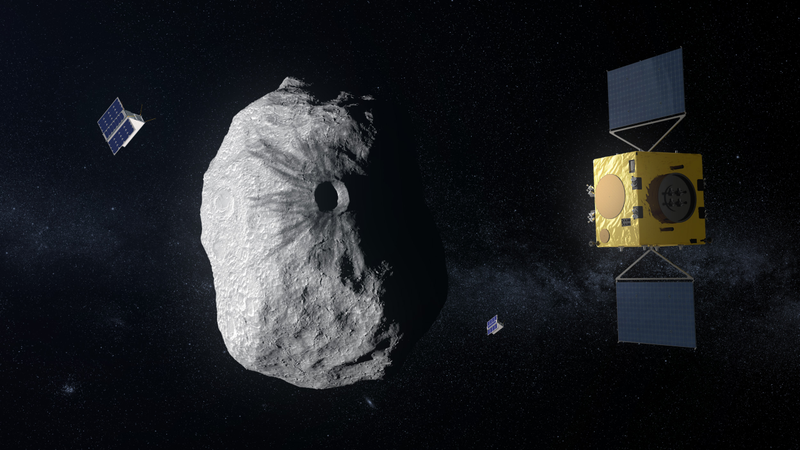
A gold-foiled spacecraft with solar wings holds station beside a large grey asteroid marked by a central crater, with two small cubesats nearby.


On 17 March 2026, somewhere past the orbit of Mars, a European spacecraft fired its hydrazine thrusters for the second time since launch. The burn lasted long enough to dump 123 kilograms of propellant and shift the probe’s heliocentric velocity by 367 metres per second, the equivalent of accelerating from a standstill to just above the speed of sound (ESA, Hera mission update, 17 March 2026). Two months later, in Thessaloniki, the entire Hera science team gathered for what the project’s own newsletter called “the last time before the probe finally arrives on site” (heramission.space, 17 May 2026). That arrival is now eleven weeks out.

ESA’s Hera, launched 7 October 2024 from Cape Canaveral on a Falcon 9, is closing on the binary asteroid 65803 Didymos. It will reach the system in early November 2026, almost exactly four years after NASA’s Double Asteroid Redirection Test slammed into Dimorphos, the smaller of the two bodies, and changed its orbit by 33 minutes (NASA/APL, 26 September 2022). What Hera will do once it gets there is, in a phrase the mission team keeps using, turn a grand-scale experiment into a repeatable planetary-defence technique. That phrase is doing a lot of work. It is the entire reason a 1,214-kilogram spacecraft is at this moment drifting toward two rocks that, until 2022, almost no one outside planetary science had heard of.

Dimorphos is small. Before DART, its diameter was estimated at roughly 160 metres, the height of a 50-storey building, and its mass was known only to within a factor of two. That uncertainty is the central problem Hera was built to solve. The first measurement of how much momentum DART delivered to the moonlet, the so-called momentum enhancement factor beta, was published by Rivkin and colleagues in 2023. They reported beta = 3.61 with a 1-sigma uncertainty of about 0.2, anchored to an assumed Dimorphos bulk density of 2,400 kilograms per cubic metre (Rivkin et al., Nature 2023). A weaker, more porous asteroid gives a higher beta. A denser, more cohesive one gives a lower beta. Without measuring Dimorphos’s actual mass, every planetary-defence scenario that uses the DART result inherits that uncertainty.

That matters because planetary defence is no longer hypothetical. The 2024 PDC25 exercise at Johns Hopkins Applied Physics Laboratory used beta = 3.61 as its baseline. The number is now embedded in the operating procedures of NASA’s Planetary Defense Coordination Office. A 0.2-point error in beta, applied to a 200-metre asteroid on a 10-year warning, translates into roughly a thousand kilometres of miss distance. That is the difference between a near miss and an ocean impact.

There is a quieter reason to care. Hera is going to make the first internal radar scan ever performed on an asteroid. The instrument is called JuRa, and it sits on a CubeSat the size of a shoebox.

NASA’s DART was the kinetic-impact end of an experiment called AIDA, the Asteroid Impact and Deflection Assessment. ESA’s Hera was always supposed to be the diagnostic half. The architecture is not unusual in physics: you hit something, then you measure what happened. In this case, the impactor flew in 2022. The diagnostician is arriving on time.

Dimorphos is in a 12-hour orbit around Didymos, a roughly 780-metre primary. Both are near-Earth asteroids in the rubble-pile class. DART hit Dimorphos head-on at about 6.6 kilometres per second and shortened its orbital period by 33 minutes, far more than the 7-minute change the spacecraft alone would have produced. The extra came from ejecta, the plume that flew off the surface in the opposite direction and acted as a natural afterburner.

Hera will do the part ground telescopes could not. It will map Dimorphos’s shape from hyperbolic arcs at 20 to 30 kilometres, then closer, down to 1 to 2 kilometres during the experimental phase in April and May 2027 (ESA Hera operations plan, 2026). Two CubeSats will be deployed starting 13 January 2027. Juventas carries JuRa, a 50 to 70 megahertz radar that will sound the asteroid’s interior to a depth of roughly 100 metres with 10 to 15 metres of vertical resolution. Milani carries ASPECT, a hyperspectral imager covering 0.5 to 2.5 micrometres, and VISTA, a dust sensor. Juventas will attempt a soft landing on Dimorphos in late January 2027, the first controlled touchdown on a body this small.

The 367 m/s maneuver tells you what the mission was actually doing during cruise. The full delta-v budget from launch through arrival is on the order of 1.4 kilometres per second, and Hera carries roughly 600 kilograms of hydrazine for chemical propulsion. That is a small budget by interplanetary standards, smaller than OSIRIS-REx’s, smaller than Hayabusa2’s. The reason it works is the Mars gravity assist of 12 March 2025, which bent the trajectory and added, for free, several hundred metres per second. Without that flyby, Hera would not have arrived.

What the chemical system has to do is trim. Each burn is small. The cumulative effect, over five maneuvers across two years, is to align the spacecraft with Didymos’s slow drift around the Sun so that, in late October 2026, the probe can begin hyperbolic approach arcs instead of flying past.

The autonomy stack is the harder problem. At 20 kilometres, Didymos subtends roughly the same angle as a person standing 100 metres away. At 4 kilometres, Dimorphos, at 160 metres across, occupies about 2.3 degrees of sky. Both bodies move visibly against the star background during a single exposure. The Asteroid Framing Camera, two redundant 1020-by-1020 CMOS sensors built by Jena-Optronik, has to track Didymos in one field of view while Dimorphos arcs through the same frame. At 1 kilometre altitude, AFC delivers roughly 10 centimetres per pixel. That is enough to resolve the rim of the DART crater and build a digital terrain model accurate to about half a metre (Jena-Optronik AFC documentation, 2024).

JuRa is the more exotic instrument. Low-frequency radar in deep space is rare because the antenna that works at 50 to 70 megahertz is, by radio-physics standards, large: on Juventas, the antennas deploy to about 1.5 metres tip-to-tip. The bandwidth is wide enough to see the boundary between regolith and a more competent interior, if such a boundary exists. Dimorphos is thought to be a rubble pile, a gravitationally bound aggregate of fragments from centimetres to tens of metres, with bulk porosity between 30 and 50 percent. Until now, no one has measured which kind of object DART actually hit.

The momentum transfer itself is described by an equation that hides a great deal of physics. The change in Dimorphos’s orbital velocity is

Δv = (m_s × v_s + m_e × v_e) / (m_s + m_e + m_t)

For DART, m_s was about 580 kilograms, v_s about 6.6 kilometres per second, giving a momentum of about 3.8 megagram-metres per second. The orbital change was 2.7 millimetres per second, implying an effective momentum delivery roughly 3.6 times larger than the spacecraft alone would have produced. That factor, beta, is what Hera will nail down by weighing Dimorphos.

Hera will not prevent an asteroid impact. That is not the job. The job is to convert the most famous kinetic impact experiment in history from a single dramatic event into a calibrated engineering method. By mid-2027, planetary-defence planners will know, to within a few percent, how much velocity change a given kinetic impactor delivers to a rubble-pile asteroid of a given size and porosity, from direct measurement rather than extrapolation.

The November 2026 arrival is the moment the field stops being theoretical.


September 12, 2026

The loneliest arrival of the decade

Posted by


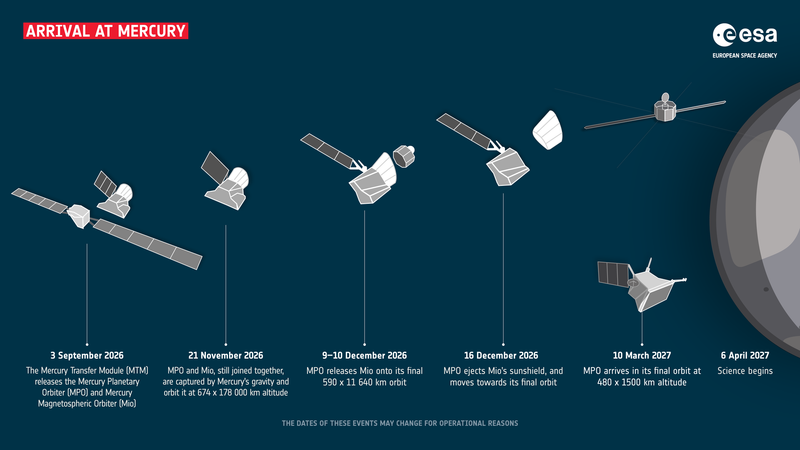
BepiColombo's arrival at Mercury, showing the four-stage separation sequence from MTM separation on 3 September 2026 through science operations beginning on 6 April 2027. (ESA)


On 15 June 2026, at 15:24 CEST, a spacecraft 100 million kilometers from Earth received a single command through ESA’s Estrack deep-space antennas: stop firing. After almost eight years of nearly continuous thrust, the four QinetiQ T6 ion engines on the Mercury Transfer Module shut down for the last time. With that, the European/Japanese BepiColombo mission crossed an invisible line. From that moment, the spacecraft was on a ballistic trajectory, coasting with no propulsion toward the deepest gravity well in the inner Solar System. Mercury orbit insertion is scheduled for 21 November 2026 (ESA BepiColombo mission timeline, July 2026 update). What used to be a braking problem became a falling problem, and falling problems don’t have throttle knobs.

Mercury is the least explored planet in the inner Solar System, and the hardest one to reach without surrendering. It sits deep inside the Sun’s gravity well, moving at 47 km/s on average, more than three times Earth’s orbital speed. To fall into orbit around it rather than whip past it, a spacecraft must shed almost all of the kinetic energy it gained falling toward the Sun from Earth. NASA managed the trick with Mariner 10 in 1974 and MESSENGER in 2011. The Soviets never made it. The Japanese never tried. If BepiColombo succeeds, it will be only the third spacecraft in history to enter orbit around Mercury, and the first from Europe or Japan (ESA BepiColombo overview).

The mission also carries the heaviest scientific payload ever sent to Mercury, sixteen instruments distributed across two orbiters stacked on a propulsion bus. The trajectory they are flying is, by itself, an engineering demonstration: a multi-year, multi-flyby spiral through nine planetary encounters that uses gravity assists from Earth, Venus, and Mercury itself to bleed off energy without spending propellant.

BepiColombo launched from Kourou on 19 October 2018 aboard Ariane 5, lifting a 4,100-kilogram composite spacecraft into a series of looping escape orbits. The plan was, in spirit, simple: spiral inward. In practice, the MTM had to do most of the braking. Its four T6 ion thrusters, each producing only about 145 millinewtons of thrust (about the weight of a sheet of paper resting on a hand), fired almost continuously for years, accumulating more than 15 kilometers per second of total delta-v.

Then, in April 2024, the system lost a fight with itself. A short circuit in the MTM power conditioning unit reduced available thrust to roughly 90 percent of nominal. The original December 2025 arrival was no longer reachable. ESA’s flight dynamics team at ESOC in Darmstadt had to rebuild the entire interplanetary approach from the ground up, slicing flyby altitudes closer to Mercury by about 35 kilometers to recover the energy deficit through sharper gravity assists. The sixth and final Mercury flyby, on 8 January 2025, came in at just 295 kilometers above the night-side surface. Close enough that the spacecraft’s M-CAM monitoring cameras caught permanently shadowed craters at the north pole that may hold frozen water (ESA, January 2025 flyby report).

What happens between now and April 2027 is a four-stage separation sequence that ESA’s infographic captures cleanly. On 3 September 2026, still on approach, the MTM detaches and falls away, its job done and its xenon tanks empty. On 21 November 2026, a stack of two science orbiters fires a chemical-propellant braking burn and is captured into a high-altitude polar orbit. On 9–10 December 2026, ESA’s Mercury Planetary Orbiter (MPO) ejects the shielded Japanese Mio spacecraft onto its own elliptical polar trajectory. On 16 December 2026, MPO jettisons Mio’s protective sunshield (MOSIF). Over the next three months, MPO uses its own thrusters to lower itself to its working orbit of roughly 400 by 1,500 kilometers, arriving on 10 March 2027. Routine science begins on 6 April 2027 (ESA BepiColombo arrival timeline, July 2026).

The propulsion architecture is the story. The T6 ion thruster, built by QinetiQ Space in the UK, ionizes xenon and accelerates the ions through a grid biased at roughly 2,000 volts. Specific impulse runs around 4,300 seconds, about five times better than the best chemical bipropellant engine on the spacecraft. The trade is brutal: thrust is so low that BepiColombo had to spiral inward for eight years to make the maneuver work. The reward is propellant efficiency. The MTM carried only about 580 kilograms of xenon, and that modest tank delivered the equivalent delta-v of tens of metric tons of hydrazine.

Once the MTM separates, MPO has to handle the rest of the braking with its own chemical propulsion: a hydrazine-based system capable of producing about 1,000 newtons of total thrust across four 22-newton thrusters. To enter Mercury orbit, MPO must dissipate roughly 1.8 km/s of hyperbolic excess velocity in a series of maneuvers spread over weeks. Because Mercury’s gravity well is so deep, an error of even one meter per second in the insertion burn propagates into hundreds of kilometers of orbital drift by the end of the commissioning phase.

The two orbiters work at very different altitudes on purpose. Mio, the JAXA Mercury Magnetospheric Orbiter (formerly MMO), sits in a highly elliptical 400 by 12,000 kilometer orbit that swings it through the magnetosphere to sample solar wind interactions. MPO, in a tighter near-circular polar orbit, holds its instruments nadir-pointed at the surface. Eleven instruments on MPO and five on Mio together cover imaging (SIMBIO-SYS), X-ray fluorescence (MIXS), gamma-ray and neutron spectroscopy (MGNS), laser altimetry (BELA), magnetometry (MERMAG), and exospheric sampling (SERENA, PHEBUS). Temperatures range from about -180°C on the night side to +430°C on the day side, so most optical and infrared instruments sit behind thermal blankets and, where needed, gold-coated mirrors.

The water-in-shadow question is one of the cleaner open cases. Earth-based radar returns from Mercury’s polar craters are consistent with volatile ices buried under regolith. BepiColombo’s MGNS and MIXS instruments should, in principle, detect hydrogen directly through neutron moderation and detect elemental composition through characteristic X-ray emission. The permanently shadowed craters (Prokofiev, Kandinsky, Tolkien, and Gordimer at the north) were imaged by M-CAM 1 during the January 2025 flyby. Their rims just catch the sun, while their floors stay below 100 K year-round.

Three months from now, an interplanetary spacecraft that has spent almost a quarter of its life quietly thrusting through the inner Solar System is going to fall into the smallest planet’s gravity well. Whether the chemical insertion burn works depends on years of trajectory redesign, on the integrity of a 90-percent-power propulsion system that engineers coaxed across nine planetary encounters, and on a separation sequence that has to be executed cleanly four times in two months. If it works, BepiColombo will spend the next several Earth years mapping an airless, 430-degree-Celsius world whose permanently shadowed craters might, just maybe, hold enough water to matter for human exploration later this century.

If it doesn’t work, the spacecraft will whip around Mercury on a flyby trajectory, and the data already gathered by M-CAM during the six gravity assists will have to carry more of the mission’s scientific weight. As ESOC mission operators Ignacio Tanco and Nacho Clerigo have stressed in briefings, the arrival phase is not a single event but a six-month sequence of one-of-a-kind operations, each of which has to go right in the right order.


September 9, 2026

BepiColombo drops its ride to Mercury

Posted by


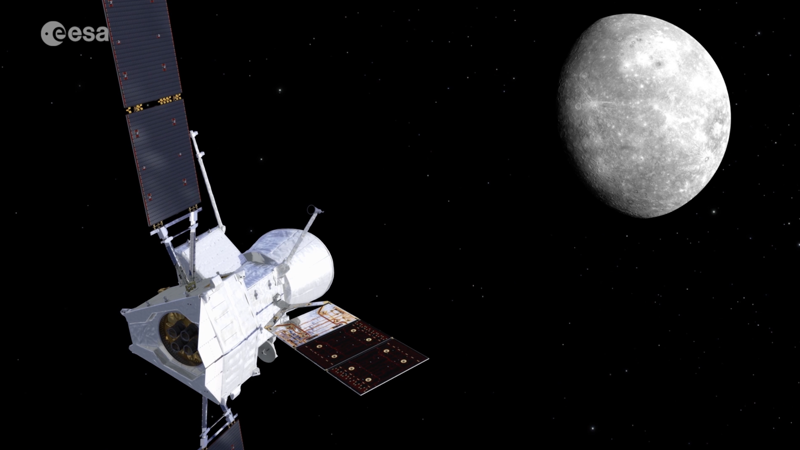
The BepiColombo composite spacecraft - ESA's Mercury Planetary Orbiter (MPO) at the base with its single solar array extended, JAXA's Mio (Mercury Magnetospheric Orbiter) sheltered inside the white MOSIF sunshield on top, and the Mercury Transfer Module's large rectangular solar wing visible behind the stack - approaches a half-lit Mercury against a black starfield. Credit: ESA / ESA Multimedia image (24 June 2026).


On Thursday afternoon at 14:00 CEST, a stack of four spacecraft modules that left Earth on an Ariane 5 in October 2018 will, very briefly, become three and then two. ESA’s Mercury Transfer Module is scheduled to detach from BepiColombo’s two science orbiters as the mission’s controllers at the European Space Operations Centre in Darmstadt look on, with the first signal from the freed composite expected back on Earth by 15:53 CEST if everything goes to plan (ESA, 27 August 2026). After eight years and nine gravity assists, the part of the spacecraft that made the trip possible is no longer needed, and the part that has to do the science is, ungainly and for the first time, on its own.

Getting to Mercury is the kind of orbital mechanics problem where the obvious solution is forbidden. Falling toward the Sun does not slow a spacecraft down; it speeds it up, pulled by solar gravity, so the usual chemical-brake trick used at Mars is not enough to be captured into orbit around the smallest planet. BepiColombo has to match Mercury’s velocity almost exactly, and that takes far more energy than reaching even the distant gas giants. The mission’s answer was to spend years bleeding speed against an ion engine instead of staging a single dramatic burn, and the upcoming separation is the moment the engine is, finally, switched off and thrown away. As ESA’s mission manager Santa Martinez put it to Euronews on 1 September, “Mercury is a challenging destination. It’s very difficult to reach, it’s very difficult to operate there.”

Why a separation matters this much, and why the next two months are unusually tense, comes down to what changes about the spacecraft on Thursday. For the cruise the four modules sat one on top of the other inside a tight stack, with their instruments and cameras physically blocked from space by the boxy MTM at the base. Once the MTM floats off, the upper composite begins an entirely new mission with an entirely new thermal and radiation budget. Solar flux near Mercury is roughly ten times what it is near Earth, and the MTM had been there partly to shield the orbiters during the inner solar system transit. The flight director, Ignacio Tanco, has described the moment to Euronews as working “with a very hot pizza oven running right on your back” and “on a knife edge,” because the MPO’s solar panels have to be tilted within fractions of a degree of the Sun. Push them slightly away and the spacecraft starts losing power; angle them slightly closer and they start to bake. There is no second chance to find the right pointing before the thermal balance tips.

The spacecraft itself carries a long memory. BepiColombo launched on Ariane flight VA245 from Kourou on 20 October 2018 and reached escape velocity the same day, then spent almost exactly eight years climbing and falling through the inner solar system using four QinetiQ T6 ion thrusters on the MTM, with a maximum combined thrust of about 290 millinewtons, the most powerful ion engine array ever operated in space. The cruise used one Earth flyby in April 2020, two Venus flybys in October 2020 and August 2021, and six Mercury flybys between October 2021 and January 2025, the last of which imaged the permanently shadowed north polar craters Prokofiev, Kandinsky, Tolkien and Gordimer. The mission’s overall cost is estimated at 1.65 billion euros, and the arrival has already slipped about eleven months from its original December 2025 date because of a power-related anomaly that limited the available thrust before the fourth Mercury flyby in September 2024. On 15 June 2026 at 13:24 UTC the MTM’s solar electric propulsion was switched off for good, and from then on the mission is ballistic: BepiColombo is, in engineering language, “weakly captured” by Mercury’s gravity and following a free-falling trajectory through space.

What happens after 3 September is a sequence of three distinct steps rather than one event. From the separation through late November, the MPO and Mio remain mechanically and electrically joined, with the Magnetospheric Orbiter Sunshield and Interface (MOSIF) still attached, and the two orbiters fly free of the propulsion module for the first time in their lives. Then, between late November and early December 2026, a series of chemical thruster burns raises the orbit’s apocentre and lets Mercury’s gravity do the rest, putting the composite into polar orbit. Once captured, MPO and Mio separate from each other and head to their distinct orbits, MPO in a lower polar orbit for surface and interior science and Mio in a higher polar orbit at 590 by 11,640 kilometres for magnetospheric work. Engineers then spend roughly four months commissioning instruments on both orbiters, and only in April 2027 does the dedicated science campaign begin. The waiting list, when it eventually opens, is unusually long. Mercury’s iron core makes up roughly sixty percent of the planet’s volume, and the mission’s principal question is why a planet that small should pack such a dense metallic interior, and what that interior is doing to the unexpectedly long-lived magnetic field that makes Mercury (along with Earth) the odd rocky planet out. The two orbiters will “taste” the planet’s tenuous exosphere of hydrogen, helium, oxygen, sodium, potassium and calcium at the same time that MPO maps the surface, measuring surface temperatures down to a few hundred metres per pixel and sounding the crust with the RIME ice-penetrating radar that was deployed once in 2023 and has waited seven years to be used on Mercury. Separation on Thursday is the first of a small handful of moments that decide whether any of that science happens, and it is the one the ESA team can already see clearly. After MTM separation, mission controllers listen for the post-separation acquisition of signal and then go through the first health checks. If the composite is in the expected attitude, the high-gain antenna locking on Earth, and the temperatures inside the expected range, MPO and Mio spend the next three months coasting together in what ESA calls a Mercury approach configuration, conservatively waiting for the November capture window. The MTM, the workhorse that brought them there, has no attitude control after separation, so ESA’s flight dynamics manager Frank Budnik has been clear that “you cannot control it, you cannot manoeuvre it,” and the module will begin to tumble away in its own orbit past Mercury rather than around it. After eight years, the most powerful ion engine array ever flown is, for a few million kilometres at least, just a derelict tumbling through interplanetary space with the Sun in its face and no way to turn around.


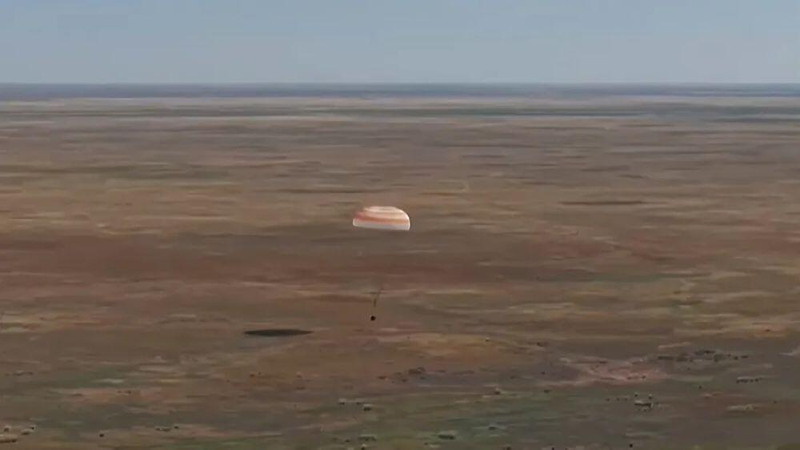
The Soyuz MS-28 descent module suspended under its main parachute during the final seconds of descent over the Kazakh steppe on July 26, 2026.


The Soyuz MS-28 spacecraft touched down on the Kazakh steppe at 5:27 a.m. local time on Sunday, July 26, 2026, with three crew members strapped into a descent module that had just survived a 7.6 km/s hypersonic dive through the atmosphere. By the time the capsule rolled to a stop about 147 km southeast of Dzhezkazgan, NASA’s Chris Williams, Roscosmos’s Sergey Kud-Sverchkov, and Sergei Mikaev had spent 241 days in orbit and crossed 3,856 orbits of the Earth, roughly 164 million kilometers of free fall, longer than the average round-trip distance from Earth to Mars (NASA, July 2026).

The Soyuz landing sequence has not changed meaningfully since 1967. The capsule separates from its orbital and service modules, fires a braking engine, falls semi-ballistically for about seven minutes through 1,500 °C plasma, deploys two drogue chutes and a 1,000-square-meter main, jettisons its heat shield, and fires six solid-fuel soft-landing engines about 70 cm above the steppe (Energia/RussianSpaceWeb, 2024). Every crew member who has flown on a Soyuz, from the first 1967 boilerplate to Williams’s 2026 flight, has come home in essentially the same hardware lineage. No other crewed spacecraft has logged more return flights to Earth.

That continuity is narrowing. The U.S. Deorbit Vehicle (USDV), a heavily modified Cargo Dragon with 46 Draco thrusters and roughly 16 tonnes of propellant, is scheduled for delivery readiness in October 2028, with launch around mid-2029, after which the 420-tonne ISS will be steered into the Pacific at Point Nemo no earlier than late 2030 (NASA Office of Inspector General, 2025). Every Soyuz landing between now and then is one of the last acts of a 30-year joint occupation of low Earth orbit. On July 26, Expedition 74 ended; Expedition 75, with Jessica Meir in command and Anil Menon freshly arrived on Soyuz MS-29, took over.

Williams, a medical physicist by training, became the 642nd person to enter orbit when Soyuz MS-28 launched on Thanksgiving Day, November 27, 2025, from the Baikonur Cosmodrome. He and his two Russian crewmates joined Expedition 73/74 and spent eight months supporting more than 200 experiments, including semiconductor crystal growth, bioprinting of vascular tissue for cancer research, and testing a new European exercise device called the E4D that combines cycling, rowing, and resistance in one frame (NASA, March 2026).

The handover began on July 14, when Soyuz MS-29, carrying NASA astronaut Anil Menon and Roscosmos’s Pyotr Dubrov and Anna Kikina, docked at the Prichal node module after a three-hour rendezvous. Twelve days later, on July 25, Kud-Sverchkov passed command of the ISS to Meir. The next morning at 3:03 a.m. EDT, MS-28 undocked from the Rassvet module. For about two and a half hours, it drifted away in free fall, trailing by roughly 12 m/s of relative velocity, while ground controllers computed the deorbit burn.

At 5:32 a.m. EDT, the KTDU-35A main engine fired for 282 seconds, slowing the spacecraft by 115 m/s, enough to drop its perigee into the upper atmosphere. Twenty-two minutes later, the habitation and instrument modules separated, leaving only the 2.9-tonne descent module pointed heat-shield-first at an entry interface around 99.7 km. For the next six minutes, the capsule was silent through ionized plasma blackout as it bled off orbital velocity through friction alone.

The drogue chutes unfurled at 10.8 km, slowing the capsule from about 230 m/s to roughly 80 m/s, then the main canopy deployed at 8.5 km and trimmed the descent to a stately 6–7 m/s. The heat shield was jettisoned at 5.5 km, exposing the six solid-fuel soft-landing engines. At 0.7 m above the steppe, the Kaktus altimeter fired them, cutting touchdown speed to about 1.5 m/s. The capsule tipped onto its side, the way Soyuz always does. Recovery teams in Mi-8 helicopters reached the site within minutes. Williams was extracted, given a matryoshka doll with his face, and flown by helicopter to Karaganda before boarding a NASA aircraft back to Houston.

The Soyuz landing is a physics exam compressed into 24 hours of flying. Three constraints drive the design.

First, the lift-to-drag ratio of the descent module is intentionally low (about 0.3 to 0.4), achieved by offsetting the capsule’s center of mass. This generates just enough lift to steer the trajectory and trim peak deceleration to roughly 4 g during a guided reentry, instead of the 8 to 9 g the crew would experience in a fully ballistic descent. When something fails, as it did on Soyuz TMA-1 in 2003, TMA-10 in 2007, and TMA-11 in 2008, the capsule rolls at high speed to wash out the lift vector and falls steeply, sometimes hundreds of kilometers off-target. The lower L/D also caps heating at 150 to 200 W/cm², which is why the ablative shield can be phenolic resin and silica-fiber blanket rather than reusable tiles.

Second, the propulsion system is split. The KTDU-35A main engine, burning UDMH and nitrogen tetroxide (N₂O₄), lives on the service module and is jettisoned before entry. It provides the 115 m/s Δv for the deorbit burn. The six DMP soft-landing engines are solid-propellant, total mass around 60 kg, hidden under the heat shield, fire only once. From Tsiolkovsky’s rocket equation, the deorbit Δv comes out as:

Δv = v_e * ln(m_0 / m_f)

For the KTDU-35A, with a vacuum specific impulse near 315 seconds (v_e ≈ 3,090 m/s), losing 2.9 of the spacecraft’s roughly 7.2-tonne stack mass produces the needed 115 m/s. The math is forgiving; the margin lives in the parachute system.

Third, the parachute system is redundant by design. Two pilot chutes extract a 24 m² drogue, which pulls out a 1,000 m² main canopy. A separate 500 m² reserve canopy is packed independently in case the main fouls. The main weighs about 110 kg and inflates in roughly 1.5 seconds, producing a peak shock load of about 4–5 g.

The Kaktus altimeter deserves a separate mention. Older Soyuz used a cesium-137 source firing downward through a collimator, counting backscattered gamma rays from the soil; modern variants use sealed cobalt-60 in a redundant design. When the count rate climbs above a threshold at about 0.7 m altitude, it triggers the soft-landing engines. The system is mechanical-electronic, not radar, which is part of why Soyuz landings are timed to the second regardless of weather.

By the time the USDV fires its 46 Draco thrusters to drop the ISS into the South Pacific in 2030 or 2031, Soyuz will have completed more than 175 crewed flights and brought more than 500 people home from orbit. The descent module that carried Williams, Kud-Sverchkov, and Mikaev to the Kazakh steppe on July 26, 2026 is a direct descendant of the capsule that killed Vladimir Komarov in 1967. The parachutes are bigger, the altimeter is better, and the crews wear Sokol pressure suits, but the compromise is the same: trade g-load and landing accuracy for simplicity, redundancy, and a soft landing where helicopters can find you.

Expedition 75 now has a seven-person crew and a packed manifest through spring 2027, with a commercial rotation arriving in September aboard Crew-13. The station’s end is on the engineering calendar, but the landing sequence that has defined how humans come home from orbit will outlive it.

Sources: NASA Space Station blog (July 26, 2026); NASA media advisory (July 27, 2026); RussianSpaceWeb Soyuz landing systems reference (Energia, 2024); NASA Office of Inspector General report on USDV (IG-25-001, 2025); Soyuz MS-28 and MS-29 mission press kits (Roscosmos, 2025–2026). Photo credit: NASA/Bill Ingalls.