


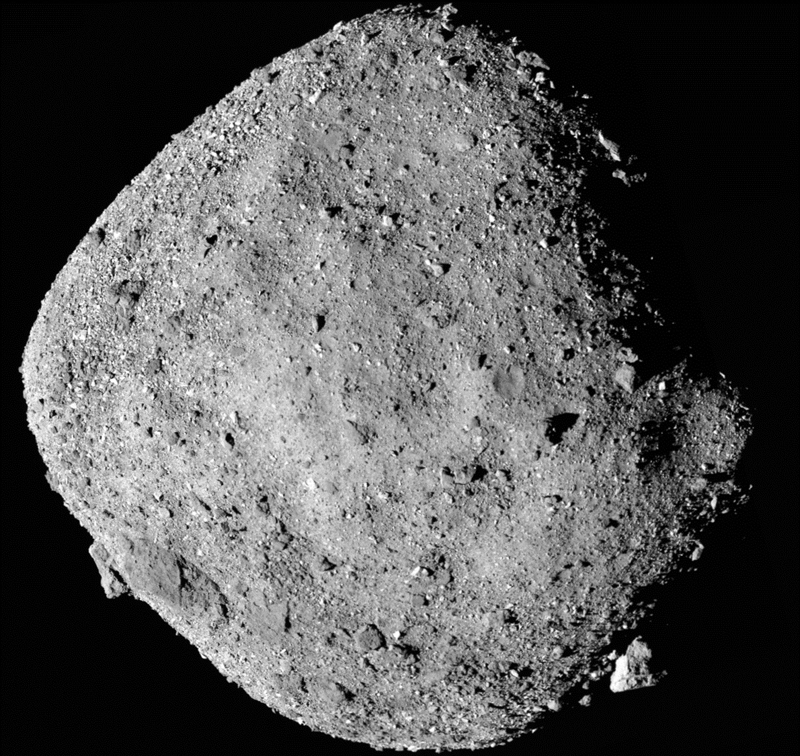
Half a gram of asteroid dust, split among three transition metals, has rewritten where Bennu came from. A team led by Maria Schönbächler at ETH Zurich reports on 23 September 2026 in Science Advances that Bennu, the near-Earth asteroid visited by NASA’s OSIRIS-REx spacecraft between 2018 and 2021, did not assemble in the cold outer reaches of the young solar system the way most researchers assumed. It assembled instead near the water-ice line, in the narrow band where temperatures were cold enough to freeze water vapour into solid ice and warm enough inside to keep it as a gas. The work leans on isotopes of iron, titanium and chromium measured in five Bennu sample portions at ETH’s isotope geochemistry lab, and it points to a culprit for the unusual chemistry: Jupiter, which grew large enough, fast enough, to filter coarse material out of the dust disk before Bennu’s parent body could form.
Source: NASA/Goddard/University of Arizona Bennu mosaic on Wikimedia Commons (public domain).
Bennu’s chemistry has been a quiet puzzle for most of the past decade. Earlier sample studies, including the joint OSIRIS-REx and Hayabusa2 preliminary results, had placed it in a family of carbon-rich objects whose closest meteoritic relatives on Earth are the rare CI chondrites: carbon-rich, water-bearing, and chemically the closest match in the meteorite collection to the Sun’s own composition, with very little thermal alteration since the solar system’s birth. What no one had pinned down was where in the protoplanetary disk that fingerprint had been laid down.
The old model put Bennu-class objects far out in the disk, beyond where most comets form, where accretion was slow and hydrated minerals could survive undisturbed. The new isotope measurements turn that on its head. Iron and titanium are distributed so well throughout the Bennu material that the parent object cannot have been a single coarse clump; it must have been built from fine dust mixed across the disk, with ice acting as a glue that bound fine particles into larger aggregates on the cold side of the water-ice line.
The phrase Schönbächler uses for the result is direct: Bennu is a hybrid. It does not clearly match either the inner or the outer solar system. It bears characteristics of both regions, because it was assembled in the specific transition zone where material from both sides met, according to the ETH Zurich announcement.
To anchor that conclusion, the team compared Bennu against the other carbon-rich sample-return target in the modern catalogue: Ryugu, the asteroid Hayabusa2 visited in 2019. The two objects share an isotopic fingerprint with each other and with the CI chondrites, all distinct from the rest of the meteorite collection and from other sampled asteroids. The authors frame the open question as a population question: if Bennu and Ryugu both formed in the same zone, what is that zone producing that sends objects to near-Earth orbits, and are these two a coincidence or a sample of a broader pattern?
That question hands the baton to the next sample-return missions. China’s Tianwen-2 arrived at the quasi-satellite Kamoʻoalewa this summer and is expected to return a sample in 2027. Japan’s MMX mission, scheduled to launch from Tanegashima in October 2026 on an H3, is set to bring back material from Phobos in 2031; Phobos is itself a possible captured asteroid, and a Phobos sample with a Bennu-like signature would extend the snow-line zone picture to the Mars system. The next-mission parallel was also flagged in Space.com’s coverage.
The water-ice line is not a feature of the finished solar system; it is a feature of the protoplanetary disk, the rotating torus of gas and dust around the young Sun. Inside the line, water vapour stays in gas form. Outside it, water freezes onto dust grain surfaces as ice. In standard models the boundary sits somewhere near the present-day orbit of Jupiter, roughly five astronomical units out, and that distance matters because the disk’s solid inventory changes composition sharply there: inside the line, rocky dust; outside, ice-coated dust; and right at the boundary, a transition layer where ice can sublimate, migrate inward as vapour, and recondense.
The new analysis proposes that this transition layer was the assembly site for Bennu, Ryugu, and the CI chondrites, with Jupiter acting as an active filter rather than background. The gas giant formed within roughly one million years of the Sun’s birth, and its gravitational influence quickly became a barrier in the disk. Coarse, clumpy material could not easily cross Jupiter’s orbital neighbourhood; fine dust could, routing around Jupiter from multiple radial directions and arriving well mixed. The result is an unusually homogeneous feedstock for planetesimals forming in the transition zone near the snow line, and that homogeneity is what the Bennu isotope data see.
The team’s mechanism also explains two aspects of the sample. The first is water. Bennu’s parent body incorporated enough ice that, when it was later broken up and the fragments were warmed by the Sun, hydrated minerals appeared in the regolith in the proportions the OSIRIS-REx analysis measured. Ice from just outside the snow line can sublimate as the disk evolves, drift inward as vapour, and recondense inside the line, so a transition-zone planetesimal ends up with both rocky and icy inputs. The second is the chemical match to the Sun. Fine dust, mixed by the disk’s turbulence and routed around Jupiter, ends up with a bulk composition close to the pre-solar nebula because it has not been sorted into coarse and fine reservoirs. Bennu samples that average composition better than any other available asteroid material.
For the broader picture, the implication is that the asteroid belt is not the only reservoir of primitive material in the inner solar system. Near-Earth asteroids like Bennu and Ryugu may be sampling a specific radial slice of the early disk that the main belt, with its heavy thermal and collisional processing, has blurred out. If planetary migration can scatter snow-line objects into near-Earth orbits, then the Bennu sample is not a quirk of one asteroid but a window onto a specific formation environment that the meteorite collection only hints at.
What is striking about the result is how much depends on a small measurement. The five Bennu sample portions, totalling a fraction of a gram, were analysed for isotopic ratios of three elements at a single laboratory over months. None of that is large-scale geophysics or a flagship space telescope survey. It is the kind of bench-scale work that historically has rewritten meteorite science, and it has now done so for an asteroid whose sample exists on Earth only because a NASA spacecraft flew for two and a half years to a rock the size of a small mountain, picked up its surface with a robotic arm, and parachuted the result home.
The Bennu story is not finished. Sample analysis at laboratories around the world is ongoing, with new allocations going out in waves as the OSIRIS-REx curatorial team works through the 120 grams that came back. Schönbächler and her collaborators flag the open question directly: are other asteroids in the same isotopic family, and how widespread is the snow-line zone fingerprint across the inner solar system? That question will not be answered by Bennu alone. It will be answered by what comes back from Kamoʻoalewa, then Phobos, then whatever the next generation of sample-return missions chooses to visit.
For now, the picture is this: Bennu is chemically the closest match in our sample collection to the mixture of elements the Sun itself inherited. Its formation was not a quiet outer-disk story; it was a product of a specific radial neighbourhood in the young solar system, with Jupiter acting as the gatekeeper that kept coarse material out and let fine dust through. The fact that we have a piece of it in a laboratory in Zurich, three years after it fell out of the Utah sky, is a measure of how much of the early solar system can be reconstructed from a sample small enough to lose between your fingers.
 Subscribe to our RSS feed









There are no comments.
Add A Comment