OrbitalHub

Where curiosity reaches escape velocity.

Domain is for sale. $50,000,000.00 USD. Direct any inquiries to contact@orbitalhub.com.

Archive for the Lunar Explorers category


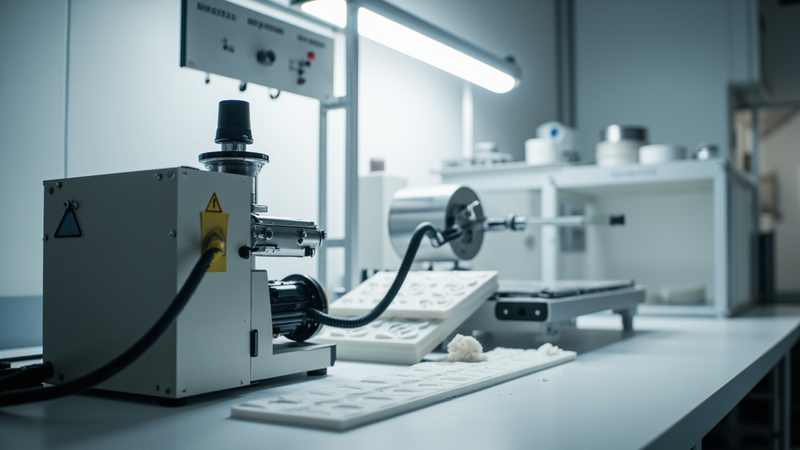
A laboratory recycling workstation: a small shredder feeds a 3D-printer filament extruder beside a heat press with PVDF foam tiles and printed parts


On the morning of August 28, 2026, in an engineering building on the campus of the University of Alabama in Tuscaloosa, fourteen teams competed in the finale of NASA’s LunaRecycle Challenge. The contestants included graduate students, hobbyists, a Wyoming aerospace LLC, an Austin 3D-printer company, and a doctoral cohort from MIT that calls itself CERBERUZ. None of them were building rockets or rovers. They were building trash compactors. The wrinkle: the trash had to be turned back into useful parts, on the Moon, in vacuum, in partial gravity, without resupply shipments from Earth.

Their brief was deceptively ordinary. Take a kilogram of dirty foam, plastic bags, Nomex flight jackets, and aluminum food wrappers — the kind of stuff astronauts throw away every day — and turn it into something a habitat can actually use. The competition carried a $3 million purse, a 1,200-team applicant pool, and a NASA program manager who announced the winners live at noon, CDT (NASA Centennial Challenges, August 28 2026).

Astronauts on the International Space Station produce roughly 2.5 kilograms of “non-metabolic” trash per crew member per day — packaging, food pouches, hygiene items, clothing offcuts, broken equipment. On the ISS, most of that ends up loaded onto a Progress cargo freighter and incinerated in the atmosphere. For a Mars mission lasting two and a half years, you can’t do that. For a permanent Artemis Base Camp on the lunar south pole, you can’t do that either, because every kilogram launched from Earth currently costs somewhere in the high five figures by the time it sits on the regolith.

The economics flip if you can keep what you bring. Recycling turns an “input” into a “stockpile.” Foam becomes a habitat tile. A torn glove becomes feedstock for a replacement bracket. The MIT team’s prototype grinds mixed waste into powder, then extrudes it into filament for a 3D printer or pellets for an injection mold. The first-place prize money — $500,000 for the prototype, $275,000 for the digital twin — is small change compared to a single Falcon Heavy launch.

Phase 1 of LunaRecycle launched in September 2024, ran through June 2025, and pulled 1,200 registrations — the largest response to any Centennial Challenge in NASA’s 20-year prize history (Wikipedia, Centennial Challenges). Seventeen teams were named Phase 1 winners from five countries and nine U.S. states. Phase 2 opened to U.S. teams only and required them to build a working prototype, optionally backed by a “digital twin” — a high-fidelity virtual model of the recycling line.

Sixteen teams cleared the Phase 2 milestone round in March 2026. They converged on Tuscaloosa from August 24 through August 28 to test their hardware at McAbee Construction, a local industry partner, with a public industry day and winners’ ceremony in H.M. Comer Hall (University of Alabama Engineering News, March 10 2026).

The first prize went to CERBERUZ, a team of undergraduate, graduate, and doctoral students at MIT. Their system — described in NASA’s award announcement as “Composites for Extraterrestrial Recycling By Engineering the Reuse and Upcycling of Zotek” — accepts mixed logistics waste, grinds it to a uniform powder, and remanufactures it into filament and injection-molded parts. The team’s insight was to stop treating the foam as contamination. Zotek F30, a closed-cell polyvinylidene fluoride foam from the British manufacturer Zotefoams, is what most aerospace interiors are made of — seat cushions, environmental control system ducting, equipment packaging. Once shredded, the foam acts as a reinforcing filler rather than a contaminant, and the resulting composite can be printed or molded into a fresh bracket or handle (NASA Centennial Challenges, August 28 2026).

The other nine teams on the prototype track ran the technology tree in different directions. Terasynth, an Orlando company, took second place with the Lunar Re-Forge System, which converts mixed waste into 3D-printing filament and recovers metals. Penn State’s RECLAIM team used microwave heating to convert plastic and metal waste into cast parts and fuel precursors — unusual because microwave heating penetrates materials volumetrically, not just at the surface. Cislune’s CRAFTER system from Rosemead, California ran pyrolysis, decomposing waste without oxygen to recover carbon, metal feedstock, and construction material. ACME Space LLC in Cheyenne, Wyoming compressed and thermally melted Zotek foam into dense tiles for lightweight structural panels (University of Alabama Engineering News, March 10 2026).

Five additional teams competed at the finale without milestone prizes, including Phoenix Loom (recycling cotton textiles), KLAW Industries (regolith-composite reinforcement), and Space Copy (foam-regolith extrusion).

The MIT team’s choice of PVDF is not incidental. PVDF is a semicrystalline fluoropolymer with a melting point of 177 °C and a density of 1.78 g/cm³ — higher than most commodity plastics, but inert to most solvents, acids, and hydrocarbons (Wikipedia, Polyvinylidene fluoride). In a vacuum-rated environment, the polymer also outgasses less than polyethylene or polyurethane, which matters when every gram of off-gassing condenses on a nearby optical surface. The Zotek F30 variant is a nitrogen-expanded closed-cell foam with densities from 30 to 150 kg/m³, thermally stable to 160 °C, and certified to the OSU heat-release and smoke-density standards required for commercial aircraft interiors (Zotefoams technical data sheet, 2024).

The grinding-and-reinforcement trick relies on a simple rule of composites. A short-fiber or particulate filler, well-dispersed, raises the modulus of a polymer matrix. The foam’s cells collapse into platelet-like fragments under the grinder, and the resulting powder behaves mechanically like a high-aspect-ratio reinforcement when re-melted with a virgin or reclaimed polymer carrier. The team’s digital twin — for which they also took first place — modeled throughput, energy use, and final-part mechanical properties under simulated lunar gravity (1.62 m/s², roughly one-sixth of Earth).

The microwave-based RECLAIM approach uses different physics. Microwaves at 2.45 GHz couple to polar molecules and lossy dielectrics; metal-bearing waste heats volumetrically, while pure plastics heat more weakly. That lets a single chamber process mixed trash without pre-sorting. Pyrolysis sidesteps oxygen entirely: at 400-700 °C under inert gas, polymers break into volatile tars, non-condensable gases, and a solid char. The char fraction typically retains 30-50% of the input carbon mass as a usable feedstock, while the gas fraction can be reformed into methane or hydrogen for fuel cells.

The throughput numbers matter as much as the chemistry. NASA’s challenge brief required finalist systems to demonstrate meaningful mass efficiency — converting a useful fraction of input waste into finished parts without prohibitive energy or astronaut time. The Highest Mass Efficiency award went to Cislune’s CRAFTER; the Most Trash Types Recycled award went to Bob Jones University’s LunaBrix, which combines recycled content with regolith simulant into stackable bricks. The Most Innovative prize went to RECLAIM for the microwave reactor. The People’s Choice went to Terasynth for the autonomous Lunar Re-Forge System (NASA Centennial Challenges, August 28 2026).

LunaRecycle is what NASA’s Centennial Challenges are designed for: a narrow, well-scoped problem with measurable success criteria, open to anyone with the engineering chops. It also happens to be one of the cheapest ways to test a piece of the Artemis program — $3 million, mostly going to small teams with no government contract overhead.

Two things will tell us whether this work matters. First, whether NASA pulls any of the prototypes into a flight experiment on a Commercial Lunar Payload Services lander or a Gateway resupply manifest. Second, whether the same chemistry shows up in the closed-loop life-support trade studies for Mars.

The deeper question is whether a Moon base can be a base at all if it cannot reuse what it already has. The fourteen teams in Tuscaloosa just spent a week making the engineering answer sound like yes.


September 24, 2026

Half a century without wheels

Posted by


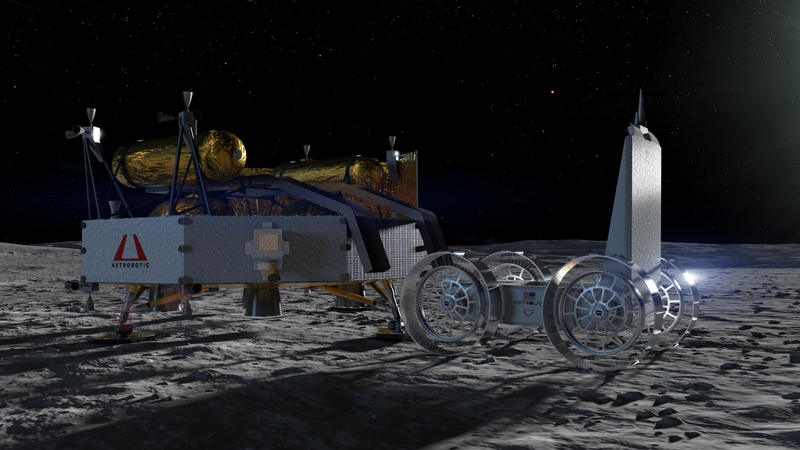
Artist rendering of Astrobotic's Griffin-1 lander deploying Astrolab's FLIP rover on the lunar surface. Credit: Astrobotic/NASA.


The last time anyone wheeled across the Moon, Richard Nixon was settling into his second term and the Apollo program still had a flight or two to go. The astronauts were Eugene Cernan and Harrison Schmitt. The vehicle was the three-wheeled Lunar Roving Vehicle from Grumman. The run was December 11, 1972. After 35.7 km and a final tool-bag swap, the rover’s parking brake was released, the motor was left running, and the dust of Taurus-Littrow settled. No wheel has rolled on another world since. That is fifty-four years, give or take a lunar quarter.

Watching for the next set of tracks is now a matter of commercial mission timing rather than national will. Currently scheduled for no earlier than July 2026, Astrobotic’s Griffin Mission One is meant to land a 625 kg payload on the rim of Nobile Crater near Mons Mouton at about 85°S, 53°E, and deploy the first wheeled explorer intended for that basin since Apollo 17 (Astrobotic, 2024; NASA CLPS updates, June 2026). The vehicle is the FLIP rover from Venturi Astrolab, a four-wheeled, 500 kg prototype that the company describes as a pathfinder for a much larger FLEX rover planned for 2027 or 2028. Two years and a couple of pivots ago, none of this looked likely. A NASA-sponsored rover meant to ride Griffin ended up canceled, then resurrected on a different lander, then carried home by a private-sector vehicle that almost did not exist in time.

Rovers are not a luxury in any plan to live on the Moon. The walking range of an Artemis astronaut in an EVA suit is a few kilometers per day, even on the best terrain. Anything beyond that hinges on a pressurized rover, an unpressurized rover, or a fleet of robotic scouts. With astronauts planned to land on Mons Mouton and other south polar sites in the late 2020s, the engineering question is not whether a vehicle should be on the surface first. It is what it should test.

The lunar south pole carries the strongest case for that urgency. Sunlight grazes the rim craters at angles so shallow that parts of their interior walls have not seen direct sunlight in billions of years. Permanently shadowed regions (PSRs) can reach 25 K, cold enough that water ice delivered by comets and volcanism over geological time has never sublimed away. NASA’s Moon Mineralogy Mapper (M3) on Chandrayaan-1 detected ice-bearing spectra at these latitudes in 2009. The LCROSS impact in October 2009 kicked up a plume with a clear water signature. Yet a remote detection is not an inventory. To decide whether to send a crew, mine regolith, or build a fuel depot, you need a rover that drills, measures, and survives the long polar night. CLPS is the on-ramp: each lander is one more bet that a company can land precisely enough to shrink future mobility risk (NASA CLPS program page, June 2026).

Astrobotic’s story starts with the company’s first flight. Peregrine Mission One launched on the maiden flight of ULA’s Vulcan Centaur in January 2024, then suffered a propellant leak that kept it from landing and forced the spacecraft to burn up over the South Pacific. Less than six months later, in July 2024, NASA canceled the VIPER (Volatiles Investigating Polar Exploration Rover) mission, which had been slated to ride Griffin. The agency cited cost overruns that had pushed VIPER past $450 million. The flight contract with Astrobotic was kept, because the agency still wanted a precise polar landing demonstration. The launch was bumped from late 2024 into 2025, then to 2026 (Astrobotic, 2024).

The mission that took shape goes like this. A SpaceX Falcon Heavy lifts the 4,500 kg Griffin lander from Launch Complex 39A at Kennedy Space Center. After a multi-day cruise, Griffin uses terrain-relative navigation and a pulsed main engine on liquid oxygen and liquid hydrogen to set down inside Nobile Crater. The flight avionics were proven against NASA’s Deep Space Network in a three-week test in late 2024, with telemetry flowing through DSN’s Goldstone, Canberra, and Madrid complexes (Astrobotic, October 2024). On the surface, Griffin will deploy Astrolab’s FLIP rover, a small Astrobotic CubeRover variant, the BEACON rover from Mission Control, and a stack of cultural and science payloads including Interlune’s helium-3 prospecting instrument.

The story behind the payload swaps is the more interesting angle. NASA reversed the VIPER cancellation in September 2025 and reassigned the rover to Blue Origin’s Blue Moon Mark 1 lander under task order CS-7, scheduled for late 2027. The same rover that was supposed to ride Griffin now goes elsewhere. Meanwhile, Astrolab, which had been working on a larger FLEX for the Lunar Terrain Vehicle competition, scaled down to a near-half-tonne demonstrator it could deliver in under twenty months. The narrowness of that window is why FLIP exists at all. Astrobotic’s Steve Clarke, in trade-press remarks, called the timing “the cleanest kind of opportunity.”

The dust problem drives more design choices than any other. Lunar regolith is roughly 20–100 µm grains of impact-shattered glass and mineral fragments. Electrons from the solar wind implant positive charge in the dayside top layer while the unlit subsurface stays negative, producing local electric fields that lift fine particles. The result is dust that clings electrostatically, abrades seals, frosts radiators, and fouls optical surfaces. FLIP carries METAL (Moon Exploration for Titanium with Active Lighting), a multicolor camera and radiometer from NASA Ames designed to estimate helium-3 concentrations in regolith, and LDES (Lunar Dust level sensor and Effects on Surfaces) from Johnson Space Center, which quantifies how dust degrades critical surfaces over time (NASA CLPS payloads, May 2026). The hyper-deformable wheels Venturi Space built in Switzerland are tuned to absorb impacts and shed dust by flexing the contact patch outward.

The thermal problem runs next. The Moon’s 29.5-day rotation means fourteen Earth days of sunlight followed by fourteen of dark at the equator. At the south pole the pattern is shorter and more chaotic, with some craters rim-locked in shadow for over seventy hours. FLIP’s high-performance batteries, built by Venturi Space in Monaco, are sized to keep avionics warm through a single night. Surviving multiple cycles is held in reserve for FLEX. Mons Mouton was picked because of ridge crests with safe-haven illumination that exceed the rover’s solar threshold for parts of each long polar night.

The mass problem is governed by Tsiolkovsky. For a stage with exhaust velocity v_e and mass ratio m_0/m_f, the budget is Δv = v_e * ln(m_0 / m_f). Translunar injection from low Earth orbit needs roughly 3.2 km/s on top of the launcher’s job, and Falcon Heavy delivers about 16.8 t to TLI fully expendable, 10.3 t with side-booster recovery. Griffin ships close to 4.5 t wet, well within margin even on a partly reusable Falcon Heavy profile. The lunar LiDAR demo from Marshall Space Flight Center is another flight-first: a hardened time-of-flight scanner for hazard detection, sized to feed terrain maps back to operators faster than orbital imagers can.

If Griffin lands cleanly and FLIP rolls, several quiet records fall in one season. The first American wheeled surface mobility since Apollo 17. The first precise landing at Mons Mouton, a site NASA has been circling for more than a decade. The first time a private company delivers another company’s rover on top of its own.

Worth watching next is not the headline. It is the dust log, the wheel telemetry, and whether the batteries survive a long polar night. By the time humans reach Mons Mouton, commercial rovers will have already mapped places no orbital camera can resolve.


September 20, 2026

McGetchin, the Moon’s newest crater

Posted by


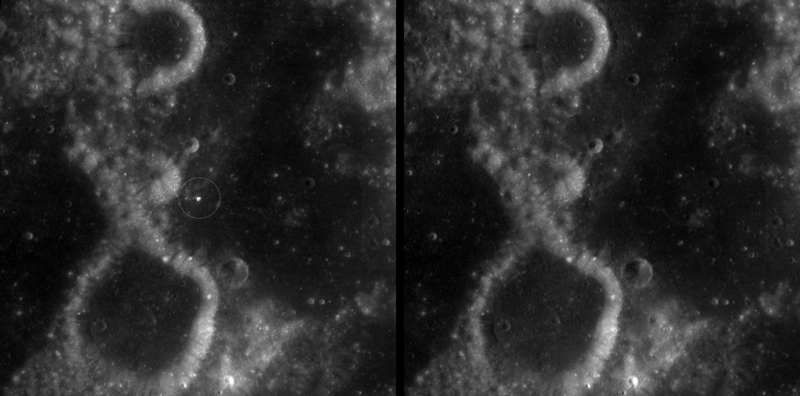
Two side-by-side black-and-white panels of the lunar surface captured by LRO's Wide-Angle Camera. The left panel shows a thin white circle around a small bright spot just right of center; the right panel shows the same area before the impact with no circled feature. The stacked-frame difference image is what tipped off Robert Wagner to the new crater.


On October 24, 2025, Robert Wagner sat down at his computer for a routine data-quality check and found a hole in the Moon that no one knew was there. The bright pixel he traced to the lunar eastern limb has now been confirmed as McGetchin crater, a 222-meter bowl carved into the surface by an impact that hit sometime between April 11 and May 22, 2024. Two papers in Science Advances on September 16, 2026 announce the find and describe what the impact did to the ground around it, and the LROC team has named the feature for Tom McGetchin, the Apollo-era field geologist who helped figure out how impact melts behave. The crater itself is roughly the length of two American football fields across and about 43 meters deep, three times the diameter of the previous record-holding fresh lunar crater spotted from LRO a decade ago.

Why this matters is that the Moon keeps taking hits, and almost no one sees them happen. There is no atmosphere to slow incoming rocks, so a small comet or asteroid fragment the size of a three- to six-story building reaches the surface essentially intact, and the only evidence it leaves is what the next orbital pass can resolve. NASA has been chasing these fresh craters with LRO since the spacecraft reached lunar orbit in June 2009 (NASA Science), and the mission has catalogued at least one thousand new impact craters and flagged a hundred thousand more surface changes from impacts or their ejecta. McGetchin is the largest of the lot, and the find arrived not because anyone was watching for it but because Wagner stacked hundreds of Wide-Angle Camera frames from before and after the impact and let the difference stand out. That methodology turned a routine quality check into a once-per-century discovery.

The story begins with a click on a thumbnail. Wagner is an image-processing specialist who works on the LROC system through Intuitive Machines, the company that has been landing commercial spacecraft on the lunar surface. He was running his usual comparison between a freshly assembled Wide-Angle Camera global map and an older one, looking for change at scales larger than about 50 meters, the size of objects his wide-field system can actually resolve. Wide-Angle Camera pixels are roughly the size of American football fields, so to spot a new feature he has to stack many frames on top of each other and let software subtract everything that did not change. Things that stay the same turn gray, and anything new shows up bright or dark. Most of what the software flags is noise, but the gray-on-gray hack works well enough that, when Wagner scrolled to a tile on the eastern limb, a bright spot circled by a darker halo stopped him cold. “It was by far the most obvious impact debris pattern I’ve ever seen in one of these images,” he said in the NASA release.

After Wagner flagged the spot, the LROC team turned the Narrow-Angle Camera on it. That instrument images the surface at about one meter per pixel, three orders of magnitude sharper than the Wide-Angle Camera, and it gave a clean view of the bowl itself and the ray pattern flung outward by the impact. The crater is roughly circular and 222 meters across, with a clean rim and a darker interior, and the ejecta blanket around it is what registered as the bright halo Wagner had seen from a distance. Independent confirmation came from comparing LROC Narrow-Angle Camera frames acquired on December 5, 2024 and again on March 3, 2025, and from thermographic observations by LRO’s Diviner instrument. The team published its analysis of the impact and its thermal aftermath in Science Advances this week (USRA newsroom); a separate paper in the same issue models the kinetic energy and the regolith disturbance, which Diviner picked up as a roughly 4-mile-wide cold spot about 16 degrees Fahrenheit cooler at night than the surrounding terrain. A follow-up Narrow-Angle Camera pass was later rolled 51 degrees to the east, producing a dramatic oblique view of the new bowl (LROC oblique view M1527218499L,R).

The deep-dive question is what the cold spot tells us about how the surface is changing in real time. Lunar regolith is a layer of loose, jagged grains sitting on top of more coherent bedrock, and over billions of years micrometeorite gardening has ground those grains into a fairly uniform fluff. An impact like McGetchin’s dumps energy into that layer in microseconds, and the explosion excavates a bowl and throws material outward. Some of that material lands around the rim, and when it does it piles up loosely, the way a sandbox pile sits lighter than the sand you started with. Loosely piled regolith does not conduct heat as well as the more compacted original surface, so at night it cools faster and to a lower temperature. Diviner saw exactly that signature, and the cold halo around McGetchin extends about 4 miles in diameter, far past the crater itself. The regolith disturbance has implications for any future rover that drives across the lunar surface: a fluffier surface means different wheel-soil interaction, and the team flagged that directly in the Science Advances paper.

The energy numbers help frame how rare an event this is. Wikipedia), citing the research papers, puts the impact energy at roughly 6.5 × 10^10 kilojoules, and the recurrence interval at about 132 years. NASA’s release phrases it as “once in a century or even longer,” which matches within the usual uncertainty of small-body population models. Either way, the take-away is that LRO has been on station long enough to catch the rare events in the lunar impact rate distribution, not just the everyday ones, and that what Wagner found is statistically one of the largest fresh craters the modern Moon has produced. The mission has been circling the Moon for more than 17 years and has mapped the topography, surface composition, thermal environment, and radiation environment there, and that sustained archive is what made the stacking comparison possible. Without it, the bright spot Wagner spotted would have been indistinguishable from a thousand other random brightness changes in any single Wide-Angle Camera frame.

What this means going forward is that the LROC team plans to keep running these global comparisons on a multi-year cadence and follow up with Narrow-Angle Camera close-ups and Diviner thermography whenever something new shows up. The same method that found McGetchin is now calibrated against a known impact and a known regolith response, so the next rare event should land faster and with less manual work. The Moon’s eastern limb will keep taking hits; the question is whether the next large one is caught the way this one was, by a quality check that turned out to be the headline.


NASA seeks industry help for five Moon Base tech gaps. Image: 2026 09 11 nasa lunar surface tech call.


On September 8, 2026, NASA opened a formal industry solicitation aimed not at the rocket that gets astronauts to the Moon, but at the quiet hardware that has to keep them alive once they are there. The NextSTEP-3 Appendix A solicitation, branded the Lunar Enabling Infrastructure Accelerator, asks U.S. companies, universities, and not-for-profit teams to mature five specific technologies: vertical solar arrays, oxygen extracted from lunar regolith, radioisotope Stirling generators, in-space manufacturing, and innovative nanomaterials, areas that NASA considers the most stubborn gaps on the path to a sustained human presence near the lunar South Pole. The announcement was made under NASA news release RELEASE 26-072, “NASA Calls for Proposals to Accelerate Lunar Surface Technologies”, with proposals due back to the agency by 5 p.m. EDT on October 8, 2026.

The framing matters. NASA is not buying finished hardware with this call; it is buying the demonstrations and the data that show a competing set of approaches can reach Technology Readiness Level 5 to 6, the band where a system has been validated in a relevant environment and is ready to be bolted into a flight article. The agency’s NextSTEP-3 Appendix A program page describes the goal as “closing key technology gaps and maturing competing solutions” so that when NASA does commit to flight hardware, it can do so from a small set of demonstrated options rather than a paper study. The five capability areas named in the final solicitation are the same ones the agency laid out in its June 29, 2026 draft BAA, which followed a May 19 synopsis under procurement identifier 80GRC026R0008, a long drafting cycle by NASA’s usual standards, and a hint that the final wording reflects substantial industry feedback.

The five capability areas, named in the press release, are deliberately heterogeneous: a vertical solar array technology that can provide consistent power generation, management, distribution, and energy storage; in-situ resource utilization oxygen from regolith production to extract usable oxygen molecularly bonded to rock and dust covering the Moon’s surface; a radioisotope Stirling generator, a type of nuclear energy technology that uses heat from fissile materials to produce electric power for operating spacecraft systems in the darkest, dustiest, and most remote places; in-space advanced manufacturing to reduce reliance on resupply missions from Earth and to optimize mission flexibility and resilience on the Moon; and innovative nanomaterials production to advance the commercial availability and quality of nanomaterials that can be used in lunar exploration. Three of the five (oxygen extraction, radioisotope power, advanced manufacturing) were already on NASA’s lunar-technology roadmap before 2024; the vertical solar array and the nanomaterials line are newer entries, which signals the agency is looking outward at commercial capabilities rather than only downward at its own R&D centers.

Why this matters is the gap the announcement is trying to close. The NASA Moon Base reference page describes a near-polar outpost to be built in three phases: robotic exploration through 2029, infrastructure construction by 2032, and long-term astronaut habitation after that. Each phase rests on a different assumption about how much of the base can be supplied from Earth versus produced locally. Artemis IV, currently planned for 2028 per the Aviation Week writeup, is supposed to deliver the first pressurized surface habitat elements. Anything that arrives on that lander, however, still needs power at night, oxygen to breathe, and replacement parts when something breaks, since a single 384-hour lunar night at the pole is too long for any solar+battery architecture to survive without either massive storage mass or a complementary non-solar source. The five capability areas in this solicitation are NASA’s bets on which of those problems get solved by industry in time for the 2028-2032 build-out window.

The story behind the timing is that the broader Artemis program is under budget pressure, and this is the solicitation where NASA is trying to spend smaller amounts of money on a wider set of competing industry approaches rather than continuing to concentrate the work inside a handful of NASA centers. Greg Stover, director of NASA’s Advanced Research and Technology Division, is quoted in the release: “NASA is accelerating the development of key technologies and closing critical gaps needed for long-term human exploration at the Moon. Partnering with industry will strengthen the U.S. industrial base as we mature the capabilities and infrastructure needed for a sustainable lunar presence.” The “U.S. industrial base” phrasing is deliberate; the Appendix A announcement specifies that the solicitation “intends to cultivate U.S.-led capabilities while maintaining full and open competition among private industry, academic institutions, and not-for-profit entities, as well as international partners participating through U.S.-led teams.” International partners are allowed, but only through a U.S. prime, which is the language NASA uses when it wants to widen competition without ceding intellectual property control.

The science and engineering question underneath the solicitation is whether these five capability areas are actually independent or whether they have to mature together. They are not independent. The vertical solar array and the radioisotope Stirling generator are competing answers to the same problem (night-side power at the pole), and a base design that picks one will not need the other at full scale. In-situ oxygen extraction and in-space manufacturing share feedstock: the oxygen a regolith-processing plant pulls out of ilmenite or volcanic glass leaves behind a metal-rich slag that is, in principle, feedstock for additive manufacturing of structural parts. Innovative nanomaterials cut across all three: better cathode materials for the Stirling generator’s thermocouples, lighter radiation shielding for the habitat, higher-strength binders for the regolith-derived construction materials. The solicitation does not formally require joint proposals across areas, but the implicit pressure is on industry teams that can show how their work in one area plugs into the others. NASA may apply insights gained from the resulting contracts, the release notes, with “such as technical data, and demonstration results, to shape future acquisition strategies,” which is unusually candid agency language for “we will pick the winners in a second-round flight buy.”

The five areas also correspond to where the agency’s internal R&D has struggled the most. NASA’s in-house oxygen extraction work, dating back to the canceled Resource Prospector rover in 2018, has consistently run into the problem that the energy needed to crack oxides out of regolith exceeds what a small surface plant can deliver from solar panels alone. Pairing an oxygen plant with a Stirling generator is the obvious answer, but only if the Stirling generator’s heat source can be packaged small enough to land on a Commercial Lunar Payload Services flight. The vertical solar array is NASA trying to specify a different solution: a deployable tower that lifts panels above the dusty surface layer where direct sunlight is available for more hours per day, because traditional rover-deployed arrays have been repeatedly sandblasted by plume ejecta from nearby landings. None of these are problems the 2026 solicitation will solve, but the demonstrations the contracts buy will at least narrow the menu of credible solutions before the agency has to commit to a flight configuration for the 2030s.

The takeaway is that the September 8 solicitation is best read as a procurement shape rather than a flight milestone. NASA is not promising any of the five technologies will reach the Moon before Artemis IV, and it is not committing to a particular contractor; it is signaling that the menu of options will be wide and that the agency plans to make its architecture choices later, from the demonstrated set. Proposals are due October 8, and Aviation Week reports NASA does not plan to hold an industry day exchange, which is a hint that the agency considers the June draft and the August 20 “Responses to Industry Feedback” attachment sufficient background for offerors. If funded contracts cluster around one or two of the five capability areas, that will be the most informative signal, since it will tell observers which of the Moon Base’s hardest problems the agency now thinks an industry team can plausibly solve before the 2032 infrastructure-construction phase begins.


NASA-IBM Lunar Foundation Model blue-outlined crater detections overlaid on a Lunar Reconnaissance Orbiter mosaic near Einstein crater, illustrating the model's ability to survey impact features at meter scale.


In 2009, the Lunar Reconnaissance Orbiter finished its commissioning burns and started taking the highest-resolution pictures of the Moon anyone had ever made. Seventeen years later, on 10 September 2026, IBM and NASA published a free neural network that reads those pictures better than anything before it. The NASA-IBM Lunar Foundation Model, released under Apache 2.0 on Hugging Face, identifies lunar ice with 22 percent less error than the strongest dedicated algorithm, maps craters 19 percent more accurately at coarse resolution using half the labelled data, and traces volcanic deposits about 3 percent more cleanly with less fine-tuning (NASA Science and IBM Research, 10 September 2026). For the first time, planetary science has a single foundation model built specifically for Earth’s oldest companion.

The work matters because the next humans on the Moon are scheduled to land somewhere most maps refuse to draw. The Artemis program targets the lunar south pole, a region ringed by permanently shadowed regions — craters so deep that the Sun never rises more than a few degrees above their rims. Floor temperatures there bottom out near 40 kelvin, cold enough that water molecules arriving on the solar wind or from cometary impacts can survive for billions of years instead of sublimating away (Vasavada et al., Icarus, 1999). NASA estimates that the lunar north pole alone may hold roughly 600 million metric tons of water ice, enough to fill at least 240,000 Olympic swimming pools; the south pole is expected to hold comparable reserves (IBM Research, 10 September 2026). Ice is propellant, drinking water, and oxygen in waiting. Every kilogram of hydrogen and oxygen a crew can mine on the surface is a kilogram a Falcon Heavy does not have to lift off Earth. The economic case for Artemis depends on how cleanly geologists can rank those PSRs before a lander commits to one.

What the new model solves is a different problem that has quietly paralyzed the field: data fragmentation. LRO has produced more raw imaging data than every other NASA planetary mission combined (NASA Science, 10 September 2026). Some of it is camera imagery at one-meter-per-pixel ground sampling in seven spectral bands. GRAIL, in 2012, mapped the gravity field at roughly 20 kilometers per pixel — the shape of the interior rather than the surface. Japan’s SELENE (Kaguya) orbiter layered in mineralogical maps and laser altimetry. For sixty years, lunar science has lived in a stack of incompatible file formats. Combining them was a graduate student’s summer project, repeated for every paper.

The Foundation Model replaces that summer project with one download. IBM and NASA call the accompanying release SomBench, the first open-source, machine-learning-ready unified lunar dataset (Hugging Face, NASA-IBM-Lunar-Foundation-Model, 2026). SomBench aggregates more than 30 spatially aligned data layers from nine instruments across four missions — principally LRO and GRAIL plus complementary observations from SELENE — into roughly two million co-registered image tiles (CNET, 10 September 2026). The training corpus itself exceeds one million high-resolution images at one-meter resolution and close to 964,000 multispectral tiles at 100-meter resolution (NASA Science, 10 September 2026). Tiles have already been re-projected onto a common grid.

The people behind the release come from a partnership that reaches back to Apollo. IBM and NASA have worked together since the 1960s, when IBM guidance computers flew on Saturn V. Kevin Murphy, NASA’s chief science data officer, said in the joint release: “We also have to make data easier for scientists to explore and use” (NASA Science, 10 September 2026). Campbell Watson, the IBM Research senior manager who led the build, told CNET the team wanted a “shared foundation that researchers can adapt” (CNET, 10 September 2026). Juan Bernabé-Moreno of IBM Research put it as travel advice: “Experienced travelers know to get the lay of the land before setting out for a foreign destination” (IBM Research, 10 September 2026).

The machine-learning choices under the hood explain why the gains are real. The architecture is a Vision Transformer Base encoder-decoder — 768 hidden dimensions, 12 transformer layers, 12 attention heads — adapted from TerraMind, the Earth-observation foundation model IBM had previously built with ESA (Tech Times, 11 September 2026). The transformer self-attention operator at the heart of each block computes pairwise token affinities scaled by 1/sqrt(d_k), with d_k set to 64 in the 12-head configuration; the softmax of those affinities is what lets the network learn which patches of the input relate to which. TerraMind’s special sauce is its cross-modal pretraining, which forces the model to learn correlations between disparate sensor streams, so that a noisy radar channel can be reconstructed by attending to what a multispectral camera saw of the same surface. On the Moon, that trick becomes a way to fill in what the PSRs will not give an optical camera: a thermal map from the Diviner instrument over a shadowed crater can be cross-referenced with a gravity anomaly from GRAIL, and the model learns that combination as a single latent representation rather than two independent ones.

Training was masked-autoencoder pretraining on the full two-million-tile corpus, where the model is asked to reconstruct randomly masked patches and in doing so must learn the statistics of lunar terrain. To prevent the network from memorising a few well-imaged tiles, the team held out distinct geographic “wedges” of the Moon for testing (Time News, 11 September 2026). The technical report lists three downstream gains. For ice detection, the model cut root-mean-square error by up to 22 percent over a SwinV2-B transformer pretrained on ImageNet. For crater detection at 100-meter context, it outperformed the same baseline by nearly 19 percent with half the labelled training tiles; at meter scale it matches state-of-the-art head-to-head. For irregular mare patches — the subtle volcanic features whose ages are reshaping the chronology of lunar cooling — the model improved extent accuracy by about 3 percent at lower fine-tuning cost (NASA-IBM Lunar Foundation Model technical report, Hugging Face, 2026).

The physics gives those percentages meaning. Ice stability inside a PSR depends on local temperature integrated over a full precession cycle and on burial depth below the gardening reach of micrometeorite impacts. A model that has internalised those thermophysical correlations can rank candidate deposits the way a specialist would, across the whole Moon. Crater counts age a surface because the impact flux is approximately known, and a model trained on the full LRO catalogue has absorbed what an impact signature looks like at every illumination angle — critical for a sensor whose parent body has a 29.5-day day-night cycle. Even IMP detection improves because the model has learned that young volcanic features are defined by a bundle of morphological and compositional cues, not by any single texture.

What changes because of this release is the slope of the field. The model is not a substitute for a graduate-level lunar geologist; it lets researchers who previously spent six months pre-processing a single tile bundle ask questions across the whole catalogue in an afternoon. Apache 2.0 means any team — a Chinese lunar university, an Indian student, a Brazilian startup — can build on the same backbone. The Prithvi family IBM and NASA open-sourced for Earth observation will likely pick up a lunar cousin by year’s end, and the codebase sits on GitHub at NASA-IMPACT, where custom fine-tunes for new instruments (Lunar Trailblazer, India’s Chandrayaan follow-ons, China’s Chang’e 7 imaging) can be trained without revisiting the data-integration problem. If the 22 percent lead against SwinV2-B holds once independent teams retrain on their own data, the rest of the 2020s will inherit a Moon that, for the first time, is machine-readable at planetary scale.


On May 13, 2026, NASA published new details about the Artemis 3 mission and the changes were striking enough to warrant attention not for what they added, but for what they removed. The mission, originally planned as the first crewed lunar landing since Apollo 17, will now send four astronauts to low Earth orbit aboard the Space Launch System and have them dock with prototype lunar landers. No landing. No lunar surface. The Moon is gone from the mission.

The agency confirmed that Artemis 3 will launch from Kennedy Space Center’s Launch Complex 39B no earlier than late 2027, and that the SLS rocket will fly without its usual upper stage. Instead of the Interim Cryogenic Propulsion Stage, the upper stage that has carried Orion to the Moon on previous flights, NASA will install an inert structural spacer — essentially a hollow cylinder with the same mass, dimensions, and interface geometry as the ICPS. The spacer preserves the rocket’s aerodynamic and structural characteristics without consuming propellant that could be allocated elsewhere.

The reason for the change is straightforward: the lunar landers are not ready. SpaceX’s Starship Human Landing System and Blue Origin’s Blue Moon have both experienced development delays. A crewed lunar landing requires those vehicles to perform rendezvous and docking in lunar orbit, execute a descent to the surface, support a stay of variable duration, and then launch back to rendezvous with Orion. Each step involves systems that have not yet been demonstrated in the configuration needed for crewed operations. NASA, having learned hard lessons from the heat shield anomalies encountered on the Artemis 2 flight in April 2026, decided it would not also accept the risk of an unproven lander.

The restructured Artemis 3 instead serves as what the agency describes as a dress rehearsal — similar in concept to Apollo 9, which tested the lunar module in Earth orbit before the first Moon landing. Four astronauts will launch on the Block 1 SLS configuration, which consists of the core stage and twin solid rocket boosters. Orion will separate from the stack and the crew will spend extended time aboard the spacecraft, testing rendezvous and docking with one or both lander prototypes in the relatively safe environment of low Earth orbit, approximately 463 kilometers above Earth at a 33-degree inclination. The European Service Module that powers Orion will handle orbital raising and maneuvering, with the ICPS being preserved for Artemis 4.

The hollow spacer solution was driven in part by hardware availability. The supply of ICPS stages is limited, having been built for the first three Artemis missions, and transitioning to the Exploration Upper Stage on later Block 1B configurations is still years away. Using the final ICPS on Artemis 4 rather than consuming it on an Earth-orbit test mission makes sense from a launch vehicle economics perspective. The spacer, being fabricated at NASA’s Marshall Space Flight Center in Huntsville, Alabama, maintains the structural interface between the Orion stage adapter and the launch vehicle stage adapter while costing nothing in propellant mass.

Artemis 4 remains targeted as the first crewed lunar landing, currently scheduled for no earlier than 2028, and will use the first ICPS from the original batch. The lander situation will need to be resolved by then. SpaceX is expected to conduct an uncrewed Starship HLS test flight before committing a crewed variant. Blue Origin is targeting an end-of-2026 launch of its Blue Moon Pathfinder MK1, an uncrewed cargo mission to validate the BE-7 engine, precision landing systems, and surface operations. Both companies face continued schedule pressure, and the May 2026 grounding of Blue Origin’s New Glenn rocket following an April 19 second-stage failure adds a further complication for Blue Moon’s path to orbit.

The decision to strip the landing from Artemis 3 drew predictable criticism from observers who saw it as another in a long series of delays. But the engineering logic is sound. Artemis 2’s heat shield erosion, traced to an arc-jet test anomaly and now requiring a redesigned thermal protection system for the Orion capsule, consumed program schedule margin. Adding a lunar landing with unproven vehicles on top of a heat shield redesign would have compounded risk in a domain where the cost of failure is measured in human lives. Moving the landing to Artemis 4 preserves schedule integrity for the test flight while keeping the lunar surface objective alive.

The Artemis program has always been a慢 exercise in managed ambition. The original Constellation program was canceled in 2010. The SLS was ordered to replace shuttle hardware that did not exist. The lunar landing has been pushed back repeatedly as funding, politics, and engineering complexity have collided. Stripping Artemis 3 to an Earth-orbit test is not a sign of weakness. It is a sign that the program has decided, perhaps for the first time, to let engineering reality set the schedule rather than politics.