OrbitalHub

Where curiosity reaches escape velocity.

Domain is for sale. $50,000,000.00 USD. Direct any inquiries to contact@orbitalhub.com.

Archive for the Launchers category


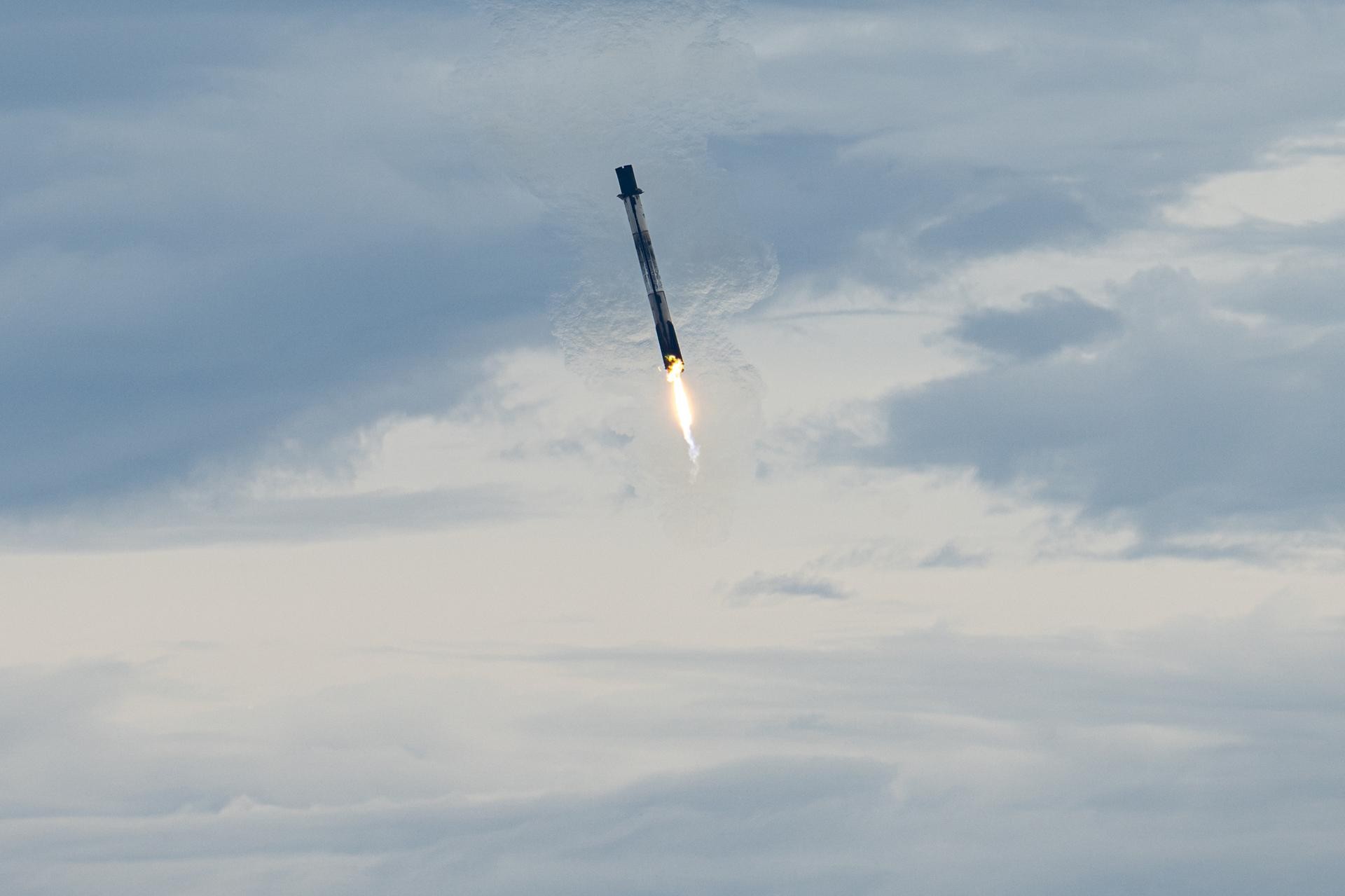
Falcon 9 ascends against a deep blue sky over Vandenberg, the bright plume trailing straight down from the booster as it climbs out of the lower stage of the atmosphere.


A Falcon 9 lifted off from Space Launch Complex 4E at Vandenberg Space Force Base at 11:32 a.m. PT on Thursday, October 1, 2026, carrying 130 satellites and hosted payloads into a sun-synchronous orbit on SpaceX’s eighteenth dedicated rideshare mission. It was one of three Falcon-family flights SpaceX flew that day, sandwiched between the Crew-13 astronaut launch from Florida in the morning and a National Reconnaissance Office Falcon Heavy from the Cape that night, and the size of the manifest made it the most diverse single launch of the year so far.

Transporter missions are SpaceX’s standing answer to the question “where do smallsats go?” The SmallSat Rideshare Program sells slots on quarterly Falcon 9 flights to SSO for as little as $350,000 per payload for up to 50 kg, with the cadence locked far enough in advance that customers can plan a satellite around a specific quarter instead of buying a dedicated rocket. The eighteenth such mission brought the program’s all-time tally past 1,800 payloads delivered to orbit, per SpaceX’s official mission page, a number that captures how the commercial smallsat industry is built as much on shared buses and shared launches as on the satellites themselves.

The first stage that flew Transporter-18 had already done this twice. It was the booster’s twenty-fifth flight, with a previous log that included NROL-126, Transporter-12, SPHEREx, NROL-57, USSF.366, and fourteen Starlink flights. Seven minutes and thirty-two seconds after liftoff it touched down on Landing Zone 4 at Vandenberg, returning to the same pad complex from which it had departed a few minutes earlier, in the kind of same-pad turnaround that has become routine for the West Coast booster fleet. Residents of Santa Barbara, San Luis Obispo, and Ventura counties may have heard one or more sonic booms as the booster came back through the denser lower atmosphere.

Inside the fairing, the manifest ran from cubesats to hosted payloads to two reentry vehicles and four orbital transfer vehicles that will deploy 41 of the 130 payloads at a later time. That architecture is the quiet structural innovation of recent rideshare flights: instead of forcing every customer into the same orbital plane on the same timeline, SpaceX has absorbed the role of mission manager. The OTV providers (D-Orbit, Exolaunch, Maverick Space Systems and others) now offer “deploy on a different day, at a different altitude” as a service to the payload builders. The Falco trade Via Satellite’s coverage of Transporter-18 describes a manifest where, for example, Tomorrow.io’s two weather satellites and Satellogic’s four optical Earth observation satellites ride along on the same Falcon 9 but can be dropped into different local times of day on station by their respective OTVs.

Several of the 130 payloads were firsts for their operators, which is what made Transporter-18 worth covering as a single story rather than as a pile of separate launches. Planet Labs flew the prototype satellite for Project Suncatcher, the joint effort with Google to test how Google machine-learning models and Google Tensor Processing Units behave when run in orbit rather than on the ground. Planet was the largest single customer on the flight, and in addition to the Suncatcher prototype it also flew the second Tanager methane-tracking satellite (Tanager being the methane mapper Planet developed with the CarbonMapper coalition), plus 18 SuperDove imagers manifested by SEOPS. StarCatcher flew Protostar, billed as a first-of-its-kind power-beaming node designed to demonstrate transferring electrical power between two free-flying spacecraft using optical links; a separate payload from Cowboy Space called Reason-1 is testing high-power laser energy transfer from low Earth orbit down to a ground receiver. Two demonstrations of moving watts around with light, on the same rocket, a few hours after the first ground-to-orbit ML inference test.

Starfish Space sent its first Otter servicing vehicle. It will run a NASA mission under the Small Spacecraft Propulsion and Inspection Capability acronym (SSPICY), and the flight is the company’s first operational satellite. CesiumAstro sent Element, its first full satellite built on the company’s own phased-array antennas, software-defined radios and onboard processors; Unseenlabs sent a pair of next-generation radio-frequency monitoring satellites, one to add capacity to its first-generation constellation and a BRO (BRO-32) to expand RF detection coverage across sea, land and space. Dhruva Space integrated LEAP-2, its second commercial mission, hosting multiple in-orbit demonstration payloads including units from Sodern ArianeGroup and the India-based Satleo Labs TAPAS-1.

The mission also carried two reentry vehicles from Varda Space Industries, continuing the company’s program of returning pharmaceuticals manufactured in microgravity, and the eight-satellite IRIDE Eaglet II cluster for Italy’s national Earth observation constellation. Constellation refreshes dominated the rest of the manifest: four ICEYE synthetic-aperture radar satellites, four Satellogic optical satellites, five Sateliot IoT nodes, two GHGSat methane monitors manifested by SFL Missions, and Tomorrow.io’s two weather satellites. According to the SpaceWatch.Global launch report and the NASASpaceFlight mission preview, the deployment sequence began at T+54 minutes and 22 seconds with the NASA-manifested Sprite cubesat and ran for the next hour through 89 individually sequenced deployments, with SpaceX confirming the deployment sequence had concluded at 3:41 p.m. ET.

What makes Transporter-18 worth thinking about beyond the manifest is the layering of three different kinds of space activity on the same rocket. There are constellation refreshes, which are now a steady, repetitive part of the smallsat industry the way cellular tower upgrades are a steady part of the telecoms industry. There are first-of-kind demonstrators: the Project Suncatcher ML-in-orbit prototype, the StarCatcher and Cowboy Space optical power-beaming tests, the Starfish Otter servicing mission. Their operational lifetimes may or may not turn into recurring revenue depending on what the data shows. And there are hosted payloads and secondary slots that let a university lab or a small country’s space agency get a satellite into orbit for the price of a rideshare ticket, which is what turns a quarterly launch cadence into infrastructure for everyone who builds the future of space hardware.

The next Transporter flight will not be far behind. Rideshare customers now plan their satellites around a known quarterly cadence from Vandenberg and the Cape, and a mission profile with 130 payloads, an OTV captain, and a twenty-fifth-flight booster is no longer an exception to the rule. It is what a normal Falcon 9 launch looks like in late 2026, and the question worth watching is not whether the next rideshare can carry this much, because the manifest will only grow. It is whether the long tail of secondary payloads can keep its quality bar as the cadence accelerates, and whether the experimental demos like Suncatcher and Protostar turn into recurring programs that share the same quarterly rocket on its own.
 

October 2, 2026

China catches a rocket out of the sky

Posted by


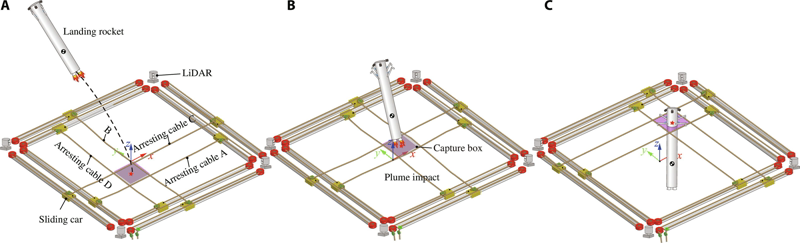
Diagram of the cable-net recovery system's three phases — following, entering, and capturing — as published in a peer-reviewed journal article on the technique.


At 04:15 UTC on July 10, 2026, a 70-meter Chinese rocket climbed off the pad at the Wenchang Commercial Space Launch Site on Hainan island, lit seven kerosene engines, and headed southeast over the South China Sea. Roughly ten minutes later, the upper stage was still climbing toward orbit, and the booster had already turned around, fallen back through the sensible atmosphere, and snagged itself on a grid of tensioned steel cables strung across a ship called Linghangzhe. The booster came to rest hanging in mid-air over the deck, engines off, plumes of evaporating kerosene streaming off the warm tank. CASC, the state-owned China Aerospace Science and Technology Corporation, called the mission a “complete success.” It is the first time any Chinese rocket has been recovered after reaching orbit, and the first time any operator anywhere has used a net to do it.

Reusability is the lever that turned SpaceX from an upstart into the dominant launch provider of the 2020s. A Falcon 9 booster that lands is a booster that flies again, and that one engineering change drives launch prices down by roughly an order of magnitude. China has watched that happen from the outside. Until last Friday, no Chinese rocket had ever returned to Earth intact after reaching orbit, which put a hard ceiling on how fast Beijing could build megaconstellations, crewed lunar hardware, or any of the other things reusable boosters make cheap.

The Long March 10B test changes that. It is also the third booster-recovery club to form on the planet, after SpaceX (Falcon 9 in 2015, Starship in 2024) and Blue Origin (New Glenn in late 2025). The catch is that China got there using a method neither of the other two has flown: catching the descending booster on a net, mid-air, instead of either landing it on legs or snatching it out of the air with a launch-tower arm like Starship does. If that approach scales, it shifts the trade-off between payload mass and reusability in a way the rest of the industry will have to think about.

Friday’s flight was the maiden launch of the Long March 10B, a two-stage medium-lift rocket built by the China Academy of Launch Vehicle Technology (CALT), a subsidiary of CASC. The booster is 5 meters in diameter and runs seven YF-100K engines burning kerosene and liquid oxygen. Unlike the older Long March workhorses, its upper stage burns methane and liquid oxygen, the same propellant combination SpaceX’s Raptor uses. The rocket was designed from the start to be recoverable.

The recovery hardware lives mostly on the ship, not the rocket. Linghangzhe (Navigator) carries a four-legged frame over which a tensioned cable grid is stretched. As the booster descends, four titanium grid fins steer it through the hypersonic and supersonic phases of reentry, the same aerodynamic trick Falcon 9 uses. Near the surface, the booster sheds its grid fins and extends small hooks that snag the cable grid. The cables carry the booster’s weight and arrest its downward velocity, and the engines shut down as it comes to rest suspended over the deck. CASC says the flight validated “multiple engine restarts with high-altitude ignition, high-precision navigation and control, and the first capture and recovery using a net system on a sea-based platform.”

While the booster was being caught, the upper stage kept climbing. About ten minutes after launch, it delivered a payload designated CX-26, built by China Satellite Network Group, into a roughly 800-kilometer low Earth orbit. Chinese officials have not publicly described the satellite’s mission, which is consistent with most classified or pre-operational Chinese payloads. SpaceNews reported that the payload may in fact be TJS-26A (Tongxin Jishu Shiyan-26A), a classified communications technology test satellite, but that identification has not been confirmed by CASC.

The flight is a stepping stone in a wider Long March 10 program. The Long March 10A, which shares the same first stage as the 10B, is intended as China’s next crewed launcher for low Earth orbit and is meant to evolve out of the older CZ-2F and CZ-7 families. A larger three-core Long March 10 will be the rocket that flies the Mengzhou crewed spacecraft toward the Moon. Data from the 10B’s recovery, and from its methane upper stage, feeds directly into both. China launched a scaled-down CZ-10A first stage in February 2026 to test the Mengzhou capsule’s launch abort system, and that booster performed a controlled splashdown about 200 meters from its recovery platform in the South China Sea. Friday’s net catch is the next step on that ladder.

Two design choices drive the net approach.

The first is mass. A Falcon 9 booster carries four deployable landing legs and four larger grid fins, plus the hardware to lock each leg into place. Mass saved is mass that can be payload. The 10B trades legs for hooks, which weigh very little, and offloads the heavy catch structure (frame, cables, winches, the frame’s support legs on the ship) to the boat. CASC’s own statements imply this is the main reason a 10B in reusable mode can still deliver 16 metric tons to a 200-kilometer low orbit, versus a single-use rocket of similar class.

The second is tolerance. A ship in the open ocean moves with the swells. A booster falling at terminal velocity has seconds to hit a moving target. The cable grid spans most of the frame, so the booster does not need to land on a small pad or balance on a single tower catchpoint the way Starship does at Boca Chica. The grid also absorbs a lot of energy, so the booster does not need a perfect engine-cutoff timing. That should, in principle, let the recovery team operate in worse weather and with less margin than leg-style landings.

The catch is not free. The booster has to be soft enough not to tear through the cables on contact, which constrains structural reinforcement and probably caps the size of recoverable boosters. The 10B is medium-lift. Falcon Heavy has three boosters, and the Super Heavy booster on Starship is far larger and heavier. Whether the net idea scales to heavy-lift, or only works for medium-lift, is an open question. CASC has not said whether the crew-rated 10A or the three-core Moon rocket will also use a net or fall back to legs.

The wider context: at least two private Chinese companies have already tried similar landings. LandSpace flew its Zhuque-3 and attempted a downrange recovery in 2025, with mixed results. Space Pioneer and Galactic Energy are working on comparable vehicles. Whether the state-led 10B flight pushes the commercial sector toward a common architecture, or sends it looking for different solutions, is one of the things to watch over the next year.

The Friday flight did not change China’s space program in one stroke. It changed the launch industry in a small, concrete way: China now has a working, reusable orbital booster, and it has a working version of an idea nobody else had flown. The next 10B flights, expected later in 2026, will tell operators whether the catch system can fly again and again without rebuilding the cables. CASC’s stated plan is to gather flight data for the crewed 10A and the lunar Long March 10. If the recovery cadence holds, the third Chinese launch of 2027 may carry a Mengzhou capsule on a rocket whose first stage was already flown once.


October 1, 2026

Crew-13 docks at ISS in under 8 hours

Posted by


A SpaceX Falcon 9 first stage descends toward Landing Zone 40 at Cape Canaveral Space Force Station on October 1, 2026, after separating from Dragon Grace carrying the four Crew-13 astronauts.

Image source: NASA Image and Video Library. Photograph by NASA, public domain.


Crew Dragon Grace docked to the forward port of the International Space Station’s Harmony module at 7:05 PM Eastern time on Thursday, October 1, completing the fastest launch-to-ISS-docking transit in the history of U.S. human spaceflight. The four Crew-13 astronauts — NASA’s Jessica Watkins and Luke Delaney, Canadian Space Agency astronaut Joshua Kutryk, and Roscosmos cosmonaut Sergey Teteryatnikov — arrived at the orbital outpost seven hours and fifty-five minutes after their Falcon 9 lifted off from Cape Canaveral, with the spacecraft traveling 263 miles above the northeastern Pacific Ocean at contact. A welcome ceremony at the station’s hatch followed at 8:45 PM Eastern.

The fast-rendezvous profile is the headline. Most Crew Dragon flights to the ISS take 24 to 28 hours and complete roughly eighteen orbits before contact; the typical transit requires Dragon to make a series of calculated engine burns to gradually raise its orbit to match the station’s altitude and phase. The Crew-13 profile completed the same work in fewer orbits by setting Dragon’s initial orbit to a period slightly shorter than the station’s, allowing Dragon to catch up faster — a more propellant-intensive but faster approach. Spaceflight Now noted in pre-launch coverage that the choice of profile depends on orbital geometry at launch time, and that the specific 11:10 AM Eastern launch window was selected in part because it put the ISS in the right relative position to support the short rendezvous. NASA’s launch-day release called the transit the fastest launch-to-docking by a U.S. spacecraft in ISS history; the previous mark was set on Crew-4 in 2022 at roughly seventeen hours.

The booster that lofted Grace into orbit made its own contribution to SpaceX’s reusability ledger. B1101 returned to Cape Canaveral and touched down at Landing Zone 40 less than eight minutes after launch — the seventh landing at LZ-40 and SpaceX’s 664th Falcon booster landing overall. The booster was on its third flight: it had previously launched the Starlink 6-88 mission and Crew-12 in February 2026. B1101’s reuse profile, plus the use of a previously-flown Crew Dragon capsule, continues to be one of the structural arguments SpaceX makes for its pricing. Recent Dragon crew rotation flights cost NASA approximately $288 million per mission, or roughly $72 million per seat. Boeing’s Starliner was priced at roughly $90 to $99 million per seat under its original contract.

The flight carried more than just crew to orbit. Grace (tail number C-213) had flown before — she was the same Dragon that flew NASA’s SpaceX Crew-4 mission in April 2022, the mission on which Watkins made her first trip to space. SpaceX’s design certification for Crew Dragon, last reviewed against the manifest in 2024, allows each capsule to be reflown up to fifteen times across its service life. The Crew-13 mission flew with no public announcement of any hardware change to the capsule. The SpaceX contract for the flight did, however, expand: in a May 2026 announcement, NASA formally added six more Dragon commercial crew missions to its Commercial Crew Program manifest, replacing flights that had originally been awarded to Boeing’s Starliner. That addition, combined with a separate $946 million contract for three flights, means SpaceX now holds contracts for all remaining NASA ISS crew rotation missions through the station’s planned retirement around 2030.

The single-source-of-supply arrangement is not what NASA’s planners wanted. The original Commercial Crew Program was structured to fund two providers — SpaceX and Boeing — so the U.S. would not be wholly dependent on a single company for crew transport. That redundancy is now absent because of Boeing’s 2024 Crew Flight Test failure. In February 2026, NASA formally classified that failure as a “Type A mishap,” the agency’s most serious category, after multiple propulsion anomalies during transit — most notably a string of helium leaks in the service module and the failure of five of eight reaction-control thrusters in quick succession. NASA returned the vehicle uncrewed and brought the test crew home on a Dragon in March 2025. Boeing’s next Starliner mission is currently targeted as an uncrewed cargo flight no earlier than the fourth quarter of 2026, but Boeing’s own SEC filings describe NASA discussions as having an “uncertain” outcome.

Once aboard the ISS, Crew-13 will join Expedition 75 alongside the crew already on station. The handover will play out over the next week, after which Crew-12 — NASA’s Jessica Meir and Jack Hathaway, ESA’s Sophie Adenot, and Roscosmos’s Andrey Fedyaev — will board Dragon Freedom for the trip back to Earth. Watkins, Delaney, Kutryk, and Teteryatnikov are then expected to stay aboard through approximately next March and April, rotating through Expedition 75 and 76 as the station hands off twice during their stay. Their science agenda includes biology, materials science, Earth observation, and human physiology studies — including work that will feed into the cardiovascular, bone-density, vision, and immune-function research programs that inform Artemis-era lunar surface planning.

One piece of context that isn’t in NASA’s release but does change how the mission should be read: Grace is, according to a separate secondary-outlet report published today, the fifth and final Dragon capsule SpaceX has built. The company is not planning to construct another. The implication for ISS operations is significant — every operational NASA crew rotation to the station through 2030 will use one of those five Dragons, including a capsule that has been aloft for some of its life cycle. NASA’s Commercial Crew Program and Boeing’s recovery of Starliner will both be factors in how that plays out, but the operational constraint is set: there are five Crew Dragons, and there will be no more.

The next major event in the Crew-13 timeline is the handover, which is expected to take about a week and concludes when Crew-12 departs. NASA’s next crewed launch of any kind is currently scheduled to be the second lunar-flyby Orion mission, in late-stage processing at Kennedy. Crew-14 has not yet been publicly assigned.

For the moment, though, the four Crew-13 astronauts are aboard. Hatch opened at approximately 8:45 PM Eastern. The welcome ceremony was broadcast on NASA TV.


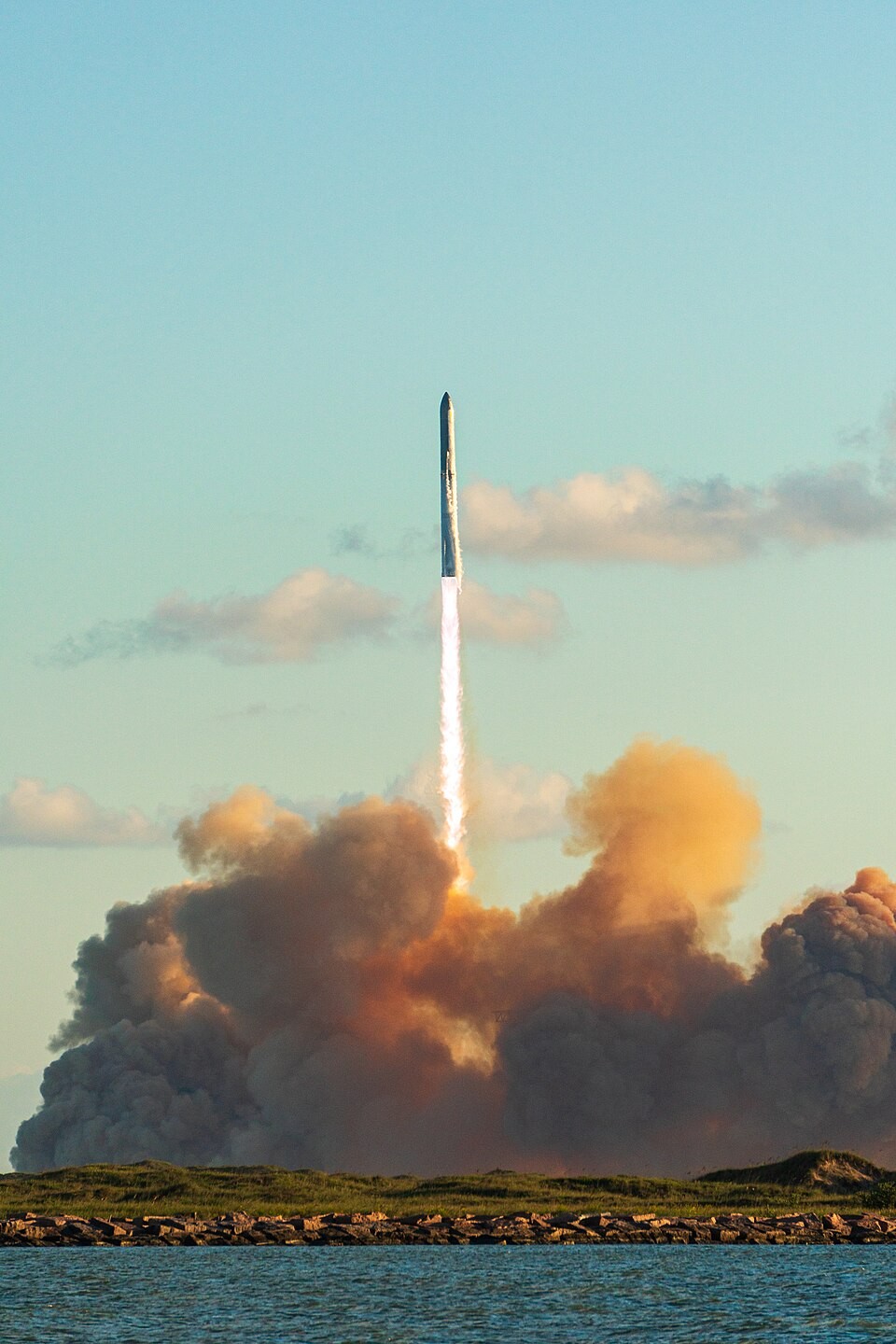
A SpaceX Starship lifts off from Starbase, Texas on a previous test flight; today's Flight 14 followed the same launch profile.

Image source: Wikimedia Commons. Photograph by Shujianyang, CC BY-SA 4.0.


A SpaceX Starship lifted off from Starbase in Boca Chica, Texas at 7:48 AM local time on Monday, September 28, and reached orbit for the first time on its fourteenth flight test. After a clean stage separation and a controlled splashdown of the Super Heavy booster in the Gulf of Mexico, the Starship upper stage completed its first orbital-insertion burn and deployed 26 Starlink V3 satellites into low-Earth orbit on a mission that SpaceX had earlier characterized as a step from developmental flight testing into operational service.

The launch was the first of the Block-3 vehicle series to fly with operational payload, and the first time a Starship vehicle has carried a Starlink batch into orbit. Three of the 26 satellites carry cameras intended to image the Starship heat shield while the upper stage is in orbit, extending the kind of data that an earlier camera-equipped batch gathered during a 2025 reentry test.

The countdown proceeded through propellant load on the booster and the ship, Raptor chill, and a final GO poll at T-30 seconds. Liftoff was at the opening of the day’s launch window. NPR, reporting live, described the 33 Raptor engines on Super Heavy as igniting together at the start of the climb. Max-Q, the moment of peak aerodynamic stress on the vehicle, cleared without incident. About two and a half minutes after launch, Starship separated from Super Heavy in the hot-staging sequence the company has used on the most recent flights, with the booster immediately turning back toward the Gulf of Mexico and the ship’s Raptor engines continuing the climb toward orbit.

Two anomalies shaped the early portion of the flight. First, SpaceX’s mission management decided during the climb that one of the six Raptor engines on the ship had failed during ascent, and the team weighed, for roughly twenty-two minutes, whether to continue to orbit. By the time Starship’s second-stage burns were scheduled to start, SpaceX confirmed it was safe to do so. Second, when Super Heavy began its boostback burn a few minutes after separation, only 26 of the 28 candidate engines relit — a partial relight rather than the full set SpaceX had planned to use. The landing burn that followed was also a partial relight: 11 of 13 engines fired. The booster nonetheless completed its boostback, descent, and landing burn sequence and executed a controlled soft splashdown in the Gulf of Mexico at roughly T+8 minutes, ten seconds after launch. SpaceX had deliberately planned an offshore splashdown for this flight rather than a return-to-launch-site catch, in part because the booster was being used to test upgraded software and hardware before the company re-attempts a tower catch on a later mission.

The ship’s first milestone after separation was a coast phase through the upper atmosphere. At T+25 minutes and 28 seconds the ship began its orbital-insertion burn; nineteen seconds later the burn ended and Starship was in a sustained orbit for the first time in the program’s history. About nine minutes after the insertion burn, the payload deployment sequence started and the 26 Starlink V3 satellites began releasing from the ship over the following half hour. The three camera-equipped satellites will spend their operational lifetime photographing Starship’s heat shield from a vantage point just behind the vehicle’s planned reentry trajectory, providing imagery that SpaceX says it will use to refine its reusable-heat-shield program.

The mission profile extended further than a suborbital hop. SpaceX had originally planned a roughly ten-hour mission with six orbits at an altitude around 170 miles, but reduced the flight plan during ascent to a shorter three-hour profile. The trade reflected, in the company’s judgment, the right margin for a vehicle running one engine short on its upper stage. After roughly nine hours in orbit, the ship is expected to perform a deorbit burn over the Pacific, descend through the atmosphere, and execute a controlled splashdown in the ocean. NPR noted that no earlier Starship flight had reached orbital velocity, which is roughly 17,500 miles per hour; today’s flight is the first vehicle in the line to do so.

Starship Flight 14 is the second flight of a Block-3 vehicle and the first of the year from Starbase. The booster, Booster 21, completed its full-duration static fire at Massey’s Test Site on August 28 after a qualification campaign that included the post-Flight-13 investigation into the landing-burn dynamics and an extended cryogenic proof sequence in mid-summer. The ship, Ship 41, completed a six-engine static fire on August 21 and a single-engine deorbit-burn simulation test two days earlier. Both vehicles were integrated, stacked, and rolled to OLP-2 ahead of the launch attempt.

The flight is also the first operational mission carrying Starlink satellites to use a Starship vehicle rather than a Falcon 9. SpaceX has been the dominant operator in commercial launch for the past several years using Falcon 9, but the larger V3 Starlink satellites only fit inside Starship’s fairing. NPR reported that SpaceX completed the final Falcon 9 launch of a Starlink batch from Florida last month and intends to move V3-class launches to Starship going forward. The shift matters to SpaceX’s plans for the constellation: in filings to the Federal Election Commission ahead of its IPO in June, the company called Starship’s launch cadence and reusability material to its growth strategy.

The flight is also material to NASA’s Artemis program. SpaceX is under contract to develop a Starship-derived Human Landing System for Artemis III, currently targeted for late next year. The Artemis III profile includes docking Starship with an Orion capsule in lunar orbit and transporting astronauts to the surface. NASA’s Administrator, Jared Isaacman, congratulated the SpaceX team on today’s milestone on social media; in earlier remarks, the agency has framed a successful first operational Starship flight as one of the gating milestones for the lunar landing timeline, alongside the unrelated second crewed Orion flight that lifted off in April.

Three of the satellites that lift with Starship today are designed to spend their working lives photographing the heat shield of the very vehicle that released them. That unusual arrangement — test instrumentation riding inside operational payload — has become a theme of the program. Cameras flew on earlier V2 Starlink satellites in 2024 and 2025 for similar purposes; SpaceX said the data from those missions was the basis for several heat-shield design changes that shipped on Block 3. Today’s cameras will, in turn, feed back into Block-4 hardware.

If the Pacific reentry and splashdown at the end of the mission go as planned, Flight 14 closes out a flight that began developmental flight testing and ended with operational payload deployment. The next ship in line, Ship 42, completed chopstick-catch tests at the tower in mid-September and remains weeks from flight readiness; the next booster, Booster 22, is also still in qualification. SpaceX has not announced a date for Flight 15, but company statements earlier in the year suggested it would follow within roughly two months of today’s flight, with a Falcon-class Starlink batch and a Super Heavy tower catch among the items on the next mission’s checklist.


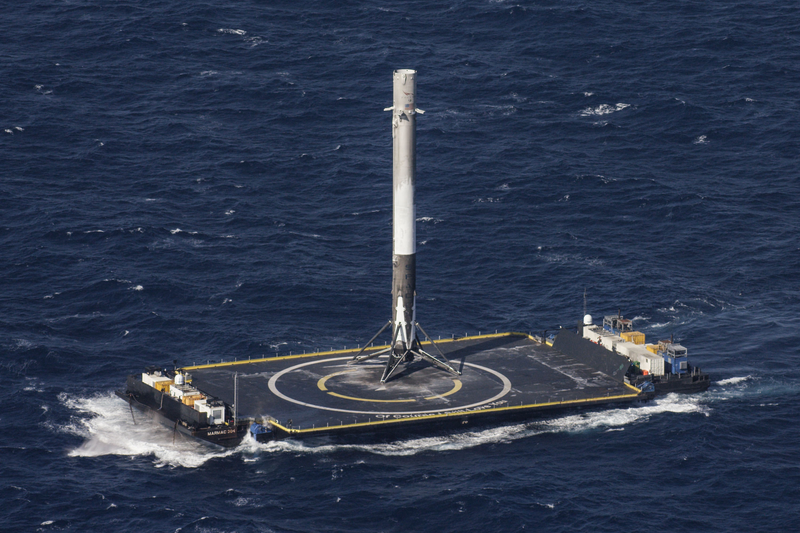
A Falcon 9 first stage stands upright on the deck of an autonomous drone ship in open ocean, seen from the air with tugs alongside.


On 22 August 2026 at 07:25 UTC, a Falcon 9 climbed off Space Launch Complex 4E at Vandenberg carrying 29 Starlink satellites. By the time the second-stage Merlin 1D Vacuum cut off over the south Pacific, the autonomous spaceport drone ship Of Course I Still Love You had caught a Block 5 booster on its ninth flight and pushed the vessel’s successful landing tally to 220 out of 228 attempts (Wikipedia, ASDS landings history, accessed 22 August 2026). The numbers look routine because they are routine. That is the point.

Reusable orbital rockets stopped being an experiment years ago and quietly became a load-bearing column of the global launch industry. The most-flown Falcon 9 first stage, B1067, has now flown 36 missions and is certified to keep going to 40 (Wikipedia, List of Falcon 9 first-stage boosters, accessed August 22 2026). A drone ship named for a science-fiction vessel is on track to record its 230th catch sometime this autumn. The launch industry has changed more in this decade than in the previous five, and the change looks, from one Starlink mission to the next, almost boring.

Cost per kilogram to low Earth orbit is the cleanest single number in the launch industry, and it has collapsed. The Space Shuttle ran near $54,500 per kilogram on the OIG baseline in 2012 dollars (NASA OIG IG-12-002, 2012). Falcon 9’s standard price sits near $67 million for an expended mission of about 22.8 tonnes to LEO — roughly $2,900 per kilogram on the list (SpaceX, Falcon User’s Guide, April 2020; Wikipedia, Falcon 9 Block 5). On a reused mission the airframe cost amortizes across the flight count, and the marginal kilogram price drops further.

The mechanism is not a bigger rocket. It is reuse of the most expensive stage. Industry analyses put the manufacturing cost of a Falcon 9 first stage at roughly 60 percent of the rocket’s total price (Wikipedia, List of Falcon 9 first-stage boosters, citing Everyday Astronaut estimates). Propellant for one Falcon 9 launch is under one percent of the vehicle price on SpaceX’s own figures. When the first stage can be reused, the marginal cost of another flight is dominated by propellant, inspection, and a small amount of refurbishment.

The Tsiolkovsky equation, Δv = v_e × ln(m_0 / m_f), describes how much velocity change a stage can deliver, where v_e is the exhaust effective velocity, m_0 the initial mass, and m_f the burnout mass. The economic equivalent, what rocket accountants sometimes call reuse leverage, looks like cost_per_flight ≈ fixed_cost / flights + marginal. Improvements in the denominator compound quietly.

The recoverable first stage began as a SpaceX research project funded out of company revenue after 2011 (Wikipedia, SpaceX reusable launch system development program). Early Falcon 9 flights tried to land on parachutes; the stages disintegrated on re-entry. The first successful propulsive landing came on Falcon 9 Flight 20 in December 2015, when a Full Thrust first stage set down on Landing Zone 1 at Cape Canaveral. Eighteen weeks later, on 8 April 2016, the same autonomous drone ship Of Course I Still Love You that would later log 220 catches recorded its first stage, the CRS-8 booster. By March 2017 SpaceX had reflown a landed first stage; by October 2017 the cadence was settling in.

Block 5, the current variant, debuted in May 2018 aboard Bangabandhu-1, and from the start it was engineered for at least 10 flights without major refurbishment. The certification staircase since then has been a study in disciplined risk: 10 flights in 2021 (B1051), 15 flights by 2023, then 20, and now 40 per booster. Each step followed a deep-dive inspection of a representative stage — B1058 and B1060 for the 20-flight certification — before SpaceX approved the next tier. B1067, which first flew in 2021, hit 36 flights in 2025 and is now the operational record holder.

Of the 694 Falcon family launches logged by 22 August 2026, 626 were Block 5 missions; 625 succeeded (Wikipedia, Falcon 9 Block 5). There has been one in-flight failure since the 2015 CRS-7 mishap — the Starlink Group 9‑3 second-stage anomaly — for a family success rate of 99.57 percent. Booster recovery is now standard, except when milestones roll over. On 22 August OCISLY hit landing 228, success 220. Just Read the Instructions, used briefly for Cape launches, logged 157. A Shortfall of Gravitas, the Atlantic drone ship, hit 166. The math: 650 successful Falcon 9 first-stage landings, 13 nominal failures, in 663 attempts.

Block 5 is not Block 4 with longer life. It is a structural rewrite aimed at thermal survival and rapid turnaround, and three components did most of the work.

First, the base heat shield at the bottom of the interstage was thickened and mounted on a stronger structure so a returning stage can absorb repeated supersonic heating without cracks propagating into the propellant tanks. Skin temperature during a boost-back re-entry peaks at roughly 1,500 K for a few tens of seconds; the aluminum-lithium alloy tanks survive only a finite number of these cycles, which is why certification life is a count, not a calendar span.

Second, the four hypersonic grid fins at the top of the stage were changed from aluminum to titanium alloy (Ti-6Al-4V) so they no longer deform visibly after each flight and can be reused without machining or replacement.

Third, the four landing legs switched from a deployable hydraulic mechanism with many moving parts to a carbon-fiber composite assembly that folds flush against the stage, removing the pins and seals that had been a top refurbishment item.

The Merlin 1D engine at the heart of the stage had to learn ten flights without major service at the same time. It runs on the gas-generator cycle with a pintle injector — the same architecture as the Apollo Lunar Module descent engine — and feeds from a single-shaft dual-impeller turbopump originally designed by Barber-Nichols. Sea-level thrust is rated at 845 kN, dry mass 470 kg, thrust-to-weight ratio near 184, and chamber pressure about 9.7 MPa. Specific impulse runs around 282 seconds at sea level and 311 seconds in vacuum per the published Falcon User’s Guide (SpaceX, April 2020). Those are modest numbers next to staged-combustion or ion engines, but they are the right trade for a reusable booster that has to be inspected, refurbished, and reflown in weeks.

Re-entry burn and landing burn use three-engine and single-engine restarts, so the Merlin 1D has to reignite in vacuum after separation and then reignite again on the way down. Cold-gas nitrogen thrusters handle fine attitude control between burns, which is what allows a Block 5 to land on a 91-by-52-meter drone ship sitting in swell at the edge of the open Pacific.

Reuse has eaten the launch industry in a way the engineers of the 1970s would have recognized but probably could not have predicted. Within SpaceX, the next step is full reusability with Starship, where the second stage also returns — a much harder problem because orbital velocity is near 8 km/s, more than four times the ~1.7 km/s a returning first stage survives. Outside SpaceX, the cadence pressure is starting to bend competitors: Blue Origin’s New Glenn has demonstrated its first-stage landing; Rocket Lab plans to recover Neutron’s booster; Stoke Space is targeting full reuse of a small launcher; China’s LandSpace has caught fairings and is testing full booster recovery. Reusability is no longer a fringe technology. It is the floor now. B1067 will eventually retire, and SpaceX will already be counting the flights of its replacement.


September 26, 2026

Four tons of rocket at 2.4 km/s

Posted by


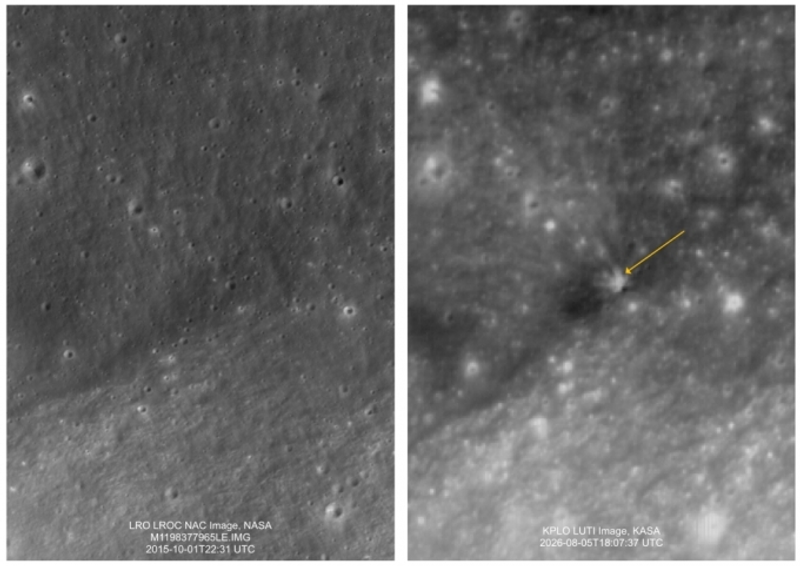
Before-and-after comparison of the Falcon 9 upper stage impact site near Einstein crater, imaged by LRO in October 2015 (left) and Danuri's LUTI camera on August 6, 2026 (right). Credit: NASA, KASA, KARI.


At 06:34 UTC on August 5, 2026, a hollow aluminum cylinder weighing roughly 3,900 kilograms crossed the last few hundred kilometers between Earth and the Moon at 2.43 km/s and stopped existing. The spent second stage of a SpaceX Falcon 9, cataloged as 2025-010D, slammed into the lunar surface near Einstein crater on the western limb and excavated a crater somewhere between 17 and 30 meters across. Almost no one on Earth saw it. The flash lasted less than a second, the impact site was on the sunlit side of the Moon during morning twilight for European and American observers, and the Sun-corona glare swamped any amateur telescope hoping to catch a thermal signature.

Eleven days later, the picture is clearer. South Korea’s Danuri orbiter published the first before-and-after images of the crater. Astronomers at Boston University working with the European Southern Observatory’s Very Large Telescope in Chile pulled a sodium and lithium line out of the ejecta plume. NASA’s Lunar Reconnaissance Orbiter is planning a follow-up pass that should image the fresh crater at half-meter resolution. For the first time in lunar science, the community has a controlled, predicted, multi-instrument observation of an artificial impact on the Moon.

The Chang’e 5-T1 third stage hit the Moon in March 2022 and the community was surprised by the double crater it left, because the shape implied more mass at the front of the rocket than the published payload would account for. The Falcon 9 stage is the second confirmed unintentional lunar impact, and the first that was on the near side, on the sunlit side, and watched in advance. About 100 lunar missions are planned over the coming decade, and each one leaves a spent upper stage in cislunar space unless the operator deliberately disposes it. SpaceX’s pre-impact statement was honest: on a translunar injection, almost all the propellant goes to the payload, and a controlled deorbit burn is not always possible. Solar radiation pressure and Earth-Moon perturbations then nudge the stage for months or years. The Falcon 9 stage launched in January 2025 carrying Firefly’s Blue Ghost-1 and ispace’s Hakuto-R Resilience; it took nineteen months for the Moon to catch it.

Most of the cameras were not pointed at the right pixel at the right fraction of a second. Jose Maria Madiedo at the Astrophysics Institute of Andalusia in Spain did publish ground-based video the next day, showing a faint plume rising above the lunar limb, but the impact point was hidden behind the Moon’s edge from his vantage. The VLT sodium and lithium detection came from Carl Schmidt, a Boston University planetary astronomer whose thesis work was on Mercury’s sodium exosphere. He had the right high-resolution spectrograph on the right telescope at the right time, and he caught a falloff of sodium and lithium emission extending tens of kilometers above the impact for five to ten minutes. The lithium is the smoking gun: the upper stage’s aluminum-lithium alloy tankage is the only plausible source.

The more satisfying story is Danuri’s. The Korean orbiter made a deliberate maneuver in mid-July to clear a worrying close approach with the incoming stage, then returned to its nominal orbit in time to take a pre-impact image at 3:01 p.m. KST on August 5, thirty-three minutes before the strike. Seven more imaging sessions followed over the next fifteen hours. The before-and-after comparison, released through the Korea Aerospace Administration on August 12, shows an unambiguous change in surface texture around the impact coordinates and a darker patch of ejecta extending some distance from the new crater. The LUTI camera has a resolution of a few meters per pixel, and the new crater is roughly the size of a single pixel or slightly larger.

The finer imaging will come from LRO. Mark Robinson, the LRO Camera principal investigator, told Inside Outer Space that the orbiter’s clean pass over the impact region on August 11 closed the acquisition cycle, with the crater in view at the LROC Narrow Angle Camera’s native 50-centimeter resolution. The high-resolution LROC imagery is expected to be published once the data is processed.

The science starts with the energy budget. A 3,900-kilogram object hitting the Moon at 2.43 km/s carries KE = 0.5 * m * v^2 ≈ 11.8 gigajoules of kinetic energy, equivalent to roughly 2.8 tons of TNT. By the standard point-source crater scaling for competent regolith, this corresponds to a transient crater about 17 meters in diameter and a final crater in the 20-30 m range once the walls have slumped, matching the predictions published by Fernando and colleagues (arXiv:2607.14625) and by Jo and colleagues at UT Austin (arXiv:2607.23904). The latter paper predicted an ejecta curtain extending 15-20 km above the surface, a central spike reaching 75-100 km, and a lateral spread of about 183 km. The central spike is the part that briefly exceeded the lunar escape velocity and would have scattered fine dust into cislunar space.

The interesting engineering question is what the hollow impactor did to the standard crater-scaling law. A spent Falcon 9 stage is mostly an empty propellant tank with a single Merlin Vacuum engine hanging off one end. Schmidt’s lithium detection is direct evidence that the stage broke up during entry rather than punching through as a coherent cylinder, because the lithium is locked inside the aluminum-lithium alloy of the tank bulkhead and would have vaporized before reaching the surface if the stage had stayed intact. The Chang’e 5-T1 double crater in 2022 told a similar story: a hollow rocket body, a mass distribution front-to-back that nobody had published, and a crater shape that surprised the modellers. Artificial impactors are not point masses.

The cislunar tracking problem is the bigger engineering gap. Ground-based optical and radar observations lose accuracy past about 0.1 AU because the radar return on a tumbling aluminum cylinder is weak and the optical signal is dominated by the Earth’s background. The Falcon 9 stage’s final weeks were tracked primarily by amateur astronomers using the Bill Gray Project Pluto pipeline and a handful of university observatories. The successful prediction and observation of this impact is a useful stress test of that network, and it came through. The next test, with about a hundred more lunar missions in the queue, will not be optional.

The Moon now has a second confirmed artificial crater, a fresh cislunar debris benchmark, and the first multi-instrument dataset of its kind. The VLT sodium and lithium detection is the cleanest engineering fingerprint of an artificial impact ever recorded, and Danuri’s images give crater-scaling models a calibration point they have not had before. LRO’s high-resolution pass on August 11 is expected to close the loop once the imagery is processed.

The less comfortable lesson is that cislunar traffic management is still a volunteer effort. The Falcon 9 stage was tracked, modeled, and observed by a coalition of amateur astronomers, two national space agencies, and academic research groups. There is no equivalent of the FAA for the volume of space between Earth and the Moon. As lunar launch cadence rises, that will have to change, because the next artificial impact will probably not be a quiet one with a known stage and a predicted trajectory. It will be a piece of hardware nobody realizes has drifted into the wrong orbit, and the only way to notice it in time is to be looking.