


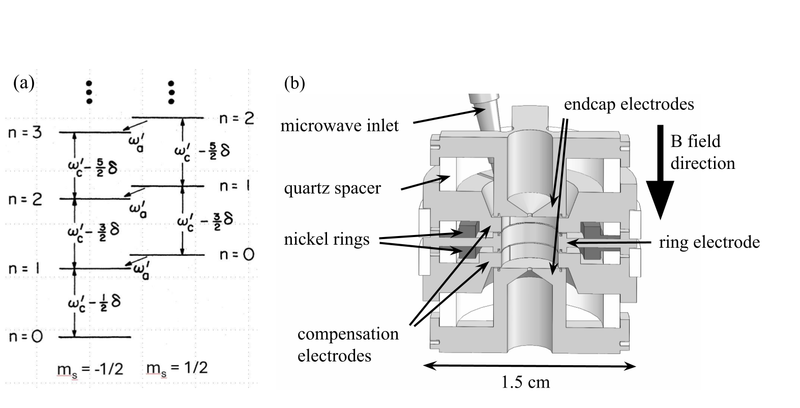
A single positron has been held inside a vacuum vessel in Evanston, Illinois, for months at a time, circling in a magnetic field with no container wall near it and no neighbouring particle to talk to. It sits in the lowest energy state its orbit allows, at a temperature of 300 millikelvin, in a trap barely a centimetre across. On 21 October 2026, Gerald Gabrielse’s group at Northwestern University described how they built that state and what they can now do with it (Myers et al., Physical Review Letters 137, 173001). The device is a one-positron quantum cyclotron, and the reason it matters is that a positron is about the cleanest referee available for a symmetry the Standard Model insists cannot break.
The asymmetry the Standard Model cannot explain is blunt. The visible universe is made of matter, and the antimatter that should have arrived with it is gone. The model predicts no imbalance at all, which is why physicists keep taking the simplest particles apart looking for a crack. The symmetry in question is CPT, which folds charge conjugation, parity and time reversal into a single operation. For any local Lorentz-invariant quantum field theory, the theorem says a particle and its antiparticle must have equal mass, equal lifetime and magnetic moments of equal magnitude and opposite sign. Electrons and positrons are supposed to be perfect mirrors, so a disagreement between their magnetic moments would be awkward to explain with physics we already have (Nature, 22 October 2026).
Magnetic moments became precision probes because of a sequence of accidents in 1947. Measurements of hydrogen hyperfine structure by Nafe, Nelson and Rabi, and then of gallium by Kusch and Foley, turned up a discrepancy with Dirac’s electron theory that the Lamb shift also confirmed. Julian Schwinger’s 1948 calculation of the leading quantum correction, a_e = (g_e - 2)/2 = α/2π, matched what the experiments were already seeing, and the agreement showed quantum electrodynamics worked. Theorists have since pushed the quantity to tenth order in the fine-structure constant, the fifth-order term alone requiring more than 12,000 Feynman diagrams (Crivelli, Physics 19, 132, October 2026).
The electron remains the benchmark: Gabrielse’s group pinned its magnetic moment to 0.13 parts per trillion in 2023, the most precise property ever measured for an elementary particle. The positron lagged badly. Its first direct free measurement, in 1966, fixed the g factor only to about ten parts per million, and the best direct electron-positron comparison, from 1987, established equality to 2.1 parts per trillion. Nothing about that gap was theoretical. It was logistics: a positron has to be born in radioactive decay, slowed by orders of magnitude and then isolated thoroughly enough that it neither touches a wall nor wanders into a stray field before anyone can measure it.
The Northwestern apparatus solves those logistics with a trick. Positrons emerge from sodium-22, whose beta decay endpoint is 546 keV, and are thermalised by scattering inside a single-crystal tungsten moderator. A positron that reaches the exit is pushed back out by the moderator’s work function, and it can pick up an electron from the tungsten surface to become a loosely bound, highly magnetised Rydberg positronium atom. Because that atom is neutral, it ignores the trap’s electric field and can slip through a 625-micrometre hole in a silver electrode into the trap’s interior. Only there, where the field is strong, does the atom ionise: the electron escapes and the positron stays. The source is deliberately feeble at 18 microcuries, and loading one positron takes eight to eleven hours, which sounds punishing until you notice that the particle then stays trapped for months.
Everything after loading is about making the trapped particle behave like a textbook. The trap hangs inside a dilution refrigerator that holds the electrodes and the sealed vacuum enclosure at 300 millikelvin, cold enough that photons capable of exciting the cyclotron states are essentially absent. A persistent 4.2 K superconducting solenoid supplies the 5.6 T field. The trap is a cylindrical Penning trap, combining that field with an electrostatic quadrupole, V ∝ z² - ρ²/2, which pins the orbit radially and adds a separate 206 MHz oscillation along the field axis. The cyclotron frequency is about 156 GHz and the spin precession frequency matches it to roughly a part in a thousand; their difference, ω_a = ω_s - ω_c, is the anomaly frequency, and the magnetic moment lives in the ratio a = ω_a / ω_c.
Reading that ratio without destroying it is the hard part. A cyclotron state radiates away on its own at a free-space rate of γ_c = (4/3)α(ℏω_c/mc²)ω_c, which would have the first excited state vanishing within 83 milliseconds at this field strength. The trap electrodes are therefore shaped into a high-Q microwave cavity with the particle suspended at its centre, and the cavity’s modes suppress spontaneous emission by a factor of two hundred or more, stretching the excited-state lifetime to roughly four seconds. Readout is subtler still. Saturated nickel rings encircle the trap to form a magnetic bottle, a gradient of 1500 tesla per square metre that shifts the axial frequency in proportion to the cyclotron and spin quantum numbers, Δω_z = β(n + m_s), with β/2π near 3.8 Hz for a single particle. The shift is picked up from a coaxial resonator of Q = 900 feeding a cryogenic HEMT amplifier, and since the measurement only watches axial motion it leaves the cyclotron and spin states untouched. That is quantum nondemolition: the experiment learns the state without spending it.
With that readout in place, the team drove the cyclotron motion at 156 GHz and watched the energy climb one step at a time and then fall back one step at a time, the signature of genuinely discrete orbital levels rather than a classical orbit. They flipped the spin up and back down by applying a drive near the anomaly frequency, and the same 3.8 Hz shift appeared on each flip. The size of the shift is itself proof that a single particle is in the trap, since two positrons sharing a centre of mass would halve it. None of this is a magnetic-moment measurement yet. The spectroscopy still has to be run and the systematics tamed, but the authors argue a quantum measurement at the electron’s precision is now in reach, which would make the lepton-sector CPT test more than thirty times stricter than anything before it (Myers et al., 2026).
A competing approach is worth watching. The Lepton Symmetry experiment at the Max Planck Institute for Nuclear Physics plans to trap a positron beside a hydrogen-like helium-4 ion, letting that ion’s single bound electron act as the electron reference, with both species held in the same field so field noise largely cancels instead of accumulating; the target is comparison at fourteen significant digits (Crivelli, October 2026). One approach reaches for a standalone positron measurement, the other for a side-by-side one.
The Northwestern result is candid about its limits. A positron vanishes on contact with anything, and the team had to thread a 546 keV particle into a millimetre-scale cryogenic cavity without spoiling the cavity before the physics could start. If the two magnetic moments eventually come out equal, the imbalance between matter and antimatter will still need explaining. If they come out unequal, the explanation may turn out to live inside the magnetic moment of one antiparticle, held still enough to read.
 Subscribe to our RSS feed









There are no comments.
Add A Comment