


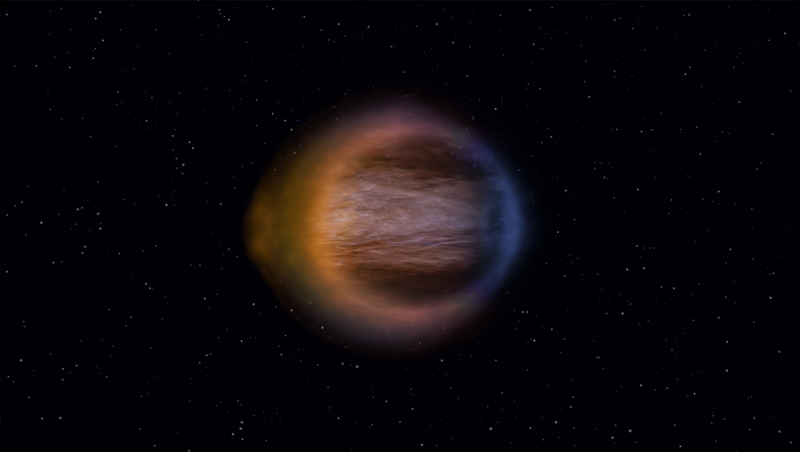
Astronomers working with the James Webb Space Telescope have produced the first three-dimensional map of an exoplanet’s atmosphere, and the planet they picked turned out to be a great choice. WASP-17b, a hot Jupiter about 1,300 light-years from Earth, has an atmosphere that is roughly circular but stretched out on one side, like an egg pulled gently at the pole. The team, led by Lili Alderson of Cornell, reports the result in Nature Astronomy on 14 October 2026 (Alderson et al., Nature Astronomy, 14 October 2026). The paper is more than a portrait of a single weird world. It demonstrates a new technique, called transmission strings, that turns Webb’s eclipse observations into a latitude-by-latitude picture of a planet’s limb. With that picture in hand, the team can finally check, observation by observation, what hot Jupiter circulation models have been predicting for two decades.
Hot Jupiters are easy to find and brutally hard to characterize. They are gas giants the mass of Jupiter or a few times over, parked in orbits of just a few days around their host stars, with equilibrium temperatures above 1,500 K. Because they transit, you can split their light into a spectrum and read the chemistry of the atmosphere from the depths of absorption lines. That part is mature. What has been hard is geometry: a transmission spectrum averages over the entire thin ring of atmosphere that the planet shows us at transit, and the average smears together the cool morning limb and the hot evening limb, the equator and the poles, and any place on the planet where the chemistry is different from the rest. For most hot Jupiters, you get one spectrum and the knowledge that it hides a lot of weather underneath. Alderson and her colleagues, working with Bristol astrophysicists Hannah Wakeford and David Grant, who developed the technique, figured out how to extract more.
The trick is in how Webb watches a planet disappear behind its star. As the planet slides into eclipse, different parts of its atmosphere are hidden at different times, and the light curve that Webb records during that slide is sensitive to where on the limb the atmosphere is hot, cold, cloudy, or clear. Alderson’s team had previously used that approach to measure global temperature maps, but the transmission-strings method goes further: instead of treating the limb as a single ring, it breaks the ring into angular slices, runs the eclipse light curve through a model that knows how a transit signal changes as the star progressively covers different pieces of the planet, and asks which slice is bright in which wavelength. The output is a map of the limb in temperature and chemistry, around the full circumference of the planet, with separate measurements for the equator, the poles, and everything in between. The phrase “transmission strings” comes from the way those angular slices line up along the limb, like beads on a string.
WASP-17b is a long way from a typical hot Jupiter target. Discovered in 2009, it was the first exoplanet found with a clearly retrograde orbit, meaning it swings around its star in the opposite direction from the star’s spin. It is also one of the puffiest planets on the books, with roughly half Jupiter’s mass stuffed into nearly twice Jupiter’s radius, putting it among the most extreme low-density worlds confirmed to date. That puffiness makes its atmosphere large and easy to probe, and its F-type host star gives Webb a bright, clean signal. It has also been a workhorse for Webb’s exoplanet team: in March 2023, the telescope watched WASP-17b for several eclipses using three instruments at once, NIRISS, NIRSpec, and MIRI, covering wavelengths from 0.6 to 12 microns, under the DREAMS survey run by Webb’s Telescope Scientist Team. That same dataset, used by Grant and colleagues to find the first evidence of quartz clouds in an exoplanet atmosphere in 2023 (ESA/Webb, WASP-17 b transmission spectrum, October 2023) and by Gressier and colleagues to measure a supersolar metallicity in the dayside in 2024, became the input for the new limb map.
The result, when the team unfolded the data, was the egg shape that the press releases kept reaching for. The atmosphere is circular at the equator, where a banded jet stream carries material from the planet’s blistering dayside around to its permanently frozen nightside. As the limb is traced up toward the poles, the atmosphere gets lopsided. One side, the evening side, where gas has just finished its rapid eastward journey from the dayside, is hotter; the other side, the morning side, where gas has crossed the long dark face of the planet and cooled, is colder. The team puts the temperature difference at 650 K between morning and evening limb at the equator, consistent with the predictions of circulation models (Alderson et al., 2026, Nature Astronomy). That confirmation matters because, until now, hot Jupiter circulation models were a chain of inferences: people used eclipse and phase-curve data to infer the dayside temperature, used that to constrain the nightside, used the difference to infer the wind speed. Transmission strings lets you measure the morning-to-evening contrast directly, which is the comparison the models need to be tested against.
Alderson was careful to note that the measurement is exactly what theory predicted. The morning-evening contrast, she told reporters, lands almost exactly where hot Jupiter circulation models say it should, bang-on the trend (Cornell Chronicle, October 2026). That kind of confirmation is rare and welcome in a field where surprises are more common than agreements. The paper also reports detections of water and carbon dioxide in the limb spectrum at high signal-to-noise, and a transition in atmospheric structure between equator and pole, which suggests that the equatorial jet does not just transport heat but also reshapes where the gas rises and falls. As Alderson put it in the same press cycle, the work demonstrates that planets are three-dimensional objects whose atmospheric behavior, as they orbit their stars, matches what general circulation models predict (Cornell Chronicle, October 2026).
WASP-17b has, in some sense, been preparing for this paper for years. The 2023 quartz-cloud finding showed the planet’s atmosphere was chemically interesting, not just hot. The 2024 supersolar-metallicity work pinned down the bulk composition. The 2026 paper, by Alderson and her colleagues, is the moment where the meteorology of WASP-17b becomes something you can put on a wall. Among the more than 6,000 confirmed exoplanets, WASP-17b is now the benchmark for three-dimensional atmospheric characterization, the place future transmission-strings results will be compared against. The technique does not require any new hardware: any transiting exoplanet with a good Webb eclipse light curve is a candidate, and there are dozens already in the archive.
There are also genuine limits to read into the result. The map is one snapshot of one planet at one phase of its orbit, taken in March 2023, and 650 K is a large number but it is also a number that depends on which latitudes the model chose to slice at. The team is already applying the method to other hot Jupiters in the DREAMS survey and beyond, and the next round of papers will start to reveal whether the morning-evening contrast varies from planet to planet in the way general circulation models expect, or whether some worlds break the pattern in instructive ways. What the Webb team has, for the first time, is a tool that lets them ask those questions in three dimensions rather than averaging them away.
 Subscribe to blog posts using RSS








