


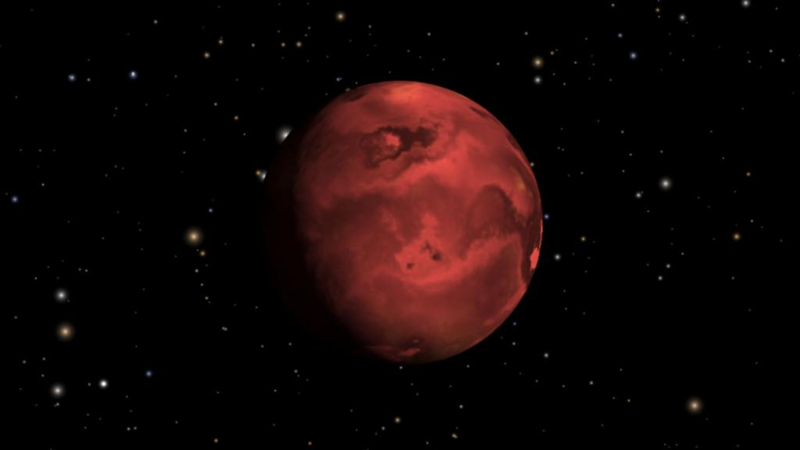
Image credit: NASA.
The James Webb Space Telescope, the NASA/ESA/CSA observatory at the Sun-Earth L2 point, has caught an exoplanet doing something a planet that close to its star really should not be able to do. HD 3167 b is a rocky world roughly one and a half times the size of Earth, and it zips around a K-type star in the constellation Pisces once every 0.96 Earth days. At that distance, the dayside should be glowing red-hot bare rock, the kind of surface where silicates are molten and any gas should have been stripped away by stellar wind and high-energy photons long ago. Instead, the dayside is noticeably cooler than the theoretical maximum, and a new analysis of a JWST secondary eclipse says the most likely reason is an atmosphere. It is the coldest lava world with evidence of an atmosphere on record, and the first result from a survey of ten such worlds led by astronomer Megan Weiner Mansfield. The team’s writeup, as covered by Space.com, lays out what makes the detection hard to explain any other way.
That word cool does not mean comfortable. The planet’s equilibrium temperature sits at about 1786 K, somewhere between a slow oven and molten glass. Lava worlds previously caught with atmospheres have all been hotter than roughly 2200 K. HD 3167 b is hot enough that the rock on its star-facing side is almost certainly molten, and cool enough that something other than bare rock is controlling its dayside temperature.
The result, published in The Astrophysical Journal Letters, comes from a single JWST observation using the Mid-Infrared Instrument’s Low Resolution Spectrometer, the team that has been doing most of the heavy lifting on small rocky exoplanets for the last two years. The team watched HD 3167 b slip behind its host star, a maneuver called a secondary eclipse, and measured how much mid-infrared light disappeared. They measured the white-light eclipse depth at 38 plus or minus 11 parts per million. That number is more than five standard deviations shallower than a dark bare rock with no heat redistribution would produce at this distance from the star. The only good explanations are an atmosphere that reflects some incoming starlight back into space, an atmosphere that moves heat from the day side to the night side, or some combination of the two.
The lead author is Brandon Park Coy, a graduate student at the University of Chicago working in planetary scientist Edwin Kite’s group. Kite is the second author and a co-author on a long line of papers trying to figure out which rocky exoplanets hold onto their air. The HD 3167 b paper, described in a University of Chicago news release, is the first published result of a survey that Megan Weiner Mansfield, who did her PhD at Chicago and is now at the University of Maryland, is running. The program is looking at ten lava worlds with JWST and asking a single question. Below what temperature do rocky planets start losing their atmospheres, and above what temperature do they keep them? The published sample so far suggested a gap. Ultra-hot lava worlds such as 55 Cancri e kept their air. Cooler rocky worlds, the ones too cold to be lava worlds at all, often did not. The boundary lived somewhere in the middle, and nobody had measured it.
HD 3167 b sits right at that boundary. Its dayside is too cool for a bare rock, so it has an atmosphere. Its equilibrium temperature is far below the ultra-hot threshold, so it is the first cool end of the population in question. The boundary should sharpen from a guess into a measured curve as the program keeps adding worlds to the sample.
The detection technique itself is worth slowing down on. A secondary eclipse is the small dip in light that happens when a planet passes behind its star as seen from Earth. The dip is small because the planet is much cooler than the star and emits much less light at the wavelengths being observed, but it is measurable, and the depth of the dip tells you how much of the observed light is the planet’s own thermal emission. Doing this in mid-infrared light, around 15 micrometers for this observation, is what lets JWST see the heat of a planet whose dayside is below 2000 K. The same measurement in visible light would be much less informative, because at those wavelengths the planet contributes essentially nothing.
Why does the dayside being cooler than the maximum matter? On a bare rock world with no atmosphere, the side facing the star absorbs starlight, heats up, and re-radiates that heat as infrared light. The temperature that produces is set by the rock’s reflectivity and the distance to the star, and it is the highest possible dayside temperature for that orbit. Add an atmosphere, and two things change. First, the atmosphere can carry heat from the day side to the night side, evening out the temperature. Second, clouds or hazes can reflect some starlight back into space before it ever reaches the surface, lowering the dayside temperature below the bare-rock maximum. Venus is the textbook example of the first effect, with almost no temperature difference between its equator and poles or between its day and night sides. Earth is the textbook example of the second effect. HD 3167 b is showing one or both on a world whose dayside is liquid rock.
What the atmosphere is actually made of, the team is careful to say, is not known. The single JWST spectrum is not precise enough to pick out individual molecules. The paper notes that the dayside emission spectrum is compatible with a silicate-rich composition consistent with vaporized rock, but also with heavier gases like carbon dioxide, carbon monoxide, or water. Picking among those will take follow-up spectroscopy, ideally with JWST’s Near-Infrared Spectrograph, which covers a different wavelength range. The team is also hoping that the rest of the ten-planet program will start to fill in a statistical picture, where several planets measured the same way start to show consistent or inconsistent composition patterns.
The planet itself is also interesting in detail. Its host star, HD 3167, is a K-type main-sequence star slightly smaller and cooler than the Sun, and the planet was first spotted in 2016 in data from the Kepler space telescope’s extended K2 mission, then confirmed by Vanderburg and collaborators in a dedicated follow-up. Like most ultra-short-period rocky worlds, it is tidally locked, with one side permanently facing the star and the other side in permanent night. The new paper refines the planet’s radius to roughly 1.6 Earth radii and confirms the bulk density is slightly lower than a pure Earth-composition planet would suggest, consistent with the planet having a substantial gas layer on top of the rock.
For the broader exoplanet field, the result is a small but real data point in a much larger argument. Most rocky exoplanets found so far, the ones that orbit small cool stars and sit at Earth-like distances, do not have atmospheres. JWST has now measured enough of them to know that, and that has driven a lot of the conversation about whether Earth-like planets are rare or common. Lava worlds are the opposite case. They are easy to observe because they are hot, and the evidence so far is that most of them have something on top of the rock. HD 3167 b extends that trend. It does not change the picture for habitable-zone rocky worlds, but it does sharpen the boundary case where atmospheres start to fail.
There is one quote in the paper and its accompanying press release that captures why a team would spend JWST time on a planet that cannot possibly host life. Lava worlds are useful because they let you watch the processes that matter for all rocky worlds at the extreme end of their temperature range. A planet that is too hot for life can still tell you something about how its rock interacts with its air, how heat moves around, and how clouds form. None of that is unique to lava worlds. All of it shows up in the physics of habitable worlds too. The difference is that on a lava world you can measure it directly, and on a habitable world you mostly have to guess.
 Subscribe to our RSS feed









There are no comments.
Add A Comment