OrbitalHub

Where curiosity reaches escape velocity.

Domain is for sale. $50,000,000.00 USD. Direct any inquiries to contact@orbitalhub.com.

October 10, 2026

Falcon Heavy flies its first NRO mission

Posted by


A Falcon Heavy rocket climbs off Launch Complex 39A at night, its 27-engine plume glowing bright orange against the dark Florida sky and reflecting off the water beside the pad.


A Falcon Heavy lifted off from Launch Complex 39A at NASA’s Kennedy Space Center at 11:54 p.m. EDT on Thursday, October 1, 2026 (0354 UTC on October 2), carrying the NROL-97 mission into orbit for the National Reconnaissance Office, the U.S. agency that builds and operates the country’s spy satellites. It was the first time the NRO has flown a payload on Falcon Heavy rather than on a single-stick Falcon 9, and it was the first national-security mission procured under the National Security Space Launch Phase 3 Lane 2 contract that the U.S. Space Force awarded in 2025.

The mission was the third SpaceX launch in a thirteen-hour stretch that also saw a Falcon 9 carry the Crew-13 astronauts to the International Space Station from the Cape at 11:10 a.m. ET and another Falcon 9 send 130 smallsat payloads into sun-synchronous orbit on the Transporter-18 rideshare from Vandenberg at 11:32 a.m. PT, per Spaceflight Now’s launch report. The triple-header ended with four booster landings inside a single calendar, the first time SpaceX has brought that many first stages back in twenty-four hours.

Falcon Heavy is the three-booster variant of the Falcon 9: a single core stage flanked by two strap-on boosters that are themselves flight-proven Falcon 9 first stages. Twenty-seven Merlin 1D engines fire at liftoff, producing roughly 22,800 kilonewtons of thrust, and the side boosters separate from the core about two and a quarter minutes into flight before flipping, boosting back toward Cape Canaveral, and returning to land. The Heavy flew for the first time in February 2018, made its second flight in April 2019 carrying the Arabsat-6A satellite, and reached its fourteenth flight on the NROL-97 mission, according to the SpaceX official NROL-97 mission page and the launch archive.

The two side boosters that flew NROL-97 had both flown before. The NRO mission reused them just a month after their last flight, which lofted NASA’s Nancy Grace Roman Space Telescope to L2 in early September 2026. B1104 made its second flight and B1072 its fourth. The new core stage, B1106, was brand new and was expended on the NROL-97 mission; the trajectory required the core to do a disposal burn that did not bring it back to a landing site. After stage separation, the side boosters made their way back. Both returned to Landing Zones 1 and 2 at Cape Canaveral Space Force Station, and the landings produced the audible sonic booms that anyone in central Florida heard three minutes before midnight local time. SpaceX had returned LZ-1 to service for this mission after that pad had been replaced for a stretch of LZs at Space Launch Complex 40, and the SLC-40 landing pad was used earlier in the day by the booster returning from the Crew-13 mission.

Little about the payload itself is public, which is the standard posture for NRO missions. The NRO rarely publishes technical details beyond launch and landing confirmations, and the live SpaceX broadcast carried only the standard hazard area and trajectory notes. It was the first NRO mission to launch under the new procurement structure the agency adopted. The agency bought the launch in 2025 through the competitive NSSL Phase 3 Lane 2 process, and that contract structure is the mechanism the U.S. Space Force uses to buy launches for the majority of its national-security payloads. Lane 2 covers the medium-to-heavy class of missions for which Falcon Heavy is now the baseline ride. ULA’s Vulcan rocket and Blue Origin’s New Glenn are the other Lane 2 providers, and the contract split is the reason Falcon Heavy (rather than first-class Vulcan) flew this payload.

The payload fairing had flown before as well. SpaceX and the NRO confirmed the fairing was previously used on the NROL-95 mission in July, another example of the steady refurbishment and reuse pattern that SpaceX has applied across the Falcon 9 fleet and is now extending into the more delicate fairing hardware. The cost model on a mission like NROL-97 is unusual for the agency context, because the contract is fixed-price rather than cost-plus: the U.S. Space Force’s published Lane 2 task order values run into the hundreds of millions of dollars per mission, with Falcon Heavy missions priced in the $97 million range per the NextSpaceflight launch entry, although the actual NRO contract value has not been disclosed for NROL-97 specifically. The economic argument for the NRO in choosing Falcon Heavy over the alternatives is the standard one in the launch market right now: it is the cheapest heavy-lift rocket that already has a flight history, and the side boosters are reused flight-proven hardware that has already amortized its development cost.

The mission is the third Falcon Heavy launch of 2026, which is shaping up to be a relatively slow year for the rocket compared to 2024 and 2025, both of which saw the vehicle fly close to a head-to-head cadence with the rest of the Falcon fleet. The pace has been limited by payload availability more than by launch capability; the heavy-lift market is dominated by geostationary communications satellites, NASA flagship missions like Roman and Europa Clipper, and a small number of national-security payloads, and there are simply not that many of those missions in any given year. Looking at SpaceX’s published manifest for the rest of 2026 and the early months of 2027, the company has only a couple more Falcon Heavy launches booked in that window [unverified], which would put the rocket on track for one of its quietest years since 2021 so far. The NROL-97 mission is the kind of flight Falcon Heavy exists to handle, and the fact that it was the NRO’s first choice of the rocket suggests that 2027 and 2028 will see the cadence pick up further as the Lane 2 contract awardees ramp their flight rates.

The triple-header that ended with NROL-97 also gave SpaceX a small operational benchmark. Three Falcon-family launches inside thirteen hours, four booster recoveries, two different launch complexes (SLC-40 for Crew-13, LC-39A for NROL-97, and SLC-4E at Vandenberg for Transporter-18), and three different mission profiles (crewed, rideshare, classified heavy-lift), per the Space.com launch report. It was the operational shape of the Falcon program in late 2026, and it was the first NROL mission ever to ride on a Heavy rocket. The next national-security mission on the manifest is likely to be a Lane 1 contract (meaning a Vulcan or a National Rocket), unless the Space Force decides to push more Lane 2 weight onto Falcon Heavy next year. That decision will tell us whether NROL-97 was a one-off or a real sign of the future for the agency’s Falcon Heavy launcher.
 

October 10, 2026

CHIME detects cosmic hydrogen on its own

Posted by


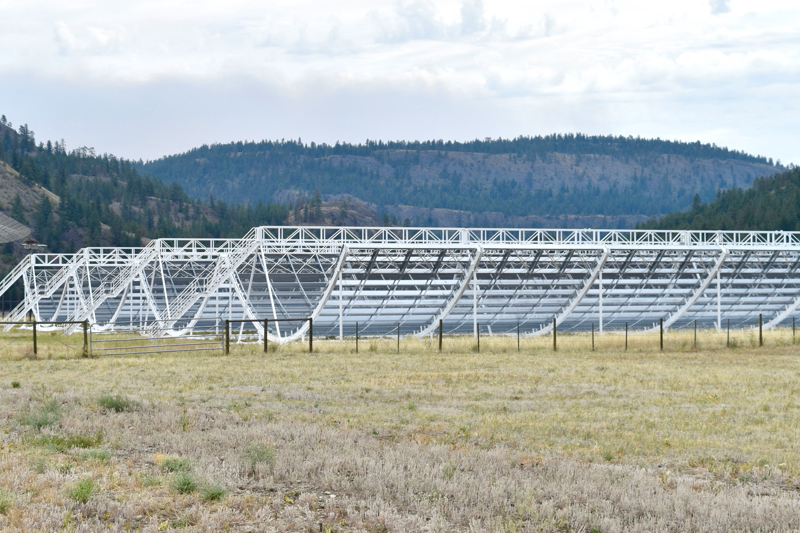
The CHIME telescope's four 100-metre wire-mesh cylindrical reflectors in an open field near Penticton, British Columbia, with forested hills behind. Image: Wikimedia Commons, CC BY-SA 4.0.


The Canadian Hydrogen Intensity Mapping Experiment, run out of a low-slung cluster of wire-mesh cylinders near Penticton, British Columbia, has just done something the rest of cosmology has been waiting on for the better part of two decades. In a paper published in The Astrophysical Journal on 28 September 2026 and posted to arXiv as 2511.19620, the CHIME Collaboration reports the first standalone detection of the cosmological 21-centimeter signal, the faint radio glow of neutral hydrogen from an era when the universe was roughly five billion years old. The result reached a signal-to-noise ratio of 12.5 across 94 nights of observing, a clean confirmation that intensity mapping can carry cosmological information without leaning on any other telescope.

The detection matters because it removes a crutch that earlier 21cm cosmology work could not do without. To pick a faint hydrogen signal out of the radio sky, every previous CHIME result had to be cross-correlated with an external galaxy or quasar catalog, so that any structure showing up in both maps could be trusted. That technique works, but it ties a hydrogen experiment to the schedule and depth of someone else’s survey. The new measurement is an auto-correlation, meaning the team trusted only CHIME’s own data and still recovered a statistically unambiguous clustering signal. Splitting the 608.2 to 707.8 megahertz frequency window in two yields independent detections at 8.7 and 9.2 sigma. Two independent confirmations in a single dataset is the kind of robustness that turns a hint into a measurement.

The reason this is exciting rather than merely incremental comes down to what intensity mapping is meant to do. Galaxy surveys like DESI, Euclid, and the Vera Rubin Observatory’s LSST build their maps by detecting and counting individual galaxies, a process that consumes enormous telescope time and tends to miss the dim, hydrogen-rich galaxies where most of the universe’s atoms actually live. CHIME does something different. Its four 100-metre cylindrical reflectors look at the whole northern sky every day, with no moving parts, and instead of resolving individual galaxies they sum the faint 21cm emission from millions of unresolved sources inside each patch of sky. The result is a low-resolution three-dimensional map of where the neutral hydrogen is, calibrated by redshift because cosmic expansion has stretched the original 21cm line into longer and longer wavelengths the further back in time one looks.

CHIME’s full operating band runs from 400 to 800 megahertz, which corresponds to redshifts between roughly 2.5 and 0.8, an epoch the collaboration describes as substantially younger than the one surrounding Earth today but old enough to capture the period when dark energy began to dominate the cosmic energy budget. The new paper uses only the cleaner half of that window, between 608.2 and 707.8 megahertz, which corresponds to redshifts of 1.34 down to 1.01, with a mean redshift of 1.16. That is exactly the slice where the universe had finished its early formative fireworks but had not yet been completely taken over by the accelerating expansion driven by dark energy.

Why this matters comes down to what the team can now attempt to do with the rest of the CHIME archive. The instrument has been collecting data continuously since first light in 2017 and the collaboration says it now has nearly seven years of observations in hand, most of which has not yet been analyzed. The Sept 28 paper uses 94 nights from 2019 only. If the new processing pipeline can keep extracting the auto-power spectrum cleanly from older data, CHIME should be able to push the measurement to higher redshifts, into the period when the universe was only about three billion years old, and to lower redshifts, where the dark-energy signal is strongest. That spans almost the entire window during which dark energy transitioned from negligible to dominant. Tracing the universe’s expansion history across that span, with a single instrument and a single tracer, is the prize the collaboration has been working toward since construction finished in 2017.

The first detection was a 2023 paper that cross-correlated CHIME’s hydrogen maps with optical galaxy and quasar catalogs from eBOSS. That cross-correlation approach was scientifically productive but also exposed. The hydrogen experiment needed a second, much larger optical survey to confirm any signal. The new result flips that around: CHIME is now the primary instrument, and any cross-correlation with another survey becomes an optional consistency check rather than a requirement. Co-author Dr. Mark Halpern, a University of British Columbia physicist and CHIME principal investigator, called the result a fundamentally new way of probing the cosmos, built on an instrument conceived, paid for, and operated entirely by Canadian institutions.

The technical work that made this possible is what most readers will not see and what most of the team spent the most time on. The 21cm cosmological signal at these frequencies is buried under several layers of brighter noise. Galactic synchrotron emission from our own Milky Way dominates by orders of magnitude. Distant radio galaxies and active galactic nuclei add another, structured layer on top. Human radio-frequency interference from satellites, radar, and cell towers adds a moving, partly unpredictable foreground. And small imperfections in CHIME’s receivers and correlator can mix otherwise smooth foreground signals into patterns that look like cosmological structure. Pulling the hydrogen out required the team to develop new radio-frequency interference detection algorithms, achromatic beamforming techniques that keep the telescope’s synthesized beam stable across frequency, and a foreground-filtering step that runs before time-averaging so that spectral leakage does not smear bright foregrounds into faint cosmological modes. Independent sub-band splits, null tests on the data, and many alternative processing choices were all checked before the team trusted the result, a process Chakraborty described as working very hard to convince ourselves that this was not a false alarm.

The team’s analysis goes one step beyond the headline detection. In a companion paper they take the auto-power spectrum at face value as a measurement of how strongly neutral hydrogen clusters at redshift 1.16, and they compare it with predictions from the IllustrisTNG cosmological simulations. The observed hydrogen clustering disagrees with the simulated clustering by about 3.1 standard deviations for the TNG100 simulation volume and 4.0 standard deviations for the larger TNG300. That is not a crisis. The team reads the gap between observation and simulation as a clue about how tightly hydrogen is packed at the small, non-linear scales the new measurement is most sensitive to, not as evidence that the total hydrogen inventory is wrong. It shows that CHIME’s standalone data can test models of how gas actually populates galaxies and dark-matter halos, not just deliver a number for dark-energy cosmology.

The long-term target is still baryon acoustic oscillations, the imprint of pressure waves from the hot early universe that act as a cosmic standard ruler. Tracking how that ruler stretches at different redshifts is one of the cleanest ways to measure how the universe’s expansion rate has changed over time, and therefore to test competing models for what dark energy is doing. The current measurement does not yet deliver BAO. Foreground-removal eliminates some of the largest-scale modes the BAO analysis needs, and the detected power spectrum occupies smaller non-linear scales where gravitational clustering has already scrambled the clean linear signal. What the Sept 28 paper establishes is the prerequisite: a telescope designed to map the universe through hydrogen can isolate that hydrogen without another survey pointing out where to look. The next step is to apply that capability across more of the CHIME archive and across the wider redshift range the telescope was built for.

For a community that has spent more than a decade waiting for a 21cm cosmology result that does not need a galaxy survey attached, the message from the Okanagan Valley this week is that the wait is over, and the next decade of dark-energy measurements just got a new instrument.


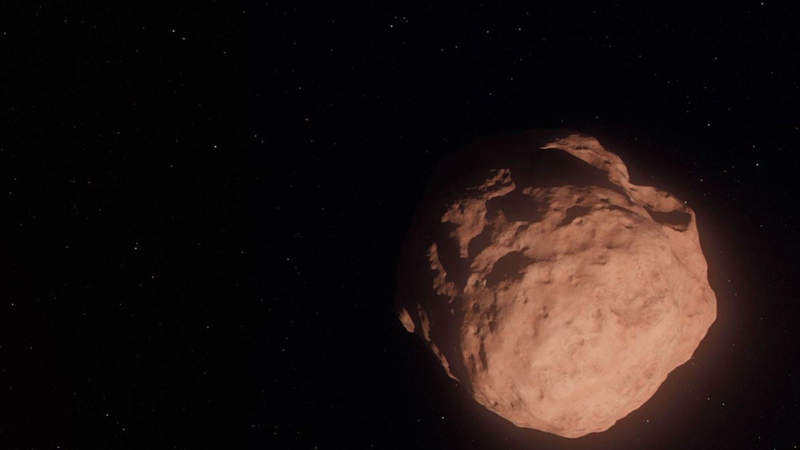
An illustration of a Trans-Neptunian Object: a small, faint, icy body orbiting the sun beyond the orbit of Neptune, shown as a single lumpy brown rock against a starless black background.

Image credit: NASA, ESA, Leah Hustak (STScI). The illustration is from the official NASA/ESA news materials accompanying the September 2026 announcement of the 27 new TNOs.


The Hubble and James Webb space telescopes have spent most of their careers looking out, at distant galaxies and the early universe. A new survey turned them around to look back home, and in the process turned up 27 new Trans-Neptunian Objects, all of them so small and so distant that they are still bearing the chemistry of the solar system’s earliest planetesimals.

These TNOs are between 6 and 25 miles across, with the smallest only about 6 miles (10 kilometers) in diameter. They sit between the cold classical Kuiper Belt and the dynamically hot Scattered Disk, and the survey is the deepest look yet into the region beyond Neptune. As such, the work is the first census with enough sensitivity to compare the smallest TNOs to their larger siblings, which is the comparison that lets you say something about how the solar system formed.

A TNO is a small icy body that orbits the sun beyond Neptune. The classical ones sit on near-circular orbits level with the ecliptic plane and are dynamically cold, meaning they have not moved much since they formed. The hot ones have been kicked there from closer in, mostly by gravitational resonances with the giant planets while those planets were still growing. They ended up on highly elongated orbits well off the ecliptic. Most of the 27 new objects are classical cold TNOs, with a smaller number from the scattered disk.

How cold are these cold TNOs, exactly? The new survey found them at apparent magnitudes between 24.1 and 29.3, putting them at the very edge of what either telescope can detect. Reaching reliable sizes for objects this faint required combining both observatories’ strengths: Hubble’s deep visible-light imaging to find the candidates, and JWST’s infrared vision to size them, because at infrared wavelengths a body’s brightness reflects its actual size rather than its albedo, the way visible-light brightness does.

The work was led by two PhD candidates, Anastasia Morgan of Northern Arizona University, who led the color and composition analysis, and Marielle Eduardo of the University of Victoria, who led the size distribution. They were part of a larger team that also included David Trilling, also of NAU. The size work was the headline: Eduardo was able to derive the diameters of the 27 TNOs from their infrared brightnesses, and the resulting size distribution was the first surprise.

Models of planetesimal formation predict a steep size distribution: many small objects and a few large ones. When Eduardo plotted the inferred sizes of the 27 TNOs, she found they followed the same shape distribution as larger TNOs. That was not the surprise. The surprise was that the slope of the size distribution was shallower than models predicted at the very smallest sizes, meaning there are fewer really tiny TNOs out there than the models would predict. Either planetesimal formation is more efficient at small sizes than the models say, or the smallest objects get eaten or ejected by something the models don’t include.

Models of how the solar system has churned through 4.5 billion years of collisions predict that small TNOs should be heavily gardened by impacts, their surface composition thoroughly mixed up and homogenized. The 27 objects should look quite different on their surfaces from their larger siblings, the way a heavily cratered asteroid looks different from a freshly fallen meteorite. But the colors of these small TNOs look just as pristine as those of larger ones, the same red-or-gray surface colors they have had since the dawn of the solar system.

Morgan, who led the color and composition analysis, said in a statement that the team’s expectation was that impacts would have erased whatever the objects’ original chemistry was. The fact that the smallest objects still preserve that chemistry is, she said, the kind of result that changes how astronomers think about the history of the outer solar system.

This same chemistry preservation holds even for the dynamically hot TNOs that originated between Uranus and Neptune before being thrown into the scattered disk by resonances with the growing giant planets. Trilling, who led the analysis on the hot-population side, said the data show the hot TNOs retain a chemical signature of where they were born, even though their orbits have been scrambled since then. Whatever preserved the cold TNOs’ surfaces preserved the hot ones’ too.

There are two ways to read this. The simpler one is that there are far fewer collisions out there than the population-density models predict, which would require a real rethink of how dense the outer solar system actually is. The more interesting one is that collisions do happen but somehow don’t tear up the surface of these objects as much as expected, perhaps because the impactors are too small to do real damage, or because the surfaces are unusually cohesive for some reason.

This is not the first time small-body surface chemistry has been unexpectedly hard to perturb. The OSIRIS-REx samples from Bennu, returned to Earth in 2023, showed that rubble-pile asteroids also remember their formation conditions far better than cratering models would predict, suggesting the same pattern holds closer to home as well as at the edge.

The deeper point is that the chemistry of the early solar system is more durable than the textbooks say. Across the size spectrum, from rubble-pile asteroids a few hundred meters across to planetesimals tens of kilometers across, the surfaces are carrying the chemistry they had when they formed 4.5 billion years ago. This makes them uniquely valuable as time capsules.

What the new survey is really telling us is that the small end of the solar system is far less weathered than we thought. The TNOs were supposed to be the battered outer suburbs of the solar system, places where collisions are common and mixing is complete. The opposite is true. They are more like a museum than a battlefield, with each object preserving a record of where and how it was made.

The team plans to expand the survey with additional JWST observations in the next year, both to find more small TNOs and to characterize the larger ones in more detail. The combination of two flagship observatories working together has turned what was once a search at the limits of detectability into a routine observation program, and the next decade is likely to see hundreds more small TNOs characterized this way.

For now, the message is clear: the smallest, most distant objects in the solar system are quietly holding onto chemistry from before the planets finished forming, and they are going to keep doing it for billions of years more.


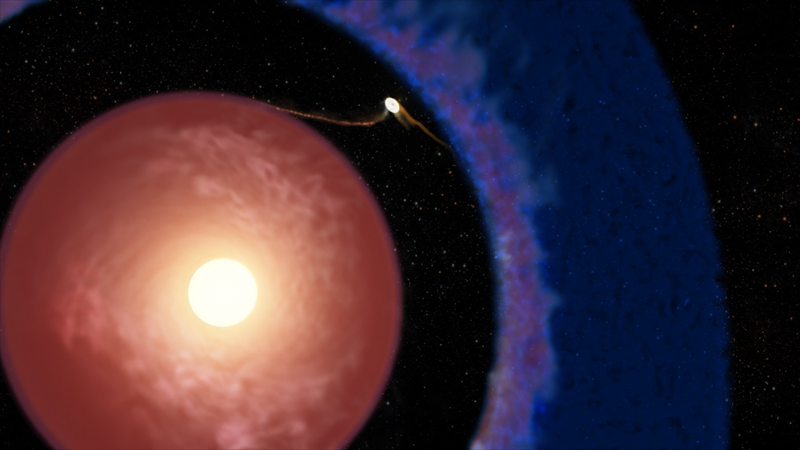
Artist's concept of Elias 2-24 b, the youngest known exoplanet, embedded in a gap of the dusty disk around its host star. The bright object inside the gap is the forming planet, pulling material from the disk edge. Credit: W. M. Keck Observatory / Adam Makarenko. Image source: NASA Science image asset page


Astronomers using archival data from the W. M. Keck Observatory have confirmed a planet that is younger than one million years, making it the youngest known exoplanet by a wide margin. The object, called Elias 2-24 b, sits 55 times farther from its star than Earth is from the Sun and is already about as massive as Jupiter. It is still pulling gas and dust from a dusty disk around its host star, deep inside a gap it has carved in that disk. NASA’s coverage of the announcement and ScienceDaily’s writeup both carried the same artist concept. Every previous record-holder for the youngest planet, including the two worlds orbiting PDS 70 and the two around WISPIT 2, was older than five million years. Elias 2-24 b undercuts that floor by a factor of more than five, and does so at a distance from its star where planet-formation models did not expect anything that large to have assembled yet. Gizmodo’s coverage of the paper flagged the same gap between observation and prediction.

The confirmation matters because it lands directly on a fault line in giant planet formation. Standard models predict that a Jupiter-mass planet at Jupiter’s distance from its star takes roughly five million years to build through the slow accretion of icy solids and gas. The longer the orbit, the longer the formation time, because the feeding zone of solid material is thinner out there. Elias 2-24 b is more than ten times farther from its star than Jupiter is from the Sun. By the textbook timeline, a Jupiter at 55 AU should still be a swarm of icy boulders with at most a thin gas envelope, not a clean planetary-mass object pulling disk material onto itself. Finding one anyway tells the field that at least one of the formation channels (core accretion, gravitational instability, or some hybrid) is faster than the prevailing models allow.

The story behind the detection is a ten-year relay between three observatories and a NASA-funded archive. Around 2016, the Atacama Large Millimeter/submillimeter Array (ALMA) in Chile imaged a sharp concentric gap in the dusty disk around Elias 2-24, a young star about 450 light-years from Earth in the Ophiuchus molecular cloud. Gaps like that one are a familiar sign that an unseen planet is sweeping up material along its orbit. The European Southern Observatory’s Very Large Telescope then picked up a faint infrared point source sitting in the gap, exactly where a planet should be. The catch was that the object was far enough from the star and buried in enough residual disk material that some astronomers argued it could be a background star or a disk feature, not a planet at all. For nearly a decade the question stayed open. Andrea Bernardi, a doctoral candidate at Universidad Diego Portales in Chile, decided to revisit the problem by searching the Keck Observatory Archive, a NASA-funded partnership between Keck and the NASA Exoplanet Science Institute at Caltech/IPAC, for coronagraphic images of the same field. Bernardi’s team found the point source again in Keck data taken in 2018 and 2020, and by stitching the two epochs together they could measure its motion against the background star field. Anything in the foreground should drift with the host star’s proper motion; anything in the distant background should stay put. The faint source moved with Elias 2-24, which closed the case in favor of a planet.

The lead author’s framing in the resulting paper, published in The Astrophysical Journal Letters on 16 September 2026, is that planet-formation theory is missing a process. Lucas Cieza, a professor at the Instituto de Estudios Astrofísicos in Chile and a co-author, put the gap in plain terms. “Our planet-formation models already struggled to explain the previous record holders for the youngest known planet, a four-way tie between two planets orbiting the star PDS 70 and two planets orbiting the star WISPIT 2, which are all more than 5 million years old,” he said. “Elias 2-24 b shows us that even our best planet-formation models are still missing some important processes.” Bernardi’s read was that the detection itself came from combining facilities rather than from any single instrument. “We usually hear about telescopes working separately, but this confirmation was possible only by using multiple telescopes together,” she said. “Elias 2-24 b is at the limit of what current telescopes can detect, but with new instruments like NASA’s Nancy Grace Roman Space Telescope, such detections should become easier.”

The mechanism at work in the disk around Elias 2-24 is the textbook version of how a giant planet interacts with its birth environment, and it is worth slowing down on it for a moment. A protoplanetary disk is a flat, rotating swarm of gas and dust that orbits a young star for the first few million years of its life. A planet that forms inside the disk does not simply sit there. As it orbits, its gravity pulls disk material toward it, but it also shears the disk on either side of its orbit. That shearing opens a low-density annular gap centered on the planet’s orbital radius, with a local pressure bump at the outer edge of the gap where drifting dust and pebbles pile up. The pressure bump is also where the planet’s gravity can grab more material: it acts as a slow conveyor belt feeding the planet from the outside. The result, on the timescales relevant for the system, is a planet whose mass grows as long as the disk is still there, and a gap whose width and depth encode the planet’s gravitational reach. The fact that ALMA saw a deep, well-defined gap at 55 AU, and that the same VLT imaging picked up a point source inside it, is what made the original Elias 2-24 system a planet-formation candidate in the first place. What the new Keck confirmation adds is that the candidate is now locked in by proper-motion evidence across a six-year baseline, not just by the static “is there a thing in the gap” image.

The numbers in the paper come with a real margin of uncertainty, which is worth being honest about. Mass estimates for young planets inferred from brightness are model-dependent because a planet’s luminosity at a million years is set by how much energy it absorbed while accreting, and that depends on the assumed disk conditions. The reported mass range for Elias 2-24 b, between roughly 1.9 and 4.0 Jupiter masses according to a SpaceDaily writeup of the ApJL paper and The Brighter Side’s reporting, comes from comparing the Keck infrared photometry against the ATMO-NEQ-STRONG 2023 atmospheric and evolutionary models. The age of the host star, which is also model-dependent for a pre-main-sequence object, drives most of that mass range. None of that ambiguity changes the headline. The object is a planet, not a background star, and it is younger than one million years by enough margin to clear the previous record by a factor of five.

The next round of discoveries in this regime is likely to come from Roman, NASA’s Nancy Grace Roman Space Telescope, which launched on 30 August 2026 aboard a Falcon Heavy and is now on its way to a Sun-Earth L2 halo orbit. Roman carries a coronagraph that is much more aggressive at suppressing stellar glare than anything currently flying, and the team’s own argument is that the same archival-style imaging technique applied at Roman’s sensitivity should pick up planets that are older but in tighter, more Jupiter-like orbits. Elias 2-24 b is about ten times farther from its host star than a true Jupiter analog would sit. A Roman-class survey that runs the same gap-and-proper-motion playbook across hundreds of nearby young stars could push the record from a single outlier at 55 AU toward a population of newborn Jupiters at 5 AU, which is where the existing formation models assumed the action was happening in the first place. For now, the youngest known planet is a single data point sitting in an unexpected place, and the open question is how many more like it are waiting in the same archive.


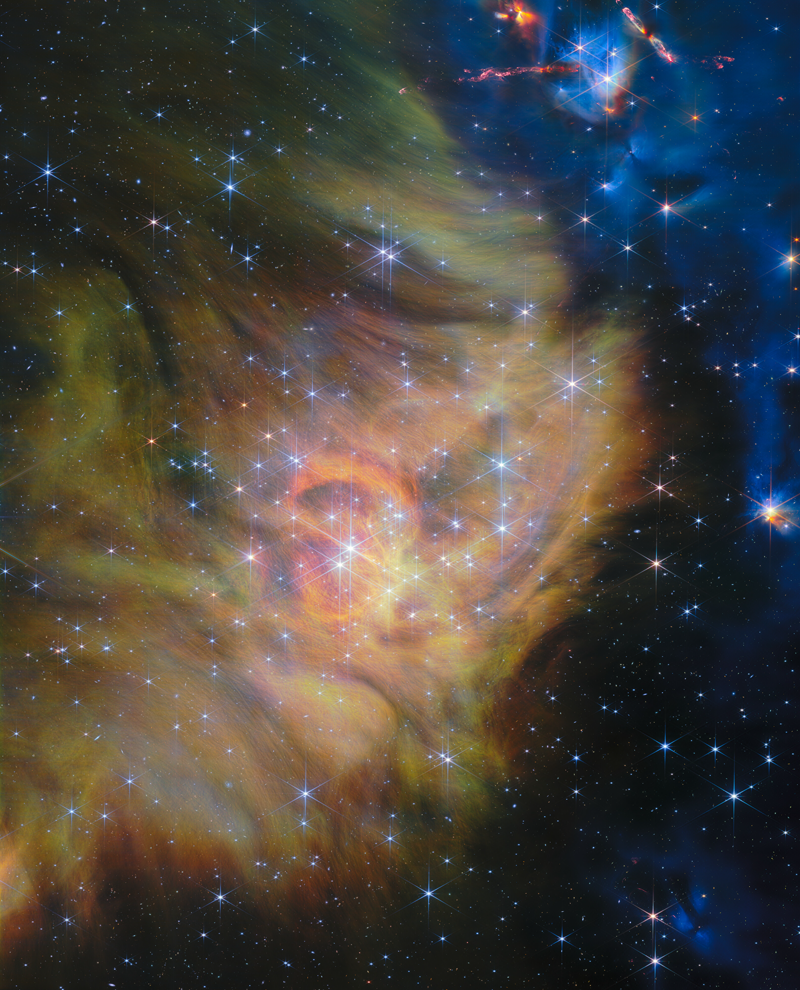
A near-infrared NIRCam mosaic of IC 348 in Perseus: orange and yellow dust lit by embedded young stars, with Webb's six-point diffraction spikes scattered across the field, and a small protostellar jet feature visible in the upper right.


In a star cluster about a thousand light years away, the James Webb Space Telescope has found brown dwarfs that weigh about as much as two Jupiters apiece. That is one fifth of one percent of the Sun’s mass, a figure that used to live exclusively in the planetary regime. The objects sit at the floor of how small a star-formation process is willing to go, and their spectra carry a chemical fingerprint no one had seen outside the solar system before. Researchers are now arguing they deserve their own spectral class.

The story comes from a paper by Kevin Luhman of Penn State and Catarina Alves de Oliveira of ESA, published in The Astrophysical Journal Letters and paired with a NASA/ESA/CSA Webb press release on 15 September 2026. The target is IC 348, a star-forming region in the constellation Perseus, sitting inside the larger Perseus Molecular Cloud about 1,000 light years from Earth. IC 348 is a familiar target for brown dwarf hunters; it has been productive for two decades because it is close enough that its lowest-mass members are bright, and young enough that its brown dwarfs are still warm and easy to detect. The cluster contains roughly 400 stars aged between two and five million years, surrounded by wisps of gas and dust lit up by the embedded young stars.

Why does the bottom of the mass spectrum matter? Stars form when cold clouds of molecular hydrogen collapse under their own gravity. The collapse squeezes the protostellar core until the center gets hot enough to fuse hydrogen into helium, and that nuclear ignition is what defines a star. Below about 8 percent of the Sun’s mass, the core never gets hot enough for sustained hydrogen fusion. Those objects are brown dwarfs, sometimes called “failed stars,” even though most of them briefly fuse deuterium early in their lives. The upper end of the brown dwarf range is reasonably well-defined, in the 60 to 75 Jupiter-mass zone. The lower end is not. Observationally, the population thins out and the objects fade, and the boundary where star formation simply stops producing bound objects is hard to pin down. Webb is well suited to the hunt because brown dwarfs are brightest in the infrared, and Webb is the most sensitive infrared telescope ever flown.

In 2022, Luhman and Alves de Oliveira used Webb to identify three new brown dwarfs in IC 348, with the faintest weighing only three to four Jupiter masses. The new paper pushes deeper. Using Webb’s Near-Infrared Camera (NIRCam) in 2024, the team imaged a wider field in IC 348 and identified thirty-nine new brown dwarf candidates based on color and brightness. They then turned to Webb’s Near-Infrared Spectrograph (NIRSpec) in 2025 to confirm which candidates were genuinely sub-stellar. Nine of the fifteen candidates they followed up spectroscopically turned out to be sub-stellar members of the cluster. The faintest two weigh only about 2 Jupiter masses each, or roughly 0.19 percent of the Sun. That is the lowest mass at which a brown dwarf has been confirmed by spectroscopy, and it shrinks the mass range of confirmed brown dwarfs by a factor of roughly seven.

One of those 2-Jupiter-mass objects also shows excess emission from a circumstellar disk, which is the standard signature of raw material for planet formation. If a brown dwarf near the planetary mass limit has its own protoplanetary disk, the eventual system would be hard to describe with familiar vocabulary. The “star” at the center would weigh only twice as much as Jupiter, and the planets would weigh less than that. The team’s framing in the paper is straightforward: a planetary system whose central object is only twice the mass of Jupiter is within reach of current data, even if the terminology is awkward.

The second headline result is the chemical one. Two of the three brown dwarfs from the 2022 study already showed an unidentified absorption at 3.4 micrometers in their spectra. The new data turned up the same feature in more brown dwarfs, for a total of eleven across the cluster. The team attributes the feature to an aliphatic hydrocarbon, a molecule built only from hydrogen and carbon, and notes that it has not been seen in any atmosphere outside the solar system. Methane, the signature hydrocarbon of cool brown dwarfs and gas-giant planets, is conspicuously absent. Because the 3.4 micrometer band grows stronger as the brown dwarfs get fainter, the researchers argue that the carrier is a natural product of the coolest brown dwarf atmospheres rather than some chance contaminant. They propose defining a new spectral class, “H,” keyed to the presence of the 3.4 micrometer fundamental band. If the community adopts the label, it will sit alongside the existing M, L, T, and Y classes as the spectral type for the bottom of the substellar sequence.

The deeper NIRCam imaging that produced this paper’s mosaic is itself a milestone. The IC 348 image, drawn from Webb observing program 4866, is one of the largest single Webb mosaics released to the public and was featured in NASA’s September 2026 image release channel. A phys.org writeup of the same result underscored the parallel between the brown dwarf discovery and the protostellar outflows in the frame: this single Webb pointing produced both the lowest-mass brown dwarfs yet confirmed and a fresh look at the youngest stars still in the process of forming.

The mosaic itself shows a field of orange and yellow nebulosity across most of the frame, scattered stars crowned with Webb’s six-point diffraction pattern, and in the upper-right corner a compact collection of protostars with bright jets and Herbig-Haro objects. The horizontal jet in the upper right is HH 797, which the imaging resolves into two protostars with nearly parallel outflows. The propeller-shaped object just to its right is HH 211, an outflow that shows narrow jets nested inside broader lobes. Those outflow features are not part of the brown dwarf result, but they sit in the same field and help explain why IC 348 keeps yielding surprises: it is still actively making stars.

The next steps are mostly spectroscopic. Luhman and Alves de Oliveira want higher-resolution JWST spectra of the same objects to nail down which specific hydrocarbon molecule is responsible for the 3.4 micrometer band, and they are calling for atmospheric modelers to explain why methane is missing in objects this cool. The remaining brown dwarf candidates from the NIRCam survey, twenty-four of them, still need spectroscopic confirmation, and at least two of them may sit near one Jupiter mass. If those candidate masses hold up, the brown dwarf mass floor would drop further, and the question of whether star formation can produce planetary-mass objects in isolation, with no host star in sight, would become a routine observational target rather than a curiosity.

The broader context is that Webb has been quietly redrawing the mass sequence at both ends for the last three years. The IC 348 result extends the bottom end downward, while complementary surveys of massive quiescent galaxies are pushing the top end of the stellar initial mass function upward. The combination suggests the mass spectrum of objects that come out of gravitational collapse is broader than the textbook categories, and that the boundaries between star, brown dwarf, and planet are matters of definition rather than physics. A 2-Jupiter-mass object with its own protoplanetary disk, glowing with a hydrocarbon feature found only in itself, is a clean illustration of the problem. Call it a brown dwarf or call it a rogue planet host; either way, Webb just put a number on the smallest thing nature seems willing to make by itself.


October 8, 2026

Bennu formed where fire met ice

Posted by


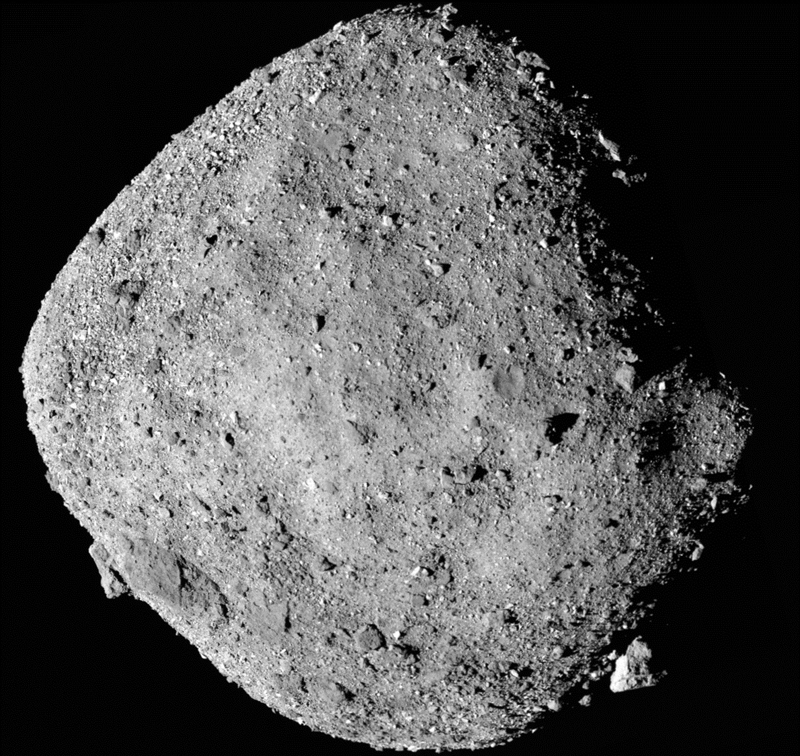
A diamond-shaped asteroid, Bennu, photographed against black space by NASA's OSIRIS-REx spacecraft from a range of 24 kilometres, showing a rubble-pile surface covered in boulders of various sizes


Half a gram of asteroid dust, split among three transition metals, has rewritten where Bennu came from. A team led by Maria Schönbächler at ETH Zurich reports on 23 September 2026 in Science Advances that Bennu, the near-Earth asteroid visited by NASA’s OSIRIS-REx spacecraft between 2018 and 2021, did not assemble in the cold outer reaches of the young solar system the way most researchers assumed. It assembled instead near the water-ice line, in the narrow band where temperatures were cold enough to freeze water vapour into solid ice and warm enough inside to keep it as a gas. The work leans on isotopes of iron, titanium and chromium measured in five Bennu sample portions at ETH’s isotope geochemistry lab, and it points to a culprit for the unusual chemistry: Jupiter, which grew large enough, fast enough, to filter coarse material out of the dust disk before Bennu’s parent body could form.

Source: NASA/Goddard/University of Arizona Bennu mosaic on Wikimedia Commons (public domain).

Bennu’s chemistry has been a quiet puzzle for most of the past decade. Earlier sample studies, including the joint OSIRIS-REx and Hayabusa2 preliminary results, had placed it in a family of carbon-rich objects whose closest meteoritic relatives on Earth are the rare CI chondrites: carbon-rich, water-bearing, and chemically the closest match in the meteorite collection to the Sun’s own composition, with very little thermal alteration since the solar system’s birth. What no one had pinned down was where in the protoplanetary disk that fingerprint had been laid down.

The old model put Bennu-class objects far out in the disk, beyond where most comets form, where accretion was slow and hydrated minerals could survive undisturbed. The new isotope measurements turn that on its head. Iron and titanium are distributed so well throughout the Bennu material that the parent object cannot have been a single coarse clump; it must have been built from fine dust mixed across the disk, with ice acting as a glue that bound fine particles into larger aggregates on the cold side of the water-ice line.

The phrase Schönbächler uses for the result is direct: Bennu is a hybrid. It does not clearly match either the inner or the outer solar system. It bears characteristics of both regions, because it was assembled in the specific transition zone where material from both sides met, according to the ETH Zurich announcement.

To anchor that conclusion, the team compared Bennu against the other carbon-rich sample-return target in the modern catalogue: Ryugu, the asteroid Hayabusa2 visited in 2019. The two objects share an isotopic fingerprint with each other and with the CI chondrites, all distinct from the rest of the meteorite collection and from other sampled asteroids. The authors frame the open question as a population question: if Bennu and Ryugu both formed in the same zone, what is that zone producing that sends objects to near-Earth orbits, and are these two a coincidence or a sample of a broader pattern?

That question hands the baton to the next sample-return missions. China’s Tianwen-2 arrived at the quasi-satellite Kamoʻoalewa this summer and is expected to return a sample in 2027. Japan’s MMX mission, scheduled to launch from Tanegashima in October 2026 on an H3, is set to bring back material from Phobos in 2031; Phobos is itself a possible captured asteroid, and a Phobos sample with a Bennu-like signature would extend the snow-line zone picture to the Mars system. The next-mission parallel was also flagged in Space.com’s coverage.

The water-ice line is not a feature of the finished solar system; it is a feature of the protoplanetary disk, the rotating torus of gas and dust around the young Sun. Inside the line, water vapour stays in gas form. Outside it, water freezes onto dust grain surfaces as ice. In standard models the boundary sits somewhere near the present-day orbit of Jupiter, roughly five astronomical units out, and that distance matters because the disk’s solid inventory changes composition sharply there: inside the line, rocky dust; outside, ice-coated dust; and right at the boundary, a transition layer where ice can sublimate, migrate inward as vapour, and recondense.

The new analysis proposes that this transition layer was the assembly site for Bennu, Ryugu, and the CI chondrites, with Jupiter acting as an active filter rather than background. The gas giant formed within roughly one million years of the Sun’s birth, and its gravitational influence quickly became a barrier in the disk. Coarse, clumpy material could not easily cross Jupiter’s orbital neighbourhood; fine dust could, routing around Jupiter from multiple radial directions and arriving well mixed. The result is an unusually homogeneous feedstock for planetesimals forming in the transition zone near the snow line, and that homogeneity is what the Bennu isotope data see.

The team’s mechanism also explains two aspects of the sample. The first is water. Bennu’s parent body incorporated enough ice that, when it was later broken up and the fragments were warmed by the Sun, hydrated minerals appeared in the regolith in the proportions the OSIRIS-REx analysis measured. Ice from just outside the snow line can sublimate as the disk evolves, drift inward as vapour, and recondense inside the line, so a transition-zone planetesimal ends up with both rocky and icy inputs. The second is the chemical match to the Sun. Fine dust, mixed by the disk’s turbulence and routed around Jupiter, ends up with a bulk composition close to the pre-solar nebula because it has not been sorted into coarse and fine reservoirs. Bennu samples that average composition better than any other available asteroid material.

For the broader picture, the implication is that the asteroid belt is not the only reservoir of primitive material in the inner solar system. Near-Earth asteroids like Bennu and Ryugu may be sampling a specific radial slice of the early disk that the main belt, with its heavy thermal and collisional processing, has blurred out. If planetary migration can scatter snow-line objects into near-Earth orbits, then the Bennu sample is not a quirk of one asteroid but a window onto a specific formation environment that the meteorite collection only hints at.

What is striking about the result is how much depends on a small measurement. The five Bennu sample portions, totalling a fraction of a gram, were analysed for isotopic ratios of three elements at a single laboratory over months. None of that is large-scale geophysics or a flagship space telescope survey. It is the kind of bench-scale work that historically has rewritten meteorite science, and it has now done so for an asteroid whose sample exists on Earth only because a NASA spacecraft flew for two and a half years to a rock the size of a small mountain, picked up its surface with a robotic arm, and parachuted the result home.

The Bennu story is not finished. Sample analysis at laboratories around the world is ongoing, with new allocations going out in waves as the OSIRIS-REx curatorial team works through the 120 grams that came back. Schönbächler and her collaborators flag the open question directly: are other asteroids in the same isotopic family, and how widespread is the snow-line zone fingerprint across the inner solar system? That question will not be answered by Bennu alone. It will be answered by what comes back from Kamoʻoalewa, then Phobos, then whatever the next generation of sample-return missions chooses to visit.

For now, the picture is this: Bennu is chemically the closest match in our sample collection to the mixture of elements the Sun itself inherited. Its formation was not a quiet outer-disk story; it was a product of a specific radial neighbourhood in the young solar system, with Jupiter acting as the gatekeeper that kept coarse material out and let fine dust through. The fact that we have a piece of it in a laboratory in Zurich, three years after it fell out of the Utah sky, is a measure of how much of the early solar system can be reconstructed from a sample small enough to lose between your fingers.