


NASA opens Dragonfly’s passenger list for a ride to Titan
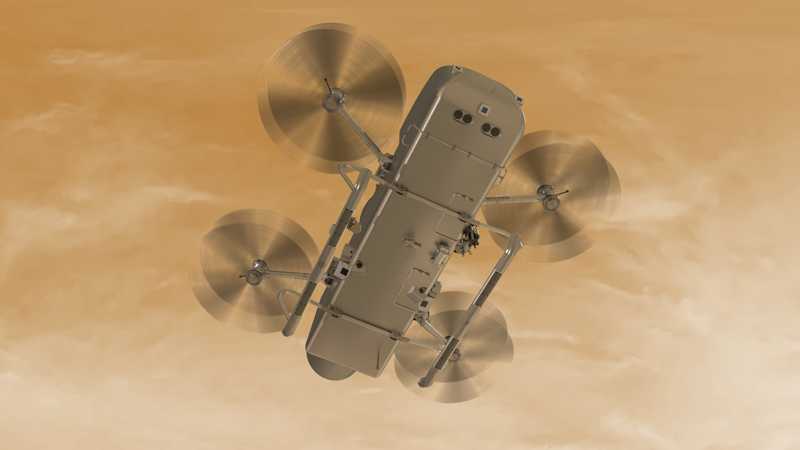
Image: NASA’s Dragonfly rotorcraft on the surface of Titan. Credit: NASA/Johns Hopkins APL, via Wikimedia Commons.
You will probably never stand on Titan. You will certainly never fly over its dunes in the way a helicopter flies over a desert on Earth, because the atmosphere is thick and orange and the gravity is a fraction of what you are used to, and nothing about the place is hospitable. But your name can go. NASA is inviting the public to have their names written onto a microchip that will be carried aboard Dragonfly, the rotorcraft now being assembled at the Johns Hopkins Applied Physics Laboratory in Laurel, Maryland, for a mission to Saturn’s largest moon (NASA’s announcement of the name campaign). People who sign up also receive a personalised digital boarding pass commemorating their place on the list. The window closes at 11:59 p.m. EST on 15 January 2027 (Johns Hopkins APL on the passenger list).
That deadline is a strange thing to set for a spacecraft that will not launch until 2028 and will not arrive at Saturn until 2034. It is also rather the point. A boarding pass for a flight that departs in seven years is not a ticket you will use. It is a token, and its value is symbolic rather than practical, which is exactly what makes the campaign worth running in the first place.
Dragonfly is the first aircraft to fly on another world. NASA describes it as a first-of-its-kind rotorcraft that will move between sites across Titan’s surface, and it is the fourth mission in the agency’s New Frontiers programme, selected in 2019 and managed from Marshall Space Flight Center, with Elizabeth Turtle of APL as principal investigator (NASA’s Dragonfly mission page). The mission profile is long. Dragonfly launches in 2028, arrives in 2034, and then flies for roughly three and a third years, making a flight every one or two Titan days, with each of those flights lasting about sixteen Earth days. The gap between Titan days is the kind of detail that only matters if you are planning to sample a place where the weather changes faster than your fuel.
The vehicle itself is more compact than its mission. It weighs 1,900 pounds, or 875 kilograms, measures 12.5 feet across in both length and width, stands 5.5 feet tall, and carries eight sets of 53-inch coaxial blades (NASA on Dragonfly’s specifications). That eight-rotor arrangement is what allows an octagonal body to fly: one pair can always be turning while the craft sets down on a leg, and the symmetry means it does not need to be kept level in the way a conventional helicopter would. The rotors make noise only in the sense that they displace Titan’s thick nitrogen atmosphere, which is otherwise almost uncannily still.
Power is the quiet constraint on everything else. Sunlight at Saturn is roughly a hundredth of what it is at Earth, so solar panels are not an option, and Dragonfly carries a Multi-Mission Radioisotope Thermoelectric Generator, the same class of device that keeps Curiosity and Perseverance alive on Mars, backed by a 134 ampere-hour battery for the hours when the generator is carrying less of the load. The generator converts the slow decay of plutonium-238 into heat and then into current, and it will do that for years without moving, refuelling or being inspected. It is the reason the vehicle can cross 115 kilometres of Titan in a primary mission that will visit 20 to 30 separate sites, moving tens of miles in under an hour rather than creeping between them the way a rover must.
What Dragonfly is actually looking for is not life. Zibi Turtle, the mission’s principal investigator, puts it plainly: the mission is not about detecting life, it is about investigating the chemistry that came before biology here on Earth. Titan is the useful place to do that because it is chemically strange in the specific ways that matter, with rivers and lakes of liquid methane, thick organic haze, and a surface that is a mixture of water ice and hydrocarbon dust rather than rock and soil. The question Dragonfly carries is whether the same chemistry that ran on early Earth had anywhere else to run, and how far it got. Instruments aboard the rotorcraft will analyse the chemistry of surface samples directly: a mass spectrometer to characterise the organic compounds present, a gamma-ray and neutron spectrometer to measure elemental composition at the surface, and a camera suite to map landforms and processes at several scales. Planned targets include the dune fields and the 100-kilometre Selk crater.
Flying is what makes that possible. Titan’s dense, calm atmosphere and low gravity mean a rotorcraft can cross terrain that would stop a wheeled vehicle cold, and it can revisit sites as the seasons change them. The trade is patience: the mission schedule is built around a solar day on Titan, a sixteen-day cycle that determines when the vehicle can fly and when it must sit still and wait out the weather.
The hardware is further along than it was a few months ago, which makes the campaign feel less like a thought experiment. In late June, the team at APL handed over the fuselage, a structure a little under 13 feet long, so that the next phase of spacecraft integration could begin ahead of schedule, and the work of populating it started in early July (NASA’s Dragonfly blog on the rotorcraft taking shape). The frame carries the features that make the vehicle recognisable, including the landing skids, the cap over the power source and the arms that will hold the rotors. In May the team integrated the high-gain antenna, a 34.4-inch disc that operators use to talk to the craft and pull down its data, mounted on a motorised arm that raises it when the vehicle is stationary and folds it into a locking mechanism before each flight. The craft has also been hung from four bungee cords above the floor of an APL clean room for ground vibration testing, so that engineers can watch how vibration from the rotors travels through the body and whether it interferes with the equipment inside.
None of that would be possible without the transport, and the transport is the reason the campaign was worth running now. NASA has flown names on spacecraft before. A disc of names flew on Curiosity, and names also went up on Kepler, on the Pluto-bound New Horizons probe, and on the Mars orbiter MAVEN (collectSPACE on the tradition of flying names aboard NASA spacecraft). The practice has run for decades and has never stopped being slightly absurd, a piece of the public folded into the payload so that the mission is shared by people who will never see it work. What is new with Dragonfly is the scale of the sharing. One rotorcraft, one microchip, a list of names that could run to millions, and a vehicle that will spend three years moving across a moon in the outer solar system.
The people behind it are unembarrassed about the sentiment. Nicky Fox, associate administrator for NASA’s Science Mission Directorate, says “NASA’s Dragonfly mission will simply blow your mind”, and Turtle says “we want everyone to share in this adventure”. The campaign closes on 15 January 2027, and after that the names are sealed into a chip that will wait on the ground for another year before it rides to Saturn on a rocket, then wait in space for six more years, then be carried down through an atmosphere of liquid methane and nitrogen by a machine that has never existed before. Nobody who signs up will see any of it. They will have been on board, in the only sense available to them.
 Subscribe to our RSS feed









There are no comments.
Add A Comment