


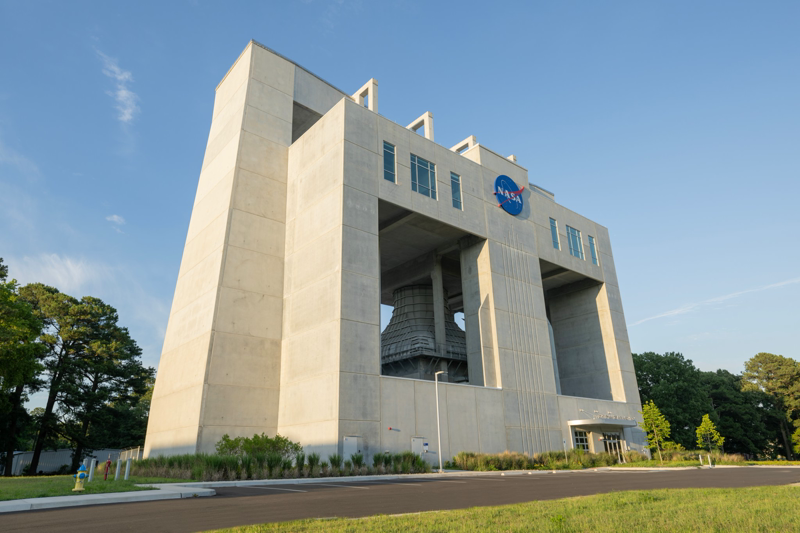
For more than 100 years, the wind tunnels at NASA’s Langley Research Center have shaped how aircraft fly and how spacecraft return to Earth. On July 31, 2026, the agency opened the Flight Dynamics Research Facility (FDRF), the first major wind tunnel NASA has built in more than 40 years. At 140 feet tall and roughly 25,000 square feet, the new facility in Hampton, Virginia, replaces two of the center’s oldest test rigs, the 1939 12-Foot Low-Speed Tunnel and the 1941 20-Foot Vertical Spin Tunnel, with a single vertical tunnel that can run faster, larger, and more detailed tests than either of its predecessors.
The opening is more than a ribbon-cutting. It is the first time in a generation that NASA has stood up a brand-new wind tunnel at all, and the FDRF arrives at a moment when the agency is preparing to return astronauts to the Moon, send a rotorcraft to Titan, and design aircraft for Mars.
Wind tunnels are the workhorse of every flight program that has ever flown. Before a new aircraft shape, a reentry capsule, or a supersonic body is committed to metal, engineers drop a scale model into a moving column of air and watch how it behaves. The data from those tests feeds the simulations that predict how the full-scale vehicle will handle turbulence, control inputs, parachute deployment, and spin recovery.
Langley in particular has been a center of that work since the NACA era. The 20-Foot Vertical Spin Tunnel was the only operational tunnel of its kind in the Western Hemisphere that could run free-spin tests on dynamically scaled aircraft models, and according to the NASA Langley Research Directorate and the agency’s facility page for the VST, nearly every USAF and USN fighter, trainer, and attack aircraft since World War II has been tested there. The 12-Foot Low-Speed Tunnel, which began operations in 1939, hosted everything from biplane-era stability studies to the X-29 forward-swept-wing demonstrator, the X-31 Enhanced Fighter Maneuverability aircraft, the X-59 quiet supersonic research plane, and the aeroshell for NASA’s Dragonfly rotorcraft now being prepared for a flight to Saturn’s largest moon.
Both tunnels were deactivated last year. Replacing them with a single facility that consolidates the capabilities of two NACA-era buildings is a deliberate move toward a more flexible, more efficient research platform, and a hedge against the maintenance burden of running machines that were already past their design lifetime.
On Friday morning, NASA Administrator Jared Isaacman, Langley Center Director Dr. Trina Dyal, U.S. General Services Administration Administrator Edward C. Forst, and a phalanx of Virginia state and local officials cut the ribbon on the FDRF at NASA Langley. The 140-foot building, the fourth new facility GSA has delivered to NASA under Langley’s 20-year campus revitalization plan, was built in partnership with GSA to replace aging infrastructure with an energy-efficient design that should reduce maintenance costs for the next several decades.
The FDRF’s signature feature is its vertical test section, where air moves upward through a 20-foot-diameter chamber, the largest such chamber ever operated at Langley. A model is dropped into the rising airflow and either flies freely to study stability and control, or is mounted on a rig to measure forces and moments directly. The fan system behind that airflow consists of four 750-horsepower motors, each driving a 14-foot-diameter, eight-bladed carbon fiber fan. Combined, the system can push the wind to 117 miles per hour, roughly twice the top speed of the two facilities it replaces, and enough to lift heavier scale models for free-flight simulations of full-scale vehicles flying at high altitude. That includes reentry capsules coming back from space.
The $57 million facility, per local coverage of the ribbon-cutting, is managed under the Aerosciences Evaluation and Test Capabilities portfolio in NASA’s Aeronautics Division, and its research portfolio is already mapped out. Engineers will use it to validate X-plane designs, study autonomous and drone flight, refine entry, descent, and landing systems for the Artemis program, and gather data for hypothetical Mars aircraft. Six wooden fan blades and the central metal fan hub from the 1939 12-Foot tunnel are on display inside the new control room; the lobby carries a timeline of both legacy facilities, with historic test models flanking the entrance.
A vertical wind tunnel is built around a deceptively simple idea. A model is dropped into a rising column of air, and the lift from that column holds the model aloft in the same way a wing’s lift holds an aircraft in the sky. By adjusting the airspeed and the model’s attitude, researchers can recreate the forces a real vehicle would feel in flight, including the asymmetric, unstable conditions of a stall or spin, without ever risking the full-scale vehicle. The original 20-Foot VST, which was designed to study stall and spin characteristics after deadly postwar accidents, used exactly this approach. Engineers hand-launched models into the rising airstream to evaluate how aircraft behaved when they lost lift.
The FDRF keeps the same physics but scales it up. The 20-foot test section admits more air around each model, which improves data accuracy and allows larger, more detailed test articles. The doubled airspeed means the tunnel can simulate higher-altitude flight regimes, where thinner atmosphere makes aerodynamic testing harder. Carbon fiber fan blades replace the heavier metal blades of the legacy tunnels, so the fan can change airspeed quickly during a free-flight test, a key capability for capturing transient events like a recovery from a spin or the deployment of a drogue chute.
Equipment reuse is part of the engineering story. Many of the major test rigs, instrumentation racks, and data systems from the 12-Foot Low-Speed Tunnel have been repurposed for the FDRF, which reduced both cost and the time needed to bring the new facility online. NASA’s Mike Fremaux, the retired chief engineer for Langley’s Intelligent Flight Systems division, who spent 30 years shepherding the project, frames the continuity in human terms as well: “You can’t have one without the other. Not just the buildings, the fans, and the motors, but also the expertise associated with those facilities.”
The facility will support three broad classes of work. First, atmospheric flight: X-planes, autonomous aircraft, military and commercial airframes, and high-altitude long-endurance drones. Second, planetary atmospheric flight: rotorcraft and fixed-wing concepts for Mars and Titan, where Dragonfly is the lead customer. Third, entry, descent, and landing: full-scale drop tests of capsule shapes returning from lunar and deep-space missions, where the FDRF’s 117 mph ceiling and large test section are uniquely well matched to the problem of stabilizing a vehicle that is descending through a thickening atmosphere.
Langley’s new wind tunnel opens with a workload that ranges from the near-term (X-plane and Artemis entry, descent, and landing) to the speculative (Mars aircraft, Titan rotorcraft). It also points to a longer arc. The 12-Foot tunnel that just closed supported 86 years of work, from biplanes to supersonic demonstrators; the VST that closed alongside it supported nearly every U.S. military aircraft since the 1940s. The 25,000-square-foot FDRF is built to do at least as much. The new control room, the lobby timeline, and the wooden fan blades on display are the agency’s way of saying that the next 86 years start now.
The first FDRF test campaigns are expected to begin in the coming months, with Artemis capsule stability work and Mars aircraft concept studies both on the early schedule.
 Subscribe to our RSS feed









There are no comments.
Add A Comment