


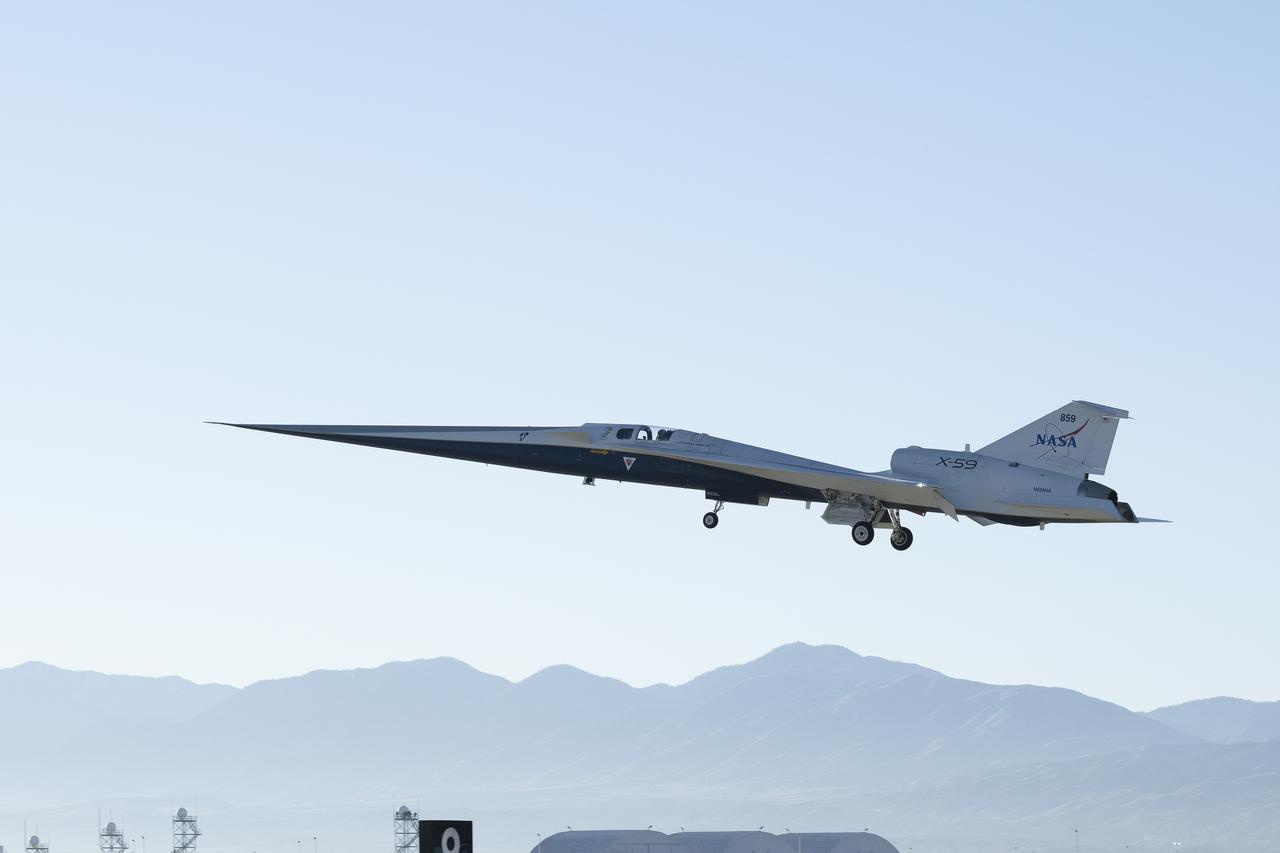
In the last week of September, NASA’s X-59 Quesst flew six times in four days. Two flights on September 22, then two more on the 24th, then two more on the 25th. The previous best was four, so the team didn’t just break its own record; it lapped it. One of those flights also pushed the aircraft to Mach 1.53, roughly 1,010 miles per hour, the fastest the X-59 has gone in the year since Lockheed Martin’s Skunk Works rolled it out of the Palmdale paint shop (NASA Quesst blog, October 2 2026). The run brought the program’s total to 38 test flights, and the aircraft is now in a scheduled three-week maintenance stand-down before the next phase of envelope expansion.
The X-59 is, on paper, the most unassuming supersonic jet ever built. It has no forward windshield. It is shaped like a long black arrow with a 33-foot nose spike, the cockpit pushed so far back that the pilot flies by reference to an external vision system, a four-camera array feeding a single high-resolution display. The whole point of the thing is what it does not do: it is designed so that the shock waves it generates at cruise do not coalesce into a single audible boom when they reach the ground. NASA wants the on-the-ground signature to come in around 75 effective perceived noise decibels, a level the agency compares to a car door closing two houses down (NASA, Quesst: The Vehicle; Lockheed Martin X-59 product page).
The reason that number matters has very little to do with engineering aesthetics and everything to do with regulation. Civil supersonic flight over land is, with limited exceptions, banned in the United States under FAA rules that trace directly back to the sonic boom problem. The Concorde, which flew at Mach 2.02 over the ocean and on a few chosen overland corridors at subsonic speeds, retired in 2003 partly because its boom made overland expansion politically impossible. Twenty-three years later, no commercial airliner has flown faster than sound over the contiguous United States. The X-59 is NASA’s bet that a different shape can produce a different shock structure, and that if the shock structure is quiet enough, regulators will eventually rewrite the rule.
The hardware story begins in February 2016, when NASA awarded Lockheed Martin a preliminary design contract under the Low-Boom Flight Demonstrator program. In April 2018, the agency converted that study into a $247.5 million build contract, the largest single X-plane procurement in a generation. Skunk Works in Palmdale, California, did the structural work. NASA Langley ran an 8%-scale model through three weeks of wind-tunnel testing in late 2017, sweeping angle of attack out to 50° and 88° at low speed to map the static margin and dynamic response of the unusually long forebody. The critical design review closed in September 2019, construction crossed the halfway line in late 2020, and the aircraft was rolled out, fully painted, in January 2024 (Lockheed Martin X-59 Quesst, Wikipedia; NASA Quesst gallery).
The first flight came on October 28 2025, subsonic, out of Armstrong Flight Research Center at Edwards Air Force Base in the Mojave. The aircraft stayed subsonic through the early envelope, and on April 3 2026 the team flew wheels-up for the first time, reaching 20,000 feet and roughly 460 mph. The first supersonic run came on June 5 2026, and a week later, on June 12, the X-59 reached its design cruise point of Mach 1.4 at 55,000 feet. What the late-September record set adds on top of those milestones is volume: not a single new speed or altitude, but the demonstrated ability to turn an experimental one-off into something that flies like a working test article, twice a day, on back-to-back days.
The underlying physics the aircraft is built to exploit is called Mach cutoff shaping, and it is older than the X-59 by several decades. A supersonic aircraft generates two main shock waves, one from the nose, one from the tail, and in a conventional shape those shocks hit the ground as two closely spaced impulses that the ear fuses into a single boom. The trick is to design the airframe so that the upper-frequency components of the pressure signature are refracted upward by the natural temperature gradient of the lower atmosphere, never reaching the surface. The rule of thumb is that a ray of the shock will be turned away from the ground if the local sound speed increases faster than the local Mach number falls as the ray climbs. In practice, that means the X-59 has to be flown within a tight band of altitude and speed; outside that band, the rays bend back down and the boom returns.
The airframe itself encodes the same idea geometrically. The 33-foot nose is shaped to spread the nose shock over a longer distance, lowering its peak overpressure. The planform is built around a long, thin fuselage with a single low-sweep wing and a horizontal tail deliberately set high enough to keep the tail shock from merging with the wing shock. Wind-tunnel Schlieren imaging in 2018 confirmed the resulting pressure signature on the ground: a rise time of about 6 milliseconds and a peak overpressure of about 0.5 pounds per square foot, low enough that listeners describe the event as a thump rather than a bang (Sonic boom, Wikipedia, Mach cutoff references; CNN, August 6 2026).
The reason nobody has been able to demonstrate this in commercial service yet is the public response. A 75 EPNdB thump is in the same A-weighted decibel range as a dishwasher running in the next room, but supersonic cruise would put that thump over populated areas that have never heard anything louder than a turboprop. To find out what people actually think, NASA plans community overflight tests in 2026 and 2027, dropping F/A-18 Hornets into shallow dives from 50,000 feet to reproduce the X-59’s signature without the X-59, then asking residents to rate the noise. The agency needs that data to take to the International Civil Aviation Organization’s Committee on Aviation Environmental Protection, which sets the supersonic noise standard, and to the FAA, which would have to amend 14 CFR Part 91 to permit overland cruise. Without that amendment, an aircraft that thumps instead of booms is still illegal to fly over Denver.
The next three weeks of maintenance, after the record run, are scheduled around exactly that preparation. When the X-59 returns to the air, the team plans to expand the flight envelope further before the first community-response flights. Whether the data ultimately change ICAO and FAA rules is not a question the engineers can answer; they can only build the airframe that makes the question worth asking. The September record tells you how far that build has come: from a concept on a Lockheed whiteboard a decade ago, to an aircraft that can fly two missions a day for three days in a row, faster than any civil airplane has flown over the United States in a generation.
 Subscribe to our RSS feed









There are no comments.
Add A Comment