


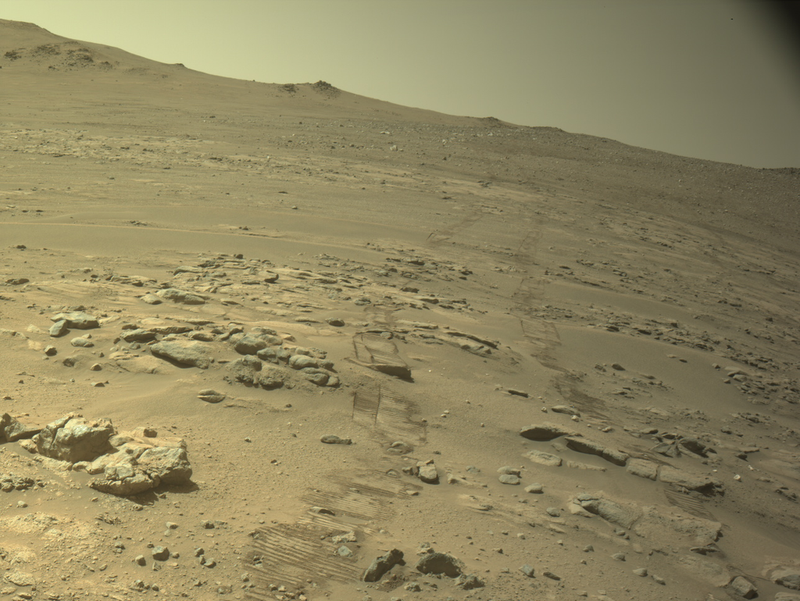
On 11 October 2026, NASA’s Perseverance rover rolled past a line nobody had crossed before. After 299.6 feet (91.31 meters) of driving on its 2,006th Martian day, the rover’s odometer read 28.10 miles (45.22 kilometers), nudging it 0.04 miles past the 28.06-mile (45.16-kilometer) total that Opportunity, its predecessor, had built up across nearly fifteen years of service on Mars. The new figure makes Perseverance the farthest-driven vehicle ever operated on the surface of another world, with margin enough that the gap will only widen as the rover keeps climbing the western rim of Jezero Crater. The number is small in absolute terms, a Sunday stroll in a city park would cover more ground, but on Mars the steps add up slowly, and the record has stood since 2018.
The reason this matters has less to do with the odometer than with what the odometer is measuring. Setting a distance record on another planet is not a vanity project. It is a budget statement: how much ground a mission can cover in a fixed number of sols, how many distinct outcrops the science team can visit, and how many rock and regolith samples the rover can collect before its hardware gives out. Perseverance has collected twenty-nine samples already, from an ancient lakebed at the bottom of Jezero, from a delta fan built by a long-vanished river, and now from the rim itself, where the geology changes character. Each new mile opens another valley, another ridge, another chance to find traces of ancient water chemistry that a stationary lander would never see. The original mission specification called for no more than 12.4 miles of driving. The team has now more than doubled the contract.
This is the fourth chapter in a thirty-year American experiment in mobile Mars geology, and each rover in the sequence has reset what counts as routine. Sojourner, the microwave-oven-sized cart that landed with Mars Pathfinder in 1997, rolled about 330 feet (100 meters) during an 83-sol mission before its solar panels gave up. Spirit and Opportunity arrived in 2004 with ninety-sol prime missions, and Opportunity, in particular, refused to stop. It crossed the first extraterrestrial marathon in 2015, logged 5,111 sols of operation, and racked up the 28.06-mile total that Perseverance just surpassed. Spirit covered 4.8 miles before getting stuck in soft soil and succumbing to a Martian winter in 2010. Curiosity, which landed in Gale Crater in 2012, is still working and has logged more than 23.65 miles (38.07 kilometers). The pattern is the same each time: longer missions, longer drives, and a better understanding of what the rovers can be trusted to do on their own. Perseverance also has the lunar record in its rear-view mirror, having already overtaken the 22.2 miles covered by the Apollo 17 astronauts in 1972 and the 24.2 miles racked up by the Soviet Union’s Lunokhod 2 rover in 1973.
The deeper reason Perseverance is pulling away is software. A navigation system called AutoNav lets the rover think while it drives, building a three-dimensional map of hazards on the fly and picking its own path between waypoints chosen by rover planners on Earth. The version flying on Perseverance is orders of magnitude sharper than the original AutoNav that flew on Spirit and Opportunity: where Sojourner evaluated the path ahead with twenty measurement points, Perseverance processes six hundred thousand of them each time it looks. Roughly ninety percent of Perseverance’s total driving distance has come under AutoNav, compared with about five percent for the earlier generation. The rover has covered as much as 1,351 feet (412 meters) in a single sol under AutoNav, a figure that would have been unthinkable during the Opportunity era. Steven Lee, the project manager for Curiosity and Perseverance at NASA’s Jet Propulsion Laboratory, called the milestone a privilege to be part of, noting that the original mission specification capped driving at 12.4 miles and that all mobility systems remain in good shape for many more years of record-setting. Mark Maimone, deputy team chief for robotic operations, said the team is not finished improving Perseverance’s driving: newer software teaches the rover to minimize steering, roll more, and cross-check its position against orbital maps mid-drive. The next engineering target is glare in the navigation cameras, which still forces the rover to stop driving by mid-afternoon whenever the Sun is ahead, and teaching it to look past those artifacts would give every future Mars rover a longer working day. NASA Science blog (12 Oct 2026), NASA JPL news (11 Oct 2026)
The science payoff from the extra mileage is already showing up. The record-breaking sol took place inside a strip of terrain nicknamed Lac de Charmes on the western rim of Jezero, an area of the crater wall the science team picked specifically because the rocks there are some of the oldest Perseverance will ever see, pieces of crust old enough that their Earthly equivalents have been erased by erosion and plate tectonics. Mars has no plate tectonics, so the equivalent record is still readable on the surface. The rover is heading toward an outcrop named Idubi, where it will look for evidence of ancient hydrothermal systems, the kind of mineral-rich, hot-water environments that on this planet often host the most interesting microbial communities. The earlier leg of the mission already produced one potential biosignature, at a rock called Cheyava Falls in the ancient river delta, and Lac de Charmes is a chance to test whether similar chemistry shows up in a completely different part of the crater. NASA approved Perseverance’s first mission extension this month, a commitment that will carry the rim work through roughly the end of 2028 and, after Lac de Charmes, toward Rainbow Falls, a 328-foot-wide (100-meter-wide) block of ancient crust that was shoved into place by the same impact that created Jezero in the first place. The image that the team released to mark the milestone is a navigation-camera frame from the record sol: a stretch of rocky Martian ground under a dusty sky, with fresh rover tracks curving off into the distance. It is a working picture, the kind of frame the navigation team uses to plot the next day’s drive, not a glamour shot from Mastcam-Z, and that feels right for what is being celebrated. As long as the wheels turn and the software holds up, the number on the dashboard will keep climbing, and the science team will keep pulling rocks out of rocks that have been sitting on the surface of Mars for four billion years. NASA Science blog (12 Oct 2026), NASA Mars 2020 mission page, NASA Photojournal PIA26812 (13 Oct 2026), Sci.News (Oct 2026)
 Subscribe to our RSS feed









There are no comments.
Add A Comment