OrbitalHub

Where curiosity reaches escape velocity.

Domain is for sale. $50,000,000.00 USD. Direct any inquiries to contact@orbitalhub.com.

Archive for the Mars Explorers category


A 360-degree Mastcam-Z panorama of Turquoise Bay in the Margin Unit along the inner edge of Jezero Crater, stitched from 818 natural-color images Perseverance captured between October 5 and 16, 2023, sols 933 through 944 of the mission. The rolling brownish-red Martian terrain stretches to the horizon, with the rover itself visible as a small bright glint near the center of the panorama.


A piece of rock on the inner rim of Jezero Crater was soaked at least three times by very different waters over the course of Martian history, and NASA’s Perseverance rover has now read each of those chemical signatures off the same outcrop. The work, led by Candice Bedford at Purdue University, appears in the journal Communications Earth & Environment and was published online on September 21, 2026 (NASA Mars news, Sep 21 2026; Sci.News coverage). It turns a single strip of terrain along the crater’s former shoreline into one of the more interesting astrobiology sites on the planet, and it quietly resets a long-running debate about how the rocks there formed in the first place.

The location in question is called the Margin Unit, a band of rock that hugs the inner edge of Jezero’s rim where the ancient lake that once filled the crater met dry land. Mission scientists had been puzzling over it since before Perseverance even landed. Orbital instruments had shown strong carbonate signals along that shoreline, and carbonates are the sort of mineral that on Earth usually forms in shallow, life-friendly water, so the natural expectation was that the Margin Unit would turn out to be sedimentary rock, the layered, sandy stuff that is great at trapping microbial remains. Instead, Perseverance’s instruments showed that the band is mostly olivine-rich igneous rock, a coarse-grained material that on Earth typically crystallizes slowly underground from cooling magma. The carbonates are there, but they are not the original rock. They are an overprint, and the new paper unpacks how three separate waters, each with a different temperature and chemistry, left their own overprint on the same parent material over time (Universe Today, Sep 24 2026). That detail matters because the Margin Unit sits inside one of the largest carbonate exposures on Mars, and Jezero itself has been the centerpiece of NASA’s most ambitious astrobiology campaign in decades. If the orbital carbonate signal really does trace a single ancient lake, then the carbonates are essentially a fossil of that lake, and they should record the chemistry of habitable water. If the carbonates instead reflect a much messier history of groundwater, hydrothermal fluids, and lake water acting on the same rock at different times, the carbonates are not a snapshot of habitability, they are a stack of snapshots. Bedford’s team argues it is the latter, and they have the chemistry to show it.

The paper is built on more than 185 rock targets, all measured by SuperCam, the laser-and-spectrometer instrument perched on Perseverance’s mast. SuperCam fires a laser up to 6.5 meters away at a target rock and reads the spectrum of the resulting plasma to determine the rock’s chemistry. Across roughly 265 meters of vertical relief in the Margin Unit, the team at high elevations saw what they expected from a deep, slow-cooled igneous body: coarse olivine crystals with essentially no sign that water had ever reached them. About 265 meters lower, at the elevation where the ancient lake would have lapped against the crater wall, the same parent rock looks transformed. The olivine grains are fractured, and silica has filled the spaces between them. Some of those silica-bearing samples also contain the calcium-sulfate and fluorite veins that mark a third, much hotter stage of alteration (Space.com coverage). The sequence the team proposes runs as follows. Long before any lake existed in Jezero, carbon-dioxide-rich groundwater percolated through cracks in the olivine-rich bedrock. Where that groundwater met the right minerals, it produced carbonate. As the softer host rock around those carbonate-filled fractures eroded away over billions of years, the carbonates were left standing as ridges, which is the texture that first drew orbital attention to the Margin Unit in the first place. Then, in a window that the team cannot date precisely, water that may have been the Jezero paleolake, or a shift in the chemistry of groundwater connected to the lake, washed through the rock again. This second event partly remobilized the early carbonates and dropped silica into the pore spaces, with more silica appearing in rocks that sit below what would have been the old waterline. Finally, a third water event, this one clearly hotter, drove fluids through younger fractures in the eastern Margin Unit and deposited 25-centimeter-thick veins of calcium sulfate and fluorite. Fluorite, in particular, is a fingerprint of hydrothermal activity on Earth, and finding it on Mars is a strong hint that hot water was circulating through volcanic terrain long after the lake was gone.

Bedford has been working with Mars rovers for a decade, and her framing of the result is worth the gravity. “It is very rare that things are as we expect them to be from orbital data,” she said in a NASA press release accompanying the paper, adding that she hopes the work helps reshape how scientists view the history of water in Jezero and across Mars, and ultimately helps reconstruct the changing climate and habitability of early Mars (NASA Mars news). Her co-author Eleni Ravanis, who works on the SuperCam team at the University of Hawaii at Manoa, made a more specific point about what the silica signal is actually telling us: turning olivine into carbonate leaves silica behind, so the more silica you see, the closer the rock sat to the waterline, which makes silica a kind of paleoshoreline marker for a lake that no longer exists. The implication is that the Margin Unit is not just a place where water once flowed, it is a place where water acted multiple times, with each event leaving its own chemical signature stacked on top of the last.

Astrobiologically, that stacking is the most interesting part. On Earth, the reaction between water and olivine can release hydrogen, and there are microbes that can live off that hydrogen. The reaction also leaves behind carbonate and silica, both of which are good at preserving traces of those microbes. So a rock that has been soaked, reheated, and re-soaked in different fluids is not a worse biosignature target than a rock that has only been touched once. It is a record of a longer, more complicated habitability window, and the chemistry preserved inside it is denser. Perseverance has already drilled and cached samples from the Margin Unit, including cores named Pelican Point and Lefroy Bay, and those samples are expected to be among the most prized tubes in the future Mars Sample Return campaign. If any of those cached samples turn out to carry organic material, this paper will be the document that explains why those particular rocks were the right ones to pick up. The image below is a 360-degree Mastcam-Z panorama of Turquoise Bay, a region inside the Margin Unit, captured between October 5 and October 16, 2023, sols 933 through 944 of the mission, and it shows the kind of rolling, weathered terrain that SuperCam has been analyzing ever since (NASA Photojournal PIA26815).
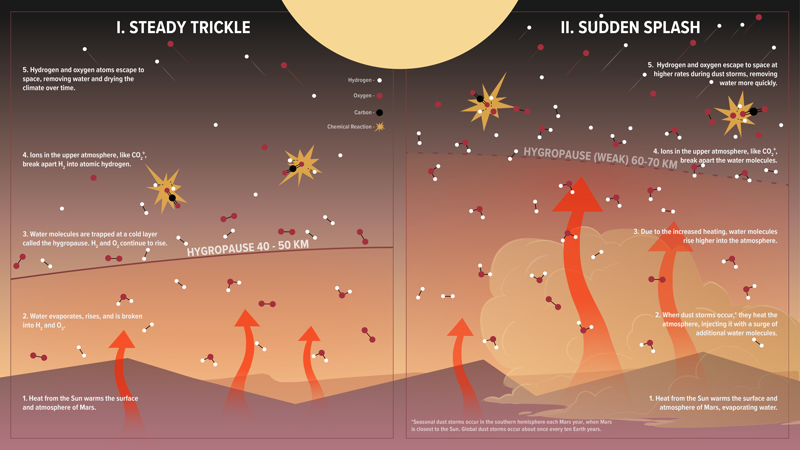


NASA Scientific Visualization Studio infographic showing two side-by-side cross sections of the lower Martian atmosphere, labeled "I. Steady Trickle" and "II. Sudden Splash," comparing normal water loss against the elevated water loss during a global dust storm


Lana Williams, a PhD researcher at Lancaster University, took the stage at the Royal Astronomical Society’s National Astronomy Meeting in Birmingham on July 21 with a result that nobody had set out to find. Her team had been doing a routine comparison: does a solar energetic particle (SEP) event (a pulse of high-energy protons and ions flung out by a solar flare or coronal mass ejection) change the temperature of Mars’ lower atmosphere? Of the five long-duration SEP events the team examined, four showed nothing. The fifth, which arrived while the 2018 planet-encircling dust storm was still expanding, showed a measured warming of roughly 50 °C (about 90 °F) at altitudes of 75 to 125 km. That is a large signal in atmospheric physics, and it appeared in the one event of five where Mars’ surface was already being scoured by a global dust storm (Royal Astronomical Society press release; Phys.org coverage).

The team used two complementary spacecraft that are normally thought of as studying different altitudes. NASA’s Mars Atmosphere and Volatile EvolutioN (MAVEN) orbiter, which has been watching the Sun-Mars interaction since 2014, contributed observations of how the incoming particles deposited their energy in the upper atmosphere. ESA and Roscosmos’ ExoMars Trace Gas Orbiter (TGO), in operation since October 2016, contributed the simultaneous thermal profile of the middle and lower atmosphere. By stacking the two datasets against the Mars Climate Database, the team could see whether observed temperatures diverged from the climatological mean (Sci.News).

Mars is not a protected planet. With no global magnetic field, its upper atmosphere takes the solar wind and SEP events head-on, and the planet’s atmospheric escape rate has been one of the long-running questions in comparative planetology. A radiation-driven temperature pulse in the lower atmosphere is a different kind of signal than the better-studied escape of hydrogen and oxygen from the top of the atmosphere. It means energy deposited above is being communicated downward into the region where dust, clouds, and weather live, and the existing models of that region do not necessarily assume such a connection.

If the pattern holds, the result has practical consequences. Dust storms are the worst time to be operating solar-powered equipment on the surface, and they already coincide with the kind of optical depth that ends rover missions, the 2018 storm being the one that finally silenced Opportunity. Adding a SEP-driven heating pulse on top of an already-stressed atmosphere changes the radiation environment and the upper-tropospheric temperature profile, with consequences for any future crew or uncrewed habitat. The work also offers a partial answer to a question that has been quietly bothering Mars atmospheric scientists: the models did not always match the 2018 TGO temperature record as well as one would like, and a SEP component may explain some of that residual.

Williams and collaborators at the University of Leicester and the Instituto de Astrofísica de Andalucía–CSIC in Granada selected five SEP events spread across the period when MAVEN and TGO were both returning science data. The event selection was the careful part: the team required each SEP to be long-duration, so that any thermal response would have time to propagate, and required both spacecraft to be making compatible observations at the same time. The first four events, occurring in quieter atmospheric conditions, did not produce a statistically meaningful divergence from the Mars Climate Database’s predicted temperature profile. In the team’s own words, “we expected that these highly energetic particles might have some effect on temperatures in Mars’ lower atmosphere, but in four of the five events we studied we found no clear evidence of heating.” The fifth, in June 2018, broke the pattern by a wide margin (Royal Astronomical Society press release; Tech Times).

The June 2018 event is the storm that ended Opportunity’s mission. NASA formally declared the rover’s end in February 2019 after more than a thousand recovery commands went unanswered, and the global dust storm that began on May 30, 2018 grew into a planet-encircling event by mid-June, with optical depths in some regions reaching tau values of 5 to 10, enough to blot out direct sunlight at the surface (2018 Mars global dust storm, Wikipedia; Space.com retrospective). It is also the same storm during which MAVEN’s Neutral Gas and Ion Mass Spectrometer measured water vapor 20 times higher than usual, lifting moisture to altitudes where it could be broken apart by ions and lost to space. That measurement was published in 2020 and is now the standard reference for the role of dust storms in Mars’ long-term water loss (NASA SVS infographic, MAVEN team).

A second-order detail has to be acknowledged. NASA’s MAVEN lost contact with Earth on December 6, 2025, and a February 2026 review board concluded the spacecraft was not recoverable. NASA formally ended the mission in May 2026 (MAVEN, Wikipedia; Reuters, May 2026). The Lancaster study relies on archived MAVEN data, so the analysis itself is not affected by the spacecraft’s loss, but the result arrives at a moment when the only orbiter dedicated to studying the Sun-Mars interaction is no longer in operation. Future SEP-Mars coupling studies will lean even more heavily on TGO and on Mars Reconnaissance Orbiter’s continuing aeronomy observations.

The 50 °C / 90 °F warming at 75 to 125 km altitude is not, on the face of it, what one would expect. SEPs deposit their energy high in the atmosphere, mostly through ionization of CO₂, which is the dominant species on Mars. In a quiet atmosphere, that energy is radiated away or conducted to space faster than it can build a temperature signal in the middle atmosphere. The Lancaster team’s working hypothesis is that the suspended dust changes the radiative budget of the lower and middle atmosphere. Dust absorbs upwelling infrared and re-emits it; it also provides a denser population of ice-coated grain surfaces on which water can condense. The net effect is to keep the middle atmosphere warmer than the climatology would predict, so when an SEP event dumps a pulse of energy from above, the column is already closer to a thermal threshold and the additional heating becomes visible. This is a “two stressors, one signal” pattern that has analogues on Earth in stratospheric ozone chemistry and aerosol-radiation interactions, but the Mars case is cleaner because the two drivers are so well separated in time and altitude (Gizmodo coverage of the talk; Phys.org).

For the engineering side, the result matters because MAVEN and TGO were not designed to look for this signal. MAVEN’s strength is in-situ ion and neutral measurements in the upper atmosphere, with instruments like NGIMS and IUVS. TGO carries NOMAD and ACS for atmospheric spectroscopy, plus a radio-science experiment that uses the spacecraft’s occultation link to derive vertical temperature profiles. Putting the two together for an SEP-dust synergy study is the kind of cross-mission analysis that only became possible once both archives had matured. The lesson for future Mars exploration architecture is the same one that keeps coming back: the value of long-lived orbital assets is realized years after their prime mission ends.

A methodological caveat is worth flagging. The Lancaster team is presenting one matching event out of five. The result is suggestive but it is not yet a population-level claim. The Royal Astronomical Society’s framing, “first study hints,” is doing real work in the press release (Royal Astronomical Society press release). Confirming or refuting the synergy will require a second matching event, and global dust storms that produce them happen roughly once every three to four Mars years, so the next opportunity may not come until late in Solar Cycle 26 or into Cycle 27.

The take-home is that Mars’ lower atmosphere is not a passive target for whatever the Sun and the surface throw at it; it is a coupled system in which a dust-driven radiative perturbation can change the visibility of a solar-driven energetic perturbation. That coupling was not in the models in 2018, and it should be in the next round. The Lancaster team has put a concrete, well-instrumented case on the table and is asking the field to plan for the next match. The answer will come on a Mars year measured in years, not months, and the MAVEN and TGO archives are now the legacy infrastructure on which that answer will be built.


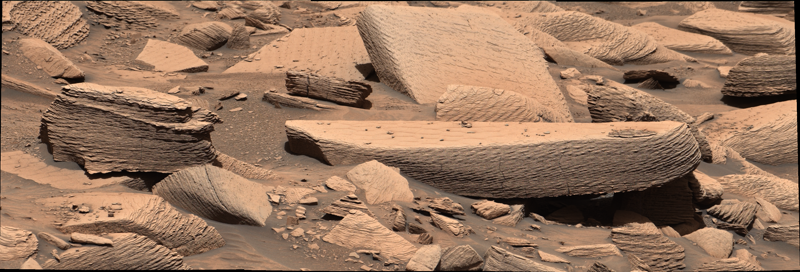
Layered beige Martian rocks at the Jawbone Canyon site in Gale crater, photographed by NASA's Curiosity rover on Sol 4391 (December 12, 2024), showing the stacked wind ripple laminations interpreted as supercritical climbing wind ripple strata.


Somewhere around 3.6 billion years ago, on what was probably an unremarkable afternoon, a sandstorm rolled into Gale crater on Mars. It may have lasted only hours. By the next day, the wind was back to normal and the surface was a sunlit desert again. No one saw it. Nothing else on the planet recorded it. But the storm left a physical imprint, and NASA’s Curiosity rover drove past that imprint on December 12, 2024, on its 4,391st Martian day, and photographed it (NASA Science Photojournal, July 20 2026).

The imprint is now the cover paper of the July 1, 2026 issue of the journal Geology. A team led by Steven Banham of Imperial College London describes millimeter-thick, crinkly laminations inside a rock the rover team nicknamed “Jawbone Canyon,” in the Mirador formation on the lower slopes of Mount Sharp. The structures are supercritical climbing wind ripple strata: a class of wind-deposited layering so rare on Earth that sedimentologists have only documented it in a handful of modern and ancient settings, and never before on another planet (Banham et al. 2026, Geology 54(7):611, DOI 10.1130/G54158.1).

Mars climate science has long had a sandstorm problem. Orbital cameras have shown that dust devils and regional dust storms lift fines off the surface today. Climate models assume that early Mars had a thicker atmosphere capable of moving sand. But the physical evidence for sustained sand-moving winds on ancient Mars has been almost entirely indirect: cross-bedded sandstones that record long-term wind patterns, dune fields that froze into rock, ventifacts worn by saltation.

Those records cannot resolve a single weather event. A climbing wind ripple is the signature of a wind strong enough, lasting long enough, and carrying enough sand that the ripples could not migrate as fast as new sand arrived. The crests piled up on the stoss side instead of sliding down the lee side. Each millimeter-thick lamina is the trace of a burst of sand transport; the climb angle records how fast sediment accumulated relative to how fast the bedform moved. The team measured angles of 10 to 18 degrees, values the paper says can only be produced by storms lasting minutes to hours, not by seasonal winds over thousands of years.

That makes the Jawbone Canyon outcrop the first direct physical evidence of a sandstorm on Mars. The paper’s wording is measured: “These climbing ripple sets occur in a thin succession, which suggests that they record a broader sustained event, such as a sandstorm or gale, lasting several hours or more.” The phrase is doing real work, because the alternative explanations had to be ruled out one by one. The central argument is a negative: ordinary wind regimes cannot deposit climbing ripples of these thicknesses at these angles, so whatever made them had to be stronger than everyday wind.

A secondary argument reaches further. Banham notes in the paper and in press interviews that the modern Martian atmosphere, at roughly 6 millibars of mean surface pressure, is too thin to drive saltation at the scale required to build these structures (Astrobiology.com, April 4 2026). The deposits imply that the atmosphere three and a half billion years ago was denser than today’s. The exact density is not pinned down, but the qualitative conclusion is clear: the air on early Mars was heavy enough to push sand in ways the present-day air cannot.

The find was not part of any planned observation. Curiosity’s science team operates in shifts, and one of the standing tasks is to scan the black-and-white navigation panoramas taken at the end of each drive for anything anomalous. Banham and his collaborators, including Linda Kah of the University of Tennessee, Joel Davis of Imperial College London, Sanjeev Gupta, Gerhard Paar, and several JPL-Caltech sedimentologists and mission scientists, noticed unusual textures in those panoramas as the rover approached the Mirador formation. They targeted the rocks with the higher-resolution Mastcam, and at full resolution the laminations resolved into the climbing ripple patterns.

Banham described the find as serendipitous: “We weren’t really looking for these deposits, and then lo and behold, we drove around the corner and found them. We were lucky that we had just the right people on shift that recognized them.” The rock itself is modest in size, roughly a meter wide and 20 centimeters high, with six discrete packages of ripple layers stacked through its thickness. The laminae dip toward the north, which means the wind that built them came from the south. Similar climbing ripples were later identified at a nearby site the team named Dry Lake, and the paper argues that the deposits formed near the margin of a larger dune field or in a wind-scoured depression where airflow patterns concentrated sand accumulation.

The discovery is also a vindication of the Mastcam team’s instinct to keep taking high-resolution follow-up imagery of “unusual” textures. Climbing ripples this small could have been mistaken for noise in lower-resolution data, or simply dismissed as weathered outcrop. The fact that a thin succession of six packages survived in one place for over three billion years, exposed at the surface for the rover to roll up to, is its own piece of good fortune.

The terminology is precise. In sedimentology, ripples are small bedforms, typically a few centimeters tall and tens of centimeters in wavelength, that form when wind or water flows over a bed of loose sand and organizes it into regular undulations. In a normal subcritical regime, sand grains saltate up the windward (stoss) face and avalanche down the leeward (lee) face, and the ripple migrates downwind without growing vertically. In a supercritical regime, the wind is strong enough and the sand supply is high enough that grains accumulate faster on the stoss face than they can slide off the lee face, so the ripple climbs. The climb angle is set by the ratio of vertical accumulation to horizontal migration; a 10-degree angle corresponds to roughly six times as much vertical deposition as horizontal migration.

Climbing ripples have been documented in a small number of terrestrial settings: deep-sea turbidity currents, certain wind-blown dune margins, and a few fluvial flood deposits. They are rare because the conditions that produce them are themselves unusual. On Mars, no one had ever identified them, in part because orbital images cannot resolve millimeter-scale laminae and in part because no previous rover had driven through sedimentary terrain with both the imaging resolution and the science team bandwidth to spot them.

The Banham paper lays out the diagnostic criteria: millimeter-scale lamina thickness, climb angles between 10 and 18 degrees, preserved stoss-side grainflow cross-stratification, and lateral continuity across the outcrop face. All four appear at Jawbone Canyon. The team estimates that a single 50-millimeter-thick layer could have formed in 6 to 20 minutes under storm conditions; the full succession of six packages therefore records on the order of an hour or two of sustained sand transport (Daily Galaxy, July 17 2026).

Curiosity has been on Mars for more than thirteen years. In that time it has found evidence of ancient lakes, rivers, groundwater, organic molecules, and a past climate that was at least intermittently habitable. What it had not found, until now, is direct evidence of an ancient sandstorm. The Jawbone Canyon outcrop fills that gap with a single rock roughly the size of a kitchen table.

The immediate payoff is a new constraint on early Mars atmospheric density: the air had to be thick enough to drive saltation at storm intensities. The longer-term payoff is a search template. Banham has said the next thing he wants the team to find is raindrop impact marks, craters in fine sediment left by rain, which would settle a separate debate about whether early Mars ever saw liquid rain rather than only snow and surface runoff. “It would be magic if we found those,” he said. The climbing ripples are not the last stop on Curiosity’s geology to-do list. They are evidence that the rover is still, after 4,391 sols, finding things on Mars that no one had asked it to look for.


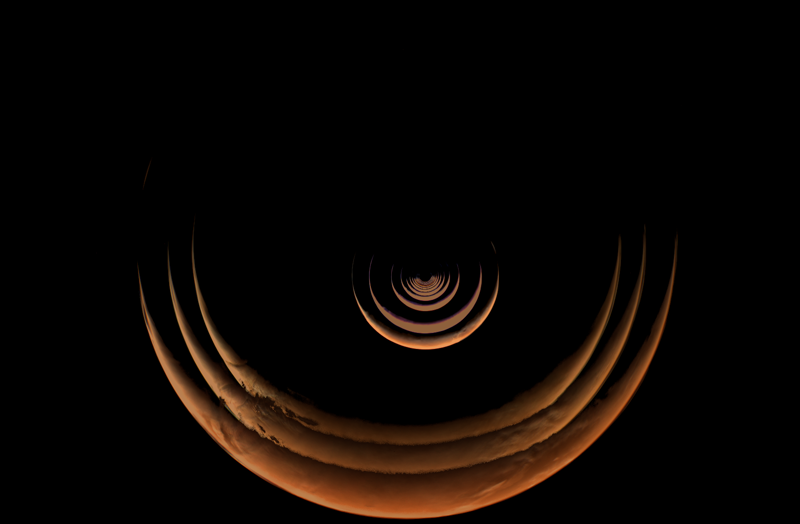
A composite of orange Mars crescents grows outward against black space as Psyche approaches the planet.


A gravity assist is usually described as celestial bookkeeping: a spacecraft borrows a little momentum from a planet and leaves on a better trajectory. NASA’s Psyche mission did that at Mars on May 15, 2026, but its science teams treated the encounter as much more than a navigation event. They pointed the spacecraft’s instruments at a world whose properties are already well measured, then asked whether the hardware returned the answers it should.

The spacecraft passed 2,864 miles (4,609 kilometers) above the Martian surface. Its cameras watched a thin crescent grow into a detailed globe. Its magnetometer crossed Mars’ bow shock. Its neutron detector registered a rise in particles near closest approach. The resulting data, released in July with a time-lapse video, made Mars a dress rehearsal for a far less familiar target: the metal-rich asteroid Psyche, which the spacecraft is due to reach in 2029, according to the NASA Science flyby report.

Space instruments spend years being designed, calibrated, launched, and monitored, but cruise provides few chances to test them against a large planetary body. Stars can check camera pointing. The solar wind gives a magnetometer a continuous signal. Neither reproduces the rapid changes, bright surfaces, stray light, and particle environment of a close planetary pass.

Mars offered a rare controlled comparison. Orbiters and rovers have observed its surface, atmosphere, and magnetic environment for decades. If Psyche’s instruments measured something wildly inconsistent with that record, engineers would have time to diagnose the discrepancy before asteroid arrival. Agreement is useful too: it confirms that the instrument, onboard electronics, ground pipeline, and scientific interpretation work together after nearly three years in space.

That last point matters because Psyche’s destination is difficult to interpret. The asteroid is often described as metal-rich, but the mission exists because remote observations cannot settle how much metal it contains, how it formed, or whether it preserves material from the interior of an early planet-building body. The spacecraft carries three dedicated science instruments: a multispectral imager, a magnetometer, and a gamma-ray and neutron spectrometer. It will also use radio tracking to map the asteroid’s gravity, as described in NASA’s Psyche mission overview. Mars let the instruments work on the same known target within hours.

Psyche launched in 2023 on a long solar-electric cruise toward the main asteroid belt. Mars was part of the route from the start. Before the encounter, NASA expected the spacecraft to pass about 2,800 miles above the surface at roughly 12,333 mph (19,848 kph). The planet’s gravity would increase the craft’s heliocentric speed and tilt its path toward the asteroid, according to the May 8 NASA mission brief.

The images began well before closest approach. Starting in early May, Psyche’s pair of identical multispectral cameras photographed Mars at a high phase angle, so the sunlit portion looked like a slender crescent. The sequence from May 2 through May 15 shows that crescent expanding as the distance closed. NASA assembled those frames into the growing-crescent composite used with this post.

Near Mars, the cameras resolved the south polar ice cap, wind-marked craters, and Huygens, a large double-ring crater. The team also detected Phobos and Deimos from far away. That was useful practice for a later search for small moons around asteroid Psyche. More quietly, the imaging team tested sensitivity to scattered light and began comparing its pictures with data from existing Mars missions. A camera can produce a sharp image and still mismeasure brightness or color; cross-calibration helps expose that kind of error.

The particle spectrometer faced a different test. It is intended to infer surface composition at the asteroid by measuring gamma rays and neutrons generated after cosmic rays strike the material. At Mars, the 4,609-kilometer altitude was too high for the detector to pick up gamma rays from the surface. The team did expect escaping neutrons, and the instrument recorded a count-rate increase close to the predicted level near closest approach.

The magnetometer had spent cruise measuring the solar wind and occasional coronal mass ejections. Mars provided its first magnetic signature from a celestial body. As Psyche entered the bow-shock region, where the solar wind encounters the obstacle formed by Mars and its induced magnetic environment, the instrument saw a strong increase. The flyby therefore exercised the detector through a rapidly changing field rather than the relatively steady background of interplanetary space.

Navigation also delivered what the science plan needed. The flyby put the spacecraft directly on its outbound course, and the mission expects to resume sustained solar-electric thrusting later in 2026. Arrival remains planned for the summer of 2029.

A gravity assist works because the planet and spacecraft exchange momentum while both orbit the Sun. In a Mars-centered frame, the spacecraft falls in, curves around the planet, and departs with approximately the same hyperbolic excess speed it had on arrival. In the Sun-centered frame, however, the velocity vector has rotated. Adding Mars’ orbital velocity before and after that rotation changes the spacecraft’s speed and direction around the Sun. Mars loses or gains an immeasurably small amount of orbital momentum in return.

The maneuver gave Psyche both energy and geometry that electric propulsion alone would have taken longer to supply. Its Hall-effect thrusters expel ionized xenon and produce low thrust for long periods. That system is efficient, but a planetary flyby can rotate the trajectory quickly without consuming propellant. Precision is unforgiving: a small arrival error changes the bending angle and therefore the outbound path. The close approach matching the planned corridor shows the navigation chain worked from orbit determination through correction maneuvers.

The instrument tests relied on three different physical signals. For imaging, filters divide reflected light into wavelength bands. Variations among bands can distinguish surface materials and reveal how illumination geometry affects the measurement. Mars supplied bright terrain, dark terrain, haze, ice, and a changing phase angle in one encounter.

For the neutron measurement, energetic cosmic rays strike atomic nuclei in the upper surface and create cascades of secondary particles. Some neutrons escape. Their energy distribution depends partly on which elements slowed or absorbed them. Hydrogen, for example, is particularly effective at reducing neutron energy. Gamma rays occur at characteristic energies associated with specific nuclei, but signal strength falls rapidly with distance; Psyche’s altitude explains why neutrons were detectable while Martian gamma rays were not.

Mars has no strong global dipole field like Earth’s. The solar wind interacts with its upper atmosphere and localized crustal magnetism, producing a bow shock upstream of the planet. Crossing that boundary gave the magnetometer an abrupt, recognizable change against which its timing and response could be checked. At asteroid Psyche, any remanent field would bear on whether its material once cooled within a magnetized parent body.

The Mars flyby did not answer the central question about asteroid Psyche. It reduced the risk that, three years from now, the mission will reach its target with a hidden calibration problem or an analysis pipeline that has never handled a fast-changing planetary data set.

That is the practical value of using a familiar world as a test object. The cameras returned surface detail and distant moon detections. The neutron detector saw the expected count increase. The magnetometer identified the bow shock. Each result connects directly to a job the instrument must perform at the asteroid, where there will be no fleet of orbiters and rovers providing an easy reference.

The spacecraft now has its outbound trajectory and a set of measurements the teams can keep analyzing while electric propulsion carries it toward the main belt. When asteroid operations begin in 2029, the first observations will still contain surprises. The basic behavior of the instruments should not be one of them.


September 28, 2026

A 700-million-dollar antenna at Mars

Posted by


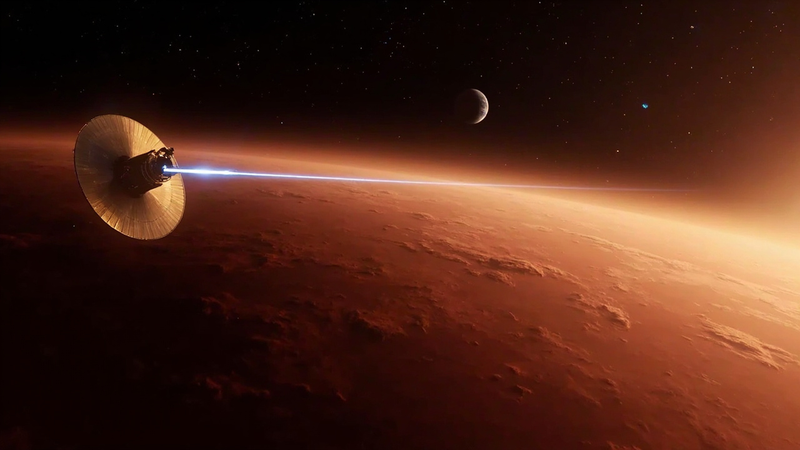
A relay spacecraft with a large dish antenna orbits above the rust-coloured limb of Mars, firing a thin blue beam along the planet's curve, with a small moon in the distance.


For twenty years, every byte of data sent home from the surface of Mars has ridden a UHF radio piggyback on a science orbiter that happened to be passing overhead. On 2 September 2026 NASA ended that arrangement. The agency announced that Blue Origin will design, build, launch, and operate a dedicated Mars Telecommunications Orbiter under a firm-fixed-price contract worth up to $700 million, with delivery by the end of 2028 and full operations at the red planet in 2030 (NASA news release, 2 Sep 2026). For the first time since the cancelled 2005 Mars Telecommunications Orbiter, NASA is buying communications capacity at Mars the way it buys launch services from SpaceX: a fixed commercial price for a working spacecraft, with the operator running the show.

The award is small in dollar terms compared to flagship planetary missions and large in strategic terms. It formalizes the commercial-services model that has reshaped cislunar space and applies it 1.4 astronomical units farther out. It puts the first dedicated deep-space relay at a planet, not at the Moon. And it gives Blue Origin — eight years after New Shepard reached the Kármán line — a planetary-scale role that no other company has held.

Every rover since Sojourner has paid a tax for its bandwidth. The UHF Electra relay on Mars Reconnaissance Orbiter tops out near one megabit per second, and that link is shared with instruments the orbiter was actually launched to run (Edwards et al., 2003). The Deep Space Network’s direct X-band uplink is even thinner — a single HiRISE frame takes 1.5 hours at MRO’s 5.2 Mb/s peak (JPL, “Deep Space Communications,” 2017). Perseverance’s plume telemetry, Ingenuity’s flight logs, the trace-gas measurements from ExoMars TGO — all of it competes for slots in orbits selected to do science, not to be comms towers.

A purpose-built relay changes the calculus. Operators can schedule lander passes against an orbit designed for continuous visibility, freed from the geometry of a science primary mission. Layer a deep-space optical terminal on top — analogous to the Deep Space Optical Communications package Psyche has been flight-qualifying since 2023 — and the link budget explodes. DSOC pushed 267 Mb/s from 31 million kilometers in late 2023 and held a link to 467 million kilometers in July 2024 (JPL, 11 Dec 2023; NASA, 25 Apr 2024).

The second-order effect is what NASA gets to stop doing. SCaN has been forced for two decades to add relay payloads to every Mars science orbiter as a tax for participating. Stripping that out frees mass, power, and cost on the next generation of orbiters — a meaningful simplification when the Mars Sample Return architecture is still being rebuilt and human Mars exploration sits on NASA’s stated timeline.

NASA’s request for proposals went out in May 2026, drawn up under procurement authority inserted by the 2025 One Big Beautiful Bill Act, which explicitly allocated $700 million for the orbiter. The Act’s wording tied the procurement to companies that had previously received Mars Sample Return study money and pitched a telecom element as part of those studies — eight firms in total: Aerojet Rocketdyne, Blue Origin, Lockheed Martin, Northrop Grumman, Quantum Space, Rocket Lab, SpaceX, and Whittinghill Aerospace. The competitive field narrowed quickly. The award names Blue Origin as prime, with no public teaming structure disclosed.

Blue Origin owns the full stack: bus, telecom payload, launch on its own New Glenn 7×2, trans-Mars injection, Mars orbit insertion, and operations. The published draft specification lists an areocentric orbit with a 180 km periareon and 4,500 km apoareon — a high-elliptical geometry that gives long dwell times over a fixed surface region while still clearing the atmosphere at the low end. New Glenn 7×2 has a trans-lunar capacity near 7 metric tons (NASA ELV Performance). The company has flown the vehicle successfully twice and failed once — the pad explosion that took LC-36A offline — so it will need to commission LC-36B or shift to Vandenberg to honor the 2028 commitment.

Behind the announcement is the same calculation that produced Commercial Lunar Payload Services and Human Landing System: in a budget environment where every Mars architecture decision is being fought between sample-return, human-exploration, and science advocates, the cheapest move is to buy the bits and let the science missions keep their mass margins.

The relay orbit is the design lever that makes everything else work. A 180 × 4,500 km areocentric orbit gives roughly 8 to 10 hours of continuous visibility over a fixed surface target per orbital period near 7.5 hours. Compared with the 250 km circular sunsynchronous science orbit flown by MRO, the relay geometry trades observation time for surface dwell time. The radio link uses UHF proximity at 390 to 450 MHz with the CCSDS Proximity-1 protocol stack — identical to what flies on MRO, MAVEN, ExoMars TGO, Curiosity, InSight, and Perseverance. Every Mars asset currently on the surface can fall back to the new relay with no hardware changes (Edwards, 2003).

The free-space loss for the UHF proximity leg is bounded by:

L_fs = (4 * pi * d * f / c)^2

At 400 MHz and a slant range of about 1,000 km, path loss lands near 158 dB — the reason surface antennas are low-gain whips and the orbiter carries the high-gain nadir-pointed Electra package. The Earth-return leg at X-band (8.4 GHz) and Ka-band (32 GHz) from Mars runs at roughly 261 dB and 281 dB of free-space loss. Closing a 1 Mb/s link to a 70 m DSN aperture at X-band requires an EIRP around 38 dBi — achievable with a 1.5 m steerable dish.

The optical path changes the math. At 1.55 μm and 1.4 AU, beam divergence dominates over L_fs. The angular beamwidth of a diffraction-limited 22 cm aperture is:

theta = 1.22 * lambda / D ≈ 8.6 microradians

At Mars-Earth range, that gives a beam footprint on Earth near 1,200 km — the same order as the DSOC ground footprint demonstrated in flight, which is why DSOC paired a 22 cm spacecraft telescope with a 5 m Hale-class ground receiver (JPL DSOC poster, 2014). A relay with both a UHF proximity payload for handoff and an optical Earth-return payload for bulk data could push daily return into the terabit range, an order of magnitude over today’s network.

The contract also stress-tests the fixed-price model at interplanetary distances. NASA’s answer was to make the procurement compatible with commercial commsat buses — Blue Origin is expected to leverage a scaled Blue Ring platform — and to define the service in throughput and availability terms, not hardware specifications. The bet is that a commercial GEO production line can be retooled for an areocentric relay without a bespoke NASA-only factory.

The Mars Telecommunications Orbiter was proposed in 2004, cancelled in 2005, rediscovered in 2018 as NeMO, stalled in 2025, and finally contracted 21 years later. If Blue Origin hits the December 2028 delivery date, its 2030 arrival will coincide with a Mars surface far busier than the one Perseverance and Curiosity see today. Mars Sample Return needs continuous relay coverage during lander choreography. Human Mars missions need guaranteed high-bandwidth links that do not depend on a science orbiter being overhead.

The deeper story is that the relay architecture of the inner solar system is being privatized the way launch has been. The agency that built the Deep Space Network is handing its first dedicated relay at Mars to a commercial prime. The hardware questions are interesting; the procurement question is the one that will define the next twenty years.


September 27, 2026

Where Mars got its moons

Posted by


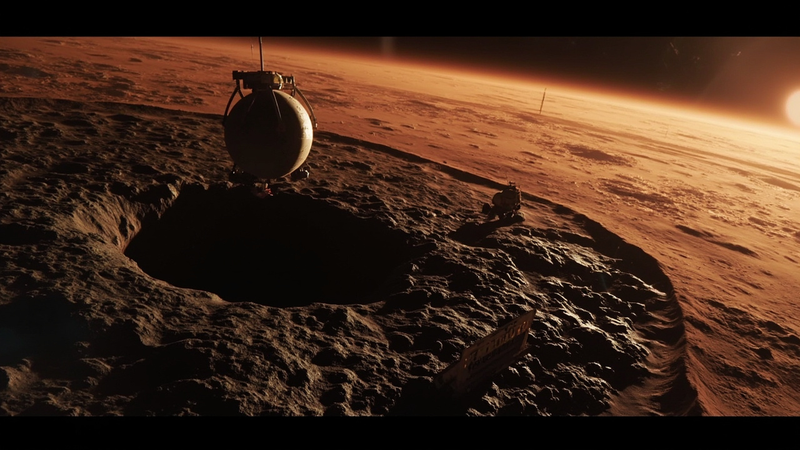
MMX at Phobos


Mariner 9 arrived at Mars on November 14, 1971, the first spacecraft ever to orbit another planet. A planet-girdling dust storm forced the mission to wait, and a planetary scientist named Joseph Veverka suggested putting the cameras on Phobos and Deimos in the meantime. Phobos came into focus on November 29 from 14,440 km, then again on December 1 from 5,720 km. The little 27-kilometer rock was already strange: a near-potato shape scarred by a 9-kilometer crater called Stickney, a long axis pointed permanently at Mars, and a charcoal-black surface that did not match the warm reddish dust it was orbiting (NASA/JPL, 1971–1972).

Two hypotheses have run in parallel since Asaph Hall discovered both moons in August 1877. The capture hypothesis says Phobos and Deimos are asteroids from the outer belt, drawn in by aerodynamic drag through an extended early-Martian atmosphere and circularized into their present orbits (Hunten 1979; Pollack et al. 1979). The color match between Phobos’s surface and the so-called D-type asteroids, dark, organic-rich bodies, has carried that story.

The giant-impact hypothesis argues the moons formed from debris thrown up when a roughly Mars-sized protoplanet slammed into early Mars, much as our own Moon is thought to have formed from a glancing blow on Earth (Craddock 2011; Rosenblatt & Charnoz 2012). If true, Phobos is made from re-accreted Martian mantle mixed with impact glass, with up to ~30% porosity to explain the low density.

The distinction isn’t trivia. If Phobos is a captured D-type, MMX returns a bona fide sample of outer-belt material with all the volatile- and organic-rich implications that follow. If Phobos is impact debris, MMX effectively becomes the first Mars sample return mission, a piece of the early Martian mantle frozen in place because there was never enough gravity to melt it (Burns 1992; Lainey & Jacobson 2017).

The first attempts were Soviet. Phobos 1 launched in July 1988 and died 51 days later of a software bug. Phobos 2 reached Mars in January 1989, swung past Phobos, and went silent 30 m above the surface during its second landing rehearsal, returning 37 images. Phobos-Grunt launched in November 2011 on a Zenit-2, failed to leave Earth orbit, and burned up over the Pacific Ocean, taking its piggybacked Chinese Yinghuo-1 smallsat with it.

Between those failures, orbiters gave us what we had. ESA’s Mars Express has now completed more than 130 dedicated Phobos flybys; Mars Reconnaissance Orbiter (HiRISE) returned the highest-resolution images of the surface, down to ~6 m/px; Perseverance and Curiosity imaged Phobos eclipsing the Sun from the ground. None was a sample return.

JAXA committed. MMX was approved in 2019 with Kawakatsu Yasuhiro as Project Manager, deliberately built on Hayabusa and Hayabusa2 heritage. It launches in JFY 2026 on H3 from Tanegashima. It carries a Coring Sampler, a NASA-built pneumatic sampler, and the DLR–CNES IDEFIX rover, which is to be released from below 100 m altitude and operate for ~3 months. After regolith capture, MMX lifts off Phobos, swings out of orbit, and heads home. The sample capsule lands in Australia’s Woomera desert in JFY 2031 (JAXA, 2026).

Phobos’s specifics dictate the engineering. It is tidally locked to Mars and orbits at 9,376 km from the planet’s center, inside synchronous. Its mass is only 1.064 × 10¹⁶ kg. Surface gravity is 0.0057 m/s² and escape velocity a casual 11.4 m/s. Dust kicked up by landing takes a long time to settle because there is essentially no atmosphere to grab it (Wikipedia, citing Jacobson 2010; Lainey et al. 2024).

The body itself is also a study in low-cohesion regolith. Stickney, the dominant crater, is nearly half the mean diameter of the moon — close to the threshold where a same-sized impactor should shatter the parent rather than scar it. The long, shallow grooves running away from Stickney’s rim are still debated: some teams interpret them as fractures propagating from the basin-forming impact (Asphaug & Melosh 1993), while others argue for ejecta-drape patterns or secondary craters from Mars-thrown debris (Murray & Heggie 2007). Mars Express and MRO photometry has refined the question but not closed it; the grooves sit at the wrong angle to simple Stickney-radial fracture models, leaving loose ends that ground truth will resolve.

Sampling strategy reflects the same facts. The primary sampler is a Coring Sampler (C-Sampler): a titanium-alloy tube pressed against the surface under low main-engine thrust, intended to pull up to a 2-cm core from the uppermost regolith. Secondary is the Pneumatic Sampler (P-Sampler), contributed by NASA: a short burst of nitrogen gas lifts loose regolith into a chamber. Multiple sites will be visited across lit and shadowed hemispheres, with a combined sample target of more than 10 g (JAXA, 2026 mission specification).

In-situ discrimination happens before the sample ever leaves Mars. NASA’s MEGANE instrument (Mars-moon Exploration with GAmma Rays and NEutrons) is a high-purity germanium γ-ray spectrometer paired with a ³He-neutron spectrometer, designed to map iron, silicon, oxygen, hydrogen, thorium, and potassium across Phobos’s surface (NASA / APL, 2024). D-type asteroidal material and basaltic Martian-mantle-derived material produce very different signatures in such an instrument, particularly in the Fe/H and Th/K ratios. Knowing the answer in orbit lowers the risk of returning rock that doesn’t actually answer the central question.

Return physics is unforgiving. The Δv budget to enter Martian orbit from a direct Hohmann transfer is on the order of 1 km/s, plus a few hundred m/s for Phobos orbit acquisition and the touch-and-go capture. Per Tsiolkovsky’s rocket equation: Δv = v_e × ln(m_0 / m_f), with v_e ~ 320 s for the bipropellant thrusters. The mass fraction is what makes the Sample Return Capsule, with its ~10 g payload, only a small fraction of the ~4,200-kg launch stack. The capsule’s heat shield has to survive entry into Earth’s atmosphere at ~12 km/s after a direct Mars return.

H3 is Japan’s first fresh-built orbital launcher since the 1980s. Its LE-9 engines run an expander bleed cycle, each chamber delivering ~1,422 kN of vacuum thrust. H3 sent up Michibiki 7 earlier this month, and MMX is the next major LE-9 passenger on the manifest (JAXA / MHI, 2026).

JAXA’s MMX is going to do something the United States and Russia combined have tried and failed to do three times: land briefly on Phobos, grab a few grams of regolith, and bring that bag of rock back to a clean lab on Earth.

Three outcomes are plausible. If the rocks look like D-type carbonaceous material with deep hydration features, the capture hypothesis wins and Phobos becomes the first outer-belt material ever returned to Earth. If they are dry, fine-grained basalts with high calcium and iron and no hydration, the impact hypothesis wins and we have, in effect, a sample of early Mars. If they are a messy mix, we’ll learn something about Phobos’s regolith history that neither hypothesis prepared us for.

The capsule should come down near Woomera in JFY 2031. JAXA’s Sample Curation Facility at Sagamihara will be where scientists first crack open the sealed container. The instruments they run on that small sample — mass spectrometers, electron microprobes, atom-probe tomographs — will quietly close out a 150-year-old argument about where Mars got its moons.