


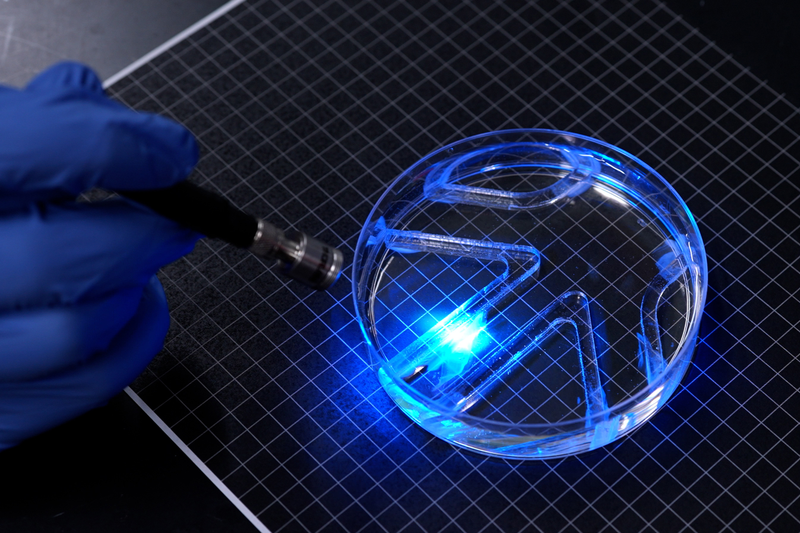
In a petri dish at MIT, a blue light moves and a small shape follows it. The object is a rectangle of gel the size of a stick of gum, with two flaps that beat when the light touches them. Each flap is lined with muscle cells grown from a mouse cell line and engineered so that a flash of blue light makes them contract. The gel film is half a millimetre thick; the living layer on it is thinner than a strand of hair. The machine swims about four body lengths per minute, a pace MIT’s news office compared to a cow shark’s cruise and well below an Olympic swimmer’s 65 body lengths per minute (MIT News, 29 September 2026). It is the first genuinely two-dimensional muscle-powered robot, and the work appeared on 28 September 2026 in Advanced Functional Materials (Bawa et al.).
The idea of a robot powered by living muscle is not new; making it useful is. Engineered muscle has driven grippers, walkers, a human-tissue hand and swimmers, and in nearly every case the muscle has been the limiting component. Cardiac muscle, the easiest to grow flat, cannot be switched off, is not built for frequencies much above 3 Hz, and because neighbouring heart cells are electrically coupled you cannot recruit one region without its neighbours. Skeletal muscle offers what a robot wants: on-off control, local spatial control, and bandwidth from below 1 Hz to above 10 Hz. It also arrives with a manufacturing problem: skeletal muscle is cultured as a three-dimensional lump, and a lump big enough to push anything means millions of cells.
Most engineered C2C12 muscle tissues produce under 1 millinewton of active force, with stresses below 2 millinewtons per square millimetre. A group using a self-training rig for muscle rings recently reached 7.05 millinewtons, and their biohybrid swimmer covered 467 millimetres per minute, or 15.6 body lengths per minute, the fastest locomotion yet reported from a skeletal-muscle robot (Nature Communications, 2026). Those muscles are thick, mechanically trained, and awkward to build.
Ritu Raman’s group at MIT had already shown a way around the manufacturing problem. In March 2025 the lab stamped a hydrogel disk with grooves in two orientations, seeded muscle cells into them, and let them fuse into fibres that pulled in more than one direction at once, an artificial iris. It was the first muscle-powered machine to generate force along several axes at once, and the stamping method can print patterns on a tabletop 3D printer. What it could not do was move. That tissue shifted about 100 micrometres, tiny from a robotics standpoint.
The new work attacks force and endurance rather than patterning. Bawa and colleagues started with the skeleton, since a thin muscle sheet is only as good as its substrate. Cells were seeded onto gelatin methacrylate at 80,000 per square millimetre, then allowed to fuse into contractile fibres. The substrate was a film 7 millimetres wide and 15 long, half a millimetre thick, patterned with square-bottomed microgrooves. Three groove sizes were tried: 12.5, 25 and 200 micrometres. The narrowest matched the roughly 12-micrometre diameter of a single myoblast, so cells could neither spread nor fuse comfortably inside them; the widest gave the fibres no reason to line up. The middle size won, cutting the angular scatter of the fibres by an order of magnitude relative to wavy or flat surfaces.
Stiffness mattered as much as shape. The earlier iris work sat on fibrin, an ultra-soft gel that shrank under the tension the muscle generated, and fibrin above about 8 milligrams per millilitre will not dissolve in culture medium, capping substrate stiffness at under 0.25 kilopascals. Gelatin methacrylate has no such ceiling, so the team made it at 5, 7.5 and 10 weight percent. The stiffest recipe that still held the tissue together won: 7.5 weight percent produced thin-film forces of 2.9 plus or minus 0.6 millinewtons, against 1.7 plus or minus 0.8 on the 5 percent gel and 0.36 plus or minus 0.19 on fibrin, with the cleanest fibre alignment on the stiffest surfaces.
Then they did what any muscle does in a gym and forgot to do in a dish: they trained it. Repeated pulses of blue light, the 470-nanometre wavelength that opens the channelrhodopsin-2 calcium channel in the cells, raised the force the tissue could hold. The group then built the machine: two independent fins, each a gel film lined on both sides with muscle, so lighting one fin strokes that side alone and lighting both produces a symmetric flap. In a dish of water with a maze cut into the floor, a hand-held light source steered the robot around the obstacles. Speed rose with light pulse frequency, and the machine turned in place at up to 1,200 degrees per minute.
A thin sheet works where a thick one would not because of where the force goes. Muscle contraction pulls on the substrate below it, and the pair behaves like a bimetal strip: the gel carries the load in shear, the cell layer in tension. That works only if the cells stay attached: adhesion improves with a stiffer gel, but the tissue itself would rather have something softer, so the design point sits in a narrow window. The team computed the stress in the gel from the shear modulus measured at 1 hertz, the area under the muscle, the film thickness and the contraction displacement, then fed a 5 percent contractile strain into a model, the value typically reported for untethered three-dimensional C2C12 tissue.
The payoff is efficiency. Force per unit volume decides how much tissue a job needs, and these thin films deliver about 20 times the force density of earlier three-dimensional muscle actuators, with forces roughly 10 times higher than previous flat skeletal-muscle devices. Endurance improved more dramatically. Earlier two-dimensional muscles tethered to a rigid backing lost their shape within ten minutes of being freed, while the optimized designs kept actuating untethered for more than 30 days, an improvement of some 4,500 times in useful lifetime.
Control is the other reason to want muscle, and it comes down to the channelrhodopsin-2 in the cells. Blue light opens the channel, calcium floods in, and only the illuminated region contracts, so a machine with two fins has two independently addressable muscles. How fast it swims is a question about fluid mechanics. At this scale the swimmer lives in the drag-dominated regime, where thrust comes from pushing water backwards over and over and resistance grows with the square of speed, F = 0.5 * rho * C_d * A * v^2, so every stroke spends energy a motor and propeller would spend more efficiently.
What happens next is mostly engineering, and the same lab has started on the pieces: separate work there, published in Advanced Science in late 2025, builds hydrogel tendons that couple muscle to a rigid skeleton. For the swimmer, the next steps are a better body shape and a light source small enough to ride along instead of a hand holding it over the dish.
That last part is the real limit. The bot needs light to be commanded and culture medium to keep its cells alive, so the maze run was piloted by a person rather than a controller. But the ratio the work establishes is the durable part: a patterned cell layer a few tens of micrometres thick, delivering millinewton-scale force from a film you could print. If that holds, actuators stop being components you buy and start being things you grow.
 Subscribe to our RSS feed









There are no comments.
Add A Comment