


Some photographs carry more information than their subjects were ever meant to give up. On 26 October the Defense Intelligence Agency released the third edition of its unclassified survey of threats in space (The Defense Watch on the DIA 2026 report), and on page 53 of the 130-page document sits a picture of a Chinese spaceplane in orbit that nobody outside a small circle of intelligence analysts had seen at full resolution (DIA press release for the 2026 edition). The shot was taken by a commercial Earth observation satellite, a WorldView-3 operated by Maxar Technologies, the company now known as Vantor, on 28 May 2024 while the craft was on the long middle leg of its third flight (Wikipedia on the Chinese reusable experimental spacecraft mission history). What the image gives up is the vehicle’s shape: a delta-winged body, doors along the flank for a payload bay, a dark heat shield across the belly, and a service module at the rear with solar arrays on short outriggers (Ars Technica on the Shenlong photograph).
That photo was not a leak and it was not a spy agency going public with something it had been sitting on. In 2024 a US Space Force officer disclosed at a conference in South Korea that an American-owned commercial satellite had imaged the Chinese craft, and a lower resolution version of the picture circulated afterwards (Wikipedia on the Chinese reusable experimental spacecraft mission history). The agency has now released the whole thing, credited to Maxar, inside a document whose stated purpose is to inform public debate rather than to leak anything (DIA press release for the 2026 edition). There is an argument that publishing it makes the vehicle more useful to adversaries than it already was. There is also an argument that a program developed in near total silence is a program nobody can write norms around, and that the public photograph is the first step toward treating it as an ordinary vehicle rather than a rumour.
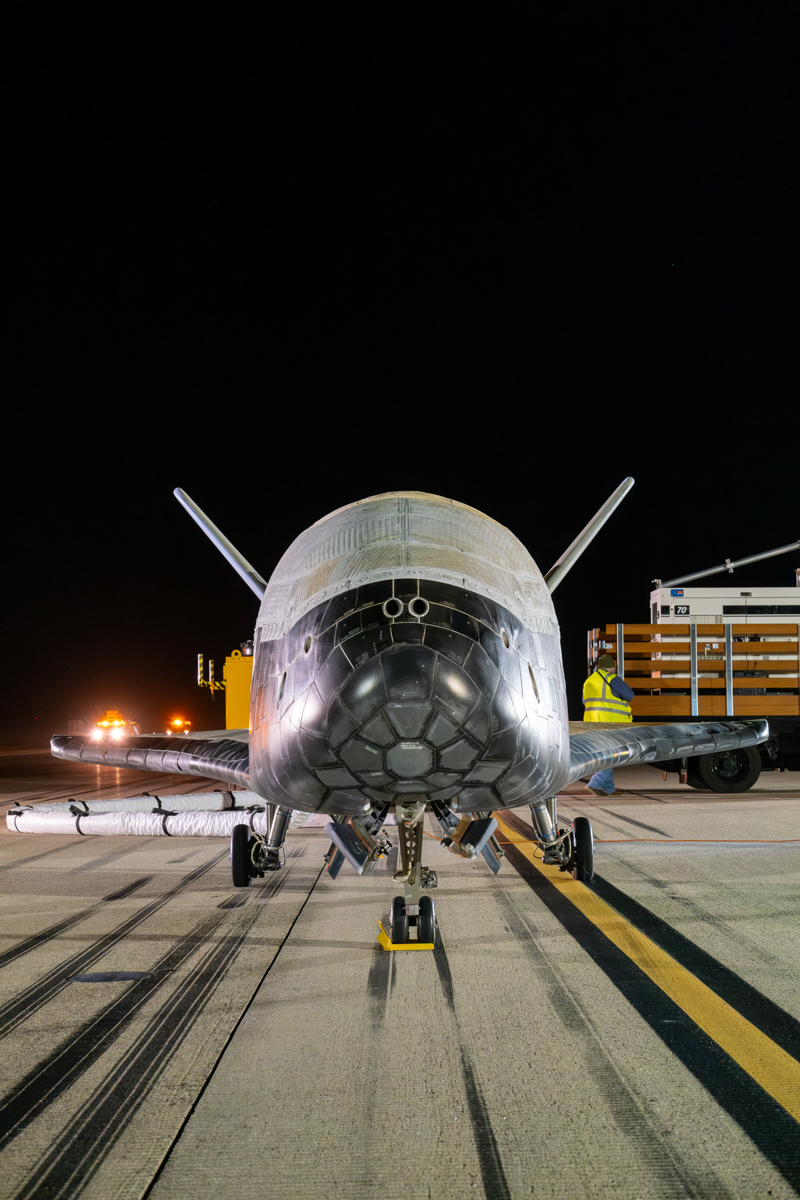
What the image shows is a machine built along the lines of the X-37B, the uncrewed spaceplane the US Space Force flies, and the resemblance runs deeper than the outline. The American vehicle lifts off vertically inside a conventional rocket’s payload shroud, works as a satellite once in orbit, then reentres and lands by itself on a runway to be refurbished for another flight (Ars Technica on the Shenlong photograph). The Chinese craft does the same, on a Long March 2F from Jiuquan, landing back at an airbase in the Gobi. The difference is what the vehicle is for, and that is where the language gets careful. The report’s own framing is that spaceplanes are reusable and have enhanced maneuverability, which makes them more suitable for certain missions than ordinary satellites, and it names two Chinese programs, Shenlong and Tengyun (Ars Technica on the Shenlong photograph). A separate Secure World Foundation fact sheet is blunter about the limits of the alarm, concluding that the vehicle has close to zero feasibility as an orbital weapon for striking ground targets and has never approached a non-Chinese object, which reads as a technology demonstrator rather than a warhead (Secure World Foundation fact sheet).
The flight record is what makes the picture interesting rather than merely striking. The first prototype went up in September 2020 and came back down two days later. The second flight launched in August 2022 and stayed up for 276 days, and during that mission it moved around a small companion satellite, holding roughly a kilometre of separation and at one point coming within about 100 metres of it, which observers read as a rendezvous before the smaller object was released again. The third flight, launched in December 2023 and still up when the Maxar camera caught it, lasted the better part of nine months and involved the spaceplane releasing and then interacting with another object. A fourth mission launched from Jiuquan on 7 February 2026 and was still in orbit when the report came out (Leonard David on the DIA report’s spaceplane flight history). By the end of that third flight the vehicle had logged a cumulative year and a half in orbit, and it was manoeuvring around objects it had deployed itself rather than flying a solo mission, which is the difference between a test article and a working spacecraft (Wikipedia on the Chinese reusable experimental spacecraft mission history).
The technique behind the picture deserves more attention than it gets. The field has a name, non-Earth imaging, and it works because the geometry occasionally lines up: an Earth observation satellite pointed at a piece of ground passes close enough to another spacecraft to photograph it as it goes by, at relative speeds measured in kilometres per second (Ars Technica on the Shenlong photograph). Commercial operators such as Maxar have turned that into a service, and government analysts buy it. The cost of the observation is the orbital mechanics of the chance encounter, not a dedicated spy platform, which is why a picture of a classified Chinese vehicle exists at all. For comparison, the X-37B has a published specification that no one outside the Space Force could match: more than 29 feet long, a wingspan near 15 feet, and orbital speed of roughly 17,400 mph (Popular Science on the DIA spaceplane photograph). The Shenlong’s dimensions remain unpublished, and the vehicle’s actual payload is classified on both sides.
The larger document puts the spaceplane in a wider argument about where the competition is heading. China’s launch cadence has gone from 22 launches in 2016 to 93 in 2025, and the number of satellites it puts into orbit each year has grown from 40 to 384 over the same period, a rate increase running alongside the national LEO megaconstellations Beijing is building (The Defense Watch on the DIA 2026 report). Alongside the reusable spaceplane work sits a much more explicitly aggressive portfolio: satellites with robotic arms, a demonstration of moving a dead navigation satellite into a graveyard orbit, a test of refuelling in geostationary orbit, and a series of inspector craft that have closed to within ten kilometres of other nations’ spacecraft in that orbit (The Defense Watch on the DIA 2026 report). The report’s sharpest new judgment is on directed energy: China already fields several ground-based laser systems of varying power that can disrupt, degrade or damage satellites in low Earth orbit, and by the late 2020s may field space-based directed energy systems along with more powerful ground systems able to threaten satellites in higher orbits (The Defense Watch on the DIA 2026 report). It is a projection, stated as a possibility, and the underlying intelligence is not published.
None of that changes the photograph. What the public now has is a clear look at a vehicle that has flown four times, spent 276 days on its longest completed mission so far, and demonstrated close approach manoeuvres with its own deployed satellites, while the X-37B on the American side has flown eight times and at one point extended a record of 908 days in orbit (Wikipedia on the X-37B flight record). What the reader does not have is a mission statement from Beijing, a set of dimensions for the Chinese craft, or confirmation of what the fourth mission is doing right now. The next useful pieces of information would be a landing date for the flight launched in February, the next edition of this assessment, and any Chinese statement of purpose for a program that has now been photographed in public twice.
 Subscribe to our RSS feed









There are no comments.
Add A Comment