OrbitalHub

Where curiosity reaches escape velocity.

Domain is for sale. $50,000,000.00 USD. Direct any inquiries to contact@orbitalhub.com.

Archive for the The Best Of category


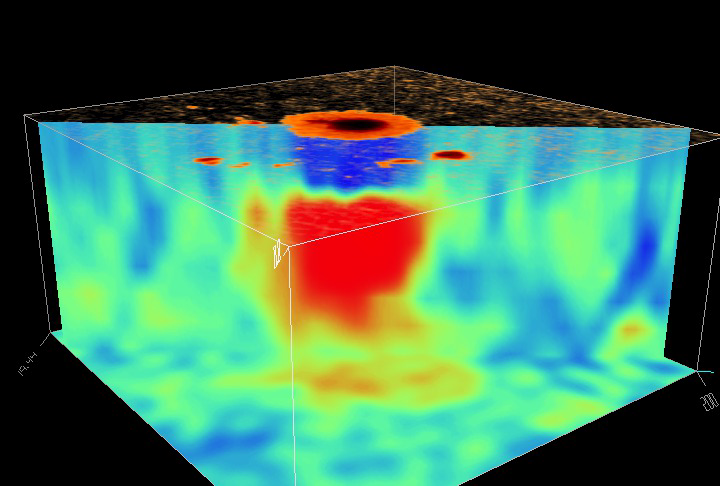
A 3D helioseismic cutaway of a sunspot: the dark sunspot visible on the top surface sits over a red region of altered acoustic power below, with subsurface flows in blue and green running through the convective volume, derived from SOHO/MDI data by Kosovichev and colleagues.


A sunspot is the last thing to show up. Long before a dark patch breaks through the Sun’s visible surface, the magnetic field that will produce it has already been gathering underneath, and the first reliable hints of its arrival are not in light but in sound. Waves travelling through the Sun’s interior are subtly bent and absorbed as that rising magnetic field pushes through them. Until recently those changes were too small to read reliably. On 14 August 2026, a team led by New Jersey Institute of Technology undergraduate Jonas Tirona reported in the Journal of Geophysical Research: Machine Learning and Computation that a Transformer model they call EarlyDetect can pick out those faint acoustic fingerprints about 9.24 hours before the corresponding sunspots are visible. NASA’s COFFIES team press release confirms the result, and the same paper sits on arXiv as 2601.13144 for those who want to read the full text.

Forecasting storms on Earth usually means watching for the ingredients of a storm and giving people time to react. The same logic is starting to govern space weather, the stream of high-energy radiation and charged particles the Sun sends our way when active regions erupt. Solar flares and coronal mass ejections can disable satellites, disrupt radio communications, and put astronauts at risk, which is why NASA’s Moon to Mars program and NOAA’s Space Weather Prediction Center track every visible sunspot the moment it darkens on the disk. Predicting where and when the next sunspot group will emerge, rather than just classifying one that is already there, has been a long-standing gap in operational forecasting. The current approach relies on human analysts at NOAA and the US Air Force characterizing regions that are already on the disk and estimating their odds of producing a flare. It is reactive by construction. EarlyDetect, if it can be made operationally reliable, would be the first step toward a forecast that announces an active region before it has even arrived.

The team built the model around a sliding-window Transformer architecture, the broad family of neural networks that underpins large language models, and trained it on observations from NASA’s Solar Dynamics Observatory, which has been staring at the Sun continuously since 2010. The Helioseismic and Magnetic Imager aboard SDO records full-disk images at 617.3 nm (the Fe I absorption line) every 45 seconds; from those, the researchers assembled hourly maps of acoustic power over the disk and overlaid them with magnetic field measurements. They then searched for the characteristic dip in acoustic power that happens when a magnetic field rising through the convective zone begins to disturb the normal pattern of solar oscillations. The Transformer, sliding a fixed-size window across a long stream of these hourly maps, picked up the dips and learned to associate them with the appearance of a visible sunspot a few hours later. Once trained, the model was tested against a held-out set of active regions it had never seen. Average lead time was 9.24 hours; the model outperformed both a baseline Transformer and a long short-term memory network that the same group had been developing earlier.

What surprised the team was how much standard preprocessing worked against them. Researchers often smooth acoustic time series to filter out noise and make the underlying trends easier to see, but the cleaned-up signal made the model worse. Tirona and his colleagues Irina N. Kitiashvili at NASA Ames and Alexander G. Kosovichev at NJIT argued in the paper that the temporal smoothing layers averaged away the faintest high-frequency dips the model was supposed to find. The faint signals turned out to be carrying the early warning. Kosovichev compared the effect to hearing a slight change in rhythm within a very noisy orchestra; the louder instruments had to be removed for the quieter beat to count, and Tirona put it more bluntly: noise-cancelling filters, which usually help, were detrimental in almost every case in this specific application. The detection itself relies on an older idea: that the Sun rings like a bell, and you can listen to its hum to learn what is happening inside. Helioseismology, the same field that mapped the rotation of the solar core and the structure of sunspot magnetic fields decades ago, supplies the raw material the Transformer chews on. A helioseismic cutaway of a sunspot’s subsurface structure is visible in the NASA SVS visualization by Kosovichev and colleagues; acoustic waves bounce between the surface and deeper layers of the convection zone, and when a magnetic flux tube pushes up from below, it bends the wave paths and changes how much energy reaches the surface in any given frequency band. Visually, the sunspot at the surface gets all the attention, but the subsurface acoustic distortion has been there for hours, waiting to be read.

The team did not stop at the paper. They released the Solar Active Region Emergence Dataset (SolARED), a curated set of SDO observations of labelled active region emergence events, plus the Solar Active Region Portal at NJIT, an interactive platform for downloading and exploring them. Mengjia Xu, the principal investigator, called SolARED the first public dataset of its kind and positioned it as a shared resource for both the machine learning and heliophysics communities to develop and test new approaches. That kind of release is what turns a single result into a research program. The caveats still matter. Detecting that an active region is about to emerge is not the same as predicting that it will erupt; many active regions, even large ones, never produce a major flare or coronal mass ejection, and the lead time of 9.24 hours is statistical, not deterministic. The paper tested against held-out active regions rather than in real time, so operational performance on live data is still an open question, and the SciTechDaily writeup notes Tirona’s own caution that the model is not yet operational and can still produce false alarms or predictions that arrive too late.

The next milestone is a real-time test. EarlyDetect trained on historical data; running it on the SDO feed as observations arrive, and proving that the 9.24-hour average translates into useful forecasts on individual events, is the open problem. The data and code being public should mean other teams can run that test without waiting for the NJIT group to do it themselves. NASA’s COFFIES program, which funded the work alongside NJIT’s Grace Hopper AI Research Institute, has been working since 2020 to bridge heliophysics theory and the kind of high-cadence data work that machine learning was built for. The 14 August paper is the first concrete demonstration that the bridge can carry weight in both directions.



A boxy communications satellite carrying flat panel antennas and solar arrays flies above a cloud-covered Earth.


The launch looked ordinary. On July 16, 2026, at 1:32 p.m. Pacific, a Falcon 9 lifted off from Space Launch Complex 4E at Vandenberg Space Force Base carrying 21 identical flat-panel satellites. The first stage — booster B1103 on its fourth flight — flipped, glided back, and set down on the drone ship Of Course I Still Love You about 8.5 minutes later, logging SpaceX’s 639th successful booster recovery. Routine, until you remember that for nine months before that afternoon, no Tranche 1 satellite of any kind had flown.

The 21 satellites, built by York Space Systems, were the third batch of the U.S. Space Development Agency’s Tranche 1 Transport Layer. They joined 42 others already on orbit. Together those 63 spacecraft form the spine of a network the Pentagon does not quite have a clean phrase for: an internet, of sorts, designed for warfighters, running roughly 1,000 kilometers up in near-polar shells that pass over the equator twice an orbit. By the time the constellation reaches its full Tranche 1 size of 126 satellites, expected by mid-2027, the network will be the largest dedicated military LEO relay ever deployed.

For decades, tactical communications for U.S. and allied forces have run through a handful of heavy, expensive, geostationary satellites. The Advanced Extremely High Frequency (AEHF) constellation carries strategic command traffic in protected, anti-jam channels at $1.8 billion per spacecraft. The Wideband Global SATCOM (WGS) system pipes bulk data to aircraft and ships. Both architectures are excellent when they work. They also depend on a few high-value nodes, parked at fixed slots 36,000 km up, that an adversary can identify, jam, or try to maneuver-kill with a direct-ascent antisatellite weapon.

The SDA’s counter-move borrows a page from commercial internet engineering. Distribute the network across hundreds of small, cheap, replaceable nodes in low orbit, route traffic around any node that gets cut, and refresh the constellation every five years. Multiply the count, distribute the risk, accept a per-satellite ceiling that buys commodity parts rather than bespoke gold boxes. The trade-off is bandwidth per node — geostationary birds carry more — but for tactical purposes where latency and resilience matter more than peak throughput, the math works out differently. The Department of Defense has projected the broader Proliferated Warfighter Space Architecture at roughly $35 billion through fiscal 2029, with about $11 billion already obligated since 2020 (SDA, 2026; GAO-26-107085).

The SDA itself is barely seven years old. Established inside DoD in 2019 to break up a slow, monolithic acquisition culture, the agency set out to demonstrate that a small office in the Pentagon could buy satellites the way a startup buys servers: in tranches, every two years, with each tranche a deliberate step up in capability. Tranche 0, the experimental precursor, flew 28 small satellites between 2023 and 2024 built by York and Lockheed Martin. Those birds proved that optical crosslinks could pass data in low orbit, but a Government Accountability Office report (GAO-26-107085, January 28, 2026) concluded that Tranche 0 never demonstrated an integrated “sensor-to-shooter” loop — partly because the planned capstone demo was reduced after on-orbit calibration ran long.

Still, by the time GAO went to print, the agency had already committed about $9.9 billion in Tranche 1 and Tranche 2 contracts with Lockheed Martin, Northrop Grumman, York, L3Harris, and Sierra Space — roughly fifteen times the Tranche 0 budget of $657 million — before Tranche 0 had fully proven its architecture end-to-end. That decision became the cornerstone of GAO’s headline finding: the risk to delivering missile warning and tracking in Tranche 1 is high.

The first operational Tranche 1 batch, T1TL-A, launched September 10, 2025 with 21 York satellites. T1TL-B followed October 15, 2025 with 21 Lockheed-built satellites. Then the agency paused. Nine months of software fixes, hardware rework, and propulsion diagnostics: a stuck-key scenario in the xenon-feed valve cycling, intermittent glitches in the cryptographic unit, and a series of attitude-control loop instabilities that did not show up on the ground. T1TL-E on July 16 was the resumption, not a clean start. By that afternoon, York had confirmed telemetry from all 21 new spacecraft within five hours of separation; engineers were still working through enabling the optical mesh.

What makes this constellation unusual is the radio underneath it. The rest is plumbing.

Link 16 is the tactical data waveform most Western military aircraft, surface ships, and air-defense batteries already speak. Originally designed for line-of-sight use among fighter jets, it hops pseudorandomly across 51 frequencies in the 969–1,206 MHz L-band at 38,000 hops per second, giving it a built-in jam-resistance that older UHF systems lack. Terrestrial Link 16 is horizon-limited. At typical F-35 cruise altitude, the radio horizon is roughly 800 km, which means a U.S. Navy cruiser off Hainan cannot directly talk to a Patriot battery in Taipei. They need a third party, or a satellite relay.

A relay at 1,000 km altitude can see a circular footprint of radius about 3,300 km. Two or three satellites in polar planes spaced around the globe give near-global skip coverage that does not depend on where the target ships happen to be. The T1TL satellite’s phased-array antennas listen on multiple Link 16 channels simultaneously, retransmitting the digital bits either down to another ground radio or across the next hop.

The crosslinks between the satellites themselves are optical, not radio. Each York-built satellite carries two Mynaric CONDOR Mk3 terminals operating at the 1,550 nm wavelength used by telecom fiber networks. The photon budget over a 5,000 km link works out like this: a 1-watt average laser, a 5 microradian beam divergence, and an 8 cm receiver aperture set a practical on-off-keying rate around 10 Gbps. The Shannon-style capacity ceiling for a wide-deviation DPSK signal at 5 GHz of detector bandwidth and a signal-to-noise of about 18 dB is in the same neighborhood:

C ≈ B * log2(1 + SNR)

With B = 5 GHz and SNR ≈ 18 dB, C ≈ 30 Gbps of theoretical clean-air capacity — the deployed 10 Gbps leaves headroom for pointing loss, atmospheric scintillation on the downlinks, and convolutional coding with 7/8 rate.

Two engineering choices that do not make the press releases deserve a closer look.

In a moving mesh at roughly 7.5 km/s, the optical path between any two satellites changes by tens of meters per second. The crosslink protocol bakes a pseudo-random ranging code into the optical packets so the constellation can resynchronize its symbol clocks to within a few nanoseconds on each handoff. And the routers inside each T1TL satellite run a simple link-state protocol that updates roughly every five seconds; if one node drops out, the network rebuilds its spanning tree in milliseconds. The whole point is that no single loss should matter.

Tranche 1’s remaining satellites will arrive over roughly the next 18 months, with the Tracking Layer — 28 infrared-sensor satellites for hypersonic missile warning — flying in parallel. SDA’s stated initial-operational-capability date is early 2027, though GAO has warned that integration risk may push capability back. The next concrete milestone to watch is the first demonstration in which two Link 16 radios, on either side of the world, exchange a live tactical packet through the optical mesh with humans-in-the-loop on both ends. That has not yet happened on orbit.

Meanwhile, July 16 was a quiet milestone for the architecture. Sixty-three satellites in a near-polar mesh, talking to radios that have been waiting forty years to be heard from space.


Fifteen years after astronomers first confirmed the existence of buckminsterfullerene molecules in space, new observations from the James Webb Space Telescope are providing the clearest and most detailed view yet of the environment where these carbon structures form and evolve. The planetary nebula Tc 1, located more than 10,000 light-years away in the constellation Ara, has become one of the most important laboratories for studying complex carbon chemistry in space.

The new observations were led by researchers at Western University, including physicist and astronomer Jan Cami, whose team first identified buckyballs in Tc 1 using NASA’s Spitzer Space Telescope in 2010. That discovery confirmed a prediction made decades earlier by chemists studying carbon molecular structures and demonstrated that these molecules could form naturally in astrophysical environments.

Buckminsterfullerene, commonly referred to as a buckyball, is a molecular structure composed of 60 carbon atoms arranged in a hollow spherical geometry. The structure resembles a geodesic dome or a soccer ball, with a repeating pattern of pentagons and hexagons. The molecule was first synthesized in laboratory conditions in 1985 by Sir Harry Kroto and collaborators, work that later earned the 1996 Nobel Prize in Chemistry.

The significance of detecting these molecules in space extends beyond novelty. Carbon chemistry plays a central role in astrophysics because carbon is one of the primary elements involved in the formation of complex molecules. Understanding how carbon-based structures form and survive in harsh interstellar environments contributes to broader models of stellar evolution, dust formation, and the chemical enrichment of galaxies.

Tc 1 itself is a planetary nebula, a phase in stellar evolution that occurs when a low- to intermediate-mass star exhausts its nuclear fuel and sheds its outer layers. The exposed stellar core emits intense ultraviolet radiation that ionizes the surrounding gas, causing it to glow. Planetary nebulae are dynamic chemical environments where high-energy radiation, shock waves, and cooling gas interact to produce a wide range of molecules and dust grains.

The new JWST observations were conducted using the telescope’s Mid-Infrared Instrument, or MIRI. This instrument is optimized for wavelengths between approximately 5 and 28 microns, a spectral region particularly important for studying molecular vibrations and thermal emission from dust. Many carbon-rich molecules, including fullerenes, emit strongly in the mid-infrared, making MIRI an ideal tool for analyzing their distribution and physical properties.

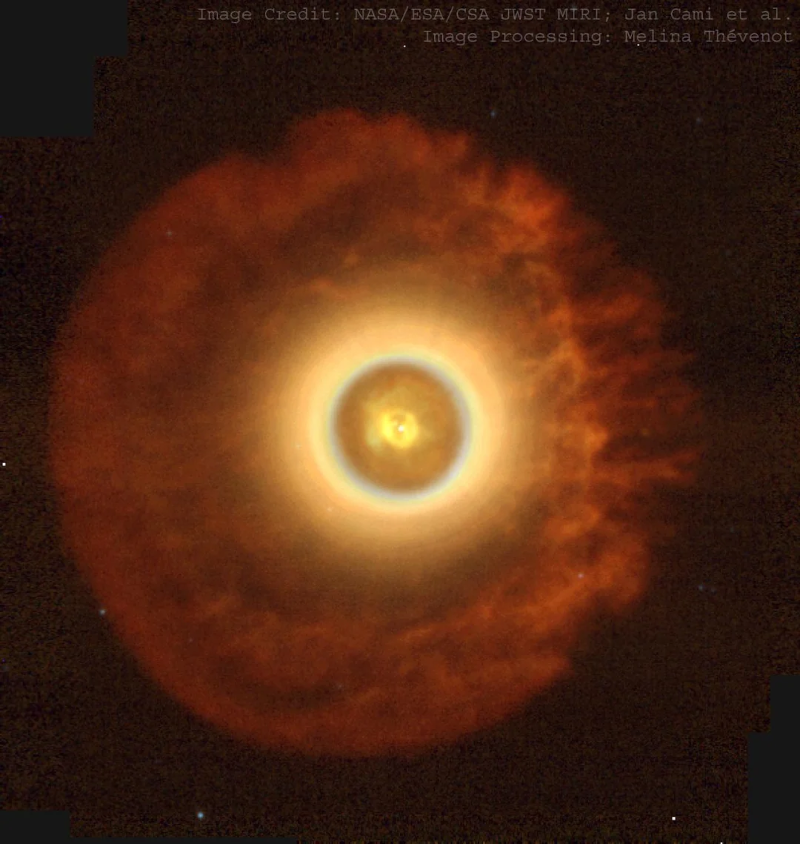
The resulting image of Tc 1 combines observations from nine infrared filters spanning wavelengths from 5.6 to 25.5 microns. Because these wavelengths lie beyond the range of human vision, the image was processed into visible colors representing different thermal regimes. Shorter infrared wavelengths, associated with hotter gas, appear blue, while longer wavelengths tracing cooler material appear red. The processed image reveals a highly structured nebula containing filaments, shells, and radial features extending outward from the central star.

One of the most notable structures visible in the new image is a feature near the nebula’s center resembling an inverted question mark. While its physical origin is not yet understood, it highlights the complexity of the gas dynamics and chemistry occurring within the nebula. The morphology suggests that multiple interacting processes are shaping the environment, potentially including stellar winds, magnetic fields, and asymmetric mass loss from the dying star.

The scientific value of the JWST observations extends well beyond imaging. MIRI also collected spectroscopic data, allowing researchers to analyze the detailed chemical fingerprints of molecules and dust throughout the nebula. Spectroscopy works by separating incoming light into its component wavelengths, revealing characteristic emission and absorption features associated with specific molecules.

Each molecule interacts with electromagnetic radiation in a unique way because molecular bonds vibrate at characteristic frequencies. In the mid-infrared, these vibrational modes produce emission features that can be used to identify molecular species directly. The spectroscopic data from Tc 1 will allow astronomers to map the spatial distribution of buckyballs and investigate how these molecules interact with their surrounding environment.

One of the major scientific questions concerns why the fullerene emission in Tc 1 is unusually strong compared to other nebulae. Understanding this requires detailed modeling of excitation mechanisms, radiation fields, and local physical conditions. Researchers are investigating whether the brightness is driven primarily by ultraviolet excitation from the central star, interactions with dust grains, or specific chemical pathways unique to this environment.

The engineering capabilities of JWST are central to enabling these observations. Unlike previous infrared observatories, JWST combines a large segmented primary mirror with highly sensitive cryogenically cooled instruments. The telescope operates near the Sun-Earth L2 Lagrange point, where its sunshield continuously blocks heat from the Sun, Earth, and Moon. Maintaining extremely low operating temperatures is essential because infrared detectors are sensitive to thermal radiation generated by the telescope itself.

MIRI, in particular, requires active cooling to temperatures below 7 Kelvin. At these temperatures, detector noise is minimized, allowing the instrument to detect faint infrared signals from distant astrophysical sources. The telescope’s pointing stability and optical precision also contribute to the high spatial resolution visible in the Tc 1 observations.

Compared to the earlier Spitzer observations, JWST provides substantially improved sensitivity and angular resolution. Spitzer confirmed the existence of fullerenes in space, but JWST can now resolve the surrounding nebular structure in much greater detail and obtain higher-quality spectra across a broader wavelength range. This transition reflects the broader evolution of infrared astronomy from detection-focused observations toward detailed physical characterization.

The observations of Tc 1 are likely to remain scientifically important for years. The combination of imaging and spectroscopy provides a dataset capable of supporting multiple studies involving molecular chemistry, dust physics, and nebular dynamics. Researchers are currently preparing several scientific papers based on the observations, focusing on both the fullerene molecules themselves and the broader physical structure of the nebula.

More broadly, the work illustrates how astronomical observations connect chemistry, astrophysics, and instrumentation. Molecules first synthesized in terrestrial laboratories have now been observed in complex stellar environments thousands of light-years away. The same physical laws governing molecular vibrations on Earth operate throughout the galaxy, and increasingly sophisticated observatories are allowing those processes to be measured directly.

The new JWST observations of Tc 1 therefore represent more than a visually striking image. They provide a detailed view into the chemical and dynamical processes occurring around dying stars and expand understanding of how complex carbon molecules form and persist in space.


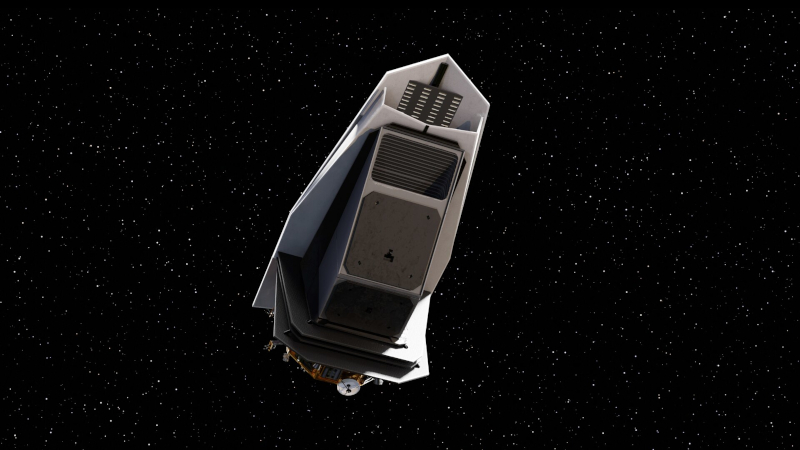
At a facility in Logan, Utah, engineers and scientists are assembling a spacecraft designed for a specific and increasingly important purpose: finding potentially hazardous objects before they find Earth. NEO Surveyor, NASA’s first space telescope built specifically for planetary defense, has now entered integration and testing at Utah State University’s Space Dynamics Laboratory. With a launch targeted no earlier than September 2027, the mission is transitioning from design and subsystem development into full spacecraft assembly and operational validation.

The mission addresses a well-defined problem in planetary science and risk management. Near-Earth objects, or NEOs, are asteroids and comets whose orbits bring them close to Earth’s orbital path around the Sun. Most are harmless, but some are large enough that an impact could produce severe regional or global consequences. The challenge is not only detecting these objects, but accurately determining their size, composition, trajectory, and long-term orbital evolution.

Traditional asteroid surveys rely heavily on visible-light telescopes. These systems detect sunlight reflected from an object’s surface. While effective, visible-light observations introduce ambiguity because brightness depends on both size and reflectivity. A small, highly reflective asteroid can appear similar to a much larger, darker one. This uncertainty complicates risk assessment.

NEO Surveyor approaches the problem differently by observing in the infrared. Instead of measuring reflected sunlight, the telescope measures thermal radiation emitted by objects themselves. Every object with a temperature above absolute zero emits infrared energy, and the intensity of that radiation depends strongly on the object’s size and temperature. By observing thermal emission directly, astronomers can estimate asteroid size with much greater accuracy than visible-light observations alone allow.

The spacecraft uses two heat-sensitive infrared imaging channels optimized for detecting and characterizing NEOs. These detectors operate at wavelengths where asteroids emit strongly after being heated by sunlight. The engineering challenge is substantial because infrared instruments are extremely sensitive to heat generated by the spacecraft itself. Any excess thermal emission from onboard systems can overwhelm faint asteroid signals.

To address this, NEO Surveyor incorporates a carefully designed thermal architecture. Passive cooling systems, including sunshields and radiative surfaces, help maintain the telescope and detectors at low temperatures. The observatory’s orientation relative to the Sun is tightly controlled to minimize thermal loading. This thermal stability is critical for detector sensitivity and calibration consistency over the mission lifetime.

The mission’s observing location also plays an important role. NEO Surveyor is expected to operate near the Sun-Earth L1 Lagrange point, a gravitationally stable region approximately 1.5 million kilometers from Earth toward the Sun. From this location, the telescope can maintain a continuous view of space near Earth’s orbit while operating in a thermally stable environment. The vantage point also allows the observatory to detect objects approaching from directions difficult to observe from Earth-based telescopes, particularly those coming from the daytime side of the sky.

The science objectives are directly tied to NASA’s planetary defense strategy. During its five-year baseline mission, NEO Surveyor aims to detect at least two-thirds of near-Earth objects larger than approximately 460 feet, or 140 meters, in diameter. Objects of this scale are considered capable of causing major regional damage in the event of an impact. Identifying and tracking them significantly improves Earth’s preparedness and response options.

Detection alone, however, is only part of the mission. The infrared data collected by NEO Surveyor will also help characterize asteroid composition and physical properties. By measuring thermal behavior over time, scientists can infer surface characteristics such as roughness and thermal inertia. Combined with rotational observations, these measurements provide insight into shape, spin state, and internal structure.

This information is scientifically valuable beyond planetary defense. Asteroids are remnants of the early Solar System, preserving material from the era of planetary formation. Their compositions reveal details about the distribution of minerals, volatiles, and organic compounds billions of years ago. Understanding asteroid populations also improves models of Solar System dynamics and long-term orbital evolution.

The engineering effort behind NEO Surveyor extends beyond the spacecraft itself. The mission will generate extremely large volumes of observational data, requiring advanced processing systems capable of identifying moving objects against dense stellar backgrounds. Software pipelines are being developed to automatically detect candidate NEOs, correlate repeated observations, and calculate preliminary orbits.

This data-processing challenge is significant because asteroids move relative to background stars, often appearing as faint, shifting points of light. Algorithms must distinguish genuine moving objects from detector noise, cosmic ray events, and background artifacts. Once detections are confirmed, orbital determination software calculates trajectories and predicts future positions. These calculations must account for gravitational interactions with planets and subtle non-gravitational effects such as the Yarkovsky effect, where uneven thermal emission gradually alters an asteroid’s orbit over time.

Integration and testing at the Space Dynamics Laboratory represent the stage where these systems begin operating together as a unified observatory. Spacecraft structure, avionics, thermal systems, detectors, and software must all function as an integrated system under simulated launch and space conditions. Environmental testing will expose the observatory to vibration, acoustic loads, vacuum conditions, and thermal extremes to verify readiness for launch and long-duration operation.

Reliability is especially important for a planetary defense mission. NEO Surveyor is intended to operate continuously for years with minimal intervention. Detector calibration, pointing accuracy, onboard data handling, and communication systems must remain stable over extended periods. Even small degradations in sensitivity or pointing precision can affect detection performance for faint objects.

The broader significance of NEO Surveyor lies in its role as infrastructure for planetary defense. Previous asteroid discoveries have largely come from general-purpose astronomical surveys. NEO Surveyor is different because it is purpose-built. Every aspect of the observatory—from wavelength selection to orbital placement—is optimized for detecting hazardous objects efficiently and systematically.

This represents a maturation of planetary defense from a research activity into an operational capability. Instead of relying on incidental discoveries, the mission establishes a dedicated system for identifying and tracking threats. The earlier a hazardous object is detected, the more response options become available, ranging from evacuation planning to potential deflection missions.

As assembly and testing continue toward launch readiness, NEO Surveyor is moving closer to becoming a permanent observational asset for Earth. Its task is straightforward in concept but demanding in execution: continuously scan the Solar System for objects that could one day intersect our planet’s path.

In practical terms, the mission is about measurement and detection. In strategic terms, it is about reducing uncertainty. By expanding humanity’s ability to identify and characterize near-Earth objects, NEO Surveyor strengthens the scientific and technical foundation of planetary defense while also deepening our understanding of the Solar System’s small-body population.


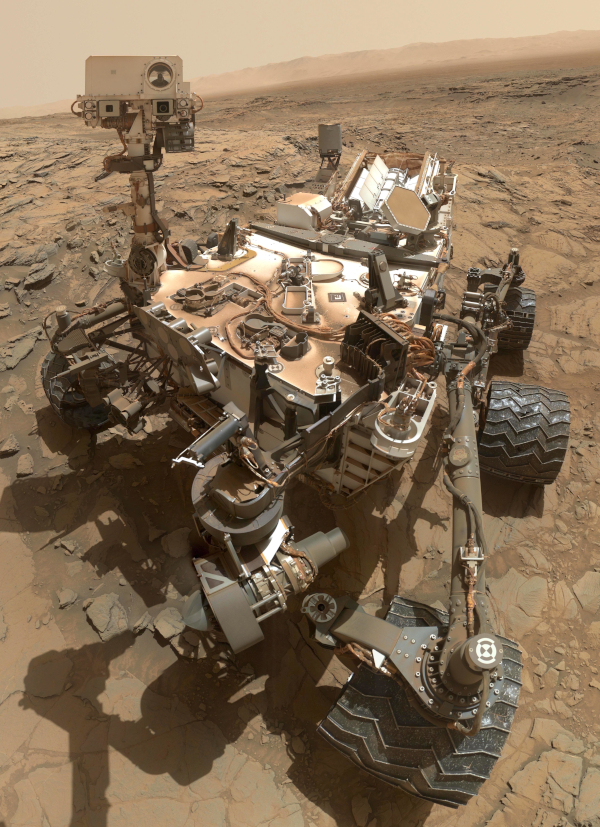
The search for signs of past life on Mars crossed a significant threshold in late April 2026, when an international team of researchers announced that NASA’s Curiosity rover had identified more than 20 distinct organic molecules preserved in ancient Martian rocks, including a nitrogen-containing compound whose structure resembles one of the building blocks of DNA. The findings, published on April 21, 2026, in the journal Nature Communications, represent the most diverse inventory of organic compounds ever detected on the Red Planet and demonstrate that the Martian subsurface is capable of protecting complex carbon-based chemistry for billions of years.

The discovery came from a chemical experiment conducted on another planet for the first time in history. Scientists used the Sample Analysis at Mars instrument suite, known as SAM, aboard Curiosity to analyze regolith and rock powder collected in the Glen Torridon region of Gale Crater. This area, explored by the rover in 2020, sits on the flanks of Mount Sharp and contains clay minerals that formed in the presence of liquid water approximately 3.5 billion years ago. Clay-rich environments are especially effective at trapping and shielding organic material from the radiation and oxidation that would otherwise destroy complex molecules near the Martian surface.

The experiment employed a chemical reagent called tetramethylammonium hydroxide, abbreviated TMAH, to break down larger organic molecules into smaller fragments that the SAM instruments could vaporize and characterize. The reagent is commonly used in geochemistry laboratories on Earth to liberate organic compounds from rock matrices without destroying them. Because Curiosity carries only a limited supply of TMAH, researchers spent considerable time selecting the optimal sampling site and timing the experiment to maximize scientific return. The successful execution of this procedure on Mars marks a milestone in analytical chemistry performed by robotic spacecraft at interplanetary distances.

Among the compounds detected, the nitrogen-containing molecule attracted particular attention. Its structure resembles nucleobases, the units that encode genetic information in DNA and RNA on Earth. The same class of molecules has been found in carbonaceous meteorites, which deliver organic material to planetary surfaces throughout the solar system. “The same stuff that rained down on Mars from meteorites is what rained down on Earth, and it probably provided the building blocks for life as we know it on our planet,” said Amy Williams, a geological sciences professor at the University of Florida and a member of both the Curiosity and Perseverance science teams, in a statement accompanying the paper’s release.

The rover also detected benzothiophene, a sulfur-containing molecule with a double-ring structure that is commonly found in meteorites and is associated with organic matter delivered from space rather than biological processes. This underscores a central challenge in interpreting organic detections on Mars: distinguishing between compounds that arrived via meteorite infall and those that might have a more local or biological origin. The Glen Torridon samples contained molecules in sufficient quantity and variety that the researchers concluded they were examining genuinely preserved ancient organic matter, rather than terrestrial contamination or trace amounts consistent with meteorite delivery alone.

Gale Crater was chosen as Curiosity’s landing site precisely because orbital spectroscopy had identified clay minerals in the region, suggesting a past environment where liquid water was stable and potentially hospitable to life. The rover arrived in August 2012 and has spent the subsequent years traversing the crater floor and ascending Mount Sharp, analyzing rock formations that record billions of years of Martian geological history. The Glen Torridon stop represented a particularly promising target because the clay minerals there act as molecular sponges, capturing and preserving organic compounds that would otherwise be degraded by cosmic rays and perchlorate chemicals in the Martian soil.

The detection of preserved organics in the shallow subsurface has direct implications for how scientists plan the next phase of Mars exploration. The ESA Rosalind Franklin rover, scheduled to launch on a SpaceX Falcon Heavy in late 2028, will carry a version of the TMAH extraction technique to a different landing site on Oxia Planum, where clay-rich deposits also exist. NASA’s Dragonfly mission to Saturn’s moon Titan, currently targeting launch in the 2030s, will employ similar chemical analysis methods on organic-rich sediments on that distant world’s surface. The success of the SAM TMAH experiment on Curiosity validates the approach and builds confidence that robotic chemistry can recover meaningful organic signatures without requiring sample return to Earth.

The authors of the Nature Communications paper are careful to note that the presence of these molecules does not constitute evidence of past life on Mars. The compounds could have arrived via meteorite infall, formed through geochemical processes in the Martian crust, or been delivered by hydrothermal systems that once operated in Gale Crater. What the discovery demonstrates is that the chemistry of life, or its precursors, has existed on Mars in sufficient quantity and diversity to be detectable after 3.5 billion years of preservation. The question of whether that chemistry ever organized itself into anything resembling living systems remains unanswered and will only be resolved when Martian samples are returned to terrestrial laboratories.

NASA’s Perseverance rover, which landed in Jezero Crater in 2021, is actively collecting and caching rock samples for eventual return to Earth as part of the Mars Sample Return campaign. The campaign, involving NASA and ESA, plans to launch the collected samples aboard a small rocket from the Martian surface and rendezvous them with an Earth return orbiter for delivery to scientists on the ground. That mission architecture is currently undergoing review and development, with the first sample return targeted for the early 2030s. Until Martian material can be examined with the full arsenal of instruments available in terrestrial laboratories, Curiosity’s latest finding stands as the most compelling indication yet that the raw ingredients for life were present on our neighboring planet at a time when life was also emerging on Earth.

Understanding why organic molecules survive on Mars requires examining the planet’s unusual surface chemistry. The Martian regolith contains perchlorate salts at concentrations of up to one percent in some soils. Perchlorates are powerful oxidizing agents that break down organic compounds when activated by ultraviolet radiation from the Sun. This chemical environment, combined with the constant bombardment of cosmic rays and solar particles that penetrate the thin Martian atmosphere, should in theory destroy exposed organic molecules within millions of years.

The clay minerals in formations like Glen Torridon offer a protective environment that substantially extends this timescale. Smectite clays, the class of clay minerals dominant in Gale Crater, have a layered sheet structure that traps molecules between the layers and shields them from radiation and reactive chemicals. The same property makes these clays useful in contamination remediation on Earth, where they are employed to immobilize organic pollutants in soils and groundwater.

The TMAH extraction process works by dissolving the clay matrix and releasing the trapped molecules for analysis. The reagent acts as a strong base that breaks the chemical bonds between the clay layers and the organic compounds, allowing the molecules to enter solution where they can be vaporized and analyzed by mass spectrometry. The SAM instrument heats the extracted samples to temperatures that ionize the organic molecules, then separates the ions by mass-to-charge ratio to identify the constituent compounds. This technique, routine in terrestrial geochemistry, had never been applied on another planet until Curiosity’s team adapted it for the SAM instrument’s constraints on mass, power, and consumables.


For as long as humans have imagined traveling between worlds, one limitation has remained stubbornly in place: time. Even the most powerful rockets ever built still rely on chemical reactions, releasing energy stored in molecular bonds. These reactions are violent, effective, and well understood, but they are ultimately constrained. They push spacecraft away from Earth with immense force, yet once the fuel is spent, the journey continues in silence, governed by inertia alone. To truly shorten the distances between planets, something more powerful is required—something that does not merely burn fuel, but transforms matter itself into energy.

This is the promise behind the Sunbird spacecraft concept, developed by Pulsar Fusion. Sunbird is not designed as a traditional spacecraft, nor even as a standalone mission vehicle. Instead, it is envisioned as a space tug, operating in orbit and attaching to other spacecraft to accelerate them across the Solar System. At its core lies a propulsion system that has long been considered the ultimate prize in aerospace engineering: a nuclear fusion engine.

Fusion is the process that powers the stars. It occurs when light atomic nuclei combine under extreme conditions, releasing vast amounts of energy. Unlike chemical reactions, which rearrange electrons in atoms, fusion rearranges the nuclei themselves, tapping into the fundamental forces that bind matter together. The energy density of fusion is orders of magnitude greater than that of chemical fuels. In principle, it offers the ability to sustain thrust over long durations while achieving velocities far beyond what conventional propulsion can deliver.

Sunbird’s propulsion system is based on what Pulsar Fusion calls a Dual Direct Fusion Drive. The concept is both elegant and demanding. Instead of using fusion merely as a heat source to generate electricity or drive a conventional engine, the system aims to convert fusion energy directly into thrust. In this approach, charged particles produced by fusion reactions are guided and accelerated by magnetic fields, forming an exhaust stream that produces propulsion without the need for traditional propellant expulsion in the chemical sense.

The choice of fuel is critical. Sunbird is designed to use a mixture of deuterium and helium-3, isotopes that offer a pathway toward cleaner fusion reactions. When these nuclei fuse, they produce high-energy charged particles with relatively low neutron output compared to other fusion reactions. This is significant because neutrons, lacking an electric charge, are difficult to control and can damage reactor materials over time. By favoring reactions that produce charged particles, the engine can more effectively channel energy into directed thrust using magnetic confinement.

The engineering challenges behind such a system are immense. Fusion requires extreme conditions—temperatures of millions of degrees and precise control of plasma behavior. On Earth, experimental fusion reactors rely on large, complex facilities such as tokamaks and stellarators to confine plasma using powerful magnetic fields. Translating this technology into a compact, space-based system demands innovation at every level.

Magnetic confinement becomes the central mechanism. Superconducting magnets generate intense magnetic fields that hold the plasma in place, preventing it from contacting the reactor walls. These fields must be stable and precisely controlled, as even small instabilities can lead to energy losses or disruptions. At the same time, the system must allow for the extraction of energy in a controlled manner, directing charged particles out of the reactor to produce thrust.

Thermal management presents another critical challenge. Even with aneutronic fusion reactions, significant heat is generated within the system. In the vacuum of space, there is no atmosphere to carry heat away, so the spacecraft must rely on radiative cooling. Large radiators may be required to dissipate excess heat, adding complexity to the design and influencing the overall architecture of the vehicle.

The concept of Sunbird as a space tug introduces an additional layer of strategic thinking. Rather than equipping every spacecraft with its own fusion engine, Sunbird would operate as an orbital asset. Spacecraft launched from Earth using conventional rockets would rendezvous with the tug in low Earth orbit. Once attached, Sunbird would provide sustained acceleration, gradually increasing velocity over time. This approach leverages the strengths of both chemical and fusion propulsion, combining the high thrust of rockets for launch with the high efficiency of fusion for deep-space travel.

The physics of continuous acceleration opens new possibilities for mission design. Instead of following purely ballistic trajectories, spacecraft could maintain thrust for extended periods, reducing travel times significantly. Missions to Mars, which currently take months, could potentially be shortened. Journeys to the outer planets could become more practical, enabling more ambitious exploration and even the transport of larger payloads.

Yet Sunbird remains, for now, a concept in development. The transition from theoretical design to operational system requires rigorous testing and validation. Plasma behavior must be understood under the specific conditions of the engine. Materials must be developed that can withstand the harsh environment inside the reactor. Control systems must be capable of maintaining stability over long durations. Each of these challenges represents a frontier in its own right.

What makes Sunbird compelling is not just its potential speed, but what that speed represents. It is a step toward a future where the Solar System is not defined by distance in the same way it is today. If fusion propulsion can be made practical, it could transform how we think about space travel, shifting the focus from isolated missions to sustained movement between worlds.

There is a certain symmetry in this vision. The same process that powers the Sun—fusion—becomes the engine that carries humanity outward. The energy that has shaped the cosmos becomes a tool for exploring it. In this sense, Sunbird is not just a spacecraft concept. It is an attempt to harness the most fundamental source of energy in the universe and turn it into motion.

Whether Sunbird ultimately achieves its goals remains to be seen. But the effort itself reflects a broader trend in space exploration: the search for propulsion systems that go beyond the limits of chemistry, reaching into the realm of fundamental physics. It is a reminder that the journey to other worlds is not just about where we go, but about how we get there.

And if that journey is ever powered by fusion, it may mark the moment when the distances between planets begin to feel, at last, a little smaller.