


Lucy heads for the Trojans with an unlatched solar array
At 5:34 in the morning on 16 October 2021, a United Launch Alliance Atlas V lifted off from pad 41 at Cape Canaveral carrying a spacecraft with two circular solar arrays and a twelve-year plan to reach asteroids no spacecraft has ever studied up close. Five years on, NASA’s Lucy is still short of its destination, and the piece of hardware the flight team thinks about most is not an instrument or a thruster but a set of photovoltaic panels that never latched. On 19 October 2026 the Southwest Research Institute, which leads the mission, published a five-year scorecard that reads less like a status report than a list of surprises: an asteroid with a satellite nobody predicted, a second asteroid turned out to be a peanut with a neck nobody expected, and a solar array the team spent a year coaxing into a configuration good enough to fly on (SwRI, October 2026).
The prize at the end of that tour sits about 5.2 astronomical units from the Sun. The Jupiter Trojans are two swarms of dark rock leading and trailing the giant planet by 60 degrees, held at the L4 and L5 points of the Sun-Jupiter system, where they have been locked into a repeating pattern for most of the solar system’s history. NASA describes them as remnants of the material that formed the giant planets (NASA, October 2021). Their value is that they are probably not native to where they now sit. The prevailing picture holds that they were captured from elsewhere when the giant planets migrated, so they preserve a sample of material that formed in a different part of the protoplanetary disk than anything in the main belt.
Reaching that sample is the difficult part, and the shape of the spacecraft is the argument. A chemical rocket hauling a tonne and a half of hardware cannot easily visit eleven asteroids over twelve years. Lucy buys efficiency with patience instead: solar electric propulsion, where the arrays feed ion thrusters that push for months at a time, with charged particles leaving the nozzles at speeds up to 90,000 mph (NASA Glenn, July 2023). The rocket equation, Δv = v_e * ln(m_0 / m_f), rewards that patience, because a large exhaust velocity lets a spacecraft trade propellant mass for speed. NASA’s thruster programme makes the bargain explicit: a 48,000-hour test of the Evolutionary Xenon Thruster burned 860 kg of xenon, where a chemical rocket would have needed 10,000 kg of propellant to impart the same momentum (NASA Glenn, July 2023).
Everything else on Lucy follows from the electricity bill. The two solar arrays are 7.3 metres across, roughly 42 square metres of photovoltaic surface apiece, the vehicle stretches 16 metres from tip to tip, and it weighs 1,500 kg with propellant aboard. By the time it reaches Jupiter’s distance it will have about 504 watts to spend (NASA, Lucy spacecraft page). Sunlight falls off with the square of distance, so at 5.2 astronomical units the arrays collect roughly a twenty-seventh of the light they saw over Florida, and every thruster throttle, every downlink and every instrument duty cycle has to be sized to what is left.
That last number explains why the array became the mission’s defining problem. Lucy deployed both arrays shortly after launch. One unfurled and latched normally. The other stopped with its panels fanned out to roughly 345 degrees of a possible 360 and would not lock. The suspected culprit was the lanyard, the line that pulls the array out of its stowage spool and holds it at full extension: NASA reported that between 20 and 40 inches of a roughly 290-inch lanyard still had to be reeled in for the latch to engage (NASA, April 2022).
What followed was a year of careful improvisation. Engineers ran the deployment motor in short bursts and watched how the spacecraft responded, using flight data to calibrate ground models of the array’s stiffness. A June 2022 effort pushed the array out to between 353 and 357 degrees and put it under enough tension to hold itself steady (NASA, June 2022). By the following January the team called it: further attempts were unlikely to help, because the work went better when the spacecraft was warm and close to the Sun, and Lucy was already 197 million kilometres out, receding at 35,000 kilometres per hour. The array was more than 98% deployed, the team estimated, and strong enough to survive twelve years in that unlatched state (NASA, January 2023).
The first Earth flyby, on 16 October 2022, carried the spacecraft within 392 kilometres of the planet and through the upper atmosphere, and the array held its shape through the encounter. That boost also sent Lucy onto an orbit reaching more than 500 million kilometres from the Sun before a return for a second gravity assist on 12 December 2024, a pass that added more than 16,000 mph to its heliocentric speed and set it on the road to the Trojans (SwRI, October 2026). Between assists, Lucy watched Dimorphos, the moonlet of the asteroid Didymos, take NASA’s DART impact in September 2022, and caught the interstellar comet 3I/ATLAS in September 2025 from an angle no telescope on Earth could match.
The science started early because of an accident of geometry. In 2022 the team realised Lucy’s planned path would pass close to a tiny, then unnamed main-belt asteroid, and they added it as a target to rehearse the spacecraft’s navigation system. The flyby on 1 November 2023 turned out to be a rehearsal that produced a discovery: the asteroid, later named Dinkinesh, had a satellite. That moonlet was named Selam, and it turned out to be a contact binary, two lobes in contact, the first such object ever seen in orbit around another asteroid. “We have never seen one orbiting another asteroid,” SwRI’s John Spencer, Lucy’s deputy project scientist, said (SwRI, October 2026).
The published analysis is stranger than the headline. Lucy passed within 431 kilometres of Dinkinesh, a body with an effective diameter of about 720 metres, and found a prominent longitudinal trough running along it with a substantial equatorial ridge on top. The team’s reading is that radiation torque, the slow spin-up of a small body driven by sunlight striking rough surfaces, eventually turned Dinkinesh until a chunk of its own mass broke off, and the ridge and the trough are the scar of that failure and the partial re-accretion of the shed material. Selam is made of lobes roughly 210 and 230 metres across, orbits 3.1 kilometres out with a period of about 52.7 hours, and is tidally locked to its parent (Scholl et al., Nature, 2024).
That finding has context that turns the two Lucy flybys from side-show into a census. Contact binaries, objects made of two pieces stuck together, are not rare: a survey of published shape models suggests they make up somewhere between 30 and 50 per cent of asteroids and comets. Detailed shape models for them are scarce. Only sixteen had been published before this October, because the usual routes to one are both rare. Building a reliable model of a contact binary usually means either watching a star wink out behind it or driving a ground radar within 0.1 astronomical units, and those opportunities do not come often (Cannon et al., MNRAS, October 2026).
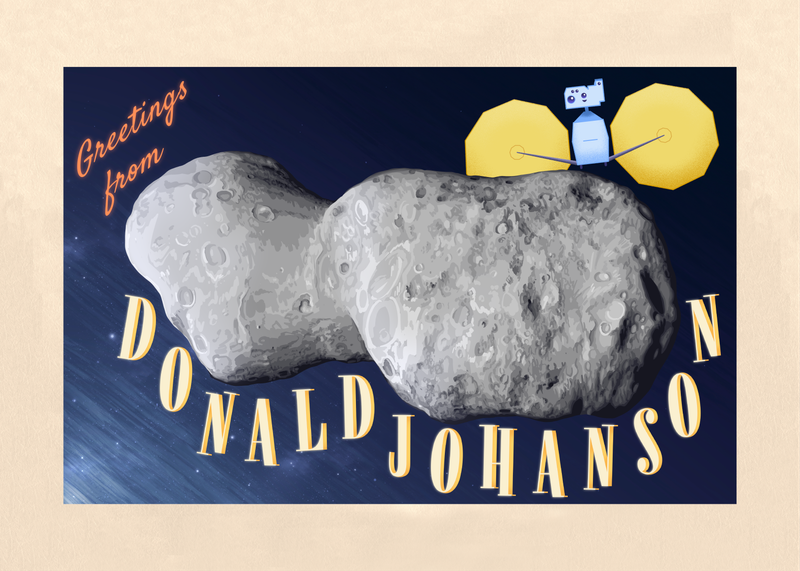
The second rehearsal, on 20 April 2025, was at Donaldjohanson, an asteroid that ground observers had already flagged for brightness changes on a ten-day cycle. Lucy passed 960 kilometres away and found a peanut: two lobes joined by a neck that Hal Levison, the mission’s principal investigator, said looked like two nested ice cream cones. The body is larger than anyone expected, about 8 kilometres long and 3.5 kilometres wide at its widest, and it turns on more than one axis, tumbling end over end every 10.5 days while rolling about a second axis every 26.5 days (NASA, Donaldjohanson page; SwRI, October 2026).
Both surprises came cheap, as rehearsals are supposed to. The real targets are much harder places to work. A Trojan’s orbit is well understood in theory and poorly known in practice, so Lucy will have to find these objects the way a walker finds a landmark in fog, by imaging them with its terminal tracking camera and rebuilding the navigation solution on the fly. The two main-belt encounters were where that machinery got shaken out, and Levison described them as engineering tests of the spacecraft’s navigation system ahead of the main event (SwRI, October 2026).
The instruments have to earn their keep in the same short time. Lucy’s long-range reconnaissance imager, L’LORRI, can pick out craters 70 metres across from 1,000 kilometres away, at roughly 14 metres per resolution element, and it has no moving parts and no focusing mechanism, which removes two failure modes from a camera that will spend years pointed at dark, cold rock. L’Ralph looks for organics, ices and hydrated minerals in the visible and infrared, using a linear etalon to slice light into a spectrum a few hundred wavelengths wide. L’TES measures how fast a surface heats in sunlight and cools in shadow, which is how a spectrometer built for warmth reads the size of the sand on an asteroid. None of that yields a density on its own. The mass comes from the Doppler shift of the radio carrier tracked by the 2-metre high-gain antenna, and the shape comes from the terminal camera; divide one by the other and you know whether you are looking at a coherent block of rock or a pile of rubble held together by its own weak gravity. That single number is what turns a set of pretty images into an answer about how the planets were built.
The schedule from here is fixed and, for once, comfortable. Eurybates and its satellite Queta on 11 August 2027. Polymele and the moon the team found around it in September 2027. Leucus in April 2028 and Orus in November 2028. Then a third swing past Earth in December 2030 throws the spacecraft into the other swarm, and Patroclus and Menoetius, a pair of unequal bodies orbiting each other, are waiting in March 2033 (NASA, Lucy mission page). By then the mission will have run for twelve years and visited eleven asteroids, and the naming will have come full circle: the asteroid called Donaldjohanson is named for the anthropologist who found the fossil Lucy, and the spacecraft is named for that fossil.
What the first five years show is that the hard part of a survey is rarely the target list. Lucy was supposed to coast past a couple of unnamed rocks on its way to the Trojans, and instead it has produced the first close-up shape models for a class of asteroid that may be the most common kind there is, plus a satellite nobody had catalogued. The open question now is what the swarms themselves turn out to be: pristine leftovers from the outer solar system, captured and preserved, or rubble that has been broken down and reassembled by impacts since. Either answer matters, and the spacecraft still carrying a solar array nobody managed to latch is in a position to give it.
 Subscribe to our RSS feed









There are no comments.
Add A Comment