


At 4:22 in the morning on February 12, a Vulcan Centaur lifted off from Cape Canaveral and started to shed pieces of itself. Less than thirty seconds after the engines lit, sparks appeared in the exhaust plume of one of the four strap-on solid rocket motors. A little over a minute in, debris came off the vehicle and the 202-foot rocket rolled along its long axis until the guidance system and the core stage’s two methane-fueled BE-4 engines caught it. The stack reached a geosynchronous orbit more than 22,000 miles up, delivered two Space Force surveillance satellites and a third payload, and ended a nearly ten-hour mission (Ars Technica; ULA, February 2026). The rocket worked. Then it never flew again.
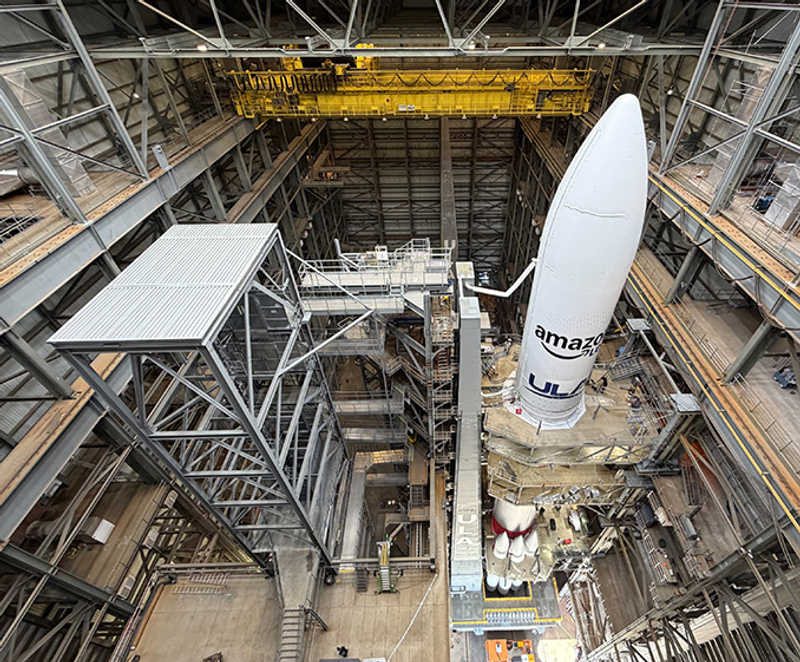
On October 28, United Launch Alliance said Vulcan would fly again on Friday, November 13, carrying 40 satellites for Amazon Leo from Cape Canaveral. The date depends on range approval, but the configuration is settled: a VC6L, the first Vulcan with all six strap-on boosters, a stretched payload fairing and a shortened Centaur V (ULA, Vulcan Leo 1 mission page).
That single flight carries more weight than most. Vulcan is the vehicle the Space Force certified in March 2025 to take over the national security launch work, and 27 Space Force missions sit on its book. After the February grounding, six Vulcan assignments moved to Falcon 9 and Falcon Heavy, including three GPS satellites and a large missile-warning satellite (Ars Technica, October 2026). NASA has also picked the two-booster VC2 configuration as a candidate for human-rating, so Vulcan can carry Boeing’s Starliner (ULA, September 2026). Amazon Leo, the constellation once called Project Kuiper, has booked 38 Vulcan launches and is weeks from commercial service (Ars Technica, October 2026).
The grounding did not come from nowhere. Vulcan has flown four times since its January 8, 2024 debut, and on two of those flights a solid rocket motor nozzle came apart.
The first was Cert-2 on October 4, 2024, a certification test the Space Force needed. About 37 seconds after liftoff, the plume of one of the two side-mounted motors changed sharply, the bell of the nozzle fell away in plain view, and the rocket tilted (Ars Technica, October 2024). ULA’s chief executive Tory Bruno called it “just the release of the nozzle.” The vehicle climbed on “reduced, asymmetric thrust,” and the Centaur’s engines burned about 20 seconds longer than planned to compensate (Ars Technica, October 2024). Investigators traced it to a manufacturing defect in a carbon composite insulator inside the nozzle, which let superheated exhaust melt through the metal it protected (Ars Technica, February 2026). Vulcan did not fly for ten months.
The second came on the fourth flight, USSF-87. One of four motors showed the anomaly, sparks and debris appeared, and the vehicle rolled further than intended. The debris landed in water too deep to recover, so investigators worked from telemetry and imagery (Spaceflight Now, May 2026). ULA vice president Gary Wentz described the recovery plainly: “We did see some roll, and the BE-4s were able to compensate to arrest that roll” (Spaceflight Now, May 2026).
The fix came from a joint team of ULA, motor maker Northrop Grumman and the Space Force. On April 15, Northrop fired a GEM 63XL on a test stand to demonstrate “nozzle design enhancements” alongside “an advanced propellant technology for future solid rocket motors” (Spaceflight Now, May 2026). ULA’s own statement is careful in a way that says the root cause is not formally closed: the team has “identified several potential contributors which have been mitigated through design and process improvements to the nozzle” (ULA, October 2026).
The Space Force wants flight data, not a test-stand signature. Brigadier General Eric Zarybnisky, the chief rocket buyer at Space Systems Command, said the military wants to see what commercial missions produce before clearing Vulcan for national security payloads again, with at least two Amazon Leo launches likely to come first (Ars Technica, October 2026). November 13 is a test flight in the fullest sense: six motors, an unfamiliar fairing, a shortened upper stage, forty satellites that have to reach the right orbital planes.
The reason February survived is worth understanding, because the same asymmetry makes the fix hard. A solid motor cannot be throttled, cannot be shut down, and its nozzle points where it points. The two BE-4 engines on the core stage can do all three, throttling between 40 and 100 percent and gimballing five degrees either side of vertical. On the VC6L, the six GEM 63XL motors contribute about 2,044 kilonewtons each, roughly 12.3 meganewtons between them, against 4.8 meganewtons from the two BE-4s (ULA, Vulcan Leo 1 mission page). Solids are close to seven tenths of liftoff thrust. Lose one motor and you lose roughly a ninth of the thrust and, worse, shift the thrust centroid sideways, which is what rolls a rocket. The liquid engines can vector to cancel that moment, and on February 12 they did.
The failure itself was not exotic. The bell of a Graphite-Epoxy Motor nozzle is carbon-phenolic composite, and inside the motor an insulator keeps the superheated exhaust off the metal structure (Ars Technica, October 2024). In 2024 a manufacturing defect in that insulator exposed metal never meant to see the exhaust directly, and the structure melted and burned through (Ars Technica, February 2026). A motor with a breached nozzle does not stop burning; it keeps burning through a deformed throat, producing less thrust at lower efficiency. That is why ULA is flying the fix rather than declaring it. A static fire demonstrates hardware; it cannot show the hardware behaving the same way under flight loads with five other motors lit.
The rest of the November changes have nothing to do with the anomaly. The mission uses the LEO-optimized Centaur V, designated CV-L: 35 feet long, about six feet shorter than the high-energy variant, carrying a third less propellant in stainless steel tanks with walls thinner than a dime (ULA, June 2026). Less propellant means a lighter upper stage, and more satellites per launch. The 70-foot fairing around them is a sandwich composite with a vented aluminum honeycomb core and graphite-epoxy face sheets, splitting along a bisector with spring packs and a frangible joint (ULA, Vulcan Leo 1 mission page). With six boosters attached, the vehicle stands 221 feet tall.
November 13 is the first test. A second Vulcan for Amazon Leo is already assembled in ULA’s original government building, and at least two of these commercial flights must come off cleanly before the Space Force trusts the rocket with a national security payload again. That puts the military’s return to Vulcan in 2027 at best, on a rocket that has flown once a year and not at all for nine months.
The schedule pressure runs the other way. Amazon Leo had 396 satellites in orbit by July against an FCC authorization for 3,236, and the deadline for half the constellation was waived in June (Wikipedia, Amazon Leo). ULA’s plan to fly 16 to 18 Vulcan missions this year is gone (Ars Technica, February 2026).
None of this turns on exotic hardware. The defect that grounded the fleet was a flaw in a piece of composite insulation, and the repair was a better nozzle and a tighter process. The arithmetic of trust is the real story: with this few flights behind it, one failed part is a verdict on the whole vehicle. The Space Force is counting flights now. ULA needs them to go the right way.
 Subscribe to our RSS feed









There are no comments.
Add A Comment