


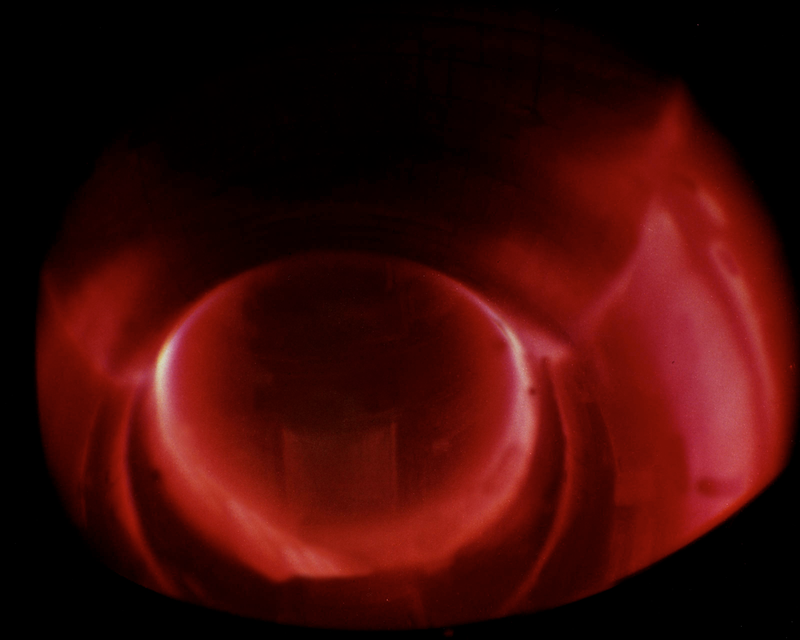
Every fusion machine begins with an awkward asymmetry. The nuclear reaction is easy to describe; sustaining it is not. Fuse two heavy hydrogen nuclei and you get back a sliver of mass as heat, and in a tokamak that heat has to arrive faster than the plasma leaks it to the walls, the radiation and the vacuum outside. Do that and the plasma heats itself, a state physicists call ignition. Miss it and you have built an extremely expensive space heater.
The puzzle organising fusion research since 1955 is not whether the reaction works, but how to reach a burning plasma without spending more energy getting there than the reaction returns. John Lawson’s answer, published in 1955, fixed three quantities a plasma must satisfy, temperature, density and confinement time (ITER). Lawson said where the finish line sat, not which road to it was cheapest. On 10 September 2026, Luis Delgado-Aparicio, Masayuki Ono and Jonathan Menard at the Department of Energy’s Princeton Plasma Physics Laboratory published a paper in Physical Review Letters that answers the second question, and not in the way most reactor designs assume.
In December 2022 the National Ignition Facility compressed a peppercorn-sized capsule hard enough to get more energy out of it than the lasers put in, 3.15 MJ from 2.05 MJ (LLNL), and by April 2025 that yield had reached 8.6 MJ at a target gain above four (LLNL). That is ignition, but it is inertial confinement, fuel squeezed by an imploding shell. A power plant needs the opposite, a burning plasma held by magnetic fields in a doughnut. No tokamak or stellarator has reached ignition.
Delgado-Aparicio and colleagues treat ignition as a problem of path rather than threshold. Their framework unifies four things fusion theory usually handles apart: the Lawson power balance, the Cordey construction that identifies the least demanding path to a burning state, the ignition ridge where a burning plasma tips into runaway, and Mills’ treatment of runaway dynamics (Delgado-Aparicio et al., Physical Review Letters, September 2026). Run as a zero-dimensional model, that turns ignition from a static line on a graph into a constrained pathway through density and temperature space.
The headline result reverses the usual operating order. Most designs compress first and heat second, squeezing a relatively cool plasma before pumping in enormous power. The Princeton calculations say the cheap route runs the other way: heat the plasma to fusion temperatures first, then raise its density. In the idealised limit, with clean fuel only, the least demanding crossing point, which the paper calls the Cordey saddle, sits where fusion power reaches roughly five times the injected heating power (PPPL, October 2026). Put real physics back in and that crossing point moves uphill.
What moves it uphill is the set of losses an ideal plasma lacks: the helium ash left behind by burnt fuel, light and heavy impurities sputtered off the reactor walls, synchrotron radiation from electrons spiralling in the magnetic field, and heat carried out by conduction and convection (Delgado-Aparicio et al., 2026). Fold all four in at once, as earlier work rarely did, and the ridge, the saddle and the entry points shift toward higher density and temperature. Masayuki Ono put it plainly: “When you leave these effects out, you say the design will work fine” (PPPL, October 2026).
The most alarming finding concerns tungsten. More than a dozen next-generation fusion machines have chosen it for their inner walls, yet contamination at one part in 10,000 can roughly double the pressure a machine needs to reach ignition (PPPL, October 2026). In a realistic three-dimensional reactor the required plasma pressure climbs further, along with the ratio of plasma pressure to magnetic pressure, where magnetohydrodynamic stability limits begin to bite (Delgado-Aparicio et al., 2026). A trace of eroded wall metal can push a reactor past the point where its plasma holds together.
The same losses that make ignition harder also brake it. A stabilizing feedback from transport, impurity and synchrotron damping, and from the unfavourable way energy confinement degrades as heating power climbs could hold a burning plasma in steady state, which suggests the thermal runaway that has worried designers for decades is self-limiting (Delgado-Aparicio et al., 2026).
Why does the order of operations matter so much? Because the gain a plasma can reach depends on where it sits on the density-temperature map, and that map is not flat. Fusion power scales as P_f = n_D n_T ⟨σv⟩ E_f, the bracketed term being the fusion reactivity. For deuterium-tritium fuel the Lawson requirement n T τ_E ≥ 3×10^21 keV·s·m⁻³ (LLNL-TR-676592) is minimised not at the highest temperature but in the low tens of keV, where reactivity is still climbing but radiation losses have not yet taken over.
Every route to ignition is also a budget. In deuterium-tritium burning, 20 percent of the released energy leaves as 3.5 MeV alpha particles that stay trapped in the plasma and heat it, so a self-sustaining burn needs P_α ≥ P_loss + P_aux. The losses come from bremsstrahlung, which scales roughly as n_e Σ n_i Z_i² √T; from synchrotron radiation, which grows with the square of the field; and from transport, which strips plasma energy at a rate W/τ_E, a confinement time that degrades as power rises. Compress a cold plasma first and you pay for density while the fusion power is still nearly zero, then buy heat against losses that scale with that density. Heat first and the injected power is spent where the triple product is easiest to satisfy.
Two escapes from the tungsten trap appear in the same work: coats of liquid lithium, which PPPL has pursued for years, to intercept sputtered metal before it reaches the core, and spin-polarized fuel, whose aligned nuclear spins raise the fusion reactivity and reopen part of the ignition window (PPPL, October 2026).
The caveats are real. The work is entirely computational, no experiment has reached the temperatures where the Cordey saddle sits, and the authors’ next step is numerical experiments rather than a machine (Delgado-Aparicio et al., 2026). It was funded by the Department of Energy’s Office of Science, so the modelling is public.
Before a reactor is built, somebody has to decide whether to line its walls with tungsten, how hard to compress, and when to start injecting heating power. Those choices run to billions, and they have usually been made with an ignition model that leaves out the four losses that matter most.
The other route to a burning plasma is being mapped just as hard. On 8 October 2026, General Fusion reported that its LM26 machine compressed a plasma to an electron temperature of 1.1 keV, measured by Thomson scattering with the UK Atomic Energy Authority, the first time a magnetised target machine crossed that threshold (General Fusion, October 2026). Its next milestone is 10 keV.
The lesson from both is that ignition is a route rather than a number. The physics of getting there is decided by losses most design studies have filed as footnotes, and the machines that might get us there are being specified at the moment those footnotes are promoted to the main text.
 Subscribe to our RSS feed









There are no comments.
Add A Comment