


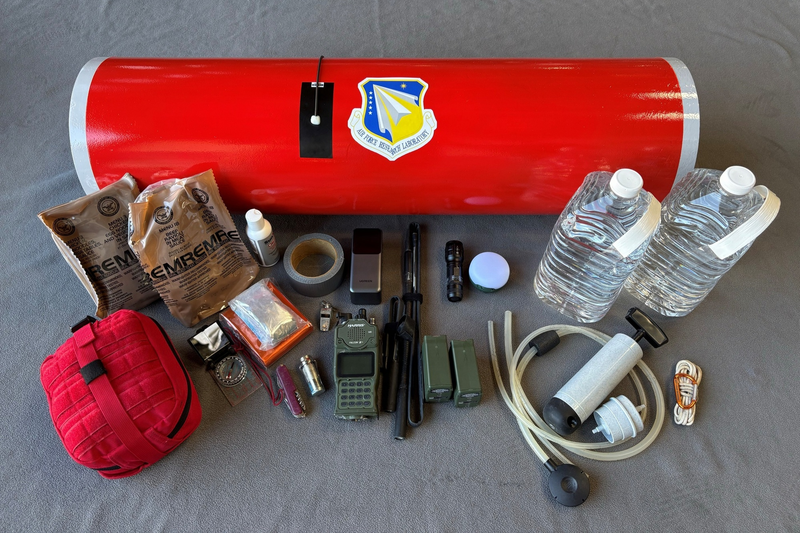
At 7:04 a.m. Eastern on 20 October 2026, a Falcon 9 lifted off from Space Launch Complex 40 at Cape Canaveral Space Force Station carrying more than thirty small satellites and one squat, uncrewed cylinder. The cylinder was a Starfall reentry capsule, and it belonged to the Air Force. Inside sat orange cargo pods holding the sort of gear you would want if the supply chain stopped working: military ration boxes, water, batteries, a hand-crank radio, a flashlight, a GPS tracker and a satellite beacon. The pods rode as a passenger on a commercial rideshare mission called Bandwagon-5, and when the capsule came back down in the Pacific a few weeks later, engineers would crack them open and see what the ride had done to the contents (AFRL, 20 October 2026; Air & Space Forces Magazine, 26 October 2026).
For five years the Air Force Research Laboratory has been trying to make a strange proposition look obvious: that the fastest way to move freight to a place with no runway is to put it in orbit first. The program, Rocket Cargo, began in 2021 with a fact sheet that set out the doctrine plainly. The lab would not build rockets. It would “leverage commercial rocket capabilities as a leased service,” and its stated goal was “up to 100 tons of cargo to be delivered anywhere on the planet within tactical timelines” (AFRL Rocket Cargo fact sheet AFRL-2021-1732, June 2021). SpaceX took the first contract in 2022, five years and $102 million (Air & Space Forces Magazine, 26 October 2026). AFRL now works with Blue Origin, Rocket Lab, Sierra Space, Anduril, Inversion Space and Outpost Space alongside SpaceX (AFRL, 20 October 2026).
What came back out of the Pacific was an experiment rather than a delivery. The pods splashed down inside the capsule and were recovered, each carrying sensors that logged temperature, shock and vibration through launch, a spell in orbit and a controlled reentry (AFRL on X, 26 October 2026). The lab also fitted a UNI-PAC III life raft inside the capsule to see how it fits, in preparation for carrying one on later flights. “Any day you launch a rocket is a good day, but today was more than just another big rocket launch,” said Brig. Gen. Douglas P. Wickert, who commands AFRL and serves as the Air Force’s technology executive officer (AFRL, 20 October 2026).
Starfall is new hardware, but the machinery around it is not. The Federal Aviation Administration’s May 2026 environmental assessment for the vehicle describes a squat cylinder about 0.75 metres tall and 3.1 metres across, with an empty mass near 2,100 kilograms, room for roughly 1,000 kilograms of payload, and a maximum reentry mass around 3,100 kilograms (FAA Final Environmental Assessment, May 2026, as summarized by Gunter’s Space Page). It has no propulsion of its own, survives the trip down under parachutes, and settles in the water roughly 700 nautical miles west of the United States coast, in international waters outside the economic zones of both the United States and Mexico. The FAA’s licence modification covers reentry of two such vehicles: a licence for two flights rather than for a fleet.
This is where the engineering gets interesting, because point-to-point cargo has to solve two problems at once: leaving orbit without cooking itself, and coming back with enough of its payload still working. The deorbit is unglamorous arithmetic. To drop from a circular orbit of radius r_a down to a perigee of r_p, the minimum retrograde burn is Δv = v_c * (1 - sqrt(1 - e)), where v_c = sqrt(mu / r_a) and the eccentricity of the new orbit is e = (r_a - r_p) / (r_a + r_p). From a 400-kilometre orbit, something like 90 to 120 metres per second buys a perigee low enough for the atmosphere to finish the job. That is a trivial amount of propellant, which is why the rocket is the expensive part of this system and the capsule is the cheap part.
Heat is the harder problem, and the numbers get worse fast. Convective heating on a blunt-body reentry goes roughly as q = k * sqrt(rho / R_n) * v^3, with rho the atmospheric density at the peak-heating point, R_n the nose radius and v the entry speed. The velocity term is cubed, so a vehicle that sheds a little speed early pays for it many times over. Low Earth orbit entry runs near 7.7 km/s. A lunar trajectory arrives at about 11 km/s, and the heating rate climbs with the cube. The work-around is a blunt forebody that stands off a detached bow shock, pushing the heat away from the vehicle, combined with an ablative shield that chars and erodes away, carrying the energy with it. SpaceX has already flown that trick at scale: Dragon’s forebody shield uses PICA-X, a phenolic-impregnated carbon ablator developed at NASA Ames from the material first flown on the Stardust sample-return capsule in 2006 (NASA Ames). Starfall’s own shield has not been published, so the physics of entry is well understood while the vehicle’s performance envelope is not.
What the lab was actually measuring decides whether any of this survives contact with commerce. Cargo is not a satellite. It is a wrench, a water purifier, a blood bag, a radio that has to work when nothing else does. The lab’s list of monitored items is a list of things with electronics and moving parts that do not forgive heat, shock or vibration: a reverse osmosis desalinator, batteries, a satellite-communications tracker, emergency medical equipment. A capsule that arrives intact but shakes a desalinator into scrap has not solved point-to-point delivery. The pods are a payload wrapped inside a payload.
The ride itself is what quietly changed. Bandwagon-5 launched more than thirty separate spacecraft for paying customers alongside the Air Force’s capsule (Gunter’s Space Page, 20 October 2026). The capsule did not buy a rocket; it bought a seat on someone else’s rocket. AFRL’s fact sheet was explicit that the program would not fund rocket development, only lease it, and a rideshare manifest is exactly that kind of lease. It divides the most expensive minute in the program, the launch, across three dozen customers, and leaves the reentry capsule as the only genuinely reusable piece of the chain. Drag the capsule’s cost per kilogram down far enough and the arithmetic stops looking like airlift.
The bottleneck is no longer hardware. It is airspace, and the paperwork. On 17 September 2026 the FAA released a draft programmatic environmental assessment that would streamline licensing for up to 70 capsule reentries a year in the Pacific, 22 in the Gulf of America and 10 in the Atlantic (FAA, 17 September 2026). Reentry has become a traffic problem, and traffic needs rules, airspace closures and a coast guard on the line. That paperwork moves slower than a rocket, and it now stands between a demonstration and a service.
Expect more of this rather than less. Starfall’s first demonstration flight in June 2026 was a vehicle test with no Air Force payload aboard; the October flight carried the cargo pods and the life raft, and the next round will carry more of both (Gunter’s Space Page; AFRL, 20 October 2026). At some point in that sequence the capsule stops being a capsule and becomes a truck. The version of this story that matters is the dull one: a pod comes down in the Pacific every week, gets unloaded by a machine onto a barge, and goes inland by road. The interesting part was always the question of who pays for the rocket.
 Subscribe to our RSS feed









There are no comments.
Add A Comment