


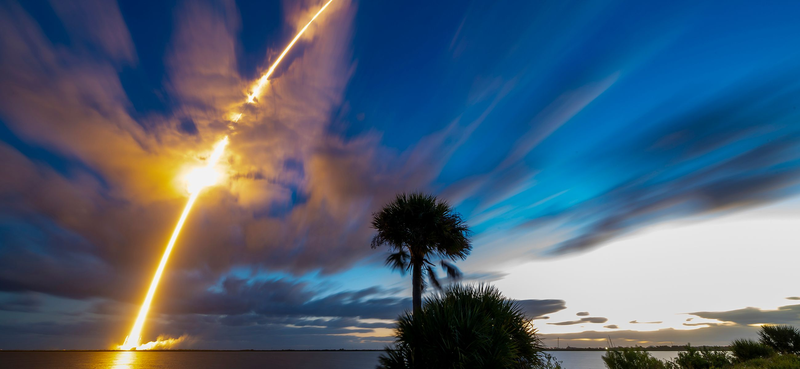
At 7:04 a.m. EDT on Tuesday, October 20, a Falcon 9 lifted off from Space Launch Complex 40 at Cape Canaveral carrying 32 payloads. The one that mattered most to the company flying it was its own hardware. Starfall, a broad, uncrewed reentry capsule, went up for the second time in its life and left the rocket last, separating from the second stage two hours and 48 minutes after liftoff, once the commercial satellites were gone (Space.com). By 8:45 a.m. EDT SpaceX had confirmed every customer payload was deployed (Spaceflight Now). What the company did not say, and has not said since, is what Starfall carried, how long it stayed up, or what happened on the way down. The same company that publishes booster flight counts to the digit has treated this vehicle with the discretion usually reserved for something it does not want competitors reading.
The most detailed public description of the capsule is not a SpaceX document. It is the environmental assessment the company filed with the Federal Aviation Administration in May to get permission for the flight, and that document treats Starfall as infrastructure rather than as a spacecraft demonstration. The filing gives two reasons for the program: moving urgent cargo point to point, and building an orbital manufacturing economy by selling time in microgravity and vacuum with a ride home, what the assessment calls safe return from orbit as a service at scale. Each unit is a short cylinder about 0.75 meters tall and 3.1 meters across, roughly 2,100 kilograms empty, rated to carry 1,000 kilograms of payload down to the surface, for about 3,100 kilograms with a load aboard. A graphic shown in SpaceX’s initial public offering roadshow material appears to depict a satellite bus with slots for as many as four capsules, labelled for manufacturing in orbit (Spaceflight Now on the June debut). Whether that bus ever flies is a different question from whether the capsules do. The permission itself is small: the assessment covers two reentries into a Pacific recovery zone, which means the flights that have happened are the entire scope of what SpaceX currently has authorization for. A service business needs a licensing footprint built well ahead of the first customer invoice, and there is no public sign of that footprint yet.
The manner of the June debut is the best explanation for the current reticence. SpaceX kept the payload off the public manifest until close to flight, shared a rendering rather than hardware photography, and cut its public timeline after the booster landing so that neither the upper stage nor the capsule appeared in the broadcast. When deployment was confirmed that morning, the company had not disclosed how many capsules were aboard. On October 20 the capsule again rode to orbit among dozens of unrelated smallsats, again last to separate, again without a stated payload. Two flights in, the public record describes the vehicle’s architecture in detail and its missions not at all.
The ride itself was routine by SpaceX standards and the manifest was not. The launch had been scrubbed the previous morning over weather in the booster recovery zone, and the 45th Weather Squadron gave the Tuesday window a 90 percent chance of acceptable conditions. The rocket flew southeast, and booster B1085, on its nineteenth flight, came down on the droneship A Shortfall of Gravitas about nine minutes after liftoff. Twenty of the thirty-one commercial payloads were manifested by Exolaunch, among them four radio-frequency monitoring satellites for HawkEye 360, four communications satellites for the Finnish firm Iceye, and six navigation satellites for Xona Space Systems. Planet flew an Earth-observation satellite called Pelican-12. Portal Space Systems used the ride to demonstrate Starburst-1, a 260 kg spacecraft with room for a 50 kg customer payload, with commercial flights advertised from 2027, a mix the company describes on its Bandwagon-5 mission page as cubesats and microsats (Spaceflight Now).
The most interesting neighbor on that manifest was Varda’s W-Series 7 capsule, about three times smaller than Starfall, carrying a cancer drug called Protac to test whether microgravity produces crystal forms with better solubility. The flight was Varda’s ninth capsule launched despite the number in its name, following W-8 and W-9 on the Transporter-18 mission earlier in October. Two returning capsules on one rocket, one of them operated by a startup that has been doing this routinely while SpaceX works quietly on its own, tells you something about where the industry actually sits. Bandwagon is the quieter of SpaceX’s two rideshare programs. Transporter has flown eighteen missions, and the first in January 2021 delivered 143 payloads in a single launch, a record that still stands.
The design is where the vehicle stops looking like a spacecraft and starts looking like a product, and the constraints live there too. According to the FAA assessment, Starfall carries no main propulsion system. It has an attitude control system that uses inert gas to orient the craft, which means it can point itself but cannot perform a deorbit burn, so it cannot shorten its own stay in orbit or choose where it comes down (Spaceflight Now). With no engine to light, the only brake available is atmosphere, which makes the capsule’s blunt shape less a styling choice than the thing that lets it survive the trip: a wide body presents a lot of area to slowing air, and the assessment notes the capsules can fly either a low Earth orbit or a suborbital profile, on a Falcon 9 or on Starship. Orbital energy sets the heat load, so the shape that handles the steepest possible reentry is the one that can also handle the shallowest. The capsule is built in two pieces that separate after reentry: an aluminum top plate partially wrapped in thermal protection material, about 1,400 kilograms, and a carbon-fiber heat shield of roughly 700 kilograms holding two large compressed nitrogen bottles of 151 liters each plus several smaller auxiliary bottles. Lifting the top plate exposes the parachute, and there are three of them, a drogue, a pilot and a main, attached at four reinforced points. Recovery happens in the Pacific, the same ocean used for Dragon. The June flight reportedly validated the capsule’s autonomous guidance before a targeted splashdown (SatNews).
Two flights is a test program, not a service. What SpaceX has not established is the cadence, the price, or whether any paying customer has boarded, and the absence of a named payload on the second flight suggests the answer to the last question is still no. The competitors are not standing still: Varda has flown nine capsules and is running pharmaceutical experiments on them, and Portal is building a vehicle that does the same orbital delivery job for small payloads. What would move Starfall from demonstration to business is not a third flight but the paperwork that follows one, since the current authorization covers exactly two reentries. Until SpaceX files for more and names a customer, the accurate description of the capsule is the one the company keeps declining to give.
 Subscribe to our RSS feed









There are no comments.
Add A Comment