


V445 Puppis: the Milky Way’s only helium nova, finally exposed after 25 years in the dust
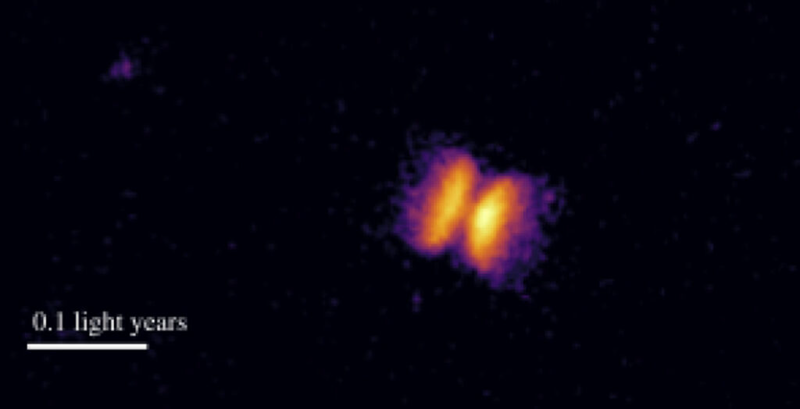
A white dwarf does not need to do anything dramatic to set the record books of stellar astrophysics. It only needs to wait. For V445 Puppis, the wait ended this week when a team led by John Mills at the University of Warwick finally traced the system back to its ingredients: a compact stellar corpse pulling material from a rare stripped helium star. The RAS press release for the Royal Astronomical Society’s National Astronomy Meeting in Birmingham described the result, and it pinned down what astronomers have wondered about since November 2000, when a point of light in the constellation Puppis brightened and then vanished behind its own debris.
The eruption produced a bipolar outflow stretching more than 1.5 trillion kilometers, with clumps of gas clocked at roughly 8,900 kilometers per second, about 3% of the speed of light, racing through the ejecta. The press release calls them “bullets” and notes that nothing of their kind has ever been seen in any other nova.
Almost every nova we know about is hydrogen-rich. A white dwarf siphons gas from a Sun-like companion, the stolen layer gets compressed and hot, and a thermonuclear runaway on the white dwarf’s surface flashes the system into view. The whole cycle takes a few weeks to a few years, then the dwarf goes back to feeding. Helium novae are different in a way that sounds like physics trivia but is genuinely awkward for the textbooks: the accreting layer contains almost no hydrogen at all. The fuel has been swapped out, and only a handful of candidates in the Milky Way match that description. V445 Puppis, the only one currently confirmed, is essentially the only laboratory on hand for studying what such an explosion actually looks like before, during, and after.
That matters because helium novae are one of the proposed pathways to Type Ia supernovae. White dwarfs that keep accreting material approach the Chandrasekhar mass limit, where the star can no longer support itself against electron degeneracy, and the result is one of the most important kinds of explosion in observational cosmology. Type Ia supernovae are the standard candles behind the 1998 discovery of the accelerating expansion of the universe, the work honored by the 2011 Nobel Prize in Physics. Understanding their progenitors is one of the standing problems in stellar astrophysics, and helium novae sit on one of the more plausible candidate routes.
The same logic explains why a 25-year wait is not the embarrassment it sounds like. The eruption’s own dust disk made any direct view of the central binary impossible through optical and ultraviolet light, and the only way to see through was to wait for the obscuring veil to thin enough for a new generation of instruments. That window has now opened.
V445 Puppis erupted in late November 2000 and was classified almost immediately as a nova, although the spectrum looked strange from the start. There was helium, carbon, and a long list of heavier elements, but essentially no hydrogen, the element that defines nearly every other nova on record. For the next 25 years the system sat inside a thick dust torus, bright in the infrared from the re-radiated light of the eruption but stubbornly opaque at the wavelengths where stellar spectra carry information about the two stars at its center.
The new result came from a deliberate effort to combine four observatories. Mills pulled infrared images from the European Southern Observatory’s Very Large Telescope, optical images from the Hubble Space Telescope’s Wide Field Camera 3, long-term spectroscopy from the Southern African Large Telescope, and photometric monitoring from NASA’s TESS satellite. The four cover the infrared through visible bands, plus time-resolved brightness measurements that make it possible to extract the orbital period. John Mills’ research page at the University of Warwick describes the same approach in his group’s broader work on hot and cool binaries.
With the dust clear enough, the spectrum showed strong ionized helium lines consistent with material actively falling back onto the white dwarf. The brightness curve gave an orbital period of 3.7 days, about twice the value the most widely cited prior estimate had produced. A 2023 paper in The Astrophysical Journal Letters, “V445 Puppis: Dustier than a Thousand Novae,” had estimated the eruption threw off between 0.01 and 0.1 solar masses of gas, which would actually mean the white dwarf is losing mass over repeated eruptions rather than approaching a Type Ia explosion. The 3.7-day orbit and the active accretion add two more data points to that open debate.
Embedded inside the bipolar outflow, the Hubble imaging also resolved distinct compact knots of gas, possibly oxygen-rich, moving at speeds comparable to the fastest ejecta ever measured in a classical nova. The RAS announcement explicitly notes that no analogous structures have been observed in any other nova, which is why Mills flagged the origin of the bullets as the unresolved problem in the talk.
The work was reported at NAM 2026 in Birmingham on Wednesday 22 July 2026, in a talk titled “Long-term evolution of the helium nova V445 Puppis and the emergence of the underlying binary.” As of this writing the results have not yet gone through formal peer review, a point Universe Magazine’s coverage makes explicit, but the data sources themselves are public and the orbital measurement should be straightforward to confirm.
A classical nova does not destroy the white dwarf; the explosion only blows off the freshly accreted surface layer. The energy budget is well understood: hydrogen-rich material piles up under degenerate conditions, the base reaches roughly 10 million K, and a CNO-cycle hot layer drives the runaway. The peak luminosity is comparable to a small star, which is why distant novae can briefly outshine the combined light of their host galaxies.
Helium novae follow the same broad pattern with hydrogen-poor fuel, and the mechanics are fuzzier because so few examples exist. The white dwarf in V445 Puppis cannot be accreting hydrogen-rich gas, which is what motivates the “stripped helium star” companion model, a star that has already lost its hydrogen envelope through prior interaction. The models get the orbital period, the spectral lines, and the mass loss to line up at least approximately, although the geometry of how the white dwarf pulls material off its donor’s outer layers is still being worked out.
The bullet problem is the genuinely new piece. A 2009 infrared study had identified clumps moving at 6,700 km/s in a narrow hourglass-shaped outflow, with knots at 8,450 km/s. Mills’ combined analysis finds similar speeds and identifies discrete oxygen-rich clumps at roughly 8,900 km/s, fast enough to cross the Earth-Moon distance in under five minutes. The knots are not fast enough to be a separate explosion, but they are too fast to be passive material carried by a slow wind, which is why the team assumes some kind of post-eruption engine. So far none of the obvious candidates, including a re-ignition on the white dwarf surface and gravitational rebound, cleanly fits both the timing and the composition.
The imaging pipeline is the more straightforward part. Hubble’s WFC3 narrow-band filters F502N, F680N, and FQ727N isolate the emission from ionized oxygen, nitrogen, and sulfur separately, which is what made the oxygen identification possible. Combining frames from two different epochs (2013 and 2015) let the team measure proper motion of each knot directly.
After more than two decades behind a self-built dust wall, V445 Puppis is now visible as what it has been all along: a white dwarf feeding helium-rich gas from a rare stripped companion. The 3.7-day orbital period replaces the older 1.87-day estimate, the dust mass loss points toward a white dwarf that is being drained rather than grown by each eruption, and a catalog of fast oxygen-rich knots has no clean explanation yet.
The next obvious step is a longer TESS baseline plus higher-cadence UV spectroscopy with HST. If the binary truly is no longer accreting efficiently, the 2023 dust-mass argument gains weight and the path to a Type Ia supernova through this channel looks harder than it did five years ago. If the bullets can be linked to a specific instability, the same mechanism probably applies to a few helium-rich extragalactic novae that have otherwise looked like clean hydrogen-poor events. Either way, V445 Puppis has stopped being a curiosity and started being a test.
 Subscribe to our RSS feed









There are no comments.
Add A Comment