


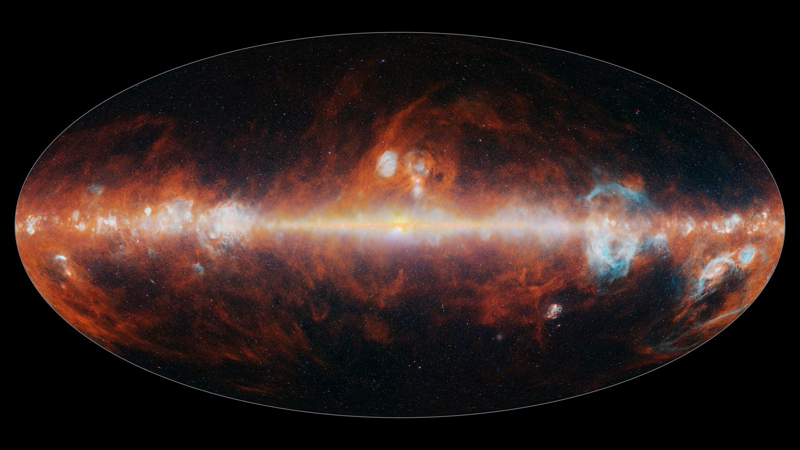
Some instruments are pointed at things. SPHEREx is not. The NASA spectrophotometer named for the history of the universe, the epoch of reionization and interstellar ices sweeps the whole sky in a fixed pattern, forever, and whatever falls into its field of view during that sweep gets measured. Nobody has to schedule it. Nobody has to file a target-of-opportunity request. The telescope simply keeps accumulating spectrophotometry of every bright thing in the sky, and the accumulating is the point (the SPHEREx instrument paper). It launched on a Falcon 9 from Vandenberg on 11 March 2025, sharing a ride with NASA’s PUNCH mission, and began surveying in May of that year (NASA’s Scientific Visualization Studio on the launch).
That passive design produced the result that a team of astronomers reported on 29 October. A nova in the southern constellation Vela, which had erupted in June 2025 and blazed to naked-eye brightness, left behind a shell of dust that cooled by roughly half its temperature over the following year. The only instrument that caught that shell cooling was a survey telescope busy looking at the entire sky at once, with no idea this particular nova existed (Astronomer’s Telegram 18127 on dust in the nova V572 Velorum).
The nova in question is V572 Velorum, also called Nova Velorum 2025. Australian observers John Seach and Andrew Pearce found it independently on 25 June 2025 at visual magnitude 5.7, and it peaked at magnitude 4.8 on 27 June (Astronomer’s Telegram 17601). The story gets stranger from there. SPHEREx had already been recording that patch of sky on 20 June 2025, five days before anyone on Earth noticed the nova, and the earlier detection is what made a clean timeline possible (Astronomer’s Telegram 17601). Gamma rays from it were also picked up in the days after the eruption by the Fermi Large Area Telescope (Astronomer’s Telegram 17252).
What made V572 Vel worth this much attention was its history before the explosion. OGLE photometry of the field, running since 2017, caught the progenitor throwing repeated outbursts between 2017 and 2024, some lasting more than thirteen days and others only three or four, which is the signature of an SU UMa-type dwarf nova (Astronomer’s Telegram 17253). A classical nova whose progenitor is itself a recurrent dwarf nova is rare to the point of being a curiosity. Two others are known, V1213 Cen and V392 Per, and V572 Vel is the third (Astronomer’s Telegram 17253). The progenitor reached magnitude 17.17 in the I band during a long outburst in February 2025 and was never detected in quiescence at all, staying fainter than magnitude 20.1 (Astronomer’s Telegram 17253).
The dust itself showed up the way it usually does, as an absence. The AAVSO light curve shows the nova plunging from about magnitude 5.5 to about magnitude 12 and recovering, a sudden fading that astronomers read as the signature of grains condensing in the ejecta, because dust absorbs the light of the hot central source and reradiates it in the infrared (Astronomer’s Telegram 18127). Two epochs of SPHEREx data then turned that qualitative hint into a measurement. The first spectrum, covering 0.75 to 2.36 microns and accumulated between 178 and 225 days after the eruption, was fit with a blackbody at roughly 1030 K, implying a dust mass near 10^-9 solar masses for a carbonaceous grain composition. The second spectrum ran from 0.75 to 5 microns, taken between 334 and 393 days after the eruption, and put the dust at about 480 K with a mass near 10^-8 solar masses. Over about a year the shell cooled by roughly 550 K while the amount of dust in it grew by a factor of ten, which fits the standard picture of a nova ejecta that expands and cools while continuing to form grains (Astronomer’s Telegram 18127).
The reason a space telescope was needed sits in the wavelength coverage. SPHEREx records spectra from 0.75 to 5.0 microns, and roughly 2.7 microns falls inside a strong water vapour band in Earth’s atmosphere, with another absorption near 4.3 microns from carbon dioxide, so ground-based observatories work around those regions rather than through them. For a dust shell sitting at 480 K the rising long-wavelength tail of the spectrum is exactly what constrains the temperature, and that is the part of the spectrum the ground cannot see. Cool it below about 580 K and its blackbody peak moves past 5 microns, which is the regime where a space-based survey is the only practical option. Getting there also takes a specific instrument design: six 2K by 2K mercury cadmium telluride detector arrays behind linear variable filters, giving the telescope 102 spectral channels across its band (the SPHEREx instrument paper, the SPHEREx project site). The scale of that survey is set by NASA to cover more than 450 million galaxies and more than 100 million stars in the Milky Way over two years of observing (NASA’s SPHEREx mission page). The instrument trades resolution for coverage, settling at a resolving power near 40 in the short-wavelength half of its range and near 120 in the long half (the SPHEREx instrument paper), which is too coarse to identify individual emission lines cleanly. The report says the spectra show emission from hydrogen, helium and oxygen, and possibly coronal lines, though the authors are careful to note that the resolution cannot confirm the latter (Astronomer’s Telegram 18127).
This is not an isolated case of a survey telescope producing science it was not built for. The same reasoning drove a separate effort that used NEOWISE infrared light curves to find slow-burning stellar outbursts and then pulled SPHEREx spectra down for eight of them, which turned up two new FU Orionis type events and one classical nova that optical surveys had missed entirely (Karambelkar and colleagues on SPHEREx as a frontier for infrared transients). And on the same day as the V572 Vel report, a completely different nova was caught in the act of making dust by a ground-based near-infrared camera on a 1.3 metre telescope at the MDM observatory, which watched the nova’s colour redden from about J minus H of zero to about 0.7 magnitudes while its J magnitude faded from 8.45 to 10.59 across seven epochs of monitoring (Astronomer’s Telegram 18129 on dust forming in the nova V488 Sge). One dust-forming nova was tracked from orbit and the other from a mountain, and both come at the same question of how much material a nova actually injects into the interstellar medium.
What the archive approach really changes is the cost of getting there. Targeted infrared follow-up has to be scheduled, has to win telescope time, and covers whatever slice of the sky its instrument can reach. A survey that measures everything has already measured the nova before anyone thought to ask, and the resulting time series comes for free with the calibration already done. The catch is real and the report says so: a survey spectrum at this resolution tells you the shell is there and how hot it is, but confirming the suspected coronal lines needs higher-resolution follow-up spectroscopy from the ground. SPHEREx can tell you that a nova formed dust and how that dust cooled. Deciding exactly what is glowing in the innermost ejecta is still someone else’s job.
Image: SPHEREx’s first all-sky map in 102 infrared colours, from observations made between May and December 2025. Hot hydrogen gas appears blue and cosmic dust red. Credit: NASA/JPL-Caltech, via JPL on SPHEREx’s first all-sky map.
 Subscribe to our RSS feed









There are no comments.
Add A Comment