


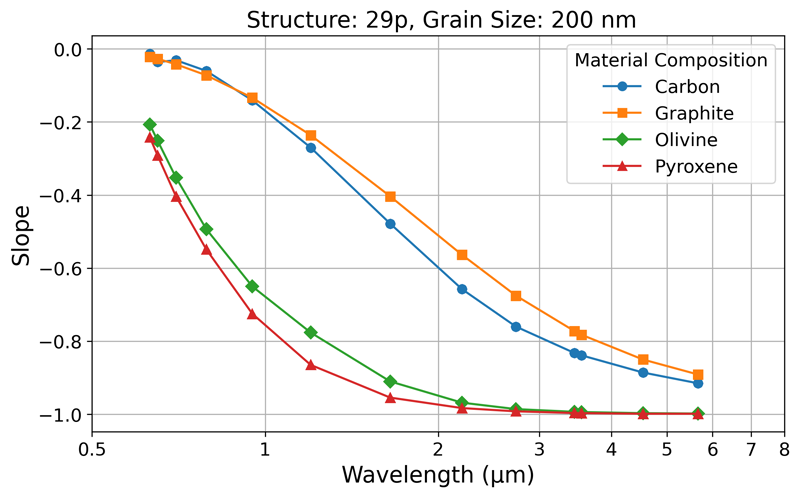
Image: fitted colour slopes against wavelength for 200-nanometre grains in the fan-shaped 29P dust model. The carbon and graphite curves run together, the olivine and pyroxene curves run together, and the two groups stay apart across the visible and near-infrared. Credit: Takacs et al. 2026, via the paper’s HTML build under CC BY 4.0.
A comet that crosses its host star dims it by thousandths of a magnitude. For most of the past decade, telling that event apart from a stellar twinkle has been an unsolved problem. A team of astronomers argues that colour, rather than a more sensitive detector, is what separates a real dimming from a false alarm. ESA’s Ariel, a space telescope approved for a 2029 launch on an Ariane 62 rocket, is meant to survey the atmospheres of roughly a thousand exoplanets (ESA’s Ariel factsheet). A paper posted on 3 November puts Ariel to a second use. From a million and a half kilometres away at the Sun-Earth L2 point (CNES on the Ariel mission), the telescope could also catch comets sweeping in front of their stars and read the dust off the colour of the fading.
Comets are already known to circle other stars. The calcium absorption lines of Beta Pictoris, reported in 1987, were the first sign of gas tails crossing a stellar disc, and a later survey with the HARPS spectrograph at ESO’s La Silla observatory turned up thirty of them around that one young star (NASA on the exocomet census around Beta Pictoris). That team used TESS to size them, putting nuclei between three and fourteen kilometres across. The star itself sits about sixty-four light-years away. Beta Pictoris is close enough and young enough that its debris disc still feeds a steady supply of these bodies, which makes it the natural test case for anyone trying to watch them.
Observing them in starlight is much harder than counting them in a spectrum. The photometric events are shallow. TESS found three dips over 105 days, each between half a millimagnitude and two millimagnitudes deep, the largest lasting up to two days (Zieba and colleagues in Astronomy and Astrophysics). They do not repeat on a schedule, and their shape is not a signature. A comet whose coma dominates produces a roughly symmetric dip, while an extended tail skews it into something resembling a shark fin. But a clump of circumstellar dust, a planet disintegrating around its star, ordinary stellar variability, a grazing eclipse and instrument artefacts can all imitate those same outlines. That ambiguity is why a decade of TESS data has not turned the dips into a well-characterised population.
The new work is led by Nóra Takács at the Konkoly Observatory in Budapest, with colleagues at ELTE, Cardiff University and observatories in Spain and Italy. They attack the problem from the side of the dust rather than the outline (the preprint on arXiv). Their models work on the colour of a cometary transit and leave the outline of the dip aside. Their radiative transfer models place the dust in a 256-cube grid around a solar-like star, with the comet on a circular orbit a tenth of an astronomical unit away and the transit seen exactly edge-on. Across that grid they varied three dust morphologies (a narrow tail borrowed from a fragment of Comet 73P/Schwassmann-Wachmann, a broad fan modelled on Comet 29P, and a tailless ball of dust). They also varied three grain size bands running from a tenth of a micron to three microns, and four pure materials: graphite, amorphous carbon, amorphous olivine and amorphous pyroxene. The resulting dips last one to two days and run two to three millimagnitudes deep.
The transit shape turned out to be nearly useless for telling those materials apart. The wavelength dependence of the colour did the work instead. The method takes the difference in brightness between each wavelength and a reference visible band, then fits a line to how that difference grows as the comet crosses in front of the star. Plotted against wavelength, the slope of that fit splits the four materials into two families. Graphite and amorphous carbon trace one path, while amorphous olivine and amorphous pyroxene trace another, and the gap between them holds across every dust morphology and grain size tested. The authors are careful about where the claim stops: within a family the materials behave alike, so the result sorts dust into two broad classes rather than naming a mineral.
Whether that colour is measurable at all is a separate question, and the same paper runs the numbers through ArielRad, the noise simulator ESA’s team uses to predict the telescope’s performance (the full paper with its figures). The real spectral energy distribution of the Beta Pictoris system, assembled from IRTF/SpeX and Spitzer/IRS spectra, goes into those simulations. They produce a detection signal-to-noise curve for a 600-second integration at one millimagnitude of intrinsic dimming. Two corrections matter here. First, the comet blocks the star’s photosphere but not the surrounding disc, so the observed dimming is diluted by the fraction of the total light that the photosphere contributes. Second, signal-to-noise grows with the square root of integration time, and these events last days rather than minutes, so long integrations pay off. Ariel’s channels cover the visible through the infrared in a single pointing, which suits the colour measurement. Compare that with TESS, whose cadence tightened to 200 seconds from its fifth observing cycle. A two to three millimag signal reaches roughly five sigma in several bands at a few minutes of integration. Ariel’s synthetic bands give better precision on top of that. Pairing Ariel with TESS and with PLATO, whose first long-pointing field is watched continuously for at least two years, would let a wide survey flag the dips and a pointed instrument characterise the dust.
The claim here is narrow and worth stating plainly. The authors say Ariel was not designed to hunt unpredictable exocomet transits, so its value depends on targets and observing opportunities that happen to line up. The colour measurement is the part that changes what such an observation can deliver. A transit depth on its own counts photons, but its colour sorts a comet’s dust into silicate or carbon-rich without resolving any individual grain. The numbers are still indicative rather than predictive, resting on pre-launch performance estimates and on models that assume one composition at a time and a perfectly central transit. If those estimates hold, a millimag dip in a star’s light will be detectable in minutes, and its colour will carry more about what is drifting past than its shape ever could.
 Subscribe to our RSS feed









There are no comments.
Add A Comment