


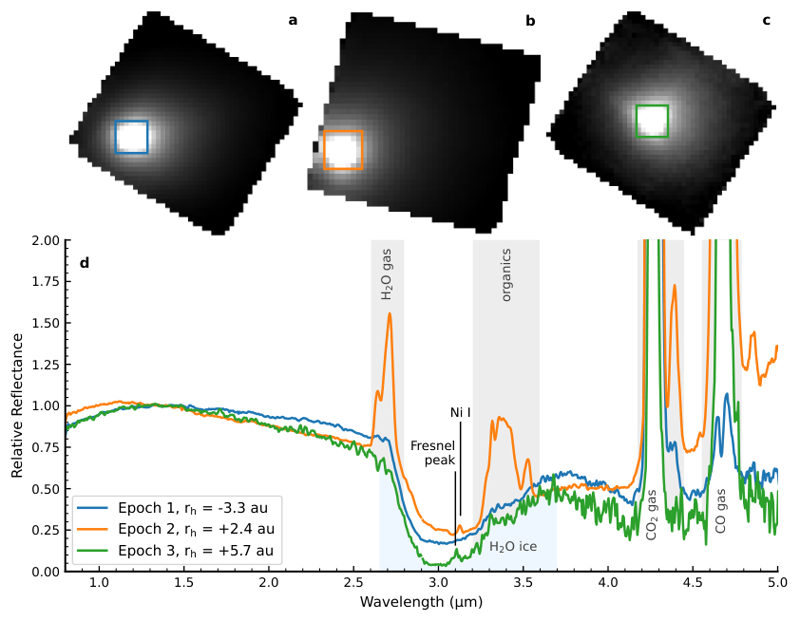
The figure is reproduced from the paper under a Creative Commons Attribution 4.0 licence.
Webb has measured the physical state of the ice in an interstellar comet, and the answer does not match what a comet is supposed to look like. 3I/ATLAS, the third object ever confirmed to come from outside the solar system, carries water ice grains mixed through with rocky dust rather than mostly pure ice, and that mixture changes the shape of the spectrum. The result, published in The Astrophysical Journal Letters on 26 October, comes from a team led by Silvia Protopapa of the Southwest Research Institute, with Michael Kelley of the University of Maryland and Martin Cordiner of NASA’s Goddard Space Flight Center, who ran the Webb observing programme behind the measurements. NASA has been tracking the comet since 1 July 2025, when the ATLAS survey telescope in Chile first reported it to the Minor Planet Center.
Interstellar comets matter because they are the only pieces of other solar systems we can touch. Everything else known about planet formation comes from a single disk, and the assumption that other disks behave like ours carries a lot of weight in the models. If the icy building blocks of a planetesimal form differently around another star, then the chemistry handed to planets under that star’s light differs too, and the galaxy would hold many planet-forming chemistries rather than one. The same comet had already hinted at this. In a companion paper in Nature in June 2026, Webb measured isotopic ratios in 3I/ATLAS and found deuterium levels around 30 times higher than in solar system comets, and only traces of carbon-13 next to the more common carbon-12. That points to material that formed in a cold, dense cloud, possibly ten to twelve billion years ago during the era of peak star formation, and that never warmed enough to reprocess its heavy water ice into the ordinary kind. The new work reads the same comet a different way. It asks what state the ice is in, and the answer is that the ice arrives already mixed with rock.
The measurements come from Webb programme 5094, and the timing matters as much as the instrument. Cordiner designed the programme to be ready when an active interstellar comet turned up, and it was used three times: on 6 August 2025, when 3I/ATLAS was 3.31 astronomical units from the Sun, on 22 December 2025 at 2.38 units, and on 1 April 2026 at 5.65 units. That spans perihelion, which the comet passed on 29 October 2025 at about 1.4 units, between the orbits of Earth and Mars, putting the second visit closest to the Sun and the third well on the way out. The observation log in the paper gives exposure times of 146 seconds for each of the first two visits and 875 seconds for the last. Each visit produced a prism spectrum running from the near-infrared into the mid-infrared, and the three differ from one another. All of them show a broad, deep absorption centred near 3 microns, the fundamental stretching vibration of the O-H bond in water ice, alongside emission from water, carbon dioxide and carbon monoxide gas in the coma. The 3 micron band reaches 77 percent depth in the August 2025 spectrum and 94 percent in the April 2026 one, and the continuum beneath it steepens from -1.1 to -2.0 percent per 100 nanometres across those two epochs.
The oddity in 3I/ATLAS lies next to the 3 micron band. Ordinary icy comets show three bands in the infrared, the strong fundamental at 3 microns and two weaker overtones at 1.5 and 2.0 microns. In 3I/ATLAS the shorter-wavelength pair are weak to the point of being missing, while the 3 micron band is deep. The team compared the spectra with models of how light scatters off grains of different sizes and compositions, computing scattering and absorption efficiencies with Mie theory and mixing materials inside each grain using the Bruggeman effective medium approximation. The preferred solution for the August 2025 data calls for a population of aggregates smaller than a micrometre, built from water ice and amorphous pyroxene with a magnesium to iron ratio of 50 to 50, alongside a coarser component of pyroxene and amorphous carbon. The April 2026 spectrum then needs something extra: a second population, larger and icier, made of water ice mixed with amorphous carbon, with the water ice volume fraction in that component fixed at 0.95 because more refractory material distorts the spectrum’s overall shape.
The mechanism behind this is a short optical path through the ice. A 1.5 micron overtone is produced when the O-H bond vibrates in a combination mode, and it appears only if light penetrates far enough into a grain to interact with more than a single molecule. Inside a large, mostly pure ice grain the light travels a long way, the overtone bands are strong, and all three bands show up together. Break the grain into sub-micron pieces and dust it through with rock, and the path through the ice collapses. The fundamental band survives because it needs the least travel, the overtones fade, and what is left is a spectrum that looks nothing like the comets of the solar system. The paper is careful about how far that argument goes. Control runs using pure water ice, or ice mixed only with carbon or olivine, overpredicted the short-wavelength absorptions or failed to reproduce the 3 micron band at all, and scored worse on the Bayesian information criterion than the preferred configuration. Even so, the authors describe the refractory-rich component as an effective reflectivity rather than a unique physical solution, and there is a second possibility they cannot separate from the first.
That second possibility comes out of the third epoch. A narrow Fresnel-like structure appears near 3.10 microns in the April 2026 spectrum and is absent from the August 2025 one. Such a feature arises from anomalous dispersion in the refractive index inside the 3 micron band, and it is more structured in crystalline ice than in amorphous ice, so the team reads it as crystalline material in the coma by April. Two stories fit: either the ice was crystalline all along and the changing spectrum reflects grains that grew or shed dust as the comet was heated and eroded near the Sun, or the grains themselves reorganised from an amorphous-like to a crystalline state. Kelley told the Southwest Research Institute press release that both are possible and that telling them apart is an open question the team wants to attack, and Protopapa’s version was shorter: the comet’s ice holds more dust than the ice in a typical comet.
Compare 3I/ATLAS with the icy worlds beyond Neptune and the oddity softens. The shape of its 3 micron band resembles that of several classes of mid-sized trans-Neptunian objects, particularly the ones whose spectra show carbon dioxide ice and organics, and those objects are also missing the 1.5 and 2.0 micron bands. The resemblance lies in the water ice, not the carbon dioxide, but it is enough to suggest that planetesimals forming in different disks share a continuum of ice grain properties, running from nearly pure ice grains to aggregates loaded with rock, with 3I/ATLAS at the dusty end of that range. The abstract in the arXiv record frames it as evidence that the physical form of water ice is fixed early, in planet-forming disks, and at least partly preserved in the bodies that form there. If that holds, it says something slightly uncomfortable about planetary formation as a field, because the state of the ice would be decided before any planet exists, in a disk that may not resemble ours. Webb will keep watching, at comets in our own system and at the next interstellar visitor to arrive, and whether 3I/ATLAS is typical or an outlier stays open until there is more than one sample. Sci.News summarised the finding as ice that is closer to the frozen bodies beyond Neptune than to the comets of the solar system, and the paper itself is where the numbers live.
 Subscribe to our RSS feed









There are no comments.
Add A Comment