

On 9 September, the team in charge of a large share of Webb’s observing time swapped one planet for another. The planet they took on, TOI-1452 b, orbits a dim red dwarf about 100 light-years away in Draco and was announced four years ago as a candidate ocean world. What makes the swap interesting is what Webb is going to do with it. Not the obvious thing. There is no water vapour detection waiting, no ocean rendered in infrared. Webb will measure the planet’s own heat, at 15 microns, across a dozen carefully timed eclipses, and read the answer off how much of that heat arrives from the day side. Whether TOI-1452 b held on to an atmosphere is still an open question, and the measurement that settles it does not involve looking for water at all.
The 2022 claim that TOI-1452 b might be an ocean world was an inference, not an observation. Charles Cadieux’s team had a radius and a mass: 1.67 Earth radii, 4.8 Earth masses, a bulk density of 5.6 grams per cubic centimetre. Run those through interior models and several compositions fit, among them a rocky core under a deep envelope of water. NASA put the headline figure at up to 30 percent of the planet’s mass as water in a simulation run by modeling specialists on the discovery team, a share comparable to Ganymede or Titan. Nobody had seen a single drop. For a planet this small and faint, the test has to be indirect.
The Rocky Worlds programme is built for exactly that kind of test. It is a 500-hour block of Webb director’s discretionary time aimed at searching for atmospheres around more than a dozen nearby systems, paired with around 250 Hubble orbits in the ultraviolet to characterize how active the host stars are, as the programme’s own announcements describe. Rather than watching starlight filter through a planet’s limb, as transmission spectroscopy does, it watches the planet pass behind its star and measures the small change in total light. At 15 microns that change is dominated by the planet’s own thermal glow. A bare rock reradiates the starlight it absorbs at a temperature set by its orbit and comes back bright. A planet wrapped in thick carbon dioxide spreads that heat toward its night side, so the day side runs cooler, the total glow drops, and the carbon dioxide leaves its own mark in the spectrum. Whether TOI-1452 b kept its air is the sort of question this particular measurement was built to answer.
TOI-1452 b was announced in August 2022 by an international team led by Charles Cadieux, then a doctoral student at the Université de Montréal in Quebec and a member of its Trottier Institute for Research on Exoplanets, as the Canada-France-Hawaii Telescope reported at the time. The transit signal came from NASA’s TESS survey, a slight dip in brightness every 11 days. Isolating that dip was not straightforward. TOI-1452 is one half of a binary whose two stars sit about 97 astronomical units apart, close enough that TESS photographs them as one point of light. Ground-based photometry from the Observatoire du Mont-Mégantic and the MuSCAT3 camera separated the two components and showed the signal really did come from a planet around the brighter one. The mass took longer: more than 50 hours of SPIRou spectroscopy on the Hawaii telescope turned a small wobble in the star’s spectrum into 4.8 Earth masses. The discovery paper appeared in The Astronomical Journal on 12 August 2022.
What came out was a planet in an unusual spot. TOI-1452 b is 1.67 times the radius of Earth and roughly five times its mass, which NASA’s discovery alert describes as about 70 percent larger in diameter. It circles its M4 dwarf every 11.06 days at 326 kelvin, receiving about as much starlight as Venus does from the Sun, which keeps surface liquid water in play despite the close orbit. The host is a red dwarf with a surface temperature of 3185 kelvin, and its companion circles it on a path of roughly 1400 years. The star’s iron, magnesium and silicon abundances, measured by SPIRou, let the team tie the planet’s bulk density to a model: a rocky core of about 18 percent of the mass, with the rest a volatile envelope in which water makes up somewhere between 22 and 43 percent. The paper could not rule out an ocean planet, a mostly rocky world with little iron, or a terrestrial planet wearing a thin hydrogen-helium shell.
Four years on, TOI-1452 b remains a water world nobody has seen. On 9 September 2026, the Rocky Worlds Core Implementation Team at the Space Telescope Science Institute announced that it had joined the programme’s target sample, replacing TOI-406 c.
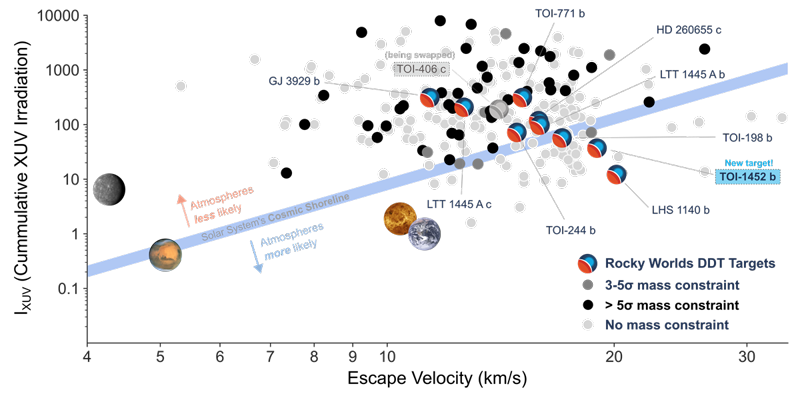
The choice of replacement came down to a diagram. Rocky Worlds ranks candidates using the cosmic shoreline, an idea from planetary scientists that separates planets which have kept an atmosphere from those which lost it. The shoreline plots estimated cumulative X-ray and ultraviolet radiation a planet has absorbed over its life against the escape velocity at which its gravity can still hold on to gas, with a slope of about four in the logarithmic version of the relation, as Glein and colleagues describe. The empirical version of the idea anchors that line with the Solar System’s own planets, then uses it to rank exoplanets by how likely they are to still be holding air. In the plot that accompanies the announcement, TOI-1452 b sits just on the wet side of the line, where a thick atmosphere is still possible, while TOI-406 c sits deep on the dry side, where it is not. Constraining TOI-406 c’s atmosphere would have taken about 14 MIRI 15-micron secondary eclipses, which the science advisory council judged too expensive. TOI-1452 b should take 12, and it complements the rest of the sample.
The calibration for what those eclipses can resolve comes from GJ 3929 b, the first planet in the programme to receive a complete data set, published this summer in the Astrophysical Journal Letters. Four observations of that warm Earth-sized world, with an instellation of 17.3 times Earth’s, gave an overall eclipse depth of 118 plus or minus 22 parts per million and a dayside surface brightness temperature of 641 kelvin, according to Connors and colleagues. The result is consistent with bare rock and still leaves room for thin atmospheres; only thick carbon dioxide without a thermal inversion is excluded, beyond three sigma. The authors also found that the choice of extraction aperture can shift the inferred eclipse depth enough to change the conclusion, and that a frame-normalized principal component method was steadier against that choice. TOI-1452 b will be a harder version of the same measurement: a fainter star, a longer baseline, and a planet whose dayside is the difference between a rock and an ocean.
None of it has happened yet. The programme’s schedule page lists no programme number, no eclipse dates and no analysis reports under TOI-1452 b, while GJ 3929 b already carries completed observations and published data products. The paper describing the target-selection analysis is still being written, and a Rocky Worlds workshop is scheduled for November.
The group behind the planet has not been idle in the meantime. On 28 September 2026, Cadieux and a wider team posted a paper on TOI-210 b, a temperate sub-Neptune around another M4 dwarf, at 368 kelvin with 6.75 Earth masses and a radius of 2.23 Earth radii, reporting a lower limit of at least 29 percent water by mass, as the preprint sets out. The same radial velocities show moderate evidence for a further planet interior to TOI-210 b, and two signals at 2.15 and 3.76 days imply minimum masses of 3.2 and 4.4 Earth masses for planets that never transit.
TOI-1452 b’s equilibrium temperature is 326 kelvin. Webb will measure the dayside temperature that a bare rock and a carbon dioxide atmosphere each predict, and the gap between those two predictions is small enough that it takes a dozen eclipses to close. The schedule shows no dates yet. The first of those eclipses, when it comes, is the moment this planet stops being an arithmetic possibility and becomes a measurement.
 Subscribe to blog posts using RSS