OrbitalHub

Where curiosity reaches escape velocity.

Domain is for sale. $50,000,000.00 USD. Direct any inquiries to contact@orbitalhub.com.


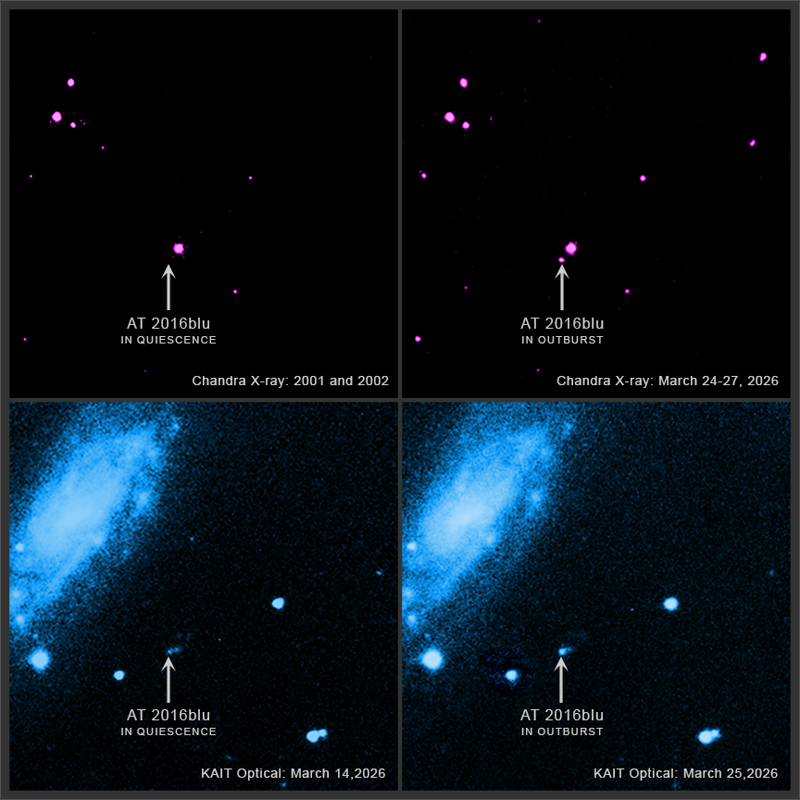
Four-panel comparison of AT 2016blu before and during its March 2026 outburst, with the two upper panels showing Chandra X-ray data from 2001 and 2002 and from 24 to 27 March 2026, and the two lower panels showing KAIT optical images from 14 and 25 March 2026, the position of the star marked by a white arrow in every panel (NASA/CXC/University of Virginia/M. Aghakhanloo et al., NSF/KAIT, public domain via Wikimedia Commons)


For fifteen years, a star in a spiral galaxy 30 million light-years away has been doing something that in visible light looks exactly like a supernova. It flares, brightens by several magnitudes, then after a few weeks it settles back down and carries on. It has done this at least 27 times since 2012, roughly every 113 days, and every single time it is still there afterwards, intact and ready to do it again. What is actually going on took until this year to pin down.

The star is AT 2016blu, in the outer spiral arm of NGC 4559. It is a luminous blue variable, a hot unstable star of at least 33 times the Sun’s mass. It is also a blue straggler, meaning it is heavier than the other massive stars around it rather than fainter. A star like that carries a small helium core inside a large hydrogen-rich envelope, which keeps it on the blue side of the Hertzsprung-Russell diagram and lets it end its life as a hydrogen-rich progenitor without ever passing through the Wolf-Rayet stage. NASA’s account of the discovery describes AT 2016blu as one of the most extreme members of a class astronomers call supernova impostors, because the eruptions mimic a star tearing itself apart right down to the brightness, without the star actually coming apart.

Impostor is the right word. A true supernova is a one-way door. The core collapses, the star comes apart, and the light curve never returns to where it started. AT 2016blu brightened by more than a magnitude on 22 March 2026, peaked at magnitude 16.6, then faded back toward where it had been. Between 2012 and June 2026 the team behind the new work counted 27 such events, with a period of roughly 113 days, although some of the smaller peaks line up better with a shorter cycle of about 38.5 days. That cadence is the giveaway. Nothing a star does to itself should repeat on a schedule.

The 113-day clock had no obvious explanation. For most of a decade the honest answer was that nobody knew, and every candidate was unsatisfying. A single unstable star erupting on a schedule is hard to account for. Pair it with a second massive star and you can get colliding winds, but the X-ray brightness that setup produces is thousands of times too low. The natural fix was a compact object, a black hole or a neutron star, which can feed on the star’s wind and make a bright X-ray source, yet there was no X-ray detection of AT 2016blu anywhere in the Chandra archive before 2026.

That missing detection was the puzzle. When the team re-examined the 2001 and 2002 archival exposures, stacking them to about 23 kiloseconds, they found nothing at the optical position of AT 2016blu. The 2026 detection is not a marginal source that has been sitting in the archive for a decade waiting to be noticed. It is new.

Getting it took coordination. AT 2016blu was monitored daily by the Katzman Automatic Imaging Telescope at Lick Observatory, by the Las Cumbres Observatory Global Supernova Project, and by more than 30 amateur observers recruited through an AAVSO alert notice issued in 2024. When the star rose past magnitude 16.6 in March 2026, the monitoring triggered a Chandra Target of Opportunity, and Chandra caught the star at five epochs across 24 to 27 March, accumulating about 100 kiloseconds in total.

Those five observations produced the numbers that make this a result rather than just an observation. Stacking the data gives an X-ray luminosity of log L_X around 38.64 erg per second, with a photon index of about 0.2 to 1.2, which is a very hard spectrum. The full paper lays out why accretion onto a compact object is the only one of the standard explanations that survives. Intrinsic shocks in the wind give soft X-rays below 10^31 erg/s, seven orders of magnitude too faint. Colliding winds in a massive binary reach 10^31 to 10^34, still four orders short. Shells of gas ejected at successive close approaches would shock too gently, because the wind velocities measured from the hydrogen alpha line are too similar from one ejection to the next. What is left is accretion, which can produce hard emission well above 10^37.

There is a more direct argument, and it comes from the archival data. Before the outbursts began, the same position in the same detector showed nothing. In March 2026 the source is at least 100 times brighter in X-rays than the 2001 and 2002 data allow. The X-rays are not a permanent fixture of this star. They arrive with the eruptions, which is the behaviour of a feeding event rather than of a stellar atmosphere. The team also checked whether the new source could be an unrelated background quasar that happened to land on the same spot, and put the odds of that at roughly six in a hundred thousand.

The accretion rate is where the result gets uncomfortable. The basic calculation, using the X-ray luminosity and a standard efficiency, gives a rate of at least 8 x 10^-8 solar masses a year. But the optical eruption is about a hundred times more luminous than the X-rays, roughly 10^7 solar luminosities against 10^5. If the optical light is also powered by accretion, then about 99 percent of the energy is absorbed in the surrounding gas and reradiated as visible light, and the true rate is closer to 8 x 10^-6 solar masses a year. That is more than two orders of magnitude above the Eddington limit for a 1.4 solar mass neutron star.

Accretion at that rate onto a neutron star should not be possible. It points instead to a black hole, though the authors stay careful, because neutron stars have been caught punching far past their Eddington limits in extreme cases. The companion is not the only loose end. The mass-loss rate from the star can be estimated from the orbit and the wind, and it comes out near 3 x 10^-3 solar masses a year, comfortably enough to feed even the boosted rate, but that number is very sensitive to the wind speed and the orbital eccentricity, and neither is well constrained. Phys.org’s write-up covers the wider framing.

The team cannot say which compact object it is, because the data do not allow it. A neutron star would show coherent pulsations, but the counts in these observations are too low to search for them at the timescales needed. A type I X-ray burst would settle it instantly, except bursts last seconds to hours and the five epochs sit a day apart, so one could easily fall between them. XMM-Newton has the sensitivity to hunt for pulsations, but it cannot resolve the star from a much brighter neighbour nearby, the ultraluminous X-ray source NGC 4559 X7, so the bigger collecting area ends up swamped by the wrong object. A dynamical mass measurement would decide the matter, and the radial velocities from the hydrogen alpha line do not follow the orbital phase well enough to extract one.

The paper appeared this week in The Astrophysical Journal, volume 1011, issue 2, page 252.

AT 2016blu is now the first X-ray detection of a supernova impostor of this kind, and the first luminous blue variable known to have a compact companion. One other impostor, SN 2010da, shows X-ray emission consistent with accretion, but its donor is a red supergiant, a star expected to end its life in a real supernova. An LBV donor is a different proposition, because single-star models keep failing to explain the strange behaviour of luminous blue variables, and a binary companion is a plausible answer to why some of them misbehave. The paper brings three families usually studied apart into one frame, impostors, ultraluminous X-ray sources, and high-mass X-ray binaries. If AT 2016blu really is a black hole draining a blue straggler, then some of the eruptions that astronomers have spent decades reading as a star’s death rattle were a feeding event instead.
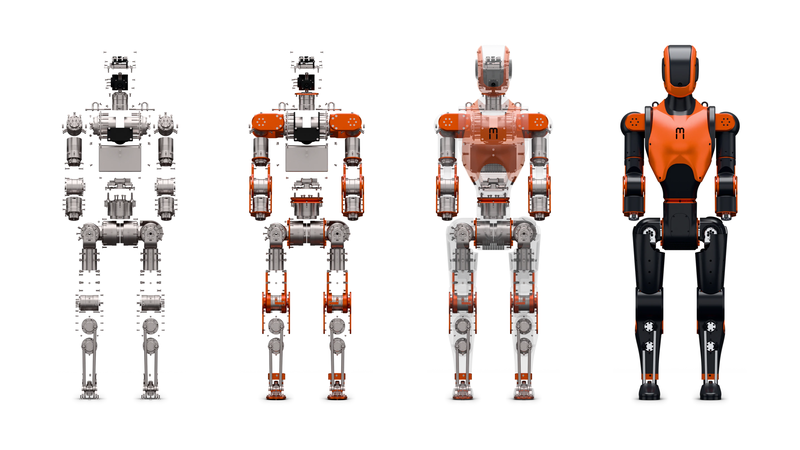


Four side-by-side renders of the Asimov 1 humanoid at successive build stages, from a bare actuator frame through increasingly covered shells to the finished orange and black robot (Menlo Research)


Open-source humanoids have mostly meant open-source marketing with a closed product underneath. Asimov 1, a 1.2 metre, 35 kilogram biped from Menlo Research, is the exception. The mechanical CAD, electrical design, simulation models, firmware, reinforcement-learning training code and the Python SDK are all public. What that has started to produce is outside work. On Sunday morning a developer with no connection to the company published a runtime safety experiment he had built on the project’s own simulation model, complete with pre-registered results, and filed it as an issue. An open pull request against the LeRobot robot learning framework would add Asimov 1 locomotion through the Menlo SDK’s UDP transport, exposing 25 measured joint positions along with the robot’s IMU and camera feeds. The official repository lists 25 actuated degrees of freedom, a 7075 aluminium and MJF-printed nylon structure, a Raspberry Pi 5 handling media and networking, and a Radxa CM5 running motion control, with 1,532 stars and 249 forks at the time of writing.

The project’s own team has been widening the published surface at the same time. The training framework that produces the walking policy is a standalone Isaac Lab extension running proximal policy optimisation with adversarial motion priors, and on 7 November it gained a new physics option that lets the locomotion tasks run on MuJoCo Warp through Isaac Lab’s Newton backend while keeping PhysX as the default. Three days earlier a merged pull request added printable accessory parts including TPU shoe soles and a dummy hand set, the kind of small addition that only makes sense once the rest of the design is already public. What the Sunday issue shows is what the published surface now makes possible. A stranger could load the published MuJoCo model, read the published joint gains, and test a safety layer of his own design against it.

The reason the project exists is more prosaic than any of that, and it explains the design choices. Menlo’s own handbook describes a team that bought a commercial humanoid to run their own software on, deployed a walking policy to it for the first time, and watched the machine lose control and drive its leg into the floor, shattering a small metal part in the ankle. The company then stood still for two months waiting for one replacement component to arrive. From that experience came the rule that a robot you cannot repair yourself will hold you back, and eventually the decision to build their own: legs first, then a torso, then a whole body, with the designs published as they went.

What the open-sourcing buys in practice is concrete and slightly unusual. The hardware sits under CERN’s Open Hardware Licence version 2 in its strongly reciprocal variant, and the April announcement put the onboard software under GPL-2.0 while the training code carries a BSD-3-Clause licence, so a builder can commercialise a derivative of the training stack without inheriting the copyleft terms of the firmware. The documentation shows two compute stacks rather than one. The first is a head unit holding the Pi 5 with a media board that handles the buzzer and brownout protection. The second is a robot processing unit carrying the Radxa carrier board, the CM5 and the power distribution board, with the carrier plus module forming the motion control board. The joints talk over six CAN buses, five at 1 Mbps and one at 500 kbps, and the repository’s specification table lists a 5 kilogram squat load and 18 kilogram peak lateral raises on each arm.

The walking policy is where the open-sourcing matters most, because a walking controller is normally the one thing a humanoid vendor keeps to itself. The released policy ships as an ONNX file under a permissive licence, and according to CircuitDigest it runs at 50 Hz, reading 78 values every 20 milliseconds and emitting target positions for 23 joints, with the neck held locked during locomotion. The training repository exposes the reward definitions and the joint-specific actuator settings, so the penalties for foot slipping, abrupt action changes and self-collision are all readable, along with the torque limits, stiffness, damping, friction and actuator delay for each joint. The simulator also varies foot friction, starting joint positions and actuator gains, and injects disturbances and noisy observations to keep the learned gait from depending on one idealised world. Humanoids Daily walks through the published configuration. Training runs on a single GPU with 4,096 parallel environments, and the menlo-sdk package puts walking, joint control, state, camera and audio behind a Python interface whose every command passes through the same arbiter and safety layer on the robot as the gamepad.

The safety experiment in that Sunday issue is the clearest evidence that the openness is real rather than promotional. The author, who describes himself as working on a runtime guardian that sits between a planner and the motors, loaded the published MuJoCo model unmodified, fixed the pelvis on a stand, and added position actuators using the project’s own PD gains. He ran eight scenarios across twenty random seeds each with the guardian on and off over identical command streams, with the metrics and the video rule fixed in advance. The results were blunt: in the scenario where a planner reaches into a seated mannequin’s torso, contact went from 20 runs out of 20 to none, and peak simulated contact force went from 157 newtons to zero. For the fast swing toward a head it was 20 out of 20 down to none and 810 newtons down to zero. Fuzzing went from 16 out of 20 to none. The check itself cost a median of 0.46 milliseconds per control step with a 99th percentile of 2.8 milliseconds, running on single-threaded Python on a laptop rather than the CM5 that would actually sit on the robot. The caveats he lists sit alongside those numbers: the pelvis was fixed so balance is untested, the hands are not modelled, and the guardian has no table keep-out, which is why the arm still hit the table in 18 of 20 fuzzing episodes even with it on.

The questions he raised in that issue are still open in the repository, namely whether joint velocity limits are published anywhere, since the MJCF carries position and torque limits but no velocity ones, and where in the stack a command filter would sit so that a safety layer can be added without cutting torque on a block mid-motion. Meanwhile the hardware side is already shipping: the first batch of DIY kits went out in late August at 20,000 dollars delivered, a price the team reached after finding that standalone actuators of this class cost upwards of 30,000 dollars when bought one at a time at low volume, and then negotiating a group buy that pulled prices near factory cost. An integration into someone else’s robot learning framework is the kind of thing that used to need a vendor’s cooperation, and the LeRobot pull request needs none. Whether strangers can use it without asking permission is the practical test of an open platform, and on that measure Asimov 1 is already past the interesting part. In the same issue the author also asked which licence covers the simulation directory, and offered to contribute a small out-of-tree adapter if the answer is workable.


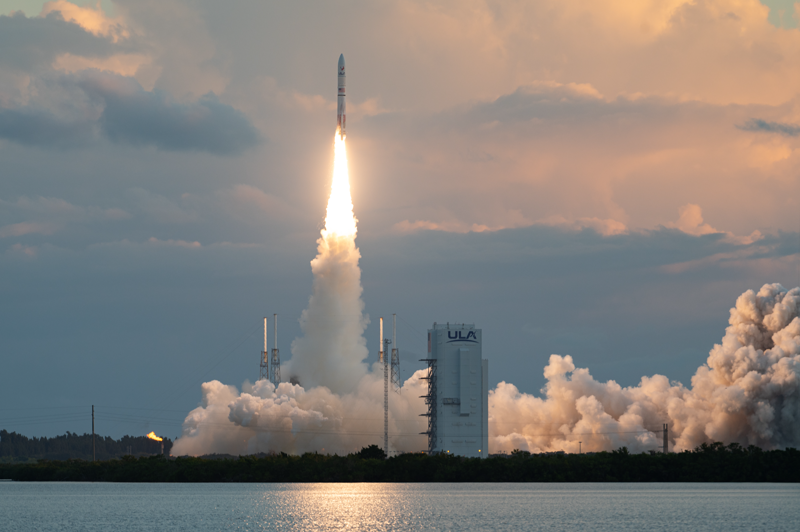
A Vulcan Centaur climbs away from Space Launch Complex 41 at Cape Canaveral on 4 October 2024, its engines burning against a low evening sun.

The Vulcan on its second certification flight, the flight that introduced the booster nozzle problem ULA spent nine months fixing.


The rocket looked right. That was the problem. On Sunday afternoon, at 12:40 p.m. Eastern time, a 214-foot Vulcan Centaur climbed away from Space Launch Complex 41 at Cape Canaveral on a north-easterly heading, throwing 3.8 million pounds of thrust and a column of orange flame over the treeline. Nothing about the first two minutes of the climb looked wrong. The six solid strap-on boosters from Northrop Grumman did their job, burning out and falling away about a minute and forty seconds after liftoff, and the two methane-burning BE-4 engines from Blue Origin kept pushing the core stage up through the thickening air. Then the flight telemetry began showing the hydrogen-fuelled Centaur upper stage correcting its attitude in ways nobody had planned. Ten minutes into the ascent, United Launch Alliance confirmed that the vehicle had suffered an anomaly and had failed to deliver its payload to orbit. The forty Amazon Leo satellites it carried went with it.

Sunday was not an easy day to get to the pad. A Friday attempt was scrubbed after a fault at a gaseous nitrogen plant knocked out a service used by several launch providers. Saturday slipped on network problems between the rocket and ground systems, and on Sunday morning controllers put the countdown on hold at twenty seconds to resolve an unexplained fault with the vehicle itself. ULA re-targeted the end of the launch window, fixed the problem and flew at the last minute. Nothing in the countdown pointed at what would happen next, and nobody yet knows whether the fault that stopped the countdown had any connection to the one that stopped the rocket. The failure was not really about the vehicle’s headline problem, and that is what makes it awkward for the company trying to prove it can compete with SpaceX. Vulcan had flown four times before Sunday and reached orbit every time. Two of those flights, the second in October 2024 and the fourth in February, ended with one of the solid boosters’ nozzles burning through and dropping away roughly thirty seconds after liftoff. Space.com described it as a problem serious enough for the U.S. Space Force to pause national security launches on the vehicle until ULA addressed it. ULA spent the following months chasing what chief executive Mark Peller called three credible causes for the nozzle damage, all of which he said had been mitigated through design and process changes. On Sunday the boosters behaved themselves. The failure came further up the stack, during the Centaur’s planned burn of twelve minutes and fifteen seconds. Wikipedia’s flight record for the vehicle now notes that the upper stage malfunctioned and the payload never reached orbit. The Centaur has been flying since the 1960s. Something about how it was being flown on Sunday broke it.

That matters more than one lost launch normally would. Sunday was not a routine mission. It was Leo Vulcan 1, the first time Amazon had put its constellation on ULA’s rocket, and it came at a moment when the other launchers on Amazon’s manifest were in no better shape. Amazon’s own mission tracker lays out the order and the vehicles: forty satellites on a Vulcan VC6L from Cape Canaveral on Sunday, thirty-six on an Ariane 6 from Kourou no earlier than 23 November, and twenty-nine more on an Atlas V in July, the last Amazon cargo flight that rocket will carry before its remaining vehicles are reserved for Starliner. The company has bought 38 Vulcan flights, 24 on New Glenn, 24 on Ariane 6 and 13 on Falcon 9 to build a constellation the FCC licensed at 3,236 satellites, and Amazon Leo has nearly 400 satellites in orbit after fourteen missions of a planned hundred or more. Forty of them were supposed to reach the same place on Sunday.

The New Glenn slot is the sharpest problem. Blue Origin’s rocket has flown three times, most recently in April 2026, and that last flight ended with an upper stage malfunction that left AST SpaceMobile’s BlueBird 7 in a lower-than-planned orbit, according to the vehicle’s flight record. Before that came a static fire test on 28 May, which tore a vehicle apart on the pad at Launch Complex 36 and wrecked the site, an explosion described at the time as one of the largest ever to happen on a launchpad. Blue Origin’s chief executive Dave Limp traced the cause to the main oxygen valve on one of the seven BE-4 first-stage engines. When he announced the finding he said hardware recovered from the pad had confirmed it. On 5 November he said the return to flight would slip to January 2027. The engines powering Sunday’s Vulcan were the same BE-4s, which makes the failure a curious one. ULA’s first stage flew on engines whose manufacturer had just lost a whole rocket to a valve defect, though Blue Origin had retrofitted a fix onto the engines installed for this mission, and ULA said the first stage ran long compared with the pre-launch timeline.

Amazon’s statement, released the same afternoon, was careful. There is risk with any launch, it said, and that is especially true for inaugural missions like LV-01. It added that ULA had been a trusted partner, and that Amazon believed the company would learn from the mission and deliver on its long-term plans for Vulcan. With 38 Vulcan flights still to fill, Amazon has every reason to mean it. But the arithmetic has tightened. ULA now faces a potentially significant grounding while engineers review telemetry, and with the New Glenn pad also out of action and the Atlas V’s remaining flights reserved for Starliner, the Ariane 6 is now the only vehicle on Amazon’s near-term manifest with a full slate of flights behind it. SpacePolicyOnline’s weekly summary called it the first total failure for ULA in the company’s history. The FCC had already waived the deadline for Amazon to reach half its constellation by July 2026, and it is now demoting the spectral priority of satellites launched after that milestone deadline unless the company speeds up.

What comes next is an investigation into a failure that happened in a sixty-year-old upper stage on a rocket that had spent nine months being patched up for an entirely different problem. ULA said it would work with Amazon and others to find the cause, determine corrective action and return to flight as quickly as possible, and that customers would have visibility into the process. NASA Administrator Jared Isaacman wrote that the agency was available to assist, adding that “Artemis, Moon Base, and the nation need ULA.” The Vulcan has flown five times now. Four of those ended with satellites in the right orbit. The fifth ended with forty of them on the way down and a customer with a hole in its deployment schedule where a constellation meant to compete with Starlink is supposed to be filling up.


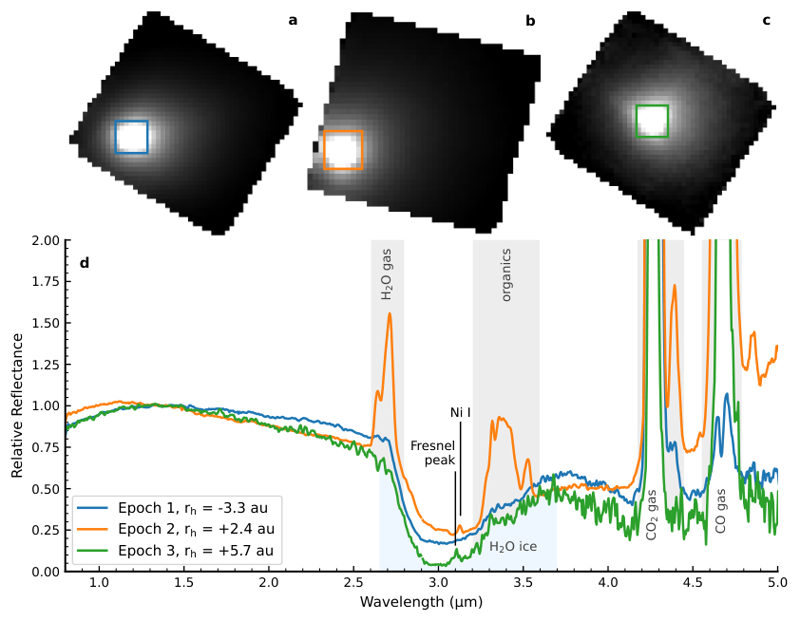
Three grayscale cut-out views of the coma of comet 3I/ATLAS above a plot of relative reflectance against wavelength from 0.8 to 5 microns for the three observing epochs, with the deep water ice absorption near 3 microns, a narrow fresnel peak and labelled gas emission from water, carbon dioxide and carbon monoxide (Protopapa et al. 2026, ApJL, CC BY 4.0)

The figure is reproduced from the paper under a Creative Commons Attribution 4.0 licence.


Webb has measured the physical state of the ice in an interstellar comet, and the answer does not match what a comet is supposed to look like. 3I/ATLAS, the third object ever confirmed to come from outside the solar system, carries water ice grains mixed through with rocky dust rather than mostly pure ice, and that mixture changes the shape of the spectrum. The result, published in The Astrophysical Journal Letters on 26 October, comes from a team led by Silvia Protopapa of the Southwest Research Institute, with Michael Kelley of the University of Maryland and Martin Cordiner of NASA’s Goddard Space Flight Center, who ran the Webb observing programme behind the measurements. NASA has been tracking the comet since 1 July 2025, when the ATLAS survey telescope in Chile first reported it to the Minor Planet Center.

Interstellar comets matter because they are the only pieces of other solar systems we can touch. Everything else known about planet formation comes from a single disk, and the assumption that other disks behave like ours carries a lot of weight in the models. If the icy building blocks of a planetesimal form differently around another star, then the chemistry handed to planets under that star’s light differs too, and the galaxy would hold many planet-forming chemistries rather than one. The same comet had already hinted at this. In a companion paper in Nature in June 2026, Webb measured isotopic ratios in 3I/ATLAS and found deuterium levels around 30 times higher than in solar system comets, and only traces of carbon-13 next to the more common carbon-12. That points to material that formed in a cold, dense cloud, possibly ten to twelve billion years ago during the era of peak star formation, and that never warmed enough to reprocess its heavy water ice into the ordinary kind. The new work reads the same comet a different way. It asks what state the ice is in, and the answer is that the ice arrives already mixed with rock.

The measurements come from Webb programme 5094, and the timing matters as much as the instrument. Cordiner designed the programme to be ready when an active interstellar comet turned up, and it was used three times: on 6 August 2025, when 3I/ATLAS was 3.31 astronomical units from the Sun, on 22 December 2025 at 2.38 units, and on 1 April 2026 at 5.65 units. That spans perihelion, which the comet passed on 29 October 2025 at about 1.4 units, between the orbits of Earth and Mars, putting the second visit closest to the Sun and the third well on the way out. The observation log in the paper gives exposure times of 146 seconds for each of the first two visits and 875 seconds for the last. Each visit produced a prism spectrum running from the near-infrared into the mid-infrared, and the three differ from one another. All of them show a broad, deep absorption centred near 3 microns, the fundamental stretching vibration of the O-H bond in water ice, alongside emission from water, carbon dioxide and carbon monoxide gas in the coma. The 3 micron band reaches 77 percent depth in the August 2025 spectrum and 94 percent in the April 2026 one, and the continuum beneath it steepens from -1.1 to -2.0 percent per 100 nanometres across those two epochs.

The oddity in 3I/ATLAS lies next to the 3 micron band. Ordinary icy comets show three bands in the infrared, the strong fundamental at 3 microns and two weaker overtones at 1.5 and 2.0 microns. In 3I/ATLAS the shorter-wavelength pair are weak to the point of being missing, while the 3 micron band is deep. The team compared the spectra with models of how light scatters off grains of different sizes and compositions, computing scattering and absorption efficiencies with Mie theory and mixing materials inside each grain using the Bruggeman effective medium approximation. The preferred solution for the August 2025 data calls for a population of aggregates smaller than a micrometre, built from water ice and amorphous pyroxene with a magnesium to iron ratio of 50 to 50, alongside a coarser component of pyroxene and amorphous carbon. The April 2026 spectrum then needs something extra: a second population, larger and icier, made of water ice mixed with amorphous carbon, with the water ice volume fraction in that component fixed at 0.95 because more refractory material distorts the spectrum’s overall shape.

The mechanism behind this is a short optical path through the ice. A 1.5 micron overtone is produced when the O-H bond vibrates in a combination mode, and it appears only if light penetrates far enough into a grain to interact with more than a single molecule. Inside a large, mostly pure ice grain the light travels a long way, the overtone bands are strong, and all three bands show up together. Break the grain into sub-micron pieces and dust it through with rock, and the path through the ice collapses. The fundamental band survives because it needs the least travel, the overtones fade, and what is left is a spectrum that looks nothing like the comets of the solar system. The paper is careful about how far that argument goes. Control runs using pure water ice, or ice mixed only with carbon or olivine, overpredicted the short-wavelength absorptions or failed to reproduce the 3 micron band at all, and scored worse on the Bayesian information criterion than the preferred configuration. Even so, the authors describe the refractory-rich component as an effective reflectivity rather than a unique physical solution, and there is a second possibility they cannot separate from the first.

That second possibility comes out of the third epoch. A narrow Fresnel-like structure appears near 3.10 microns in the April 2026 spectrum and is absent from the August 2025 one. Such a feature arises from anomalous dispersion in the refractive index inside the 3 micron band, and it is more structured in crystalline ice than in amorphous ice, so the team reads it as crystalline material in the coma by April. Two stories fit: either the ice was crystalline all along and the changing spectrum reflects grains that grew or shed dust as the comet was heated and eroded near the Sun, or the grains themselves reorganised from an amorphous-like to a crystalline state. Kelley told the Southwest Research Institute press release that both are possible and that telling them apart is an open question the team wants to attack, and Protopapa’s version was shorter: the comet’s ice holds more dust than the ice in a typical comet.

Compare 3I/ATLAS with the icy worlds beyond Neptune and the oddity softens. The shape of its 3 micron band resembles that of several classes of mid-sized trans-Neptunian objects, particularly the ones whose spectra show carbon dioxide ice and organics, and those objects are also missing the 1.5 and 2.0 micron bands. The resemblance lies in the water ice, not the carbon dioxide, but it is enough to suggest that planetesimals forming in different disks share a continuum of ice grain properties, running from nearly pure ice grains to aggregates loaded with rock, with 3I/ATLAS at the dusty end of that range. The abstract in the arXiv record frames it as evidence that the physical form of water ice is fixed early, in planet-forming disks, and at least partly preserved in the bodies that form there. If that holds, it says something slightly uncomfortable about planetary formation as a field, because the state of the ice would be decided before any planet exists, in a disk that may not resemble ours. Webb will keep watching, at comets in our own system and at the next interstellar visitor to arrive, and whether 3I/ATLAS is typical or an outlier stays open until there is more than one sample. Sci.News summarised the finding as ice that is closer to the frozen bodies beyond Neptune than to the comets of the solar system, and the paper itself is where the numbers live.


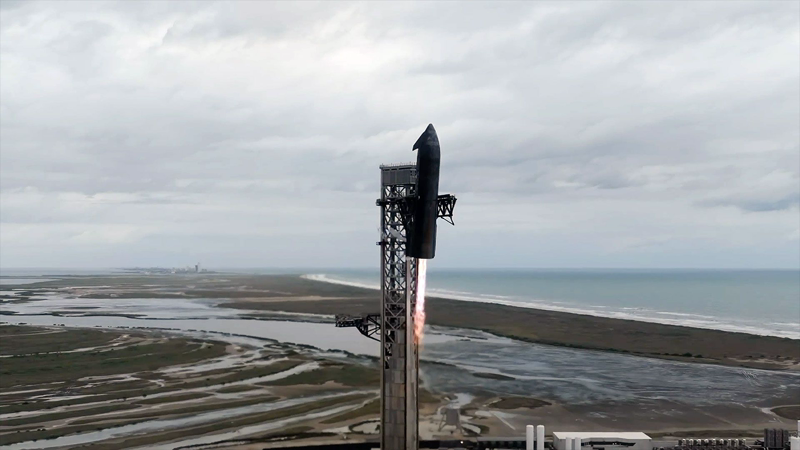
Ship 42 held upright between the arms of Orbital Launch Tower 2 at Starbase, the landing burn still burning beneath the vehicle as the catch completes on 14 November 2026.

The upper stage settles into the tower arms after its first return from orbit.


At 3:20 in the afternoon, Texas time, on Saturday, a Starship came down through the overcast above Boca Chica and stopped. It did not settle onto a drone ship or splash into the ocean. It hung there instead, upright between the two steel arms of the launch tower it had left a day earlier, its landing engine still lit as the arms closed around the vehicle. Ship 42 had been in orbit for 22 hours and 32 minutes by then, and no one had ever done what it had just done. SpaceX’s own reaction, posted on X, began: “Mechazilla catches Starship!” Dan Huot, the company’s spokesperson, was less restrained on the landing webcast. “That was the missing link,” he said, calling the maneuver “the holy grail of spaceflight.” He described what the vehicle had just done as “plummeting through fire to be snatched out of the air by steel,” and added that “We caught a Starship, and now everything changes.” Jessie Anderson, another of the company’s presenters, called it one of the most incredible and historic engineering feats of all time, and a good number of employees had gone outside to watch. The broadcast soundtrack was “Baby Come Back.”

The upper stage has always been the hard half of this problem. SpaceX has caught Super Heavy boosters three times before, on flights 5, 7 and 8, the most recent in March 2025. A booster comes home from a few kilometres up at speeds the tower arms can handle. A ship that has been to orbit comes home from orbital velocity, with a heat shield that has to survive the trip and a shape steady enough for a tower arm to find. Every Starship before Ship 42 ended in the ocean or was destroyed on the way down. The comparison is with Falcon 9, which lands its booster on almost every flight and throws its second stage away every time. Catching Ship 42 does not by itself make the economics work, but it removes the objection that the top half of the vehicle is a consumable. That matters for Starlink V3 satellites, each expected to carry about ten times the download capacity of a V2 Mini, for a network that already has more than 11,000 satellites in it. Starmind, the orbital data centre network Musk has described as a million spacecraft, matters more. NASA has its own stake in it, because Starship is the Artemis lunar lander and reaching the Moon means refilling ships in orbit with tanker flights, which means vehicles that can fly again soon. Morgan Stanley’s Adam Jonas wrote before the flight that a catch of both stages would probably be “a material positive” for SpaceX stock.

The flight itself began the way these things now do, with paperwork arriving late and a regulator saying go in the afternoon. The FAA issued Revision 10 of the launch licence on the day itself, hours before the window opened, explicitly covering both the booster catch and a ship return that overflies populated ground. Liftoff came at 22:47 UTC on 13 November from Pad 2 at Starbase, during a nationwide ground stop issued by the FAA that afternoon, CNN reported. Ship 42 inserted itself into a 276 by 278 kilometre orbit and spent the next twenty-one hours coasting through fourteen revolutions, moving at about 26,442 km per hour. The payload went out through the door: 26 Starlink V3 satellites over roughly 42 minutes, three of them carrying cameras pointed back at the ship so that the heat shield could be inspected from orbit. Ground cameras and satellite imagery together convinced flight controllers the tiles were in good shape. Three return checks were built into the flight plan, one over Hawaii an hour and a half in, one off Chile around the seven-hour mark and a final one over Hawaii near the twenty-hour mark, each one a point where the ship could have been told to ditch in pre-cleared water instead of coming home. All three passed. A ten-second single-engine deorbit burn at T+21:35 put it on a path out over the Pacific and around the Gulf, using its flaps to steer clear of populated areas of northern Mexico and southern Texas. Entry came at T+22:10, the vehicle went transonic at T+22:29 and subsonic a half-minute later, and the landing burn started at T+22:32:16. The flip followed two seconds after that, three engines dropped to two and then to one, and the burn shut down at T+22:32:28 as the arms took the weight. The published flight plan also had the ship banking on final approach rather than flying straight in, and the final go call came with only two minutes to spare before contact.

The other half of Flight 15 did not go the same way, and the explanation took most of Saturday to settle. Super Heavy 22 was the first Block 3 booster to attempt a return to the tower, and it aborted itself. Its boostback burn started 32 of 33 engines successfully, the landing burn ran from T+06:10 to T+06:35, and then guidance decided it was not in the right position to be caught and turned the vehicle out to sea. Kate Tice said the early indications were that the booster had ended its boostback burn early on a low fuel mass alarm, and that its guidance then detected it was out of position and diverted it to an offshore water landing. Dan Huot, who had first described the abort as a guidance, navigation and control problem, walked that back on Saturday and said the system had performed as expected. The vehicle hovered over the Gulf with its engines down before the flight termination system took it out shortly before the water. Musk, who has been more forthcoming about hardware than his engineers, put it down to the engines themselves. They underperformed slightly, he wrote, and the fix is better consistency from Raptor V3.2 plus a flight software change to cut the engines “about one second earlier” so enough propellant survives for the trip home. The booster loss, he added, does not change SpaceX’s timeline for high-volume fully reusable flights. The investigation is still open, which is worth remembering when the celebratory photographs start circulating.

A catch does not make a vehicle fly again. Ship 42 now sits at Pad 2 where it landed, and it has to be inspected, refurbished and refuelled before anyone knows how long the turnaround actually is. SpaceX has said that returning both stages to the launch site is what speeds up inspection and refurbishment, which is the point. No caught Starship has yet flown a second time, and the number of days on the ground between flights remains the open variable behind Musk’s claim of a weekly launch cadence in the first half of 2027. The next test will presumably try to catch both stages at once, which has not been done since the block of hardware changed. The booster side of that is still unfinished: no Block 3 Super Heavy has ever been caught. The programme is also spreading. SpaceX expects to start launching Starships from Kennedy Space Center within a few months, and NASA has restructured Artemis so that next year’s flight is a docking demonstration in Earth orbit with Orion and Blue Origin’s Blue Moon, pushing the crewed landing to Artemis IV as early as 2028. There is a footnote in the vehicle’s name, too. Ship 42 is 42 for the same reason it carries a “Don’t Panic” inscription, both references to Douglas Adams, and one of the heat shield tiles on this flight was installed and signed by the YouTube streamer MrBeast. The ship that flew furthest and was caught by a tower was also a piece of SpaceX’s outreach. Whether it gets back on a pad is the next thing to find out.


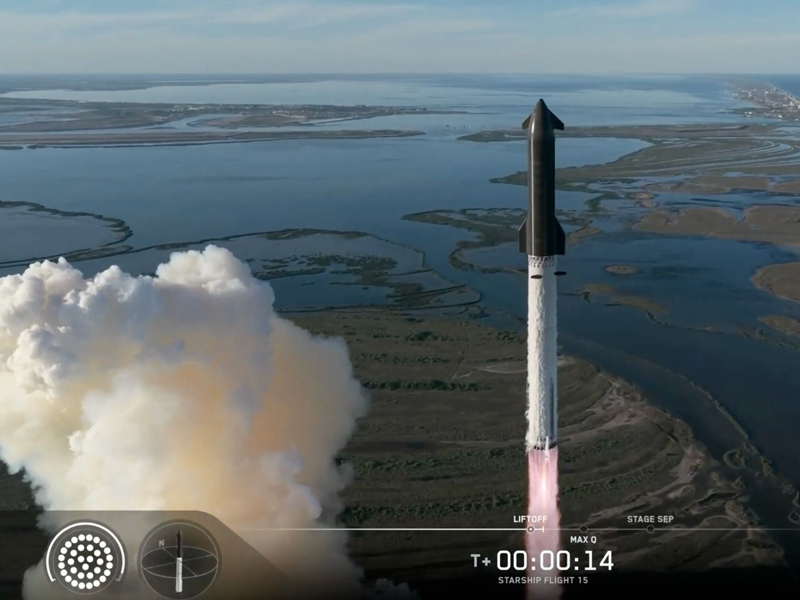
Starship climbing away from the Starbase launch pad on 13 November 2026, the flight computer overlay showing liftoff and the staging timeline.

Flight 15 clears the tower with the vehicle’s own telemetry laid over the image.


Friday night, for the first time, SpaceX tried to bring both halves of an orbital rocket home with the mechanical arms of a launch tower. About six and a half minutes after Starship lifted off from Starbase in South Texas, the catch was called off with the booster already on its way back to the tower it had just left. Super Heavy Booster 22 was falling back, engines lit, when the order came through to divert it into the Gulf of Mexico instead of a catch between the arms. The booster splashed down, and the double catch became a single catch: Ship 42 kept climbing, reached orbit, and is now on the first day of a coast that ends with a return to the same tower at about 21:20 UTC on Saturday. SpaceX’s own account of the decision ran to one sentence, posted a couple of minutes later: Super Heavy has diverted to an offshore splashdown in the Gulf. No cause was given. Dan Huot, the company’s spokesperson, said only that the team would dig into what caused the abort during the booster’s flight back to the tower.

A wave-off is not a failure, and SpaceX has one built into the flight plan on purpose. Every booster that flies carries the option of returning to the tower or coming down in the water, and that second option has already saved a vehicle once. On Flight 6 in November 2024 the tower took damage during liftoff and the booster was diverted to an ocean splashdown instead of attempting a catch on hardware that might have been damaged. The company had caught three Super Heavy boosters before Flight 15, all of them first generation vehicles, and had reflown two of them. It had never caught an upper stage. Flight 15 was the first attempt at a Block 3 booster return, and Block 3 has a poor record so far: the boosters on Flights 12 and 13 were both lost during landing attempts, and on Flight 14 the company skipped the catch entirely and put Booster 21 down in the Gulf. The half of the double catch that did not happen was also the harder half to pull off, on a booster generation that had never been caught.

Flight 15 lifted off at 22:47 UTC on Friday, two minutes into a 75 minute window, pushing more than 18 million pounds of thrust from 33 Raptor 3 engines. The stack passed Max Q a minute in, shut down most of those engines a little after two minutes, and left Ship 42’s own engines to take over the push, clearing the upper stage in the hot staging that follows. One booster engine failed to relight for the boostback burn, which the flight record scores as a partial success. The booster was still tracking back toward Starbase when the catch was called off. Long range cameras caught the Super Heavy coming down under a shroud of steam, then in a fireball as residual propellant ignited, and the vehicle made a controlled splashdown off the Texas coast. The ship had its own longer day ahead of it. It shut its six engines down a little over eight minutes in and coasted on a suborbital trajectory while controllers checked it over. At the 26 minute mark it fired a single Raptor for about 20 seconds, enough to push itself into a 275 km orbit, the second orbit Starship has ever reached. Starlink deployment began at the 35 minute mark and ran for roughly 40 minutes, and by early Saturday SpaceX confirmed that all 26 Starlink V3 satellites were in orbit. Each one adds a terabit of capacity according to SpaceX’s own mission outline, so the batch is worth about ten Falcon 9 flights of V2 Mini satellites, and the ship has roughly 21 hours of coasting ahead of it before a deorbit burn.

The most interesting engineering on Flight 15 is hidden in the payload. Three of the 26 Starlink V3s flying on Ship 42 carry cameras, and during deployment the ship rotates slowly so one of those satellites can turn around and photograph the heat shield tiles on the upper stage’s belly. Those images decide whether the ship gets to come home at all. SpaceX has said this flight’s tiles carry extra retention hardware in the areas most likely to shed during ascent, that it has closed some of the flow paths where plasma could slip behind the tiles, and that a large part of the shield now uses a curved tile design that has shown lower heating in the gaps between tiles. One of the tiles was installed by Mr. Beast, the YouTube streamer, which says something about how the programme now reaches an audience well beyond the launch site. Whatever the cameras find, the ship does not get to argue with it.

The catch itself is mechanical and unforgiving. The booster comes home on three engines, and the arms close below it. The ship has to come home at orbital speed, survive reentry on the same heat shield, then flip from a belly first attitude to tail first in the seconds before the landing burn. The published timeline puts the landing burn at 22 minutes and 32 seconds after liftoff, with three engines dropping to two and then one as the vehicle descends between the arms. Three checkpoints sit between orbit and the deorbit burn: one over Hawaii about an hour and a half in, one off Chile near the middle of the coast, and a last one over Hawaii roughly twenty hours after launch. Miss any of them and the ship comes down in a pre-cleared zone instead, with the Gulf held open for a late reentry failure. The FAA licence issued on launch day covers the return of both stages, including the ship’s flight back over populated areas.

Saturday’s real test is the ship, which has to survive reentry and hit a tower that has never caught anything larger than a booster, at about 21:20 UTC, a little over 22 hours after liftoff. The other thing worth watching is what SpaceX eventually says about Friday. The company’s record on booster aborts mixes hardware trouble, such as the tower damage on Flight 6 and the engine failures on Flights 12 and 13, with deliberate go or no-go calls. An automatic abort that fires without a published explanation is a reasonable thing to be sceptical about on a vehicle generation whose boosters have never been caught. Booster 22 came down in the Gulf instead, which is the cheap outcome. The expensive one is still ahead, and it is the part nobody has done before.