


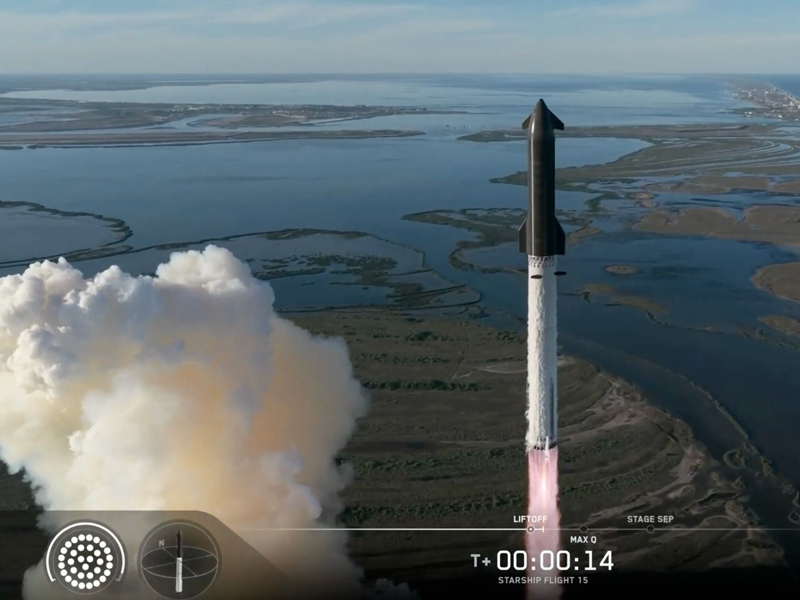
Flight 15 clears the tower with the vehicle’s own telemetry laid over the image.
Friday night, for the first time, SpaceX tried to bring both halves of an orbital rocket home with the mechanical arms of a launch tower. About six and a half minutes after Starship lifted off from Starbase in South Texas, the catch was called off with the booster already on its way back to the tower it had just left. Super Heavy Booster 22 was falling back, engines lit, when the order came through to divert it into the Gulf of Mexico instead of a catch between the arms. The booster splashed down, and the double catch became a single catch: Ship 42 kept climbing, reached orbit, and is now on the first day of a coast that ends with a return to the same tower at about 21:20 UTC on Saturday. SpaceX’s own account of the decision ran to one sentence, posted a couple of minutes later: Super Heavy has diverted to an offshore splashdown in the Gulf. No cause was given. Dan Huot, the company’s spokesperson, said only that the team would dig into what caused the abort during the booster’s flight back to the tower.
A wave-off is not a failure, and SpaceX has one built into the flight plan on purpose. Every booster that flies carries the option of returning to the tower or coming down in the water, and that second option has already saved a vehicle once. On Flight 6 in November 2024 the tower took damage during liftoff and the booster was diverted to an ocean splashdown instead of attempting a catch on hardware that might have been damaged. The company had caught three Super Heavy boosters before Flight 15, all of them first generation vehicles, and had reflown two of them. It had never caught an upper stage. Flight 15 was the first attempt at a Block 3 booster return, and Block 3 has a poor record so far: the boosters on Flights 12 and 13 were both lost during landing attempts, and on Flight 14 the company skipped the catch entirely and put Booster 21 down in the Gulf. The half of the double catch that did not happen was also the harder half to pull off, on a booster generation that had never been caught.
Flight 15 lifted off at 22:47 UTC on Friday, two minutes into a 75 minute window, pushing more than 18 million pounds of thrust from 33 Raptor 3 engines. The stack passed Max Q a minute in, shut down most of those engines a little after two minutes, and left Ship 42’s own engines to take over the push, clearing the upper stage in the hot staging that follows. One booster engine failed to relight for the boostback burn, which the flight record scores as a partial success. The booster was still tracking back toward Starbase when the catch was called off. Long range cameras caught the Super Heavy coming down under a shroud of steam, then in a fireball as residual propellant ignited, and the vehicle made a controlled splashdown off the Texas coast. The ship had its own longer day ahead of it. It shut its six engines down a little over eight minutes in and coasted on a suborbital trajectory while controllers checked it over. At the 26 minute mark it fired a single Raptor for about 20 seconds, enough to push itself into a 275 km orbit, the second orbit Starship has ever reached. Starlink deployment began at the 35 minute mark and ran for roughly 40 minutes, and by early Saturday SpaceX confirmed that all 26 Starlink V3 satellites were in orbit. Each one adds a terabit of capacity according to SpaceX’s own mission outline, so the batch is worth about ten Falcon 9 flights of V2 Mini satellites, and the ship has roughly 21 hours of coasting ahead of it before a deorbit burn.
The most interesting engineering on Flight 15 is hidden in the payload. Three of the 26 Starlink V3s flying on Ship 42 carry cameras, and during deployment the ship rotates slowly so one of those satellites can turn around and photograph the heat shield tiles on the upper stage’s belly. Those images decide whether the ship gets to come home at all. SpaceX has said this flight’s tiles carry extra retention hardware in the areas most likely to shed during ascent, that it has closed some of the flow paths where plasma could slip behind the tiles, and that a large part of the shield now uses a curved tile design that has shown lower heating in the gaps between tiles. One of the tiles was installed by Mr. Beast, the YouTube streamer, which says something about how the programme now reaches an audience well beyond the launch site. Whatever the cameras find, the ship does not get to argue with it.
The catch itself is mechanical and unforgiving. The booster comes home on three engines, and the arms close below it. The ship has to come home at orbital speed, survive reentry on the same heat shield, then flip from a belly first attitude to tail first in the seconds before the landing burn. The published timeline puts the landing burn at 22 minutes and 32 seconds after liftoff, with three engines dropping to two and then one as the vehicle descends between the arms. Three checkpoints sit between orbit and the deorbit burn: one over Hawaii about an hour and a half in, one off Chile near the middle of the coast, and a last one over Hawaii roughly twenty hours after launch. Miss any of them and the ship comes down in a pre-cleared zone instead, with the Gulf held open for a late reentry failure. The FAA licence issued on launch day covers the return of both stages, including the ship’s flight back over populated areas.
Saturday’s real test is the ship, which has to survive reentry and hit a tower that has never caught anything larger than a booster, at about 21:20 UTC, a little over 22 hours after liftoff. The other thing worth watching is what SpaceX eventually says about Friday. The company’s record on booster aborts mixes hardware trouble, such as the tower damage on Flight 6 and the engine failures on Flights 12 and 13, with deliberate go or no-go calls. An automatic abort that fires without a published explanation is a reasonable thing to be sceptical about on a vehicle generation whose boosters have never been caught. Booster 22 came down in the Gulf instead, which is the cheap outcome. The expensive one is still ahead, and it is the part nobody has done before.
 Subscribe to our RSS feed









There are no comments.
Add A Comment