


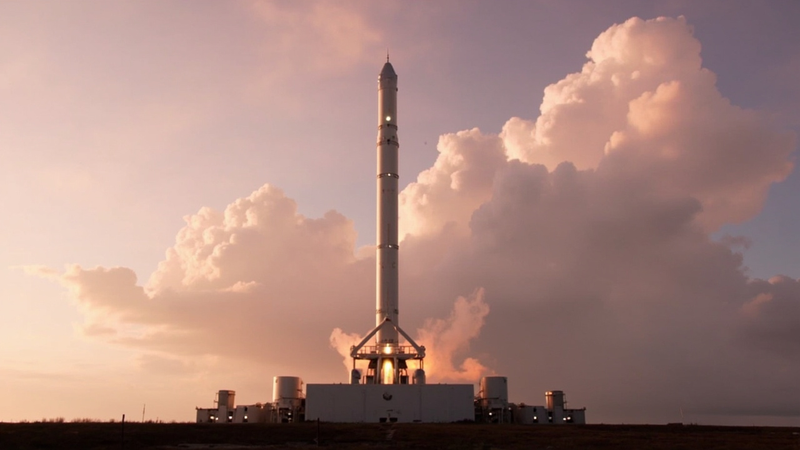
Twenty-six Starlink V3 satellites are bound for the payload bay of Ship 41 at Starbase, Texas, on a flight that has not yet left the ground. SpaceX is now targeting Monday 28 September 2026 for Starship Flight 14, with the window opening at 7:15 a.m. Central Time, 12:15 UTC, from Pad B. That is the fourth date set for this mission: attempts on 15, 18 and 22 September were each stood down, and the 28 September slot is still pending final regulatory approval. Ship 41 has completed its cryogenic proof testing and its static fire campaign, and Booster 21 has been moved to the pad for stacking. If the count reaches zero, Booster 21 will lift Ship 41 off the pad and, for the first time in the program’s three-year test campaign, hand a Starship upper stage enough velocity to circle the planet. The flight, designated IFT-14, would be the first orbital mission of the world’s largest operational rocket. Every previous Starship test, including the successful Flight 13 on 24 July 2026, was flown on a deliberately suborbital arc that splashed down either in the Indian Ocean or the Pacific (SpaceX, September 2026).
What changes because of this is the shape of the test program itself. For thirteen flights, SpaceX used the upper stage’s engines to push it downrange without ever crossing the orbital velocity threshold of roughly 7.8 km/s. The result was a “passively safe” trajectory that guaranteed reentry and splashdown at a known point even if all vehicle control was lost (Ars Technica, 15 September 2026). To stay on a closed orbit around Earth, Ship 41 will have to perform two burns in space, a coast phase of nearly ten hours, and a controlled deorbit burn at the end of the mission, all while carrying real revenue payload. That last detail is why SpaceX Chief Financial Officer Bret Johnsen told the Goldman Sachs Communacopia and Technology Conference audience on 10 September 2026 that this is “a revenue-generating flight” (TeslaNorth, 10 September 2026). No previous Starship test ever carried satellites that were intended to serve paying customers.
The procurement story behind the announcement starts with Starlink V3 itself. Each V3 satellite adds about 1 Tbps of downlink capacity and 160 Gbps of uplink capacity to the constellation, roughly ten times faster on the downlink and twenty-two times faster on the uplink than a V2 mini Starlink (PCMag via BaseNor, 15 September 2026). Twenty-six of them on Flight 14 will add a combined 26 Tbps of capacity in a single mission, more than ten times what a Falcon 9 V2 mini launch delivers (TeslaNorth, 16 September 2026). V3 satellites are too large to fit inside a Falcon 9 fairing; they can only reach orbit on Starship (SpaceX IPO filing, May 2026; azmth.space, 15 September 2026). The first batch of twenty V3s flew inside Ship 40 on Flight 13 in late July. This is the second and larger batch, with three of the twenty-six modified to carry cameras aimed back at the ship’s heat shield during deployment.
The engineering choices that make the orbit possible begin with Booster 21’s hardware fix. On Flight 13, Booster 20 had successfully used all thirty-three of its Raptor 3 engines during boostback, the first time a Block 3 Super Heavy had done so, before the terminal phase of the landing burn went wrong. Three of the thirteen center engines showed signs of ice clogging and triggered an early shutdown, leaving only eight engines to complete the burn before the booster splashed down hard in the Gulf of Mexico (Tech Times, 16 September 2026). The cause was straightforward. Liquid oxygen, stored at roughly −183 °C, draws moisture into propellant feed lines and filters where it can freeze into crystals. The center engines of the booster feed from a dedicated liquid-oxygen header tank used only during terminal deceleration, and that header tank’s filters were not sized to keep the contamination out under flight loads. Booster 21 carries redesigned filters on the propellant path between the header tank and the center cluster, along with new software for relight reliability (SpaceX, 15 September 2026). A successful landing burn on Flight 14 will be the qualification event for that change before SpaceX attempts the first tower catch of a Block 3 booster on Flight 15.
Ship 41’s heat shield is the second engineering story of the day. SpaceX recovered Ship 40 from the Indian Ocean in early August largely intact, harvested two of its ceramic heat-shield tiles, and plans to refly them on Ship 41 (Ars Technica, 15 September 2026). Three upgrades followed. Stronger retention mechanisms on tiles in regions at highest risk of shedding during ascent. Additional shielding against plasma flow paths behind the tile field. And a curved tile design that has shown it can reduce heating in the gaps between individual tiles. Three of the twenty-six V3 satellites carry cameras pointed back at the ship’s flank during their deployment sequence, so the mission returns not just operational spacecraft but a heat-shield health dataset from inside the bay.
The trajectory is also new. All earlier Starship flights followed ballistic arcs aimed at splashdown zones west of the Bahamas, in the Indian Ocean, or, in the case of the catch attempts, at Starbase itself. Flight 14 will splash Ship 41 down in the Pacific Ocean west of Chile, the geometry forced by a true orbital insertion at 275 km altitude. The booster will attempt a controlled splashdown in the Gulf of America on its own landing burn, not a tower catch (SpaceX, 15 September 2026). SpaceX has not yet received regulatory approval for an upper-stage tower catch in this campaign; that step is reserved for later flights.
The numbers underneath are what make the orbital geometry work. A Block 3 Super Heavy at liftoff carries 3,650 tonnes of methalox propellant across its two stages, with the booster delivering 89.5 Meganewtons of thrust from thirty-three Raptor 3 engines and the upper stage pushing six engines of its own, three of them Raptor Vacuum variants with a vacuum specific impulse of 380 seconds (Wikipedia, SpaceX Starship; SpaceX, 2024). The orbital velocity target of 7.8 km/s, multiplied by the natural logarithm of the mass ratio, gives the rocket equation Δv = v_e * ln(m_0 / m_f) that Tsiolkovsky wrote in 1903 and that every orbital mission since has had to satisfy. For a single-stage-to-orbit architecture, the ratio m_0 / m_f must clear roughly twenty. Two stages let Starship keep both ratios smaller, with Booster 21 shedding its structure shortly after its boostback burn and Ship 41 climbing to operational orbit on its own.
The mission control plan adds one explicit safety gate. Ship 41 will execute the burn to enter orbit only after the flight control team has confirmed “sufficient redundancy on hardware critical” to the later deorbit burn (SpaceX, 15 September 2026). If the ship is not healthy enough to come back down on command, it stays on its initial suborbital trajectory and splashes down in the Pacific regardless. The decision is made in flight, after launch and stage separation, rather than at any point in the ground count.
What’s next is the catch. Musk confirmed in mid-September 2026 that Flight 15 will attempt the first Block 3 booster tower catch, building directly on the Flight 14 landing burn (Starlust, 15 September 2026). From there, SpaceX’s published roadmap points toward higher flight cadences, larger payloads of up to sixty V3 satellites per launch, and the eventual test of orbital propellant transfer, the unproven technology that still gates every Mars mission. Flight 14 is not the destination. It is the flight that would end Starship’s run as a suborbital demonstrator and finally make it what it was always meant to be: a vehicle that goes around.
 Subscribe to our RSS feed









There are no comments.
Add A Comment