


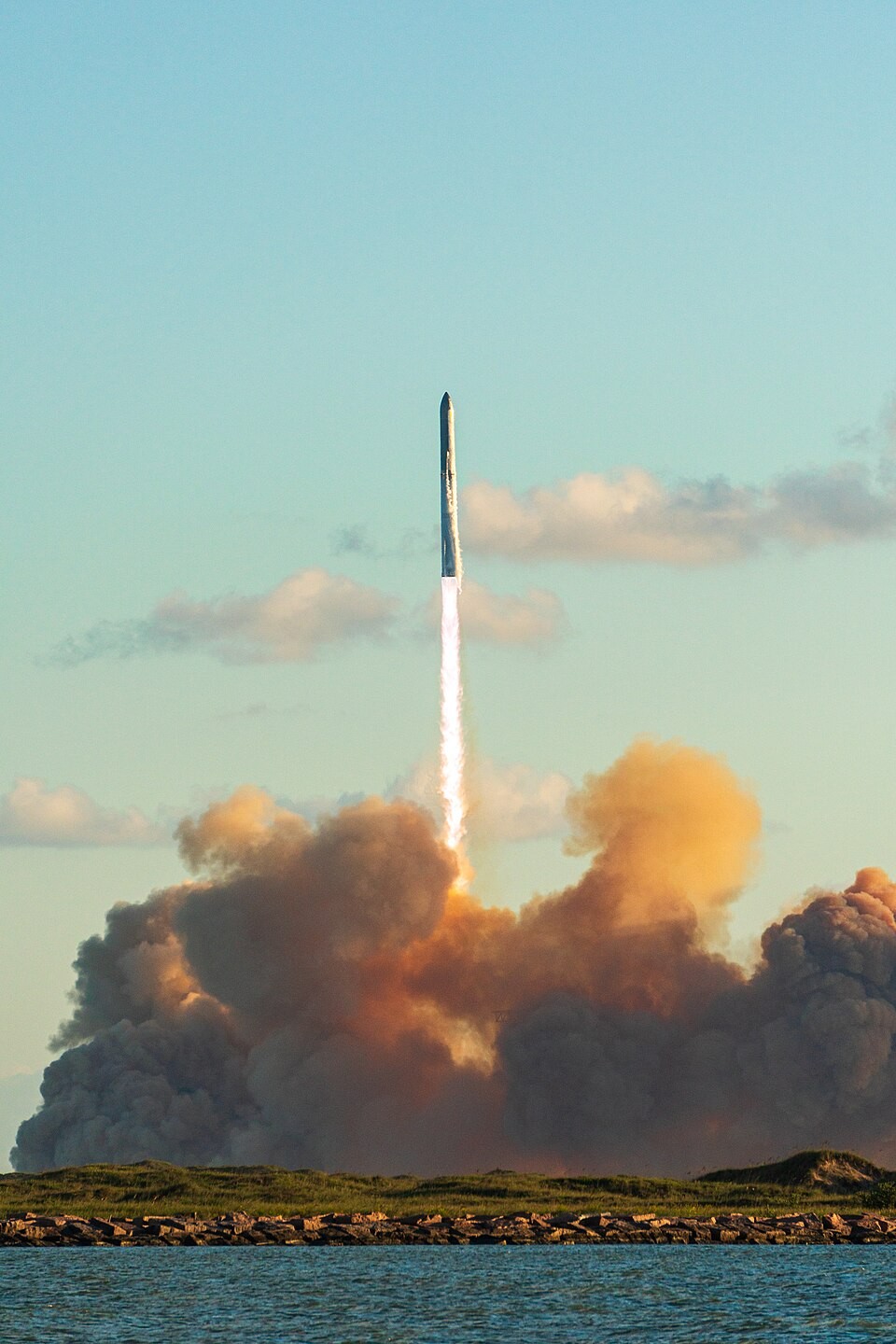
Image source: Wikimedia Commons. Photograph by Shujianyang, CC BY-SA 4.0.
A SpaceX Starship lifted off from Starbase in Boca Chica, Texas at 7:48 AM local time on Monday, September 28, and reached orbit for the first time on its fourteenth flight test. After a clean stage separation and a controlled splashdown of the Super Heavy booster in the Gulf of Mexico, the Starship upper stage completed its first orbital-insertion burn and deployed 26 Starlink V3 satellites into low-Earth orbit on a mission that SpaceX had earlier characterized as a step from developmental flight testing into operational service.
The launch was the first of the Block-3 vehicle series to fly with operational payload, and the first time a Starship vehicle has carried a Starlink batch into orbit. Three of the 26 satellites carry cameras intended to image the Starship heat shield while the upper stage is in orbit, extending the kind of data that an earlier camera-equipped batch gathered during a 2025 reentry test.
The countdown proceeded through propellant load on the booster and the ship, Raptor chill, and a final GO poll at T-30 seconds. Liftoff was at the opening of the day’s launch window. NPR, reporting live, described the 33 Raptor engines on Super Heavy as igniting together at the start of the climb. Max-Q, the moment of peak aerodynamic stress on the vehicle, cleared without incident. About two and a half minutes after launch, Starship separated from Super Heavy in the hot-staging sequence the company has used on the most recent flights, with the booster immediately turning back toward the Gulf of Mexico and the ship’s Raptor engines continuing the climb toward orbit.
Two anomalies shaped the early portion of the flight. First, SpaceX’s mission management decided during the climb that one of the six Raptor engines on the ship had failed during ascent, and the team weighed, for roughly twenty-two minutes, whether to continue to orbit. By the time Starship’s second-stage burns were scheduled to start, SpaceX confirmed it was safe to do so. Second, when Super Heavy began its boostback burn a few minutes after separation, only 26 of the 28 candidate engines relit — a partial relight rather than the full set SpaceX had planned to use. The landing burn that followed was also a partial relight: 11 of 13 engines fired. The booster nonetheless completed its boostback, descent, and landing burn sequence and executed a controlled soft splashdown in the Gulf of Mexico at roughly T+8 minutes, ten seconds after launch. SpaceX had deliberately planned an offshore splashdown for this flight rather than a return-to-launch-site catch, in part because the booster was being used to test upgraded software and hardware before the company re-attempts a tower catch on a later mission.
The ship’s first milestone after separation was a coast phase through the upper atmosphere. At T+25 minutes and 28 seconds the ship began its orbital-insertion burn; nineteen seconds later the burn ended and Starship was in a sustained orbit for the first time in the program’s history. About nine minutes after the insertion burn, the payload deployment sequence started and the 26 Starlink V3 satellites began releasing from the ship over the following half hour. The three camera-equipped satellites will spend their operational lifetime photographing Starship’s heat shield from a vantage point just behind the vehicle’s planned reentry trajectory, providing imagery that SpaceX says it will use to refine its reusable-heat-shield program.
The mission profile extended further than a suborbital hop. SpaceX had originally planned a roughly ten-hour mission with six orbits at an altitude around 170 miles, but reduced the flight plan during ascent to a shorter three-hour profile. The trade reflected, in the company’s judgment, the right margin for a vehicle running one engine short on its upper stage. After roughly nine hours in orbit, the ship is expected to perform a deorbit burn over the Pacific, descend through the atmosphere, and execute a controlled splashdown in the ocean. NPR noted that no earlier Starship flight had reached orbital velocity, which is roughly 17,500 miles per hour; today’s flight is the first vehicle in the line to do so.
Starship Flight 14 is the second flight of a Block-3 vehicle and the first of the year from Starbase. The booster, Booster 21, completed its full-duration static fire at Massey’s Test Site on August 28 after a qualification campaign that included the post-Flight-13 investigation into the landing-burn dynamics and an extended cryogenic proof sequence in mid-summer. The ship, Ship 41, completed a six-engine static fire on August 21 and a single-engine deorbit-burn simulation test two days earlier. Both vehicles were integrated, stacked, and rolled to OLP-2 ahead of the launch attempt.
The flight is also the first operational mission carrying Starlink satellites to use a Starship vehicle rather than a Falcon 9. SpaceX has been the dominant operator in commercial launch for the past several years using Falcon 9, but the larger V3 Starlink satellites only fit inside Starship’s fairing. NPR reported that SpaceX completed the final Falcon 9 launch of a Starlink batch from Florida last month and intends to move V3-class launches to Starship going forward. The shift matters to SpaceX’s plans for the constellation: in filings to the Federal Election Commission ahead of its IPO in June, the company called Starship’s launch cadence and reusability material to its growth strategy.
The flight is also material to NASA’s Artemis program. SpaceX is under contract to develop a Starship-derived Human Landing System for Artemis III, currently targeted for late next year. The Artemis III profile includes docking Starship with an Orion capsule in lunar orbit and transporting astronauts to the surface. NASA’s Administrator, Jared Isaacman, congratulated the SpaceX team on today’s milestone on social media; in earlier remarks, the agency has framed a successful first operational Starship flight as one of the gating milestones for the lunar landing timeline, alongside the unrelated second crewed Orion flight that lifted off in April.
Three of the satellites that lift with Starship today are designed to spend their working lives photographing the heat shield of the very vehicle that released them. That unusual arrangement — test instrumentation riding inside operational payload — has become a theme of the program. Cameras flew on earlier V2 Starlink satellites in 2024 and 2025 for similar purposes; SpaceX said the data from those missions was the basis for several heat-shield design changes that shipped on Block 3. Today’s cameras will, in turn, feed back into Block-4 hardware.
If the Pacific reentry and splashdown at the end of the mission go as planned, Flight 14 closes out a flight that began developmental flight testing and ended with operational payload deployment. The next ship in line, Ship 42, completed chopstick-catch tests at the tower in mid-September and remains weeks from flight readiness; the next booster, Booster 22, is also still in qualification. SpaceX has not announced a date for Flight 15, but company statements earlier in the year suggested it would follow within roughly two months of today’s flight, with a Falcon-class Starlink batch and a Super Heavy tower catch among the items on the next mission’s checklist.
 Subscribe to our RSS feed









There are no comments.
Add A Comment