


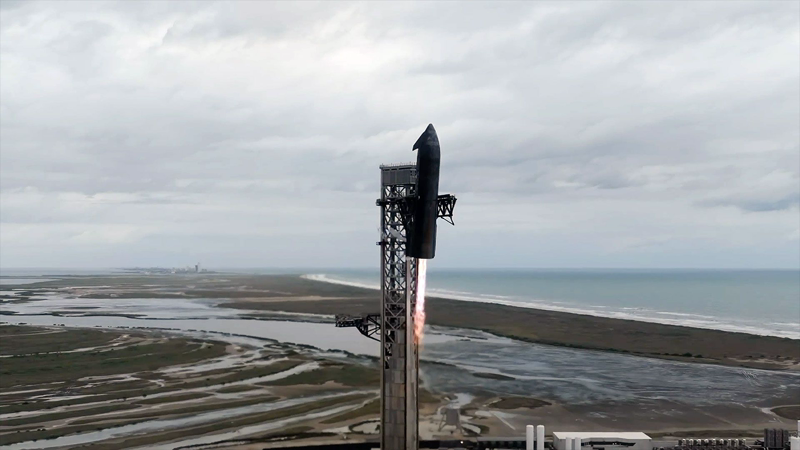
The upper stage settles into the tower arms after its first return from orbit.
At 3:20 in the afternoon, Texas time, on Saturday, a Starship came down through the overcast above Boca Chica and stopped. It did not settle onto a drone ship or splash into the ocean. It hung there instead, upright between the two steel arms of the launch tower it had left a day earlier, its landing engine still lit as the arms closed around the vehicle. Ship 42 had been in orbit for 22 hours and 32 minutes by then, and no one had ever done what it had just done. SpaceX’s own reaction, posted on X, began: “Mechazilla catches Starship!” Dan Huot, the company’s spokesperson, was less restrained on the landing webcast. “That was the missing link,” he said, calling the maneuver “the holy grail of spaceflight.” He described what the vehicle had just done as “plummeting through fire to be snatched out of the air by steel,” and added that “We caught a Starship, and now everything changes.” Jessie Anderson, another of the company’s presenters, called it one of the most incredible and historic engineering feats of all time, and a good number of employees had gone outside to watch. The broadcast soundtrack was “Baby Come Back.”
The upper stage has always been the hard half of this problem. SpaceX has caught Super Heavy boosters three times before, on flights 5, 7 and 8, the most recent in March 2025. A booster comes home from a few kilometres up at speeds the tower arms can handle. A ship that has been to orbit comes home from orbital velocity, with a heat shield that has to survive the trip and a shape steady enough for a tower arm to find. Every Starship before Ship 42 ended in the ocean or was destroyed on the way down. The comparison is with Falcon 9, which lands its booster on almost every flight and throws its second stage away every time. Catching Ship 42 does not by itself make the economics work, but it removes the objection that the top half of the vehicle is a consumable. That matters for Starlink V3 satellites, each expected to carry about ten times the download capacity of a V2 Mini, for a network that already has more than 11,000 satellites in it. Starmind, the orbital data centre network Musk has described as a million spacecraft, matters more. NASA has its own stake in it, because Starship is the Artemis lunar lander and reaching the Moon means refilling ships in orbit with tanker flights, which means vehicles that can fly again soon. Morgan Stanley’s Adam Jonas wrote before the flight that a catch of both stages would probably be “a material positive” for SpaceX stock.
The flight itself began the way these things now do, with paperwork arriving late and a regulator saying go in the afternoon. The FAA issued Revision 10 of the launch licence on the day itself, hours before the window opened, explicitly covering both the booster catch and a ship return that overflies populated ground. Liftoff came at 22:47 UTC on 13 November from Pad 2 at Starbase, during a nationwide ground stop issued by the FAA that afternoon, CNN reported. Ship 42 inserted itself into a 276 by 278 kilometre orbit and spent the next twenty-one hours coasting through fourteen revolutions, moving at about 26,442 km per hour. The payload went out through the door: 26 Starlink V3 satellites over roughly 42 minutes, three of them carrying cameras pointed back at the ship so that the heat shield could be inspected from orbit. Ground cameras and satellite imagery together convinced flight controllers the tiles were in good shape. Three return checks were built into the flight plan, one over Hawaii an hour and a half in, one off Chile around the seven-hour mark and a final one over Hawaii near the twenty-hour mark, each one a point where the ship could have been told to ditch in pre-cleared water instead of coming home. All three passed. A ten-second single-engine deorbit burn at T+21:35 put it on a path out over the Pacific and around the Gulf, using its flaps to steer clear of populated areas of northern Mexico and southern Texas. Entry came at T+22:10, the vehicle went transonic at T+22:29 and subsonic a half-minute later, and the landing burn started at T+22:32:16. The flip followed two seconds after that, three engines dropped to two and then to one, and the burn shut down at T+22:32:28 as the arms took the weight. The published flight plan also had the ship banking on final approach rather than flying straight in, and the final go call came with only two minutes to spare before contact.
The other half of Flight 15 did not go the same way, and the explanation took most of Saturday to settle. Super Heavy 22 was the first Block 3 booster to attempt a return to the tower, and it aborted itself. Its boostback burn started 32 of 33 engines successfully, the landing burn ran from T+06:10 to T+06:35, and then guidance decided it was not in the right position to be caught and turned the vehicle out to sea. Kate Tice said the early indications were that the booster had ended its boostback burn early on a low fuel mass alarm, and that its guidance then detected it was out of position and diverted it to an offshore water landing. Dan Huot, who had first described the abort as a guidance, navigation and control problem, walked that back on Saturday and said the system had performed as expected. The vehicle hovered over the Gulf with its engines down before the flight termination system took it out shortly before the water. Musk, who has been more forthcoming about hardware than his engineers, put it down to the engines themselves. They underperformed slightly, he wrote, and the fix is better consistency from Raptor V3.2 plus a flight software change to cut the engines “about one second earlier” so enough propellant survives for the trip home. The booster loss, he added, does not change SpaceX’s timeline for high-volume fully reusable flights. The investigation is still open, which is worth remembering when the celebratory photographs start circulating.
A catch does not make a vehicle fly again. Ship 42 now sits at Pad 2 where it landed, and it has to be inspected, refurbished and refuelled before anyone knows how long the turnaround actually is. SpaceX has said that returning both stages to the launch site is what speeds up inspection and refurbishment, which is the point. No caught Starship has yet flown a second time, and the number of days on the ground between flights remains the open variable behind Musk’s claim of a weekly launch cadence in the first half of 2027. The next test will presumably try to catch both stages at once, which has not been done since the block of hardware changed. The booster side of that is still unfinished: no Block 3 Super Heavy has ever been caught. The programme is also spreading. SpaceX expects to start launching Starships from Kennedy Space Center within a few months, and NASA has restructured Artemis so that next year’s flight is a docking demonstration in Earth orbit with Orion and Blue Origin’s Blue Moon, pushing the crewed landing to Artemis IV as early as 2028. There is a footnote in the vehicle’s name, too. Ship 42 is 42 for the same reason it carries a “Don’t Panic” inscription, both references to Douglas Adams, and one of the heat shield tiles on this flight was installed and signed by the YouTube streamer MrBeast. The ship that flew furthest and was caught by a tower was also a piece of SpaceX’s outreach. Whether it gets back on a pad is the next thing to find out.
 Subscribe to our RSS feed









There are no comments.
Add A Comment