


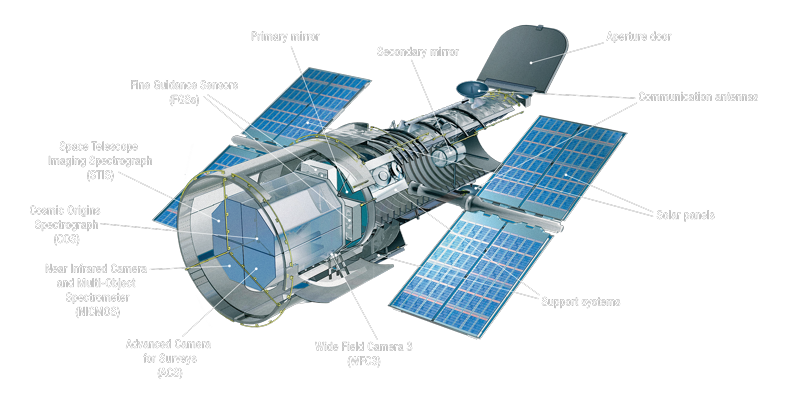
Image: the Hubble Space Telescope in orbit after the final servicing mission, its open aperture door facing the viewer and the solar array wings extended. Credit: NASA, via Wikimedia Commons.
The Hubble Space Telescope has been falling toward Earth for years, one imperceptible nudge at a time. It has no propulsion system of its own to push back, and it spends every orbit dragging against the thin upper atmosphere, losing altitude a little faster each time. There is no engine to fire and no thruster to spare. The telescope was built to be serviced by hand, and for the last seventeen years nobody has done it. On 29 October, NASA asked the commercial space industry to tell it how to fix that (NASA’s announcement of the Request for Information). Responses are due at 3 p.m. Eastern time on 30 November, and the agency is asking about three things: putting Hubble into a higher orbit, servicing it to extend what it can do, or guiding it down in a controlled way when the science finally runs out.
The case for acting is not sentiment, though the scientists who want Hubble kept alive are certainly articulate about it. An uncontrolled reentry of a spacecraft this size is a public safety question. NASA puts the likely date of Hubble’s uncontrolled arrival at 2033 or 2034, and says a mission would need to happen by 2032 to make a difference (NASA on commercial servicing of Hubble). That is a hard wall with a date on it. The probability of an uncontrolled reentry in 2033 works out to roughly 1 in 330 for casualties, averaged across the whole band of latitudes the telescope’s 28.5 degree inclination sweeps, against a NASA safety standard of 1 in 10,000 (TechTimes on the casualty risk). Over the emptiest stretches of the South Pacific the odds fall to something like 1 in 31,000, which is still not nothing. Hubble was never designed to be landed. NASA had assumed a space shuttle would retrieve it, and when the shuttle fleet retired, that assumption quietly expired. The telescope itself is the size of a large school bus, weighing 27,000 pounds with a 2.4 metre primary mirror and a solar array generating more than 5,200 watts (NASA’s Hubble by the Numbers).
What makes the timing unusual is that Hubble has already had this conversation once. NASA ran a similar Request for Information in December 2022 and received eight responses, and the agency did not pursue any of them. Two of the companies involved, Astroscale and Momentus, proposed a partnership in which a Momentus orbital service vehicle launched on a small rocket would approach Hubble, attach using docking hardware Astroscale was developing, raise the orbit by 50 kilometres and then detach to go on removing debris in nearby orbital shells (SpaceNews on the Astroscale and Momentus concept). NASA was careful to say the responses were information rather than proposals, and that any company might take on the work with no exchange of funds, as a demonstration rather than a procurement. Nothing came of it. Administrator Jared Isaacman had advocated for a SpaceX Crew Dragon mission to boost Hubble before he took the job, and NASA studied that proposal without pursuing it.
The circumstances have shifted in ways worth setting apart from the political argument. The shuttle fleet that serviced Hubble is long gone, so NASA has no vehicle of its own to send. Meanwhile the commercial market that the 2022 solicitation was testing has had three more years to mature, and companies like Northrop Grumman now fly an orbital servicing vehicle that docks with commercial satellites in geostationary orbit and moves them to higher slots (The Register on NASA’s Hubble options). Isaacman has said the equation has changed as those capabilities matured, that an uncontrolled reentry is not acceptable, and that a funded visit should prioritise extending the observatory’s science return (NASASpaceflight on Isaacman’s remarks). He has also said he expects the request to draw interest from robotics companies rather than from anyone planning to fly astronauts to a telescope in a 28.5 degree orbit (Ars Technica on NASA’s Hubble request).
One piece of the hardware makes the capture problem more tractable than it sounds. When Atlantis visited in May 2009 for the fifth and final servicing mission, it installed the Wide Field Camera 3 and the Cosmic Origins Spectrograph, which gave the telescope the ultraviolet reach it has today, and replaced its gyroscopes and batteries (ESA on Servicing Mission 4). Engineers also fitted a Soft Capture and Rendezvous System to the aft bulkhead, a ring-like device with structures and targets that lets a future vehicle capture the telescope and guide it into a safe controlled reentry, whether that vehicle is crewed or robotic (ESA/Hubble on the Soft Capture Mechanism). The docking port a servicing robot can grab, built seventeen years before anyone needed it, turns the hardest part of the job into the easiest part. The capture is still harder than a routine docking, because Hubble’s own orbit offered no safe haven at the space station, and in 2009 Endeavour stood ready on an adjacent pad as a rescue mission for the entire duration of the flight.
The observatory is not in the condition it was in when it was last visited. Hubble now runs on two of its six gyroscopes, flying in single-gyro mode, a change that has cut its usable observing time by roughly 12 percent and limited which targets it can track (NASASpaceflight on Hubble’s systems). A servicing mission that restored gyroscopes, upgraded the batteries and gave the telescope a few more years of full-rate pointing would be worth doing for the astronomers even if the orbit question went unsolved. The case for keeping it alive, though, runs the other way. NASA is reporting that Hubble’s observing time remains oversubscribed seven to one even at reduced capability, and that no replacement is expected before the 2040s, when the Habitable Worlds Observatory might fly (The Register on NASA’s Hubble options). The successor has a different and complementary job from the ultraviolet and visible-light survey work Hubble has been doing since the shuttle released it from Discovery in April 1990, 332 nautical miles up (NASA on Hubble’s deployment). ESA, which built Hubble’s flexible roll-out solar arrays and holds 15 percent of its observing time as its share of the partnership, put the telescope’s original working altitude at around 600 kilometres (ESA’s Hubble overview). The Habitable Worlds Observatory, by contrast, is a much larger infrared, optical and ultraviolet observatory whose central aim is hunting for biosignatures in the atmospheres of worlds around other stars, with a main objective of directly imaging 25 potentially habitable candidates (NASA on the Habitable Worlds Observatory).
Two things will decide whether this goes anywhere. The first is whether a commercial company can make a number work on a piece of government hardware that nobody has tried to dock with in orbit, at a scale larger and more awkward than the satellites the servicing industry was built for. The second is time. A response submitted by 30 November still leaves years of development and launch ahead of it, and NASA has already said a mission has to happen by 2032 to beat the reentry forecast, a schedule that assumes a company that has never done this before moves at a pace the space industry has not always managed. The window for a crewed visit has closed. Whatever saves Hubble now has to be a robot.
 Subscribe to our RSS feed









There are no comments.
Add A Comment