


Figure 3 from the paper, showing the paired helicity peaks at each distance, reused under CC BY 4.0.
Parker Solar Probe’s FIELDS magnetometer is a fluxgate instrument built to sit inside the Sun’s outer atmosphere, and for most of the mission it did what it was designed to do: measure how the interplanetary magnetic field behaves once the solar wind has been stripped of its larger structure. One dataset from late 2021 is now being mined for something else. Masatomi Iizawa of the Technische Universität Braunschweig and eight colleagues working across ten countries sorted the magnetometer’s record between 29 September and 22 November 2021 into one-hour bins spaced 0.002 astronomical units apart, spanning a radial sweep from 0.100 to 0.782 AU. Close to the Sun the instrument sampled every 3441 microseconds; farther out the interval stretched to 109,227 microseconds, and that stretch is what made the analysis work: sampling rate sets the finest scale a record can resolve. The paper appeared in The Astrophysical Journal Letters on 13 October 2026 (arXiv record, full text with figures), and the universities behind the work described what they had found (press release).
Inside that record the magnetic field’s helicity stops looking like noise. Helicity counts how twisted and how linked the field lines are, and in the solar wind it has usually been statistically indistinguishable from random fluctuation across the inertial range where turbulence does its work. At 0.1 AU the reduced normalized magnetic helicity spectrum carries a negative peak at 10 Hz and a positive one at 20 Hz, both clear of the 95 percent confidence bounds the team computed around them. Iizawa’s summary was that the team saw “a clear structure in the spectrum” where the turbulence had looked unstructured. Opposite-sign peaks had been reported before at ion scales, but only as snapshots tied to whatever local conditions happened to be around. Nobody had tracked them outward.
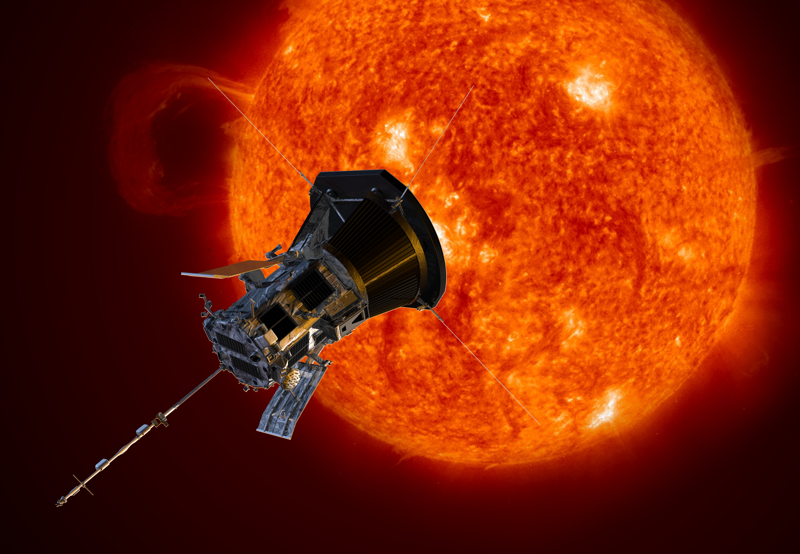
Magnetohydrodynamic theory treats the solar wind as a magnetized conducting fluid, and helicity is close to conserved in that description as energy and twist cascade from large scales to small ones, which makes it a useful tracer of what the wind carries. Space weather forecasting leans on the same quantity: the helicity arriving with the wind is one of the better early indicators of a geomagnetic storm, and it gets measured routinely from Earth. Understanding where helicity goes inside the cascade, and why its sense of rotation flips at one scale, is a step toward predicting what the wind will do when it gets here. Close to the Sun the solar wind is a plasma whose turbulent fluctuations run from thousands of kilometres down to a few hundred, and somewhere in that range the fluid description runs out and individual particle motions start to matter. Whether helicity survives that handover is not a settled question. Parker Solar Probe was built for this work: a 685 kg spacecraft launched on a Delta IV Heavy in 2018, shielded by a 4.5 inch carbon composite heat shield that takes temperatures near 2,500 degrees Fahrenheit, on a mission of seven years and 24 orbits through the corona, closer to our star than any spacecraft has been (NASA’s mission page).
The measurement is a standard one, and the method explains why the sampling rate mattered. Helicity here is the reduced normalized magnetic helicity density: twice the imaginary part of the cross-spectral density between the transverse and normal field components, divided by the sum of their power spectra, from fast Fourier transforms of the magnetometer series in radial, tangential and normal coordinates. The reduction is the catch. A single spacecraft measures one line through the plasma, so this quantity describes the sense of rotation of the field about the sampling direction, not the full three-dimensional winding. To convert frequency to wavenumber the analysis assumes the flow sweeps past the probe faster than the structures evolve, the frozen-in hypothesis, and the team checked that assumption rather than trusting it. The ratio of velocity fluctuation to sampling speed falls from about 0.3 near perihelion to about 0.03 at 0.7 AU, and a Doppler factor between 1 and 4 with a mean near 2.5 means the derived wavenumbers could be overestimated by that factor, a shift of a few next to the orders of magnitude the spectra span.
The spectra show a pair of peaks that drifts. At 0.1 AU the pair sits at 10 Hz and 20 Hz, and as the spacecraft moved outward both slid toward lower frequency, a shift the team tracks cleanly between 0.1 and 0.4 AU. Some peaks appear to vanish around 0.2 AU, but the paper attributes this to the lower sampling rate in survey mode rather than a physical disappearance, and the paired peaks return in the observable band beyond 0.3 AU at lower frequencies. Beyond roughly 0.5 AU the structure becomes hard to pick out of the data. The fit to the migration is an exponential in distance, with a frequency scale of 20 hertz and a decay constant of 9 per astronomical unit, and that shape is the point. If the solar wind were merely expanding as it travelled outward, stretching structures along the way, the frequency of a given feature would fall as the inverse of distance, a power law. The data show something else, which rules out passive geometric expansion as the main driver and points instead at nonlinear interaction between scales. A November write-up describes the same finding (ScienceDaily).
The drifting peaks do not stay put relative to the local plasma. If the helical structure were sustained by purely local kinetic instabilities, scaling the spectra by the local proton cyclotron frequency, or the local ion inertial length, would collapse the peaks onto one fixed scale regardless of distance from the Sun. That collapse does not happen. The peaks cross the constant-scale reference lines and migrate toward larger scales relative to those local kinetic scales as the spacecraft recedes, a slippage that points to structure being transported rather than continuously created and destroyed in place. The paper connects this to the helicity barrier, an idea in which the passage from fluid to kinetic scales blocks the forward transfer of magnetic helicity for flows with a large cross-helicity component, forcing an inverse transfer that piles helicity up at scales larger than the ion gyroradius. As for where the two opposite signs originate, the authors favour proton temperature anisotropy as the seed: a perpendicular to parallel temperature ratio above one drives left-hand polarized ion cyclotron waves, a ratio below one drives the firehose instability into right-hand polarized whistler waves, and the Doppler shift into the spacecraft frame splits what is symmetric in the plasma frame into two signs.
The authors also flag what their data cannot settle. Third-order correlations that would pin down the direction of the cascade are out of reach at these sampling rates, so the barrier argument rests on second-order spectral evidence. The vanishing of the structure past 0.5 AU may be orbital rather than physical: Parker Solar Probe’s path stays within about 3.4 degrees of the ecliptic, so there it was repeatedly crossing the heliospheric current sheet, which would disrupt the transport of helical fluctuations. That disappearance also lines up with a reported shift in how the energy spectrum depends on distance, between 0.4 and 0.6 AU. They call for Solar Orbiter, at higher latitudes and larger distances, to settle it.
No new species of turbulence has been found. The result is a measured map of where helical structure travels and how it behaves at the scale where plasma physics changes character. By 0.4 AU the opposite-sign peaks that sat at 10 and 20 hertz at 0.1 AU have shifted measurably lower in frequency. The shift follows an exponential rather than the power law a stretched, expanding wind would produce, and the peaks refuse to stay pinned to the local ion scales. Those are falsifiable statements Parker Solar Probe can revisit, and the data and code behind them are posted under the identifier 10.5281/zenodo.22779133. The spacecraft set a record on its way, passing 3.8 million miles above the solar surface in December 2024 at 430,000 miles per hour (NASA on that pass).
 Subscribe to our RSS feed







There are no comments.
Add A Comment