
OrbitalHub

Where curiosity reaches escape velocity.

Domain is for sale. $50,000,000.00 USD. Direct any inquiries to contact@orbitalhub.com.


A computer model of Earth's magnetotail rendered in orange, pink and purple with thin blue field lines threading through it, and short cyan dashes marking the track the ESCAPADE spacecraft took through the region in March 2026 (NASA Scientific Visualization Studio, public domain, via Wikimedia Commons)

The visualization models how the magnetotail shifts over eight hours, with the cyan traces showing where the spacecraft were headed that March.


Two spacecraft the size of a refrigerator are about to do something no Mars-bound spacecraft has done before: fire their engines while diving past Earth, using the planet’s gravity at the same moment, to sling themselves toward the Red Planet. The first of the pair, named Blue, will make its closest approach to Earth and light its engine at around 5 a.m. EST on Saturday, November 7. Its twin, Gold, does the same thing two days later, around 6 a.m. EST on Monday, November 9, with each burn lasting roughly nine minutes. NASA’s announcement of the maneuver calls it a trans-Mars injection burn, and no Mars-bound spacecraft has ever executed a powered Earth flyby, or Oberth maneuver, before it.

The trick exists because of a calendar. Earth and Mars reach a favourable alignment for a fuel-efficient transfer only every 26 months, and for most of the history of Mars exploration that spacing has decided when missions could launch. ESCAPADE, a NASA and University of California, Berkeley mission in the agency’s small and cheap SIMPLEx programme, refused to wait. Its two spacecraft launched on November 13, 2025, when the two planets sat on opposite sides of the Sun and a direct transfer was expensive or impossible. Instead the pair curved out to the Earth-Sun L2 point, about a million miles away, and looped there in what NASA describes as a kidney-bean-shaped orbit for nearly a year, studying space weather while they waited for the planets to come round. When the geometry finally lined up, the spacecraft fell back toward Earth and met it at exactly the right moment. The route saves propellant. In the long run it may save whole missions from having to schedule themselves around a planetary clock.

There is a reason to burn at the closest point rather than earlier or later, and it comes down to arithmetic rather than bravado. Kinetic energy scales with the square of velocity, so a spacecraft moving twice as fast has four times the energy to give away. A burn applied at the bottom of a gravity well, where the vehicle is moving fastest, does far more work for the same propellant than the identical burn applied higher up where the speed is lower. The Oberth effect is named after Hermann Oberth, an Austro-Hungarian-born German physicist who described it in 1927, and it explains why the useful place to burn is the point of closest approach: the engine has the least time to act but the most energy to convert. ESCAPADE gets both effects at once. Earth’s gravity bends the trajectory toward Mars while the engine, firing at maximum speed, gets more out of every kilogram of propellant it spends.

Getting there took some doing. ESCAPADE began as a cheap ride-along on the Psyche asteroid mission, and the spacecraft were built on the Rocket Lab Explorer bus with a launch date set by somebody else’s manifest. When Psyche moved to a different rocket, ESCAPADE needed a launcher of its own, and the spacecraft grew from an original 90 kg design to about 200 kg dry mass each, with a launch weight of 535 kg per spacecraft. Blue Origin’s New Glenn won the launch contract in February 2023 for roughly $20 million, and the first attempt was scrubbed on November 9, 2025 because of cumulonimbus clouds in the launch area. A second attempt on November 12 was called off because of a solar storm. Launch finally happened at 3:55 p.m. EST on November 13, with the booster returning to its landing site.

On the science side, the pair carries a magnetometer, an electrostatic analyzer and a Langmuir probe for measuring plasma density and electron energy, plus a dual-wavelength camera that takes visible and infrared pictures of Mars at the same time. The instruments were built by teams at Berkeley, Embry-Riddle and Northern Arizona University, and the camera’s wide field is meant to catch Mars in a single frame from far enough out to watch the polar caps change with the seasons and to image the planet’s aurora. Both spacecraft are designed to fly as a pair, holding a separation of zero to 30 minutes along the same path so that scientists can tell whether a magnetic signal changed because the instrument moved or because the environment did. After the cruise they will reach Mars in September 2027, split into orbits with apoapsis values of 7,000 and 10,000 kilometres, and become the first multi-spacecraft mission to fly in formation around another planet.

The year at L2 produced work of its own. The spacecraft passed through a distant part of Earth’s magnetotail, the region stretched away from the planet by the solar wind, and no spacecraft had explored that part of the tail directly before. NASA says the instruments recorded activity and structure there that the team has not yet published, which amounts to a rehearsal for the plasma environment the pair will face around Mars.

The flybys are also visible from the ground, if faintly. NASA says some observers may be able to pick the spacecraft out as dim points against the stars with a telescope. The best viewing is from the western United States, between midnight and 1 a.m. Pacific time on November 7 and between 1 and 2 a.m. on November 9, before each craft drops below the horizon to make its burn. The burns themselves happen over southern Australia at around 8:51 p.m. and 9:51 p.m. local time, and should be watchable with a telescope from there. NASA has published all-sky charts for several cities and points to the Jet Propulsion Laboratory’s Horizons system for coordinates.

What happens in the days after each burn will settle how much of this works. Within a few days the mission team will know how accurately the spacecraft are pointed, and a series of trajectory correction manoeuvres through the summer will trim the path to line up with Mars. The payoff arrives in September 2027, when the pair starts measuring how the solar wind strips gas off the Martian atmosphere, a question NASA’s MAVEN mission has been working on for more than a decade. The schedule is what changes. If a Mars mission can park at L2, sit out a bad alignment and leave on a powered flyby, then the 26-month cycle stops being a law of nature and becomes a budget question. The Planetary Society notes that SIMPLEx missions receive less than $80 million, against $583 million for MAVEN through its primary mission, and the whole ESCAPADE programme cost about $75 million including the launch. The failure mode is just as plain: if an engine does not light on the day, the next good window is two years away.
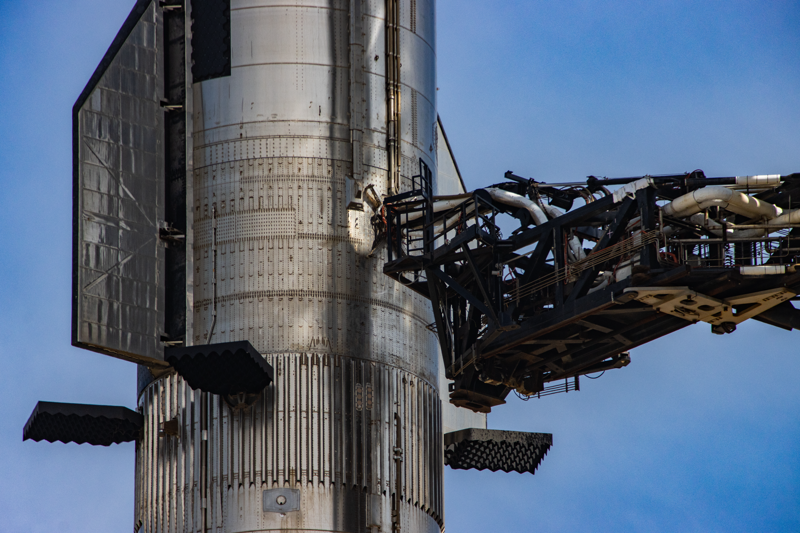


Close view of a stainless steel Starship stage at Starbase, with the launch tower's black quick disconnect arm and its insulated cryogenic piping reaching in from the right (Wikimedia Commons, CC BY-SA 4.0)

The quick disconnect arm is the fitting that practice refuelings are rehearsed with, the same class of hardware a fleet of V4 tankers would need on orbit.


Late on Friday night, Elon Musk posted a single sentence about the next version of Starship on X, and it was about how tempting it would be to fit a 500-ton-thrust Raptor 4 into the booster’s outer ring, replacing the Raptor 3 that sits there now. It came with no schedule and no commitment. Underneath that musing sits Starship’s next major upgrade. V4 is the version due to fly in 2027, and it is the version the Artemis IV architecture rests on, whether or not anyone at the agency has put it in those words.

The arithmetic behind that is not complicated. A crewed lunar landing needs a depot in low Earth orbit, and one recent model of that fill puts it at roughly 1,200 tonnes of propellant. Tankers have to supply it. At the 100 tonnes per tanker used in that model, that takes about twelve flights. Musk has been saying that six to eight will do, and the reason his number is smaller is that he is counting on a different rocket. Divide the same 1,200 tonnes by the 200 tonnes that a V4 tanker is projected to carry and you land on six, which is close to the figure he has been using. The lower manifest rests on a fleet of V4 ships and V4 boosters flying V4 Raptors, plus close to zero boiloff while the depot sits in orbit for weeks. NASA’s own safety advisory panel is working from 22 flights instead. That count is built on the capabilities of the rocket that exists today and on thin data about how fast cryogenic methane and oxygen leak away from an unshielded tank in sunlight. An analysis of the boiloff problem puts both numbers side by side. Both are in circulation, and the gap between them comes down to which of the two versions of Starship you are counting on.

Getting to V4 means getting through V3, which is where the programme stands. Flight 14 on September 28 was the first Starship to reach orbit, and it deployed 26 Starlink V3 satellites on the way up. It did not finish as planned. An early engine shutdown, which Musk attributed to a fault in the engines’ flight software, forced an early return, and both stages ended up in the ocean rather than on the tower. Flight 15, the next attempt, is the one the reuse case depends on, and SpaceX is targeting Friday November 13. Kiko Dontchev, the company’s vice president of launch, gave that date at the UP.Summit. That made it the first target to come straight from a SpaceX executive rather than from air traffic planning slides. The mission plan is a dual catch. The Super Heavy booster returns to the launch tower, as it has done three times already, and then the Ship comes home from orbital velocity and gets caught by the same arms, which has never been attempted. Booster 22 fired all 33 of its Raptors for a full-duration static fire on October 25. Ship 42 followed with a single-engine burn on October 26 and a 60-second firing of all six engines on October 27. The hardware is ready. The Federal Aviation Administration has not yet published a Flight 15 licence, and Gwynne Shotwell has said she expects it to cover a return to the launch site and tower catches for both stages. Teslarati has the details.

The vehicle on that pad is a V3, and the changes SpaceX described for V3 show how the company works from one version to the next. Propulsion was reworked around Raptor 3, a higher-flowing engine that now sits on both stages. The Ship carries new docking adapters, which are the fittings a future propellant transfer needs. The booster’s fuel transfer tube, the large metallic structure that runs cryogenic methane and liquid oxygen down to the engines, was redesigned. Super Heavy picked up an integrated hot stage, more vent area, and three grid fins in place of four, each half again as large and strong enough for lifting and catching the vehicle. V4 continues that logic rather than replacing it. Wikipedia’s Starship entry now lists Block 4 at an estimated 142 metres, or 466 feet, against 124.4 metres for Block 3, with payload to low Earth orbit of an estimated 200 tonnes against 100. Thirty-nine Raptors fly today, 33 on the booster and six on the Ship; V4 stretches the Ship and takes the count to 42, and is expected to debut in 2027.

The engine is where the performance comes from, and the Raptor line has bought thrust without buying mass at every step. Raptor 1 delivered 185 metric tons of thrust on an engine weighing about 2,080 kilograms. Raptor 2 raised that to 230 tons while cutting the mass to roughly 1,630 kilograms. Raptor 3 is flight-rated at 250 tons at sea level and 275 tons in vacuum, with the engine mass down to 1,525 kilograms and a stated target of 280 tons. The thrust-to-weight ratio of the family has climbed from 88.9 to 141.1 to 163.9. In late October Musk said Raptor 4 should reach 300 tons at sea level at roughly the mass of Raptor 3. Thirty-three engines at that rating would amount to about 9,900 tons of liftoff thrust, close to three times what the Saturn V produced from its five F-1 engines. Wikipedia tracks the engine’s history and Teslarati covers the Raptor 4 target. Sea-level thrust is the number that matters. The stack is heaviest and still deep in the gravity well at the moment it leaves the pad, where every extra second of climbing spends propellant against gravity rather than against orbit. The booster’s engine count is fixed by its 9-metre diameter and by how densely the engines pack around it, so thrust per engine is the cheapest way to raise liftoff performance without redesigning the booster. That is the logic behind the outer ring in Musk’s post. Whether a 500-ton engine ever reaches the pad is a separate question from the direction of travel.

What to watch is dated and physical. The first tells are the licence that authorises Flight 15 on November 13 and whether the Ship comes home from orbit and gets caught by the tower. The deeper tell is whether SpaceX can hold the Raptor 4 promise of 300 tons at Raptor 3’s mass, since every tanker flight saved in the Artemis manifest is paid for by engine performance. If the 500-ton outer-ring engine stays a musing, the six-flight manifest stays a target rather than a plan, and V4 still arrives as a 142-metre stack with 42 Raptors and roughly twice the payload of the vehicle flying today. The Flight 15 licence is still unpublished, and no Starship upper stage has ever been caught.


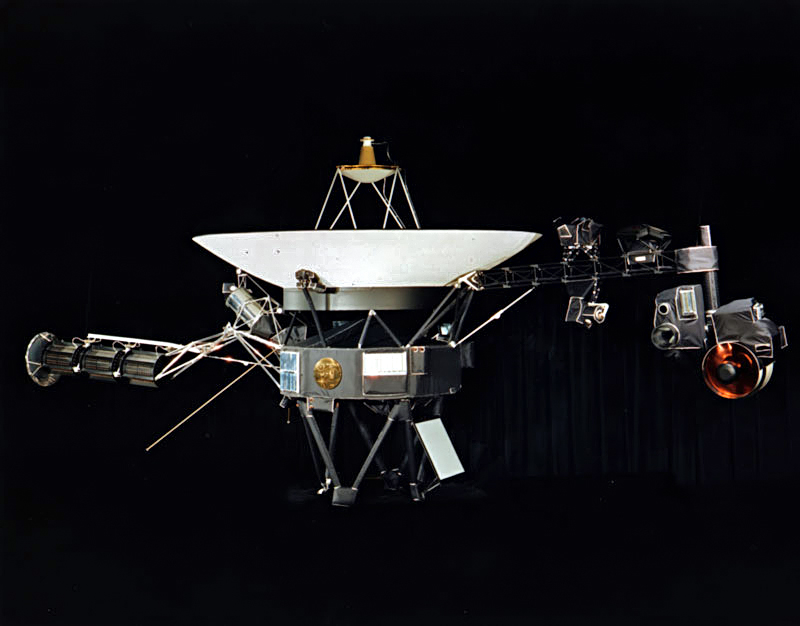
A 1977 NASA photograph of a Voyager spacecraft against a black background, showing the white parabolic high-gain antenna dish above the ten-sided electronics bus, the three cylindrical radioisotope thermoelectric generators stacked end to end on the boom extending to the left, and the science instrument boom extending to the right with the particle detectors and camera scan platform at its tip (NASA/JPL-Caltech, public domain, via Wikimedia Commons)


On 18 November 2026, at 2:16 in the morning Pacific time, Voyager 1 will cross a line in space that no human-made object has ever reached. The probe will be 16.094 billion miles (25.902 billion kilometers) from Earth, which is the distance light covers in a single day. Getting there took 49 years, two months and 11 days of flight for a probe that has cruised at nearly 38,000 mph (61,000 kph) since leaving Cape Canaveral on a Titan-Centaur rocket in September 1977. Nothing on board will react to it: no instrument fires, and the space on either side of the marker looks the same. The significance is arithmetic. After nearly half a century of flying away, the distance to home is large enough that a radio exchange takes a full day each way.

That is a strange condition for a machine to be in. Light travels about 186,000 miles every second, so once the marker is passed it crosses the gap between Earth and Voyager 1 in exactly 24 hours. A command sent then would take a day to arrive, and the reply another day to come home. Suzanne Dodd, the Voyager project manager at NASA’s Jet Propulsion Laboratory, put it plainly: you send your message and then “you go home and you wait two days” before an answer arrives. Two days is not much for a person waiting on a colleague. It is a long time for a spacecraft with a power supply running down and a radio that has to keep its dish on target.

The light-day is a useful unit for a reason that has nothing to do with poetry. Nothing outruns light, so it is the one ruler that never stretches as you take it to larger distances. The same logic that lets astronomers quote the Sun as 8 light-minutes away and Andromeda at about 2.5 million light-years also puts the Moon at 1.3 light-seconds from here. Neptune sits about four light-hours and 10 light-minutes off, and Voyager 2 needed 12 years to get there. The nearest star, Proxima Centauri, is 4.24 light-years away. Voyager 1’s new marker falls between those scales, and the number makes the solar system look small: a neighborhood whose nearest house is a four-and-a-quarter-year walk away.

The spacecraft that reached that marker was never meant to get there. It was built for a five-year job involving flybys of Jupiter and Saturn, and nobody involved had any idea how far it would eventually go. Voyager 1 launched on 5 September 1977 with ten science instruments and weighing 1,592 pounds (721.9 kg). Its power came from three radioisotope thermoelectric generators, which turned the heat of decaying plutonium into about 158 watts each at launch. It took the faster of the two routes, past the asteroid belt ahead of its twin, and overtook Voyager 2 on 15 December 1977. The alignment of the four outer planets that made the mission possible occurs only about every 175 years, and the two Voyagers together cost about $865 million including their nuclear batteries.

What it found along the way is a long list. At Jupiter it found a thin ring and two new moons, Thebe and Metis. At Saturn it added five moons and a new ring called the G-ring. Another discovery came out of an image nobody was looking for, taken for navigation rather than science: four days after the Jupiter encounter, project astronomer Linda Morabito processed a picture of Io and noticed something protruding from the limb of the moon. It was a volcanic plume, the first sign of active volcanism seen beyond Earth, and it changed what people expected from a world that had seemed dead. Later, the spacecraft turned its cameras back toward the planets for a family portrait taken from 40 AU, and the small pale speck of Earth in one of those frames became the Pale Blue Dot, a phrase that Voyager science team member Carl Sagan made famous.

In December 2004 Voyager 1 crossed the termination shock, where the solar wind still dominates, and in August 2012 it became the first spacecraft to pass the heliopause into interstellar space. By then it was still working, and it is now one of only two objects ever to have operated outside the heliosphere. The probe has been sending back data from a region no other human-made object has ever occupied, doing it with a shrinking tool kit.

The instruments have been switched off in a planned order for years, one at a time, as the plutonium decays. Of the ten instrument sets the spacecraft carried, seven have been shut down. The cosmic ray telescope stopped on 25 February 2025, and the Low-energy Charged Particles experiment, which had run almost without interruption since launch and measured the density structure of the space beyond our heliosphere, was switched off on 17 April 2026. What remains on Voyager 1 are the magnetometer and the plasma wave instrument. Voyager 2, which flew the longer path to Uranus and Neptune and has stayed closer to Earth as a result, still runs three.

In September 2026 the team pulled off a maneuver they call the Big Bang. Engineers switched off three powered devices on Voyager 1 in one step and swapped in three lower-power alternatives. All six exist to keep the spacecraft warm enough to operate in the cold. The swap had to happen all at once, because the heat the old units put out only balances if all three change together. Without it, the mission would have had to shut off another instrument as early as summer 2027. The same swap, run on Voyager 2 a few weeks earlier, gave the twin’s three instruments more time too.

The thin margin showed in October. On 18 and 19 October, NASA’s Deep Space Network could not detect Voyager 1’s signal during two scheduled communications attempts 24 hours apart, and the probe reappeared on the 20th. Engineers have so far traced the loss to a group of thrusters going offline with the backups switching on automatically, a protective response built into the spacecraft that puts it into a safe state when something looks wrong. Nothing on board was permanently broken, and the team has kept talking to the spacecraft since. But a half-century-old probe deciding on its own to go quiet for two days, then coming back, is what happens when the margins are this thin.

Science, meanwhile, has not stopped. A paper by Jeewoo Park of NASA’s Goddard Space Flight Center and colleagues, published this year in The Astrophysical Journal, reports what Voyager 1’s magnetometer has seen since a pressure front in 2020 pushed the surrounding magnetic field up. The strength of that field has stayed elevated instead of settling back down, holding between 0.45 and 0.53 nanotesla, while the field’s orientation has kept rotating toward the nominal Parker spiral, the pattern the Sun’s own rotation would produce. Intermittent, spiky behavior has generally been easing off, though it flared up again in 2023 and 2024 before settling. The authors’ conclusion is careful but pointed: after all these years the spacecraft has not yet reached a pristine interstellar medium free of the Sun’s influence, so the boundary where the solar system ends looks less like an edge than a transition.

The milestone on 18 November is mostly bookkeeping rather than a change in the sky. It marks the point at which the distance to the nearest star takes more than a single day’s worth of light to cross. Voyager 2 will get its own light-day in November 2035. Both probes keep climbing away from the Sun on the power their plutonium still gives them, carrying a gold-plated copper record with greetings in 55 languages, whale song and ninety minutes of music toward a star more than 17 light-years off, AC +79 3888 (Gliese 445), which Voyager 1 should pass within about 1.7 light-years of in some 40,000 years. Nobody will be around to watch that happen, and the disk will still be there, waiting for whoever does arrive.


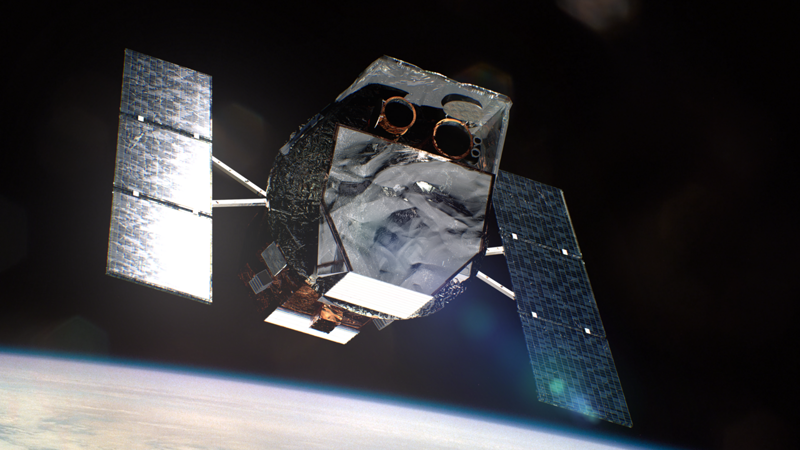
NASA's Neil Gehrels Swift Observatory in orbit above the limb of Earth, its two long blue solar arrays extended on either side of a silver foil-wrapped bus with the cylindrical barrels of the three telescopes visible on the upper face, against the blackness of space (NASA/Goddard Space Flight Center/Chris Smith, public domain, via Wikimedia Commons)


Early on Wednesday morning a dead space telescope will come apart over the Pacific. NASA’s Neil Gehrels Swift Observatory is expected to enter Earth’s atmosphere at roughly 3:30 a.m. Eastern time on 4 November, nearly 22 years after a Delta II launcher put it into orbit, and the US Space Force prediction NASA is quoting comes with an uncertainty of 11 hours. Most of the 3,200-pound spacecraft will burn up on the way down, though Space.com reports that the X-ray and optical telescope’s innards might survive. The odds of a fragment hurting anyone are about 1 in 2,100, and because Swift flew in a low orbit, anything that makes it through can only fall between 20.6 degrees south and 20.6 degrees north of the equator. It will not be steering itself, cannot be commanded, and has no engine to point at the atmosphere differently. It is falling the way a stone falls.

What Swift did was hard to do and harder to replace. It was a three-instrument observatory, a Burst Alert Telescope, an X-ray Telescope and an Ultraviolet/Optical Telescope, built to catch gamma-ray bursts, the most violent explosions in the universe, which flare and fade in seconds and happen about once a day. Because a burst is over almost before most telescopes can react, Swift was designed to point itself, slewing to a new target on its own and switching between instruments fast enough to catch the fading afterglow. It found more than 2,000 of those bursts over its life, and it was usually the fastest thing in the sky at pointing somewhere new. In July it caught a wandering black hole tearing apart a star well outside its galaxy’s bright core, briefly outshouting the entire host galaxy in the ultraviolet. Lynn Cominsky of Sonoma State University, who has worked on the mission for decades, described the change it made to the field this way: time-domain astronomy became a rich field.

It launched on 20 November 2004 as part of NASA’s medium-class Explorer programme, a mission built for two years of prime science and operated from Penn State in State College, with a main ground station at Malindi in Kenya run by the Italian Space Agency. It was renamed in 2018 for Neil Gehrels, the principal investigator who died in early 2017. Its record is long. It saw the naked-eye burst GRB 080319B in March 2008 from 7.5 billion light-years away, and in April 2009 caught GRB 090423 at 13.035 billion light-years, the most distant cosmic explosion known at the time. It caught the ultraviolet glow of the kilonova from the 2017 gravitational wave event, saw GRB 221009A in October 2022, the brightest and among the closest bursts ever recorded, and found hydroxyl on the interstellar comet 3I/ATLAS in 2025. A second gyroscope failure had already cost it a long stretch in safe mode in 2024, fixed by software in April that year.

The end was not a hardware failure so much as a change in the sky above it. Every spacecraft in low Earth orbit is slowly dragged down by the thin air it flies through, and the rate depends on how much the Sun has heated and inflated the upper atmosphere. The current solar cycle peaked in 2025, and the extra particles streaming outward from the Sun have left the atmosphere puffier than expected. Swift lost altitude faster than its models allowed, and the fix was as old as orbital mechanics: point less at the Sun and spend less power. NASA switched instruments off, loosened the requirement that the solar arrays stay within ten degrees of the Sun, and cut the average cross-sectional area Swift presented to the airflow to about 30 percent of normal. That bought months. It also cost the telescope its eyes when its science was most wanted. By January 2025, most of NASA’s models had Swift re-entering by summer 2026.

In September 2025 NASA gave a $30 million contract to Katalyst Space Technologies of Arizona to build a machine that could catch a satellite nobody had designed to be caught. The plan was a servicing spacecraft called LINK, carrying three robotic arms on a split Stewart platform, each fitted with lidar and three-degree-of-freedom grippers that would grab ground-handling flanges on Swift’s bus. The servicing craft would then push the joined pair upward with ion thrusters to around 600 kilometres, where the drag would be far weaker. There was no docking port to plug into and no grappling fixture to latch onto, so the grippers had to find something on the spacecraft never meant to carry them. Katalyst had roughly a year to design, build, test and fly it. LINK launched on 3 July 2026 on a Pegasus XL air-dropped from Northrop Grumman’s Stargazer aircraft over Kwajalein Atoll in the Marshall Islands, released at about 40,000 feet. It was the last Pegasus launch ever planned.

Three weeks in, on 25 July, LINK lost attitude control and began tumbling at about nine degrees per second. Two of its three reaction wheels were not operable and its cold gas thrusters were degraded. The team got the spin down to 1.47 degrees per second by 5 August using less than 100 grams of propellant out of the 60 kilograms the craft launched with, and uploaded a new attitude controller on 11 August to work around the damage. It was not enough. On 19 August NASA and Katalyst announced that LINK would not capture or boost Swift, though it would still fly close rendezvous passes. It came within 12 to 15 kilometres of Swift and re-entered the atmosphere on 25 September. Katalyst did not receive the final payment on the contract. NASA’s administrator Jared Isaacman framed the decision as one worth making anyway: move quickly and take smart risks when the potential return is worth it. The astrophysics division director Shawn Domagal-Goldman said the team had known the odds going in: We knew this was a high-risk, high-reward mission. LINK’s principal investigator Kieran Wilson was blunter about the cause, describing his power systems team as overly stretched in too many different directions, and saying they simply did not have enough time or people to test with the care the work needed.

Swift spent what was left of its life doing science. Two of its three instruments came back on in late August, the Burst Alert Telescope having stopped in April, and the observatory went on to observe hundreds of targets, from the wreckage of stellar explosions to active black holes in distant galaxies and comets in our own solar system. Then the drag won. On 20 October, at 275 kilometres, Swift could no longer hold a stable attitude and dropped into safe mode, and the operations team at Penn State sent the command that ended the mission. NASA formally terminated operations on 23 October. The spacecraft kept its orbit for a few more weeks, descending with no engine, no fuel and no one able to change it.

The archive is what remains, and it is substantial. NASA says Swift detected and tracked more than 2,000 gamma-ray bursts, and Cominsky says the mission produced a data set of over 1,750 bursts with enough detail to keep producing papers for years. The gap is on the observing side. Fermi’s field of view is broader than the Burst Alert Telescope’s, but it cannot pin down a burst to a precise position, and the other large observatories take too long to re-plan and re-point. After Swift, only Hubble covers part of the ultraviolet, and NASA’s Ultraviolet Explorer will not arrive until the 2030s. There is no replacement in orbit.

The lesson of the way this ended is not simply that spacecraft fall. The failure was in a machine built to catch something that could not be caught safely, on a schedule set by the Sun rather than by a programme. NASA said it would learn from the attempt, and it may. A servicing craft that can approach a satellite nobody designed for servicing is a capability that gets reused. But the clock on this particular telescope was always solar. Swift ran for two decades because the atmosphere let it, and it dies because the atmosphere stopped caring. It is a piece of falling metal and a set of numbers on a disk, and the numbers will outlive the metal by a long time.


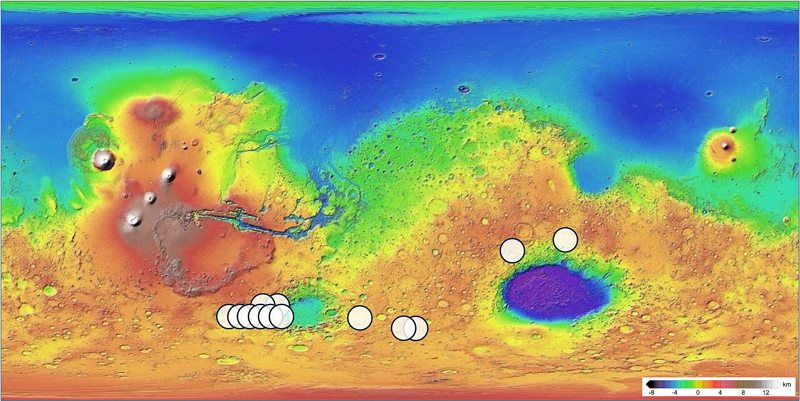
Global color-coded elevation map of Mars with white circles marking thirteen candidate source regions for the meteorite, clustered in the southern highlands, two of them just northwest of the dark-blue Hellas impact basin, and an elevation scale in kilometres running from about plus 8 down to minus 12. (NASA/JPL-Caltech/USGS, public domain, via Wikimedia Commons)


A rose-colored stone the size of a dinner roll was picked up in the Sahara desert in 2022 and then sat in a collection drawer for four years. It took until this autumn for anyone to work out what it actually was, and even then the answer unsettled the planetary science community. Researchers at the University of New Mexico had tagged the rock as Martian from its oxygen isotope ratios, and to them it looked like an ordinary member of the shergottite family, the group that accounts for most of the meteorites we have from the Red Planet. Yang Liu, a researcher at NASA’s Jet Propulsion Laboratory, almost turned the job down. Unfamiliar textures and odd minerals were enough to make her look twice, and what she found were zircon crystals, the mineral geologists use to put a precise age on a rock. The dating came back at more than 4.1 billion years. The meteorite, named Teghaza 001 after the salt flat in Mali where it turned up, turned out to belong to a group of three: the most ancient Martian meteorites ever recovered on Earth. The NASA account of the work appeared at the end of October, alongside a paper in the journal Science (Liu et al. 2026).

The reason this rock matters is a mismatch that planetary scientists have been stuck on for decades. The surface of Mars is dominated by terrain that is more than three billion years old, yet the meteorites we have collected from Mars are mostly much younger than that. The three main families of Martian meteorite, shergottites, nakhlites and chassignites, all formed 2.4 billion years ago or later. That leaves a gap: we have been sampling a planet whose ancient crust we cannot reach, using rocks that tell us about a comparatively recent chapter of its history. Only two specimens have ever turned up that are genuinely ancient. One, ALH84001, is made almost entirely of a single mineral and has yielded conflicting age readings for decades. The other is a jumble, Northwest Africa 7034, better known as Black Beauty, whose fragments include material older than 4.3 billion years but which mixes together many distinct rock types. Teghaza 001 is different in kind. It is a single coherent igneous rock, coarse-grained and rich in plagioclase, and its composition, mineralogy and texture all point to something no other sample has shown: a piece of Martian crust that formed from a mantle source with essentially primordial composition, then soaked in water.

Getting there took a change of heart. Liu had been handed the meteorite because the New Mexico group had already confirmed its Martian origin and assumed it was a routine shergottite. She took a look anyway. The textures did not match anything in her experience, and the mineral suite was strange, and buried inside was a set of zircon grains. Those zircons gave the team a uranium-lead age of roughly 4.11 billion years, which is the headline number. The second author, Lee Saper, who did the work as a postdoctoral scholar at JPL and is now at NASA Ames, put it more plainly than the age did: in the team’s view this is the first piece of Martian crust from a region of Mars for which no sample has ever been obtained. Carl Agee, who directs the Institute of Meteoritics at the University of New Mexico and co-authored the companion study, was more impressed still. A reviewer of the Science paper, Liu has said, called the rock a Rosetta Stone for Mars, and Agee pointed out that Black Beauty contains a few pieces of that age but is a conglomeration of many rock types, whereas Teghaza 001 is one unadulterated kind of rock. Sci.News reported both reactions, and Scientific American ran with the Rosetta Stone framing.

The dating itself was the hard part, and the method matters more than it might appear. Most age determinations dissolve a sample entirely and analyze the bulk. That works fine on an ordinary rock. It does not work on something rarer than anything the team had handled before, and it destroys what is left. So Francois Tissot at Caltech, whose group pioneered the in-situ alternative, used rubidium and strontium instead, working on a piece no larger than a fingernail and analyzing single mineral grains on its surface. Because the method leaves the sample largely intact, the meteorite stays available for later work. Tissot’s rubidium-strontium result came in near 4.24 billion years, less precise than the zircon number but consistent with it. The two dates bracket something slightly more interesting than a crystallization event. Either one may mark the moment hot, mineral-rich water moved through the rock shortly after it cooled, rather than the instant it solidified, which would explain why the oxygen isotopes are heavier than those of other Martian meteorites. Those heavy isotopes come from fluids enriched in oxygen-18, either circulating through the crust or interacting directly with the magma. A companion paper in Science Advances pushed the water story further by measuring the hydrogen and deuterium locked inside igneous calcium phosphates. The magmatic water in the rock looks ordinary for Mars, but a deuterium-rich component had been mixed into it, carried in by magmas that passed through crust which had already been altered by water. That sets a floor under the deuterium-to-hydrogen ratio of the Martian hydrosphere 4.1 billion years ago at roughly twice the value in Earth’s seawater, which fits models in which Mars lost hydrogen to space quickly.

Closing the loop took orbit. Comparing the rock’s chemistry against spacecraft measurements, the team narrowed the origin down to thirteen candidate sites, and the map NASA’s Jet Propulsion Laboratory published with the work shows where they sit. Nearly all of them fall in the southern highlands, the heavily cratered terrain in the planet’s southern half, and two lie just northwest of the enormous Hellas impact basin, whose dark blue floor in the elevation rendering marks it as one of the lowest places on Mars. The candidates cannot be narrowed further than that. A meteorite ejected by an impact carries no record of the direction it came from, and the southern highlands are among the most heavily resurfaced terrains in the solar system, so the specific outcrop is likely long gone. What the map does establish is that the rock came from a part of the ancient crust, most likely the highlands, that has never been sampled and that orbital instruments had already shown to be chemically distinctive.

What happens next is mostly a matter of other teams getting hold of the science. The two papers published this year, one in June and one at the end of October, are a starting point rather than a summary, and the authors make no pretence that the story is closed. The meteorite is eight fragments weighing 798.5 grams in total, with the largest about 442 grams and roughly ten centimetres across, and it has already yielded two independent ages, a water story, and a set of candidate launch sites. There is a reasonable chance that no second rock like it turns up soon, which is what makes the reviewer’s comparison do real work: one fragment, carried off Mars by an impact nobody witnessed and landing in the Sahara decades later, is giving scientists their first physical evidence about the crust of a planet at an epoch they could previously only model.