


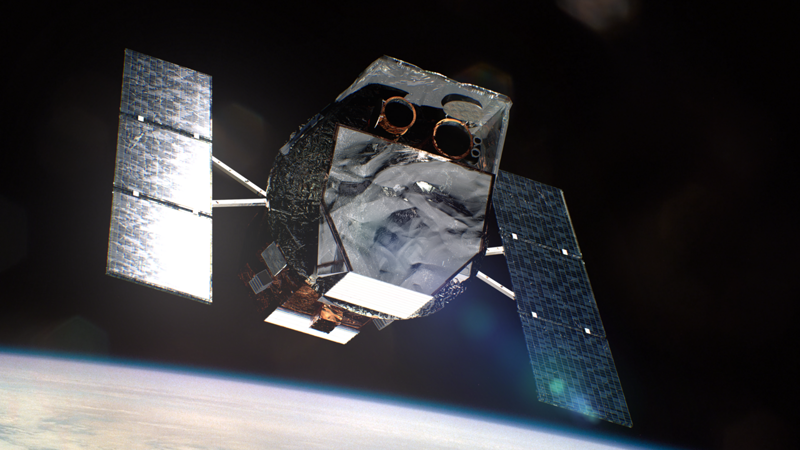
Early on Wednesday morning a dead space telescope will come apart over the Pacific. NASA’s Neil Gehrels Swift Observatory is expected to enter Earth’s atmosphere at roughly 3:30 a.m. Eastern time on 4 November, nearly 22 years after a Delta II launcher put it into orbit, and the US Space Force prediction NASA is quoting comes with an uncertainty of 11 hours. Most of the 3,200-pound spacecraft will burn up on the way down, though Space.com reports that the X-ray and optical telescope’s innards might survive. The odds of a fragment hurting anyone are about 1 in 2,100, and because Swift flew in a low orbit, anything that makes it through can only fall between 20.6 degrees south and 20.6 degrees north of the equator. It will not be steering itself, cannot be commanded, and has no engine to point at the atmosphere differently. It is falling the way a stone falls.
What Swift did was hard to do and harder to replace. It was a three-instrument observatory, a Burst Alert Telescope, an X-ray Telescope and an Ultraviolet/Optical Telescope, built to catch gamma-ray bursts, the most violent explosions in the universe, which flare and fade in seconds and happen about once a day. Because a burst is over almost before most telescopes can react, Swift was designed to point itself, slewing to a new target on its own and switching between instruments fast enough to catch the fading afterglow. It found more than 2,000 of those bursts over its life, and it was usually the fastest thing in the sky at pointing somewhere new. In July it caught a wandering black hole tearing apart a star well outside its galaxy’s bright core, briefly outshouting the entire host galaxy in the ultraviolet. Lynn Cominsky of Sonoma State University, who has worked on the mission for decades, described the change it made to the field this way: time-domain astronomy became a rich field.
It launched on 20 November 2004 as part of NASA’s medium-class Explorer programme, a mission built for two years of prime science and operated from Penn State in State College, with a main ground station at Malindi in Kenya run by the Italian Space Agency. It was renamed in 2018 for Neil Gehrels, the principal investigator who died in early 2017. Its record is long. It saw the naked-eye burst GRB 080319B in March 2008 from 7.5 billion light-years away, and in April 2009 caught GRB 090423 at 13.035 billion light-years, the most distant cosmic explosion known at the time. It caught the ultraviolet glow of the kilonova from the 2017 gravitational wave event, saw GRB 221009A in October 2022, the brightest and among the closest bursts ever recorded, and found hydroxyl on the interstellar comet 3I/ATLAS in 2025. A second gyroscope failure had already cost it a long stretch in safe mode in 2024, fixed by software in April that year.
The end was not a hardware failure so much as a change in the sky above it. Every spacecraft in low Earth orbit is slowly dragged down by the thin air it flies through, and the rate depends on how much the Sun has heated and inflated the upper atmosphere. The current solar cycle peaked in 2025, and the extra particles streaming outward from the Sun have left the atmosphere puffier than expected. Swift lost altitude faster than its models allowed, and the fix was as old as orbital mechanics: point less at the Sun and spend less power. NASA switched instruments off, loosened the requirement that the solar arrays stay within ten degrees of the Sun, and cut the average cross-sectional area Swift presented to the airflow to about 30 percent of normal. That bought months. It also cost the telescope its eyes when its science was most wanted. By January 2025, most of NASA’s models had Swift re-entering by summer 2026.
In September 2025 NASA gave a $30 million contract to Katalyst Space Technologies of Arizona to build a machine that could catch a satellite nobody had designed to be caught. The plan was a servicing spacecraft called LINK, carrying three robotic arms on a split Stewart platform, each fitted with lidar and three-degree-of-freedom grippers that would grab ground-handling flanges on Swift’s bus. The servicing craft would then push the joined pair upward with ion thrusters to around 600 kilometres, where the drag would be far weaker. There was no docking port to plug into and no grappling fixture to latch onto, so the grippers had to find something on the spacecraft never meant to carry them. Katalyst had roughly a year to design, build, test and fly it. LINK launched on 3 July 2026 on a Pegasus XL air-dropped from Northrop Grumman’s Stargazer aircraft over Kwajalein Atoll in the Marshall Islands, released at about 40,000 feet. It was the last Pegasus launch ever planned.
Three weeks in, on 25 July, LINK lost attitude control and began tumbling at about nine degrees per second. Two of its three reaction wheels were not operable and its cold gas thrusters were degraded. The team got the spin down to 1.47 degrees per second by 5 August using less than 100 grams of propellant out of the 60 kilograms the craft launched with, and uploaded a new attitude controller on 11 August to work around the damage. It was not enough. On 19 August NASA and Katalyst announced that LINK would not capture or boost Swift, though it would still fly close rendezvous passes. It came within 12 to 15 kilometres of Swift and re-entered the atmosphere on 25 September. Katalyst did not receive the final payment on the contract. NASA’s administrator Jared Isaacman framed the decision as one worth making anyway: move quickly and take smart risks when the potential return is worth it. The astrophysics division director Shawn Domagal-Goldman said the team had known the odds going in: We knew this was a high-risk, high-reward mission. LINK’s principal investigator Kieran Wilson was blunter about the cause, describing his power systems team as overly stretched in too many different directions, and saying they simply did not have enough time or people to test with the care the work needed.
Swift spent what was left of its life doing science. Two of its three instruments came back on in late August, the Burst Alert Telescope having stopped in April, and the observatory went on to observe hundreds of targets, from the wreckage of stellar explosions to active black holes in distant galaxies and comets in our own solar system. Then the drag won. On 20 October, at 275 kilometres, Swift could no longer hold a stable attitude and dropped into safe mode, and the operations team at Penn State sent the command that ended the mission. NASA formally terminated operations on 23 October. The spacecraft kept its orbit for a few more weeks, descending with no engine, no fuel and no one able to change it.
The archive is what remains, and it is substantial. NASA says Swift detected and tracked more than 2,000 gamma-ray bursts, and Cominsky says the mission produced a data set of over 1,750 bursts with enough detail to keep producing papers for years. The gap is on the observing side. Fermi’s field of view is broader than the Burst Alert Telescope’s, but it cannot pin down a burst to a precise position, and the other large observatories take too long to re-plan and re-point. After Swift, only Hubble covers part of the ultraviolet, and NASA’s Ultraviolet Explorer will not arrive until the 2030s. There is no replacement in orbit.
The lesson of the way this ended is not simply that spacecraft fall. The failure was in a machine built to catch something that could not be caught safely, on a schedule set by the Sun rather than by a programme. NASA said it would learn from the attempt, and it may. A servicing craft that can approach a satellite nobody designed for servicing is a capability that gets reused. But the clock on this particular telescope was always solar. Swift ran for two decades because the atmosphere let it, and it dies because the atmosphere stopped caring. It is a piece of falling metal and a set of numbers on a disk, and the numbers will outlive the metal by a long time.
 Subscribe to our RSS feed









There are no comments.
Add A Comment