


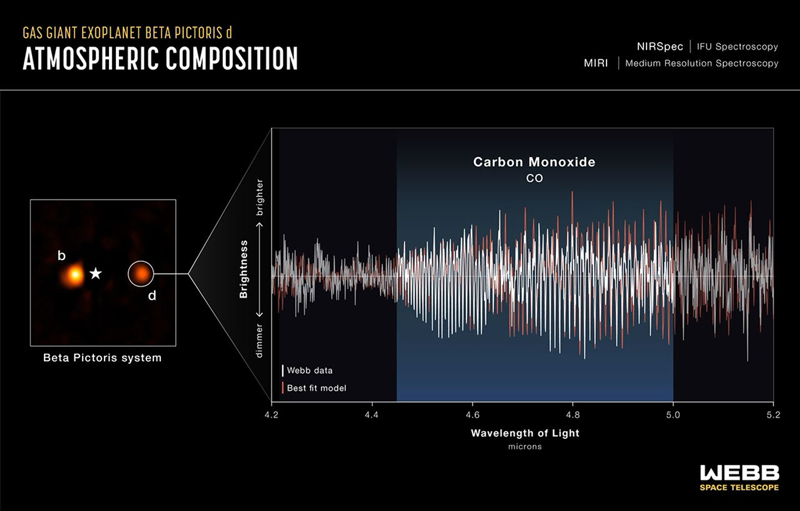
The Beta Pictoris system has been studied for more than forty years, and on Wednesday, July 15, 2026, it gave up another secret. Two independent teams, one using the James Webb Space Telescope and the other the European Southern Observatory’s Very Large Telescope, announced at the same time that they had discovered Beta Pictoris d, a cold gas giant orbiting at roughly the distance of Neptune. The discovery is a notable one for two reasons. It is the faintest exoplanet ever imaged directly from Earth, and it is the first planet ever confirmed primarily by reading its atmospheric chemistry with a spectrograph instead of by spotting it as a bright dot next to a star (NASA Webb announcement).
What sounds like a technical footnote is, in practice, a new way of finding planets. It opens up categories of systems that direct imaging has never been able to reach.
For most of the history of exoplanet science, “discovered” meant “transited in front of its star” or “wobbled its star with its gravity.” Direct imaging, where you take a picture and see the planet next to its star, has always been the most visually satisfying method, but also the hardest. It only works for planets that are far from their stars, large, and young enough to still be glowing with heat from formation. Most of the directly imaged catalog so far has been self-selected from that narrow slice of parameter space.
Beta Pictoris d is technically in that slice: it is young, large, and far out. But it is also faint to an unusual degree, about 100 times fainter than Beta Pictoris b, the much more famous planet in the same system, and the youngest of the two previously known planets (Sci.News, July 15, 2026). It also sits inside one of the brightest debris disks in the sky, which scatters starlight in every direction and makes conventional imaging almost useless.
What Webb did was different. Rather than trying to suppress the disk light with a coronagraph and then see the planet, the team used NIRSpec’s Integral Field Unit, which captures a spectrum at every pixel of an image at once. They were not trying to find a planet. They were re-observing Beta Pictoris b to refine its atmosphere. The new planet appeared as an unexpected series of absorption lines, a “barcode” of carbon monoxide, where the smooth disk spectrum was supposed to be (NASA Webb announcement).
The implication is straightforward. If you can identify a planet by its chemical fingerprint, you can find planets in places where direct imaging fails. The “dusty graveyard” environment around young stars, which until now has been a dead zone for planet detection, becomes a place to look.
Beta Pictoris has been an unusual system since 1984, when the IRAS satellite picked up an infrared excess around a young A-type star 63 light-years away in the constellation Pictor. The first direct image of its disk, taken a few years later, was one of the first clear pictures of another solar system in the process of forming. Two giant planets were eventually confirmed: Beta Pictoris b, one of the first exoplanets ever directly imaged, with a 22-year orbit at 9.8 astronomical units and a mass of 9 to 13 Jupiters; and Beta Pictoris c, discovered in 2019, closer in at 2.7 AU with about 8 Jupiter masses and a roughly 1,200-day period (Sci.News).
A third planet had been predicted, on theoretical grounds, to exist somewhere between the inner system and the inner edge of the debris disk. The disk has an unusually sharp inner boundary, and the simplest way to carve such a boundary is with an unseen giant planet shepherding the dust. But for more than a decade, no one could find it.
That is where the two teams come in. Aidan Gibbs and Jean-Baptiste Ruffio at UC San Diego, with collaborators, used JWST’s NIRSpec IFU to study Beta Pictoris b. They were not searching for anything new. As Ruffio put it later, “There was an unexpected bright source of light within the Integral Field Unit imaging, but we’ve learned not to trust bright blobs in images.” The spectrum is what gave it away. The peaks and troughs of carbon monoxide, water vapor, and methane absorption matched a planetary atmosphere, not a disk artifact. Two epochs of NIRSpec plus follow-up with JWST’s MIRI confirmed it. Mass estimates from atmospheric models put Beta Pictoris d at 2 to 4 Jupiters, with a likely semi-major axis above 30 AU (Gibbs et al. 2026, ApJL 1006, L11).
The second team, led by Ben Sutlieff at the University of Edinburgh with Markus Bonse at ESO, did not use Webb at all for the initial detection. They used the ERIS instrument on the Very Large Telescope in Chile, looking at Beta Pictoris b for time-domain monitoring. They saw the new planet close to b, and then went back through the ESO archive, where they found the same faint source in data going back 11 years, sometimes hiding in the glare of b. As Jayne Birkby of Oxford put it, “Beta Pictoris d, it seems, has been playing a game of hide-and-seek with us for over a decade and only now can we say ‘found you!'” (Watchers.news report on the VLT archival recovery).
The two papers appeared in the same issue of the Astrophysical Journal Letters, dated July 15, 2026. They were coordinated, though not collusive. The Webb team’s spectroscopy and the VLT team’s imaging arrived at the same answer from independent directions, which is the kind of cross-confirmation exoplanet scientists like to see.
The reason the spectroscopic approach worked comes down to the difference between continuum light and line emission. Direct imaging, in its classical form, relies on detecting the planet’s broadband thermal glow against the suppressed starlight. That glow is faint to begin with and is further washed out by the dust disk. Spectroscopy is different. Molecular absorption lines, particularly of carbon monoxide in the 4.3 to 5 micron band where NIRSpec operates at moderate resolution, are narrow features that sit on top of a smooth continuum. The disk’s scattered light has very little structure in that band. The planet’s atmosphere, if it has CO, contributes a recognizable signature.
The trick the Webb team used was forward modeling. They took a grid of cool planetary atmosphere models with different temperatures, surface gravities, and compositions, and slid each one across the IFU data cube. Where the model and the data lined up in wavelength and velocity space, that was a detection. The radial velocity measurement was the clincher: an object orbiting Beta Pictoris should show a specific line-of-sight speed that a stationary disk feature or background star would not (Gibbs et al. 2026).
The same approach works, in principle, for any star with a debris disk. And debris disks are common: Spitzer surveys and now JWST itself have cataloged hundreds of them. A generation of planet searches that wrote those disks off as obstacles may have been discarding exactly the systems where this method works best.
There is a limitation. The spectroscopic technique does not give you a planet’s radius, since forward-model fitting suppresses the broadband continuum to isolate the molecular features. Beta Pictoris d has a mass and an atmospheric inventory, but not yet a measured size. A radius will come from follow-up photometry or coronagraphy.
Beta Pictoris d is interesting on its own terms: a cold gas giant at roughly the orbital distance of Neptune in a 23-million-year-old system, almost where disk dynamics had predicted. It completes a planetary system that has been the textbook example of planet formation for two generations.
The bigger lesson is methodological. Webb’s spectroscopy-first approach worked because the team was willing to look for a signal that was not the planet’s brightness but its chemistry. That is a small change in technique and a large change in reach. The next several years of JWST observing time are likely to see this pattern repeated, with planets surfacing in disks where nobody had bothered to image carefully before.
The team plans to refine the orbit, temperature, and atmospheric composition. Beta Pictoris is one of the closest young systems we have, and the third planet, the one that has been hiding for a decade, is finally on the books.
 Subscribe to our RSS feed









There are no comments.
Add A Comment