


The figure every planetary scientist carries in their head is the Moon-forming impact: a Mars-sized body called Theia slamming into the infant Earth roughly 100 million years after the Sun was born, vaporising rock, blasting a disk of debris into orbit, and leaving behind a moon that still shows the chemical scar of that single catastrophic day. The trouble is that this picture has lived mostly inside models and inside Apollo-era geochemistry, with no direct way to watch an equivalent event happen elsewhere. NASA’s James Webb Space Telescope has now produced the largest mid-infrared sample yet of extreme debris disks, the rare young stellar systems whose warm dust tells astronomers that something inside them has just been smashed to pieces. The team, led by Kate Su at the Space Science Institute in Boulder, Colorado, reports that the sample splits cleanly into two populations whose separation lines up, almost uncannily, with the timing of the impact that built our Moon.
These collisions matter because they are how rocky planets finish being built. A young star starts life wrapped in a gas-rich protoplanetary disk where dust accretes into planetary seeds, then spends the next few hundred million years refining those seeds into fully grown worlds. By the time the gas is gone, what is left is a colder, thinner debris disk populated by asteroid and comet-like bodies. Most of those debris disks are quiet, with low infrared brightness and dust grains sitting at their original sizes, and a planetary scientist would describe such a system as a settled, post-construction environment. A small fraction are not quiet, and these are the extreme debris disks. They have unusually large amounts of warm dust close to the star, in the region where rocky planets orbit our Sun, and the only way to make that much warm dust is to start with recently shattered, vaporised, or melted rock. Estimates from Spitzer and early Webb data put the fraction at roughly one percent of young stars showing observable signs of this phase, a low number than what theorists expect from models of late-stage accretion, and possibly including our own solar system during the brief epoch when Earth was finishing its assembly.
For Su’s team the breakthrough was less about finding the disks and more about characterising them. Webb’s Mid-Infrared Instrument, with its 6.5-metre primary mirror sitting in the cold L2 environment, can read the chemical fingerprints of silicate minerals in the dust at wavelengths no previous instrument had enough sensitivity to pursue. Some of the disks are silica-rich, with spectra full of features from glassy, high-temperature minerals like the volcanic glass obsidian on Earth. Some are silica-poor, dominated instead by forsterite, the same mineral that gives some Hawaiian beaches their green tint. According to Su’s reading of the mineral record, a silica-rich disk is the sign of a high-energy impact between Mars-sized bodies, where collisions vaporise enough rock to leave behind freshly quenched silica glass. A silica-poor disk comes from gentler, lower-energy collisions between Moon-sized bodies, where the debris is just shattered rock rather than vapor. The geometry of the collision, not just its existence, shows up in the infrared spectrum.
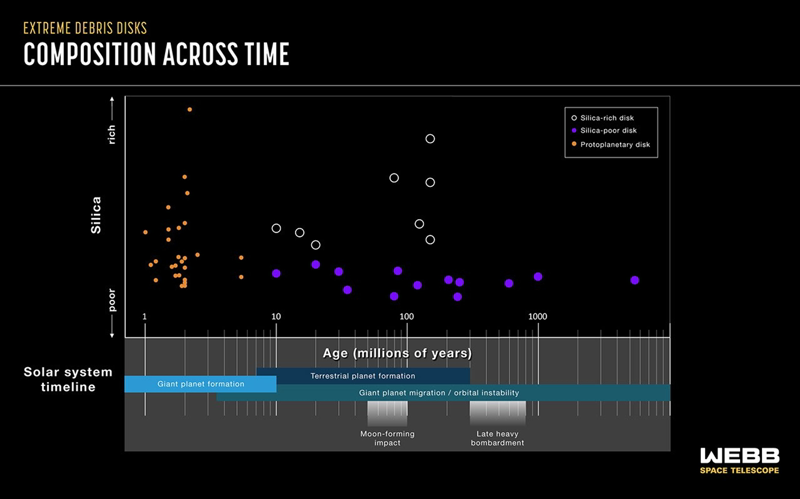
The ages of the disks fall in line with their chemistry. Of the 21 disks the team compiled (five drawn from retired Spitzer archives and 16 from new Webb observations), about one third are silica-rich, and they appear only around stars younger than 300 million years. The remaining two thirds are silica-poor, persist across a much wider age range, and show larger swings in infrared brightness. The age boundary is doing real work. Silica-rich impacts, the team argues, are a young-system phenomenon, products of the chaotic last stage of terrestrial planet assembly. Once a system has settled into a stable architecture, the big bodies stop crashing into each other and only the smaller, lower-energy rubble collisions continue. This is what makes the boundary line up with the Moon-forming epoch. Geochemists place the giant impact at roughly 100 million years after the Sun formed, deep inside the silica-rich range. If the Sun went through its own extreme debris disk phase, the chemistry of its dust would have to be silica-rich.
The solar-system timeline beyond the Moon-forming impact also has a place in the picture. Su’s team points to the Late Heavy Bombardment as a possible silica-poor phase for the Sun, a window roughly 600 to 800 million years after formation when the giant planets migrated far enough to destabilise smaller orbits and trigger fresh cratering across the inner system. The age fits the silica-poor range, where the disks are still appearing a billion years into stellar life, and the mechanism fits the irregular brightness swings the team measures, since orbital instability produces bursts of dust rather than steady amounts. Both the Moon-forming phase and the Late Heavy Bombardment phase are inferred events that happened here, and both have plausible counterparts in the catalogue Su has now built. The chart accompanying the paper makes the alignment visible: protoplanetary disks fill the first ten million years, silica-rich disks take over between roughly ten and one hundred million years, and silica-poor disks continue to show up across the full timeline to several billion years.
There is an honest gap in the picture. Of the 21 disks, only three sit in the silica-poor, old-system range that the team needs to confirm the Late Heavy Bombardment analogy. As coauthor Attila Moor of Konkoly Observatory put it, three disks are not enough to test the hypothesis, and Webb time over the next several cycles will determine whether older silica-poor systems are simply rare or whether the picture needs to be redrawn. The current catalogue is enough to show that Mars-sized collisions leave a recognisable chemical fingerprint in the dust, that the fingerprint disappears after a few hundred million years, and that the disappearance happens for a reason that the Solar System’s own record independently supports.
For planetary science the lesson is operational rather than philosophical. When Su’s team says they have used Webb to bring together the big picture of how rocky planets formed and how giant planets evolved, what they mean is that infrared spectra can now resolve the difference between two collision regimes that previously looked the same in dust-mass measurements. That kind of resolution opens a path to testing formation theories on a per-system basis rather than inferring them only from our own neighbourhood. Earth is no longer the only place we can read the chemistry of giant impacts. There are now twenty-one other laboratories in the catalogue, with more on the way, and the odds that one of them catches a collision in progress just got measurably better.
 Subscribe to our RSS feed









There are no comments.
Add A Comment