


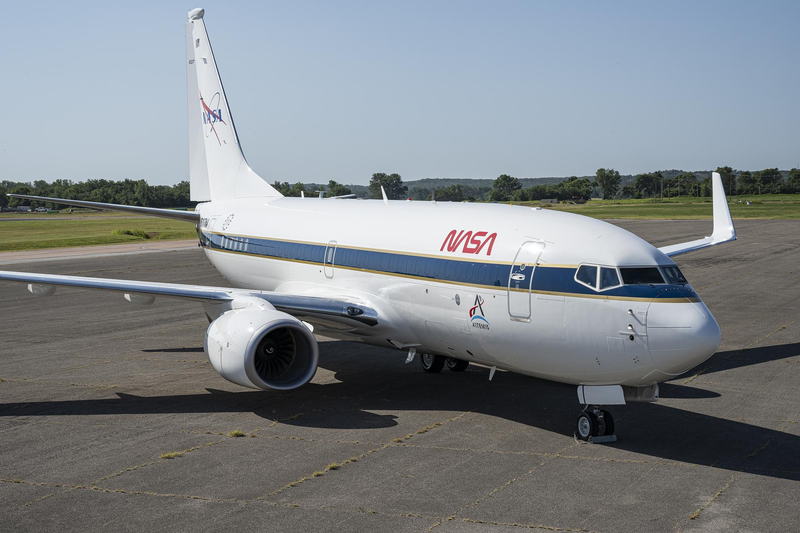
In mid-August, on a concrete ramp at an undisclosed airport in Oklahoma, a freshly painted Boeing 737-700 sat in red, white, and blue. The NASA meatball was on the tail, the registration N837NA on the rear fuselage, and the words reduced gravity research aircraft across the cabin. NASA released the frames on 13 August 2026 (NASA, August 2026).
Behind the new paint is a stranger story. This airframe was delivered to a private operator in 2013 as N712JM, a Boeing 737-73W. By 2020, plane spotters noticed it sitting at Colorado Springs in a green protective coating, bristling with sensors and wiring runs no commercial jet had any business carrying. Aviation journalists at The War Zone traced the registered mailing address on its airworthiness documents to the same building that houses the U.S. Air Force’s Rapid Capabilities Office, the secretive acquisition outfit that fields programs like the B-21 Raider. The Air Force confirmed to The War Zone that N712JM flew for a classified program that has since ended, and NASA acknowledged in contracting documents that the agency itself did not have the need-to-know (The Aviationist, 17 August 2026; The War Zone, 2024).
NASA Armstrong Flight Research Center took ownership in June 2026. The new “NASA 837” carries the registration that once belonged to the agency’s NF-15B test jet, retired in 2009 after 36 years of flight-control research. The 737 inherits the number; the secrets stay behind.
Landing on the Moon is not like floating in orbit. The Moon pulls at roughly 1.62 m/s², about one-sixth of Earth’s 9.81 m/s², and a pressurized suit under that load behaves in ways pure weightlessness cannot reproduce. A suit that weighs as much as the person inside it changes the biomechanics of walking, picking up rocks, climbing ladders, and getting up after a fall. Ground labs cannot simulate those effects without removing gravity.
NASA’s answer for decades has been parabolic flight. A maneuvering aircraft traces the arc of a free-falling object, so for a brief window everything inside the cabin, including the aircraft, falls together. The standard maneuver gives about 20 seconds of microgravity per parabola, with 15 to 30 parabolas stacked into one flight (NASA, “Parabolic Flight,” 2026). Roughly two-thirds of first-time passengers get sick, which is how the aircraft picked up its unofficial name.
Microgravity is the wrong flavor of reduced gravity for Artemis. To produce Moon-like 1/6 g, the pilot cannot just unload the controls and coast. The trajectory must be flown with the airplane carrying more lift and slightly more thrust than it would in a true free fall, so its downward acceleration in the inertial frame is about 8.2 m/s², the difference between Earth’s 9.81 and the Moon’s 1.62. Mars at 0.38 g needs a smaller lift offset. Each profile is a separate skill and a separate test campaign for whatever the experimenters strap to the cabin floor.
NASA has been without a dedicated government parabolic jet since the agency wound down the Reduced Gravity Research Program in July 2014, after its McDonnell Douglas C-9B Skytrain II (N932NA, ex-KLM) developed unsolvable airworthiness issues. The agency now charters flights from Zero Gravity Corporation’s Boeing 727-200, G-FORCE ONE, and from Novespace’s Airbus A310 Zero-G in Bordeaux-Mérignac. Both can simulate lunar and Martian gravity, but neither belongs to NASA, and neither is configured for the suit qualification Artemis is asking for (Wikipedia, “Reduced-gravity aircraft,” 2026).
On 1 June 2026, NASA awarded Denmar Technical Services of Nevada an $8.4 million firm-fixed-price contract to modify the 737-700 for lunar-gravity parabolic operations. The contract runs through 1 February 2027, after which the aircraft will be owned by NASA Armstrong but flown out of NASA Johnson in Houston, with Armstrong retaining oversight (NASA, 1 June 2026).
The aircraft’s primary job is astronaut lunar suit qualification. Each Artemis crew will run parabolas inside the pressurized suit, working through the tasks they expect on the surface: kneeling to deploy a sample scoop, picking up a rock, recovering from a stumble, climbing into a lander hatch. NASA has historically used neutral buoyancy, the large pools where suited astronauts practice procedures underwater, for most of this training, and the agency’s new Langley partial-gravity simulator will handle suspension-based work. The 737 adds a third leg: short bursts of true free-fall at lunar gravity, in an aircraft moving fast enough to give the suits a realistic test of inertia.
The 737 will also serve as a flying testbed for autonomy, sensors, and digital flight-control research under Armstrong’s traditional portfolio (NASA, 13 August 2026).
A parabolic trajectory is, in the inertial frame, what Newton predicted for any object under gravity alone: a constant downward acceleration of g, with the horizontal component unchanging. The aircraft pulls up at about 45°, trading airspeed for altitude. The pilot throttles back to idle and pushes the nose over. From that point, the plane falls along the same arc a dropped stone would, and so does everything loose inside it. From the cabin’s frame of reference, gravity simply vanishes. The reduced-g phase ends when the descent angle reaches roughly 30° below horizontal, where the pilot must pull out.
The 20-second budget is set by how steeply the plane can dive without exceeding airframe limits or the FAA’s airspeed envelope. A 737 enters the maneuver around 7,600 m at roughly 450 km/h. The velocity vector rotates from 45° up through horizontal to 30° below, a swing of 75°, with no vertical speed at the top and acceleration equal to g along the way. That arc, plus the climb-out and recovery, gives 20 to 25 seconds. Each parabola is bookended by a 1.8 g pull-up and a 1.8 g pull-out, so a passenger’s g-load in one cycle runs 1.8 g → ~0 g → 1.8 g (NASA, “Parabolic Flight,” 2026).
To produce lunar gravity rather than zero, the trajectory follows a shallower arc in which the cabin accelerates downward more slowly than a true free-falling object would. The pilot adds enough lift and a small, steady nose-down command so the airplane traces an arc that would correspond to falling toward a body with a stronger pull than the Moon. The residual force on cabin occupants is the difference between Earth’s gravity and the airplane’s actual downward acceleration: 9.81 − 8.19 ≈ 1.62 m/s², or about 0.165 g. Mars is easier at 3.71 m/s².
The aircraft modifications are mostly about padding and instrumentation, not propulsion. A 737 already has the wing loading, thrust margin, and fuel capacity to absorb a parabolic stack. The hard engineering is in protecting the cabin from the 1.8 g bookends (suited astronauts get crushed into their seats for the first and last 30 seconds of every parabola) and in mounting cameras, accelerometers, and umbilicals so test subjects can be observed without falling on top of each other in 0.165 g.
The new 737 is one piece of a much larger validation program. The Artemis suit, the Human Landing System, the Gateway space station, and the rovers all eventually need real partial-gravity testing before they fly. Neutral buoyancy will keep handling long, procedure-driven rehearsals. The Langley gantry will handle suspension work. The 737 supplies what neither can: short, repeated, true free-fall at the right fraction of Earth gravity, even if only twenty seconds at a time.
It is also, quietly, the agency’s first government-owned research aircraft with a classified past NASA still cannot fully explain. The engineers at Armstrong and Johnson get the airplane and the schedule. The historians will keep digging.
 Subscribe to our RSS feed









There are no comments.
Add A Comment