


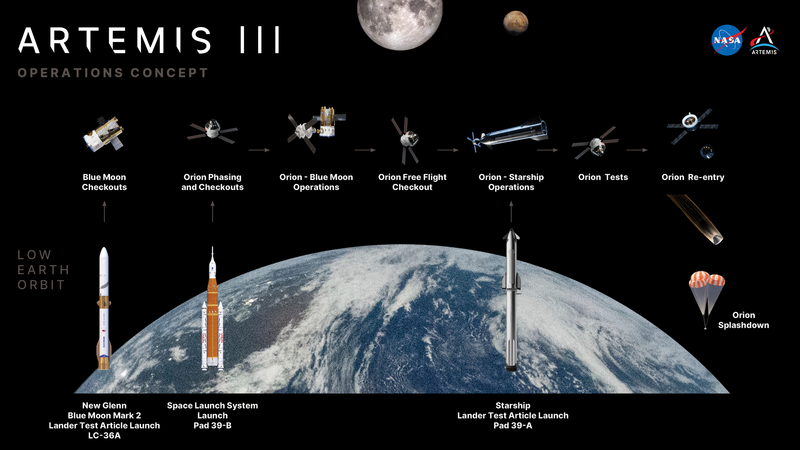
NASA’s Artemis III operations concept graphic has the Moon above the Earth and three rockets lined up beneath it: a New Glenn carrying a Blue Origin lander test article, the Space Launch System carrying Orion, and a Starship carrying a second test article. All three fly in low Earth orbit, and none goes to the Moon. That is the plan Administrator Jared Isaacman, Associate Administrator Amit Kshatriya and Artemis Program Manager Jeremy Parsons presented at Kennedy Space Center on October 23, and it reverses the promise that defined the program for a decade. Artemis III, the mission built to put astronauts back on the surface, is now a two-week low Earth orbit flight targeted for mid-2027, with four astronauts docking first with a Blue Origin test lander and then with a SpaceX Starship. The first landing since Apollo 17 moves to Artemis IV in early 2028.
Artemis II cleared the way, launching on April 1, 2026 and flying four astronauts around the Moon on a free-return trajectory, 406,771 kilometres from Earth at closest, before splashing down in the Pacific ten days later (Wikipedia, Artemis II). The mission worked, but the arithmetic behind the schedule never changed. The European Service Module, the Airbus-built element that powers Orion and pushes it around, lacks the delta-v to return from low lunar orbit; in Apollo the lunar module was the crew’s lifeboat, and in Artemis the lander must do that job and more (Wikipedia, European Service Module).
That lifeboat arrangement had a staging point, the Lunar Gateway, and NASA cancelled it in March 2026. A month before Artemis II flew, Isaacman had already restructured the flight sequence so Artemis III would stay in Earth orbit and Artemis IV would attempt the landing (Wikipedia, Artemis III). The pressure sits on the parts NASA does not build: both commercial landers are behind schedule, as is Axiom’s spacesuit, and the FY2026 budget request proposed ending SLS and Orion after Artemis III, citing a launch cost of about $4 billion (Wikipedia, Artemis III).
The flight plan is specific enough to be built. Blue Origin goes first, with a lander test article lifted off New Glenn from Launch Complex 36A carrying a crew module, avionics, partial life support and a reaction control system but no main propulsion. It can loiter in orbit for weeks, which is why it launches first, and Blue Origin would spend about two weeks checking it out before Orion flies (Wikipedia, Artemis III). Orion follows on an SLS Block 1 from Pad 39-B with an inert structural spacer in place of the Interim Cryogenic Propulsion Stage, since the mission never leaves low Earth orbit and does not need that stage’s RL10 engine (Wikipedia, Artemis III and Interim Cryogenic Propulsion Stage).
Orion is the chaser in both encounters, holding station while the passive target keeps its orientation, with time for another attempt if the first docking fails. Once mated, the crew stays about two days, equalises pressure in the Blue Moon vestibule with Orion’s atmosphere, opens the hatch and goes inside to check cabin habitability and the interfaces between the lander and Axiom’s AxEMU suit (Wikipedia, Artemis III). After undocking, a standard Starship v3 with a passive docking fitting on its nose cone launches from Pad 39-A, and Orion docks with it briefly without the crew leaving the capsule, because that vehicle has no crew cabin and no life support. The point is control: verifying that Starship can hold the attitude of a combined stack with Orion attached. Orion comes home on an upgraded heat shield and splashes down off San Diego for Navy recovery.
What the rehearsal is for became clearer in the briefing charts. Two landing architectures are on the table and NASA has not chosen between them. In the Starship version, Orion docks with a Starship Human Landing System in low Earth orbit and Starship pushes both vehicles to the Moon, which needs a propellant depot and several tanker flights to move cryogenic methane and oxygen in orbit, a manoeuvre never demonstrated at scale (SpacePolicyOnline, October 23, 2026). In the Blue Moon version, three transfer stages on New Glenn push the lander to lunar orbit while Orion flies straight to the Moon. Each company must land uncrewed first, and NASA intends “to wait as long as possible” before choosing the provider that carries the first crew back (CBS News, October 23, 2026). NASA will also accept a lighter “sortie” suit with about two hours on the surface (SpacePolicyOnline, October 23, 2026).
The destination is unsettled. Kshatriya conceded that NASA’s knowledge of the south pole is thin, while Isaacman called it “probably the most advantageous area” for ice in permanently shadowed terrain, and a National Academies report in mid-October identified four non-polar sites with scientific value (SpacePolicyOnline, October 23, 2026). NASA’s Aerospace Safety Advisory Panel objected a day earlier to requiring only one uncrewed landing per provider and to putting cryogenic propellant on the Moon for the first time (SpacePolicyOnline, October 22, 2026). China is aiming for a crewed landing by 2030 (CBS News, October 23, 2026).
The propulsion problem underneath is arithmetic. Orion’s service module carries 8,600 kg of usable MON-3/MMH propellant and flies one AJ10 main engine at 26.6 kN, eight R-4D thrusters and 24 smaller reaction control units (Wikipedia, European Service Module). A direct rendezvous profile asks that stack to leave Earth, arrive at the Moon and come home: roughly 3,100 m/s for the translunar injection, a few hundred for lunar orbit insertion, about 900 m/s to come back, close to 4,800 m/s in total. The rocket equation says what that costs: Δv = v_e * ln(m_0 / m_f), with v_e = Isp * 9.80665. At a generous 300 seconds of specific impulse, exhaust velocity is about 2,940 m/s, so 4,800 m/s demands a mass ratio near 5, and Orion would have to burn four-fifths of its own mass.
The cheap way to buy delta-v is not a bigger spacecraft but a cryogenic stage, because hydrogen’s chemical energy per kilogram is roughly three times that of the hypergolic mix and empty tanks are cheap. The Interim Cryogenic Propulsion Stage that flew Artemis II shows the arithmetic: a single RL10 at 110.1 kN, specific impulse 462 seconds, gross mass 32,748 kg, empty mass 3,800 kg, so Δv = 462 * 9.80665 * ln(32,748 / 3,800) comes to about 9,700 m/s, roughly double the whole cislunar budget (Wikipedia, Interim Cryogenic Propulsion Stage). NASA is now working with United Launch Alliance on an extended Centaur V to fly with the SLS core stage, so the launch vehicle can inject Orion to low lunar orbit and leave the service module’s small tank for the lunar leg and the return (Ars Technica, October 24, 2026).
The orbit where the vehicles meet matters as much as the propulsion. NASA’s charts show Orion and the Blue Moon lander joining in an elliptical lunar orbit with an apolune near 8,500 km, which lets a lander with limited propellant reach the surface; Parsons said a low lunar orbit a few hundred kilometres up would cut the lander’s propellant requirement substantially (Ars Technica, October 24, 2026; Wikipedia, Artemis IV). Docking adds its own problem: Orion is the active vehicle, the other side passive, and with Starship the mass difference is roughly an order of magnitude, so a closing speed of a few centimetres per second is the difference between a soft mate and a bent structure. Isaacman’s summary of the fix was blunt: reaching low lunar orbit means “solving propulsion and spacecraft integration problems that were left unaddressed for far too long” (Ars Technica, October 24, 2026).
The most useful thing NASA did on October 23 was turn a landing into a list of things that can be checked, in an orbit where a failed rendezvous ends in a re-entry within hours instead of a rescue measured in days. What Artemis III will not settle is the hardest part: the test articles are stripped of the systems that make the real flight hard, with no main engine on the Blue Origin vehicle and no life support aboard Starship. Those are the 2028 problems, and they will be solved, if at all, by the two companies racing each other to be ready. The long-lead hardware keeps renewing in the meantime: on October 21 an RS-25 fired for 500 seconds on the Fred Haise Test Stand at Stennis, reaching 111 percent of the thrust needed to launch SLS (NASA, October 21, 2026). Apollo was a state program with one rocket and one schedule. Artemis is a procurement program that has to fit itself around two private launch cadences, and the first way NASA tests that arrangement is to launch three rockets and see whether they can find each other.
 Subscribe to our RSS feed









There are no comments.
Add A Comment