


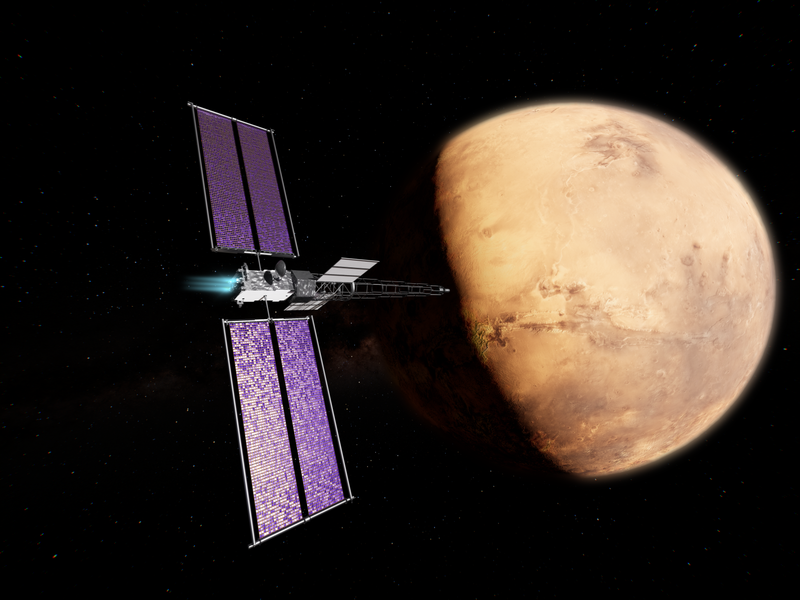
On October 20, 2026, NASA named Sierra Lobo Inc. as the supplier of the closed Brayton-cycle converter for Space Reactor-1 Freedom, or SR-1. Electricity is the converter’s product: heat from the fission core will drive its machinery to generate current, while the reactor itself is being designed at the Department of Energy’s Idaho National Laboratory. The launch is set for late 2028. Success would mark the first departure of a fission-powered craft from Earth orbit. Startup is deliberately delayed: only after SR-1 has cleared Earth orbit will the reactor be allowed to run, keeping an operating reactor away from the launch pad (NASA, Oct. 20, 2026).
The assignment matters because it links two machines that have to become one spacecraft. The receiving hardware is listed on NASA’s SR-1 page: a power-and-propulsion bus and a 12-kilowatt Hall thruster (NASA SR-1 mission page). The converter’s job is to close that gap with reactor heat, turning an announced Mars goal into work that can be scheduled, reviewed and tested against flight hardware.
The machine belongs to an old idea that has had a long wait for flight hardware. The United States launched SNAP-10A in 1965, the first and only U.S. fission reactor flown in space, then spent decades developing reactors without sending one to another planet (NASA Space Nuclear Propulsion). NASA separates the field into two broad designs. Nuclear thermal propulsion heats a propellant directly and sends it through a nozzle, producing high thrust. Nuclear electric propulsion first makes electricity, then uses it to accelerate a gas. SR-1 Freedom belongs to the second class, so its defining feature is a long, frugal burn rather than a brief shove.
That choice changes what the spacecraft has to carry. A chemical engine carries both fuel and oxidizer; a fission reactor supplies energy but still needs a working gas for the thruster. NASA notes that nuclear systems can provide solar-independent power for years, along with electricity for instruments and communications. The design bet is that a years-long low-thrust cruise can consume less propellant than a faster chemical departure. As sunlight weakens with distance from the Sun, that trade becomes more attractive. Those choices also directly affect spacecraft mass, shielding, thermal design and mission timeline.
That bargain appears in NASA’s 12-kilowatt Advanced Electric Propulsion System thruster. A 2025 technical paper reports about 600 millinewtons of thrust and a specific impulse near 2,800 seconds at full power (NASA Glenn Research Center, 2025). The exhaust velocity implied by that specific impulse is v_e = Isp * g_0, roughly 27,500 metres per second. Yet the propellant flow is tiny: mass flow = F / (Isp * g_0) gives about 0.079 kilograms per hour. Applied to a 12,000-kilogram spacecraft, one thruster produces an acceleration near 0.00005 m/s2 and adds only about 4.3 m/s over a full day. The craft is not trying to leap. It is trying to spend almost nothing while it goes.
The vehicle inventory on NASA’s SR-1 page lists a 12,000-kilogram mass, high-assay low-enriched uranium fuel, a 20-kilowatt-electric closed Brayton converter, a 48-kilowatt power-and-propulsion bus, and a 12-kilowatt Hall thruster (NASA SR-1 mission page). Those power numbers describe different pieces and should not be added into one reactor output. One labels the converter; the other belongs to the bus. The electrical design therefore has to reconcile a 20-kilowatt fission source with a bus capable of 48 kilowatts. That gap makes power management, radiator sizing and the operating sequence central engineering questions before the first Mars departure.
The converter is where nuclear physics turns into machinery. In a closed Brayton cycle, a working gas is compressed, heated through a heat exchanger coupled to the reactor, expanded through a turbine to drive a generator, then cooled and returned to the compressor. “Closed” means the working fluid circulates. The reactor fuel and working gas need not touch, which keeps the power-conversion loop separate from the radioactive core. For an ideal Brayton engine, thermal efficiency follows eta = 1 - 1 / r_p^((gamma - 1) / gamma), where r_p is compressor pressure ratio and gamma is the gas ratio of specific heats. Real hardware loses efficiency to expansion, pressure drops and heat leakage.
Heat also has to leave. If reactor thermal input is Q_in and the converter efficiency is eta, the waste heat is Q_reject = Q_in * (1 - eta). At a useful 20 kilowatts, even a hypothetical 30 percent converter would have to shed roughly 47 kilowatts. That is why the artist concept shows radiator panels: the cycle cannot close without a way to dump heat in space. At 20 kilowatts of output, the converter is a heat-rejection problem as much as an electricity problem. Radiator area, fluid temperature and reactor thermal limits have to be solved as one system.
Safety has shaped the schedule as much as propulsion. NASA has ruled out critical reactor operation during launch; startup waits until the spacecraft is beyond Earth orbit. The agencies also apply interagency reviews, regulatory compliance and failure-tolerance analysis, while a NASA chief safety officer provides continuing oversight (NASA, Oct. 20, 2026). That separation reduces one class of accident: if the launcher fails, there is no active reactor to scatter. The remaining work is substantial. Fuel must be produced and qualified; the converter must survive vibration and years in space; the reactor must start remotely; and ground teams must rehearse commands across a communications delay that grows with distance.
The science payload gives the engineering test a reason to keep flying. SR-1 will carry SkyFall, three Mars helicopters derived from NASA’s Ingenuity design. They are to be released during atmospheric descent, fly to the surface and use ground-penetrating radar, imagery and atmospheric sensors to scout terrain and look for buried ice. NASA plans an initial Mars flyby in 2029 and a landing after a second approach in autumn 2030 (NASA SkyFall mission page). The helicopters can scout landing sites that a rover would take much longer to reach, and their data can be transmitted directly through an orbiter rather than a relay rover.
SR-1’s late-2028 launch also has a schedule built into it: NASA has targeted the 2028 Mars launch window, with arrival in 2029 before deployment (NASA SR-1 mission page). If the reactor, converter, bus and thrusters work together, the mission will establish an operating fission system in deep space. It will also test a supply chain that NASA wants to reuse for Lunar Reactor-1, the surface power system intended for its Moon Base (NASA SR-1 mission page).
Success will be a chain of systems behaving together: the reactor starts, the converter holds a stable electrical output, the radiators reject waste heat, the thrusters accelerate the craft and the payload separates cleanly. Each link can be tested on Earth. Their behavior together, after years of unattended exposure and a communications delay measured in minutes, cannot. If that chain holds, the useful outcome is larger than three helicopters. It is a flight-proven method for carrying watts instead of sunlight into places where the Sun is weak, absent or inconvenient.
Spaceflight systems tend to fail at their interfaces. A converter can meet its bench target and still strain the reactor; thrusters can work while the bus changes modes; the payload can separate but its radio link can fail. A useful sortie would give engineers measured limits, failure modes and workarounds for those seams. That knowledge is what a lunar reactor, cargo tug or outer-planet probe will need. The helicopters are visible; the operational inheritance is the point.
 Subscribe to our RSS feed









There are no comments.
Add A Comment