


BepiColombo’s ion thrusters end eight years of braking
On 21 November 2026, a spacecraft that has been decelerating since 2018 will finally stop. Partway through the day, more than 200 million kilometres from the people flying it, the stacked BepiColombo orbiters will turn their chemical thrusters against their own motion and fire. If the burn behaves, the joint ESA-JAXA mission becomes the first to hold two spacecraft in orbit around Mercury simultaneously. If it does not, eight years of trajectory design has to be rebuilt from scratch around a rock that most spacecraft are barely engineered to survive.
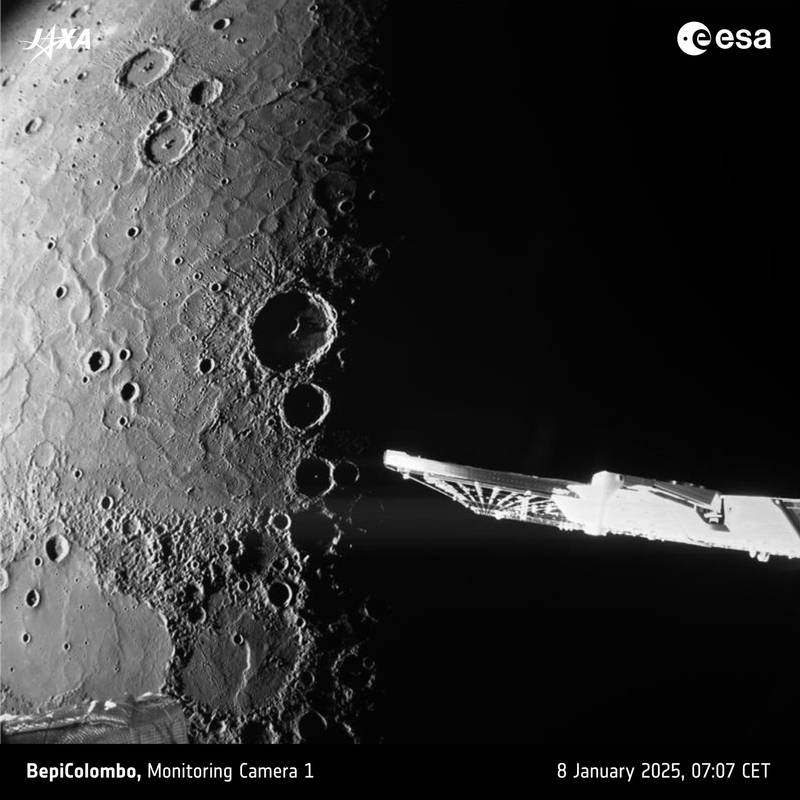
That frame is among the last things the mission photographed with the hardware it no longer needs. M-CAM 1 is bolted to the Mercury Transfer Module, the ESA-built propulsion stage that carried both science orbiters across the inner Solar System and was discarded on 3 September 2026 at a point 63 million kilometres from the Sun (ESA, September 2026). What remains is roughly 1,500 kg of spacecraft still moving fast enough that Mercury cannot simply grab it.
The module carried three of those 1,024 by 1,024 pixel black-and-white cameras, which exist less for science than for triage: they let engineers check hardware health from a distance when the main science instruments are pointed the wrong way or blocked. They also became the mission’s accidental souvenir shop, recording Earth, both Venus encounters and all six Mercury passes. The final swing-by on 8 January 2025 came within about 295 km of the surface and was the last gravitational tug before the long approach.
Mercury’s reputation as a hostile destination is mostly a matter of velocity. It orbits at 0.387 astronomical units, where the Sun’s pull is roughly seven times stronger than at Earth, and a spacecraft launched from Earth arrives there carrying far too much speed. Run the numbers with the vis-viva equation, v^2 = GM(2/r - 1/a), and a direct transfer from Earth’s orbit to Mercury’s comes out near 57 km/s at the arrival point, against Mercury’s own orbital speed of about 48 km/s. That surplus has to go somewhere. Entering a low orbit around a small planet means surrendering most of it to the planet’s gravity, and the only cheap way to surrender velocity is to let a planet take it away for you.
That is what the nine flybys were for. BepiColombo launched from Kourou on an Ariane 5 on 20 October 2018 at 4,100 kg, comprising a 1,230 kg orbital module carrying 85 kg of instruments and a 255 kg Japanese magnetospheric orbiter carrying 45 kg (ESA fact sheet). It swung past Earth once, Venus twice and Mercury six times, shedding heliocentric energy in small instalments, and used solar-electric thrust between encounters to trim the orbit inward. It is named for the Italian engineer Giuseppe Colombo, whose 1970s work on gravity-assist trajectories let Mariner 10 visit Mercury three times. ESA notes that orbit insertion at Mercury demands more energy than sending a probe past Pluto, which is why a nearly $2 billion mission needed a nine-stop itinerary.
The itinerary almost did not survive 2024. On 26 April, while the module was mid-manoeuvre, its power system began drawing unexpected currents between the solar array and the unit that extracts and distributes power, starving the ion engines. Engineers at ESOC in Darmstadt restored thrust to about 90 percent within eleven days but could not recover full power, and the flight dynamics team concluded in September that the reduced thrust could no longer reach the December 2025 insertion date (ESA, September 2024). The hardware was unfixable, so the trajectory moved. The fourth Mercury flyby on 4 September 2024 was flown roughly 35 km lower than planned, a small shave of altitude that conserved propellant and let a redesigned path carry the spacecraft to Mercury a year late while keeping the science programme intact (ISAS).
September 2026 was the handover. When the transfer module let go, the remaining pair had to inherit power generation, propulsion, pointing and thermal control in one shot, at a distance where a radio round trip takes hours. Confirmation came through Doppler shift as the two halves changed velocity, read out from Cebreros in Spain and Malargüe in Argentina (ESA, 3 September 2026). By mid-September the instruments that had spent years staring at the back of a dead engine deck were working. The BepiColombo Laser Altimeter fired more than 700,000 pulses over 21.5 hours, MERTIS returned about a gigabit during a 22-hour look at empty space through its planet and calibration ports, and SIMBIO-SYS returned its first image in space (ESA, 6 October 2026). A thruster rehearsal on 24 September produced 11.4 m/s over 8 minutes 42 seconds, the first trajectory correction of the arrival sequence.
The propulsion that carried it here deserves the credit. ESA loaded 581 kg of xenon into the module’s three tanks at Kourou in June 2018, and that fuel went through four QinetiQ T6 gridded ion thrusters, 22 cm across and rated around 4.5 kW each, producing 75 to 145 mN of thrust at a specific impulse up to 4,300 seconds (Hofer et al., AIAA 2010-7114). Do that through Tsiolkovsky’s rocket equation, Δv = v_e × ln(m_0 / m_f), with an effective exhaust velocity near 39 km/s, and burning a bit over a fifth of the stack’s mass buys on the order of 10 km/s of velocity change. The same job on a chemical engine with a 3.3 km/s exhaust would demand a mass ratio near 20 to one, meaning a spacecraft more propellant than spacecraft. That arithmetic is the whole reason solar-electric propulsion exists.
The other constraint was sunlight. At 63 million kilometres the solar flux is roughly 5.6 times what Earth receives, and heat limits how squarely the array can face the Sun, so ESA canted the wings and accepted a deployed span near 30 metres to collect the power four thrusters needed (ESA fact sheet). The September 2024 power fault sat uncomfortably close to that limit, which is why the recovery plan was flown conservatively rather than pushed.
What happens on 21 November is closer to a chemical burn, because capture cannot be done slowly. Arrival commands go up days ahead and execute autonomously, because at Mercury’s distance there is no opportunity to watch a burn and correct it. After capture, the pair separates on 9-10 December, MPO settles into a 480 by 1,500 km polar orbit with a 2.3-hour period, and Mio stretches out to 590 by 11,640 km to study the magnetosphere from outside. Sixteen instruments begin formal operations in April 2027 (ESA fact sheet).
The paired-orbit arrangement matters more than it sounds. MPO works close in, repeatedly crossing the planet’s surface to build topography, map composition and weigh the interior from gravity and radio tracking. Mio works far out, crossing the magnetopause and sampling the solar wind that Mercury sits inside rather than outside. No single spacecraft can do both jobs at once, and building two cost an extra decade and an extra module to carry them.
What MESSENGER left open in 2015 is what these two orbiters are built to close, and the arrival itself is an argument for slowness in a field that rewards speed. BepiColombo spent five years producing thrust no desk lamp could outrun, because that was the cheapest way to buy the velocity change it needed, and the bill for that patience came due in a single burn that nobody will be able to touch.
 Subscribe to our RSS feed









There are no comments.
Add A Comment