


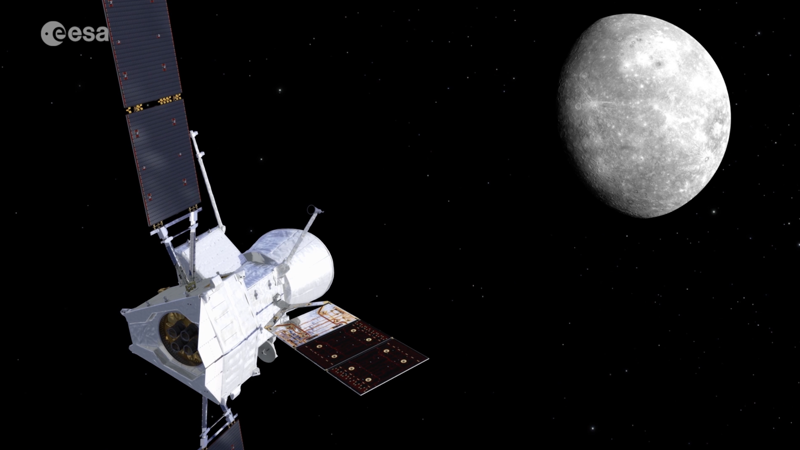
On Thursday afternoon at 14:00 CEST, a stack of four spacecraft modules that left Earth on an Ariane 5 in October 2018 will, very briefly, become three and then two. ESA’s Mercury Transfer Module is scheduled to detach from BepiColombo’s two science orbiters as the mission’s controllers at the European Space Operations Centre in Darmstadt look on, with the first signal from the freed composite expected back on Earth by 15:53 CEST if everything goes to plan (ESA, 27 August 2026). After eight years and nine gravity assists, the part of the spacecraft that made the trip possible is no longer needed, and the part that has to do the science is, ungainly and for the first time, on its own.
Getting to Mercury is the kind of orbital mechanics problem where the obvious solution is forbidden. Falling toward the Sun does not slow a spacecraft down; it speeds it up, pulled by solar gravity, so the usual chemical-brake trick used at Mars is not enough to be captured into orbit around the smallest planet. BepiColombo has to match Mercury’s velocity almost exactly, and that takes far more energy than reaching even the distant gas giants. The mission’s answer was to spend years bleeding speed against an ion engine instead of staging a single dramatic burn, and the upcoming separation is the moment the engine is, finally, switched off and thrown away. As ESA’s mission manager Santa Martinez put it to Euronews on 1 September, “Mercury is a challenging destination. It’s very difficult to reach, it’s very difficult to operate there.”
Why a separation matters this much, and why the next two months are unusually tense, comes down to what changes about the spacecraft on Thursday. For the cruise the four modules sat one on top of the other inside a tight stack, with their instruments and cameras physically blocked from space by the boxy MTM at the base. Once the MTM floats off, the upper composite begins an entirely new mission with an entirely new thermal and radiation budget. Solar flux near Mercury is roughly ten times what it is near Earth, and the MTM had been there partly to shield the orbiters during the inner solar system transit. The flight director, Ignacio Tanco, has described the moment to Euronews as working “with a very hot pizza oven running right on your back” and “on a knife edge,” because the MPO’s solar panels have to be tilted within fractions of a degree of the Sun. Push them slightly away and the spacecraft starts losing power; angle them slightly closer and they start to bake. There is no second chance to find the right pointing before the thermal balance tips.
The spacecraft itself carries a long memory. BepiColombo launched on Ariane flight VA245 from Kourou on 20 October 2018 and reached escape velocity the same day, then spent almost exactly eight years climbing and falling through the inner solar system using four QinetiQ T6 ion thrusters on the MTM, with a maximum combined thrust of about 290 millinewtons, the most powerful ion engine array ever operated in space. The cruise used one Earth flyby in April 2020, two Venus flybys in October 2020 and August 2021, and six Mercury flybys between October 2021 and January 2025, the last of which imaged the permanently shadowed north polar craters Prokofiev, Kandinsky, Tolkien and Gordimer. The mission’s overall cost is estimated at 1.65 billion euros, and the arrival has already slipped about eleven months from its original December 2025 date because of a power-related anomaly that limited the available thrust before the fourth Mercury flyby in September 2024. On 15 June 2026 at 13:24 UTC the MTM’s solar electric propulsion was switched off for good, and from then on the mission is ballistic: BepiColombo is, in engineering language, “weakly captured” by Mercury’s gravity and following a free-falling trajectory through space.
What happens after 3 September is a sequence of three distinct steps rather than one event. From the separation through late November, the MPO and Mio remain mechanically and electrically joined, with the Magnetospheric Orbiter Sunshield and Interface (MOSIF) still attached, and the two orbiters fly free of the propulsion module for the first time in their lives. Then, between late November and early December 2026, a series of chemical thruster burns raises the orbit’s apocentre and lets Mercury’s gravity do the rest, putting the composite into polar orbit. Once captured, MPO and Mio separate from each other and head to their distinct orbits, MPO in a lower polar orbit for surface and interior science and Mio in a higher polar orbit at 590 by 11,640 kilometres for magnetospheric work. Engineers then spend roughly four months commissioning instruments on both orbiters, and only in April 2027 does the dedicated science campaign begin. The waiting list, when it eventually opens, is unusually long. Mercury’s iron core makes up roughly sixty percent of the planet’s volume, and the mission’s principal question is why a planet that small should pack such a dense metallic interior, and what that interior is doing to the unexpectedly long-lived magnetic field that makes Mercury (along with Earth) the odd rocky planet out. The two orbiters will “taste” the planet’s tenuous exosphere of hydrogen, helium, oxygen, sodium, potassium and calcium at the same time that MPO maps the surface, measuring surface temperatures down to a few hundred metres per pixel and sounding the crust with the RIME ice-penetrating radar that was deployed once in 2023 and has waited seven years to be used on Mercury. Separation on Thursday is the first of a small handful of moments that decide whether any of that science happens, and it is the one the ESA team can already see clearly. After MTM separation, mission controllers listen for the post-separation acquisition of signal and then go through the first health checks. If the composite is in the expected attitude, the high-gain antenna locking on Earth, and the temperatures inside the expected range, MPO and Mio spend the next three months coasting together in what ESA calls a Mercury approach configuration, conservatively waiting for the November capture window. The MTM, the workhorse that brought them there, has no attitude control after separation, so ESA’s flight dynamics manager Frank Budnik has been clear that “you cannot control it, you cannot manoeuvre it,” and the module will begin to tumble away in its own orbit past Mercury rather than around it. After eight years, the most powerful ion engine array ever flown is, for a few million kilometres at least, just a derelict tumbling through interplanetary space with the Sun in its face and no way to turn around.
 Subscribe to our RSS feed









There are no comments.
Add A Comment