


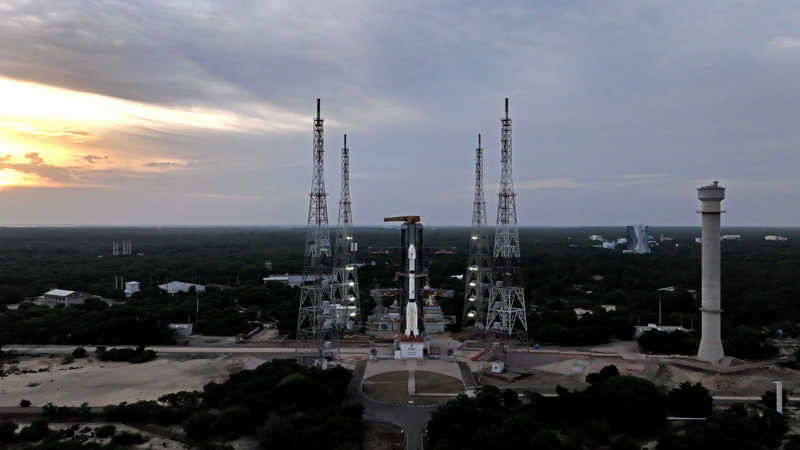
A 51.7-metre rocket lifted off in the dark hours of Friday morning at Sriharikota, on India’s southeast coast, and put a roughly 2,367-kilogram Earth-observation satellite into a Sub-Geosynchronous Transfer Orbit. ISRO’s GSLV-F17 mission was scheduled for 2:55 am IST on 4 September 2026 from the Second Launch Pad at Satish Dhawan Space Centre (ISRO mission page), and the launch itself went according to plan. What made it more than routine was that EOS-05 is the country’s first imaging satellite to operate from a geosynchronous perch, and it flew on a launcher that India’s space agency has spent more than two decades trying to make reliable.
The Geostationary Imaging Satellite programme goes back nearly a decade, to an earlier concept called GISAT-1 that was meant to give India a continuous, fixed-eye view of the subcontinent from 36,000 km up. The original GISAT-1 launch in 2020 was called off because of a technical issue with the cryogenic stage, and a second attempt the following year failed to ignite the cryogenic engine in flight. That delay had already pushed India’s geosynchronous imaging ambition by roughly five years before EOS-05 picked up the work as a direct replacement, with design updates informed by the failure analysis (TechTimes coverage). This time the cryogenic stage behaved. The third stage, designated CUS15, burned for about 814 seconds with the indigenous CE-7.5 engine, which ISRO developed to replace a Russian KVD-1 design after the Missile Technology Control Regime complications of the early 2000s (CE-7.5 Wikipedia entry). The launch matters because India’s earth-observation fleet has until now operated almost entirely from low Earth orbit, where a satellite passes over any given patch of ground for only a few minutes per orbit. From 36,000 km up, EOS-05 will sit over a fixed longitude and stare down at the same region continuously, day and night, gathering visible, near-infrared and shortwave-infrared imagery across roughly the whole visible disc (Wikipedia: EOS-05). That is a qualitatively different tool. A polar-orbiting imager gives you high spatial resolution at the cost of infrequent revisits; a geostationary imager gives you continuous revisits at coarser spatial resolution. EOS-05 is aimed at the second regime, with a 700 mm Ritchey-Chrétien optical telescope tuned for agricultural monitoring, cyclone tracking, and rapid disaster mapping over India, its 7,500-kilometre coastline and the surrounding maritime zones (Times of India mission summary).
This was the 19th flight of the GSLV and only the fifth to use the Mk II configuration with the indigenous cryogenic upper stage, which is the part of the rocket that has historically given ISRO the most trouble. The Mk II stands 51.7 metres tall, weighs 420.5 tonnes at lift-off, and uses a stack of three stages wrapped by a four-metre composite ogive fairing. The first stage is the S139 solid core with four L40H liquid strap-ons clustered around it; the second is the GL40HT liquid-propellant stage; and the third is the cryogenic CUS15 (ISRO mission brochure summary). That third stage is what makes GSLV comparable to other medium-lift geosynchronous launchers in the world: liquid hydrogen and liquid oxygen are notoriously hard to handle because they sit at around -253 °C, which is why cryogenic upper-stage development is often the single largest non-recurring engineering cost for any space agency building a geosynchronous launcher.
The mission was also a deliberate break from a difficult 18 months for the Indian launch programme. PSLV, the workhorse polar-orbit rocket, suffered consecutive failures in May 2025 and again in January 2026, and the investigations into both kept most of ISRO’s launch manifest on the ground (Indian Express on the PSLV investigations). NDTV called GSLV the “Naughty Boy” of the Indian fleet in its post-launch coverage, an affectionate reference to the launcher’s long history of partial failures and stand-downs (NDTV: How ISRO’s ‘Naughty Boy’ Rocket Delivered A Big Win For India). Putting EOS-05 into a precise Sub-GTO is exactly the kind of success that rebuilds confidence launch by launch; ISRO Chairman V. Narayanan confirmed after the mission that the cryogenic upper stage had performed as designed and that the satellite’s Liquid Apogee Motor would now do the work of raising the orbit to its final geosynchronous station.
The CE-7.5 engine that powered that critical third stage is itself the product of a long-running technology development programme. It is a regeneratively cooled, fuel-rich, staged-combustion-cycle engine, which is the same thermodynamic cycle used by the Space Shuttle’s RS-25 main engines (CE-7.5 details). The engine is about 2.14 m long and 1.56 m in diameter, runs at variable thrust, and has a specific impulse of around 454 seconds in vacuum. Staged combustion is the most efficient chemical cycle in practical use, because the propellants are partially burned in a preburner before the main chamber, which extracts more energy from the same mass of fuel. The trade-off is that the engine is harder to build and to test; the preburner runs at extremely high pressures and temperatures, and any leak of the hydrogen-rich preburner gas into the wrong part of the engine can damage it. That is why ISRO’s early GSLV flights used the Russian-supplied KVD-1 instead, which uses a simpler gas-generator cycle at the cost of lower efficiency. By replacing the Russian engine with a domestic one, ISRO removed a long-standing supply-chain risk and aligned the upper stage with India’s existing manufacturing base. It also brought the GSLV’s payload capacity to geosynchronous transfer orbit up to roughly 2,500 kg, which is enough for EOS-05 and for the heavier navigation and communications payloads ISRO has planned for the rest of the decade. The fact that EOS-05 was the first GEO imaging payload to fly on it is not coincidental; ISRO held the satellite back until it had a launcher it trusted enough to put an irreplaceable asset on.
For the broader commercial and strategic picture, EOS-05 also closes a gap that India’s civilian and military users have lived with for years. The Indian National Satellite System’s INSAT fleet has carried transponders for communications and weather imaging for decades, but it has not had a dedicated hyperspectral imager staring down from geostationary orbit. Hyperspectral means the imager splits incoming light into many narrow bands, which lets it distinguish, say, healthy crops from drought-stressed ones in ways that a conventional three-band imager cannot. Continuous coverage from geosynchronous orbit, in turn, lets disaster managers watch a cyclone’s eye wall reorganise in near-real-time or track the spread of a flood across a state hour by hour. The payload does not replace India’s existing low-Earth-orbit earth-observation satellites, which still do most of the heavy lifting on high-resolution mapping. It complements them.
The next test will be whether the satellite reaches its final station and powers up its instruments cleanly. ISRO’s GSLV-F15 in January 2025 placed a navigation satellite into GTO correctly but the satellite’s own Liquid Apogee Motor failed due to an oxidiser valve malfunction, leaving that spacecraft stuck in a transfer orbit (NDTV: What Back-to-Back PSLV Failure Means For ISRO). EOS-05 has the benefit of a fresh cryogenic upper-stage performance record and of a launch-to-orbit precision that should let its own propulsion system do less work. If all goes well, the satellite should be operational at its assigned geostationary slot above the equator within a few months, and India’s weather, agriculture, and disaster-management agencies will have their first continuous watch over the subcontinent.
 Subscribe to our RSS feed









There are no comments.
Add A Comment