


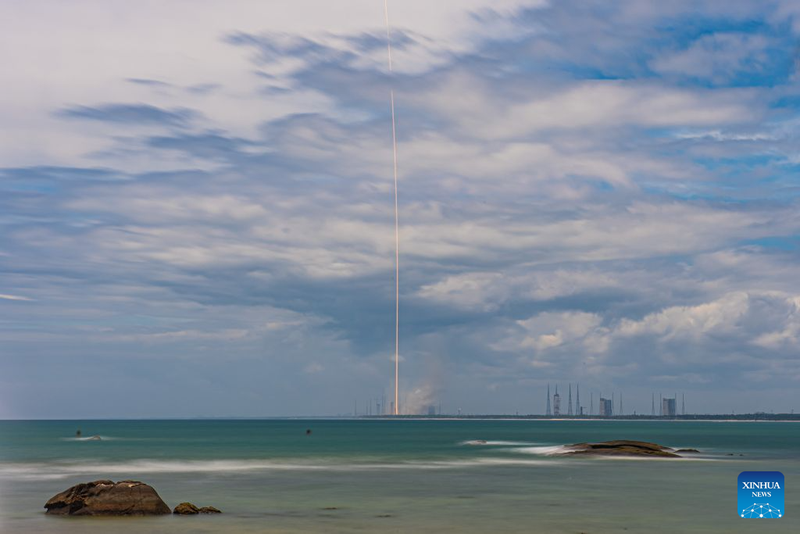
On the morning of July 10, 2026, a 63-meter rocket climbed off a brand-new launch pad on Hainan Island, deposited an unnamed payload into a low orbit, and then — six minutes later — fell back out of the sky and let a steel net on a ship catch it. The vehicle was the Long March 10B, designated CZ-10B in China’s rocket catalog, and the flight was its maiden voyage. Both halves of the mission succeeded, which made China only the second country, after the United States, to propulsively recover an orbital-class booster. The second thing that mattered was that the recovery hardware was nothing like SpaceX’s drone-ship landings: no deployable legs, no tower catch, no hover-slam. The booster carried four hooks and used them to latch onto a cross-shaped steel cable net strung across the deck of a ship called Linghangzhe. Chinese state media called it the world’s first successful wire-arrestment recovery of a carrier rocket (Xinhua, July 10, 2026). For an industry that has spent the last decade copying the Falcon 9 playbook, the choice to do something different is the story.
Reusability is no longer optional in the commercial launch market. Reusing a first stage is the single largest lever on launch cost, and the cost gap between an expendable booster and a flight-proven one is roughly a factor of two on Falcon 9 (SpaceX stated figures cited in SpaceNews, 2025). The industry consensus for the last decade has been that vertical propulsive landing is the only path: relight a few engines, fall ballistically through the upper atmosphere, use grid fins to keep the stack on course, throttle down, set down on legs. China has just demonstrated a working alternative, which suggests the engineers at CALT made a deliberate trade.
The arguments are mostly about mass. Landing legs, deployment hinges, hydraulic dampers, the extra beef in the engine bay to absorb landing loads, and the reserve propellant for a hoverslam all eat into payload. Falcon 9 sets aside on the order of 6% of its first-stage propellant load for a drone-ship landing and roughly 30% for a return-to-launch-site profile (SpaceX public estimates; Flight Club reconstructions). A booster that does not have to carry legs can carry more propellant or more payload. CALT’s published commentary frames the net as a way to “shift the structural burden from the vehicle to the sea-based platform.” The ship, not the rocket, holds the arrestment load.
Geography helps. Wenchang sits on the east coast of Hainan, and the standard launch azimuths send boosters downrange over the South China Sea. A recovery vessel can sit offshore and the booster has a flat ocean to fall into, with no populated land downrange and no steep boostback burn. Linghangzhe is the first ship purpose-built for this. It is 144 meters long, 50 meters wide, displaces 25,000 tonnes at full load, has DP2 dynamic positioning, and carries the arrestment net on a steel frame taller than a six-story building (CASC, July 2026). LiDAR units at the corners of the frame feed an automated capture loop. No one on deck is steering.
Liftoff came at 12:15 p.m. Beijing time on July 10. Seven YF-100K engines, each rated at about 1,250 kilonewtons of sea-level thrust, lit together to push the 760-tonne stack off the pad (Xinhua, July 10, 2026; CALT engine specifications, 2024). The seven-engine cluster is notable: this is the LOX-kerosene YF-100 in its latest pump-back-swing variant, with the thrust chamber gimbaled while the turbopumps stay fixed. That rearrangement is what lets CALT fit seven of them into a 5-meter core. About 150 seconds into the flight, at roughly 100 kilometers of altitude, the first stage separated and the second stage’s single YF-219 methane-LOX engine took over to deliver the satellite. The first stage then began a six-minute return: unpowered coast to apogee, attitude turn using cold-gas thrusters, a reentry burn to scrub velocity, aerodynamic deceleration with titanium grid fins steering, and then a final descent burn that cut off just before the hooks met the cables.
The flight was an operational test of the recovery system and engines. The booster caught in the net has to be inspected, refurbished, and flown again. CASC said it intends to refly this exact first stage before the end of 2026. If that happens, China will have skipped the long Falcon 9 march from 2013 to 2017 that SpaceX needed to land and re-fly the same booster.
The CZ-10B is the middle child of a three-rocket family. The crew-rated CZ-10A will launch astronauts in the Mengzhou spacecraft to the Tiangong station. The heavy-lift CZ-10 — three cores bundled together, 92.5 meters tall, 21 engines — will eventually carry the Mengzhou and Lanyue lander to the Moon with roughly 27 tonnes on a trans-lunar trajectory. The 10B is the test bed: same diameter, same first-stage engines, with a methane upper stage optimized for commercial missions rather than crew.
The trick that makes the architecture work is the propulsion. Specific impulse is the engine-design figure of merit: how many seconds of thrust one kilogram of propellant produces. The YF-100K runs an oxidizer-rich staged combustion cycle at a chamber pressure near 18 megapascals, with a sea-level specific impulse around 302 seconds and a vacuum number near 338 seconds (CALT YF-100K specification sheet, 2024). For comparison, the Merlin 1D on Falcon 9 produces about 282 seconds at sea level. Higher Isp means less propellant mass buys a given delta-v, which the rocket equation makes unforgiving:
Δv = v_e * ln(m_0 / m_f)
Every kilogram of dead mass stripped off the first stage translates, through that logarithm, into more kilograms of payload at orbit.
Methane on the upper stage is the second bet. LOX-methane engines run cooler, leave less coking residue, and are easier to turn around between flights than kerolox. That matters more for an upper stage than for a booster, because the upper stage burns for several minutes and accumulates more thermal soak-back. The YF-219 has been a long-running CALT development, and the 10B flight is its first orbital demonstration.
The recovery system is the engineering story most worth lingering on. The cross-shaped net is built from high-strength steel cables with hydraulic buffers at the four corners that absorb kinetic energy. Four hooks on the booster engage the cables at low speed (the descent burn throttles the booster down to a few meters per second before capture). Once the cables take the load, hydraulic winches stabilize the booster against wind and waves, and an automated locking platform clamps it for the trip back to port. The sequence is unmanned: LiDAR tracks the booster, the position-keeping system holds the ship steady, and the capture happens in software.
The CZ-10B was a single Friday-morning launch, but the chain it pulls on is longer. The 10A will use the same first stage (minus the net hardware) to put Mengzhou crews into low orbit; the heavy CZ-10 will use it again, three at a time, to support China’s crewed lunar program before 2030. If CASC can fly, catch, inspect, and re-fly a first stage in 2026, the company buys a launch cadence for the Guowang megaconstellation and Tiangong that costs a fraction of an expendable fleet. The United States spent the better part of a decade proving booster reuse was physically possible. China has, in a single afternoon, suggested there is more than one way.
The lesson for the rest of the industry is straightforward. Reusability is the destination, not the route. The path that SpaceX blazed — vertical landing on legs — is one road. A net on a ship is another. Both work. Both have trade-offs. The only thing that no longer works is to keep throwing away 70% of a rocket.
 Subscribe to our RSS feed









There are no comments.
Add A Comment