


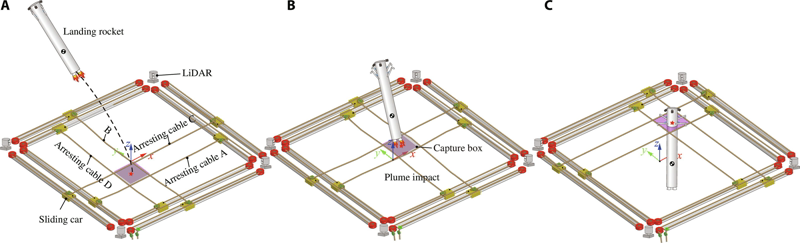
At 04:15 UTC on July 10, 2026, a 70-meter Chinese rocket climbed off the pad at the Wenchang Commercial Space Launch Site on Hainan island, lit seven kerosene engines, and headed southeast over the South China Sea. Roughly ten minutes later, the upper stage was still climbing toward orbit, and the booster had already turned around, fallen back through the sensible atmosphere, and snagged itself on a grid of tensioned steel cables strung across a ship called Linghangzhe. The booster came to rest hanging in mid-air over the deck, engines off, plumes of evaporating kerosene streaming off the warm tank. CASC, the state-owned China Aerospace Science and Technology Corporation, called the mission a “complete success.” It is the first time any Chinese rocket has been recovered after reaching orbit, and the first time any operator anywhere has used a net to do it.
Reusability is the lever that turned SpaceX from an upstart into the dominant launch provider of the 2020s. A Falcon 9 booster that lands is a booster that flies again, and that one engineering change drives launch prices down by roughly an order of magnitude. China has watched that happen from the outside. Until last Friday, no Chinese rocket had ever returned to Earth intact after reaching orbit, which put a hard ceiling on how fast Beijing could build megaconstellations, crewed lunar hardware, or any of the other things reusable boosters make cheap.
The Long March 10B test changes that. It is also the third booster-recovery club to form on the planet, after SpaceX (Falcon 9 in 2015, Starship in 2024) and Blue Origin (New Glenn in late 2025). The catch is that China got there using a method neither of the other two has flown: catching the descending booster on a net, mid-air, instead of either landing it on legs or snatching it out of the air with a launch-tower arm like Starship does. If that approach scales, it shifts the trade-off between payload mass and reusability in a way the rest of the industry will have to think about.
Friday’s flight was the maiden launch of the Long March 10B, a two-stage medium-lift rocket built by the China Academy of Launch Vehicle Technology (CALT), a subsidiary of CASC. The booster is 5 meters in diameter and runs seven YF-100K engines burning kerosene and liquid oxygen. Unlike the older Long March workhorses, its upper stage burns methane and liquid oxygen, the same propellant combination SpaceX’s Raptor uses. The rocket was designed from the start to be recoverable.
The recovery hardware lives mostly on the ship, not the rocket. Linghangzhe (Navigator) carries a four-legged frame over which a tensioned cable grid is stretched. As the booster descends, four titanium grid fins steer it through the hypersonic and supersonic phases of reentry, the same aerodynamic trick Falcon 9 uses. Near the surface, the booster sheds its grid fins and extends small hooks that snag the cable grid. The cables carry the booster’s weight and arrest its downward velocity, and the engines shut down as it comes to rest suspended over the deck. CASC says the flight validated “multiple engine restarts with high-altitude ignition, high-precision navigation and control, and the first capture and recovery using a net system on a sea-based platform.”
While the booster was being caught, the upper stage kept climbing. About ten minutes after launch, it delivered a payload designated CX-26, built by China Satellite Network Group, into a roughly 800-kilometer low Earth orbit. Chinese officials have not publicly described the satellite’s mission, which is consistent with most classified or pre-operational Chinese payloads. SpaceNews reported that the payload may in fact be TJS-26A (Tongxin Jishu Shiyan-26A), a classified communications technology test satellite, but that identification has not been confirmed by CASC.
The flight is a stepping stone in a wider Long March 10 program. The Long March 10A, which shares the same first stage as the 10B, is intended as China’s next crewed launcher for low Earth orbit and is meant to evolve out of the older CZ-2F and CZ-7 families. A larger three-core Long March 10 will be the rocket that flies the Mengzhou crewed spacecraft toward the Moon. Data from the 10B’s recovery, and from its methane upper stage, feeds directly into both. China launched a scaled-down CZ-10A first stage in February 2026 to test the Mengzhou capsule’s launch abort system, and that booster performed a controlled splashdown about 200 meters from its recovery platform in the South China Sea. Friday’s net catch is the next step on that ladder.
Two design choices drive the net approach.
The first is mass. A Falcon 9 booster carries four deployable landing legs and four larger grid fins, plus the hardware to lock each leg into place. Mass saved is mass that can be payload. The 10B trades legs for hooks, which weigh very little, and offloads the heavy catch structure (frame, cables, winches, the frame’s support legs on the ship) to the boat. CASC’s own statements imply this is the main reason a 10B in reusable mode can still deliver 16 metric tons to a 200-kilometer low orbit, versus a single-use rocket of similar class.
The second is tolerance. A ship in the open ocean moves with the swells. A booster falling at terminal velocity has seconds to hit a moving target. The cable grid spans most of the frame, so the booster does not need to land on a small pad or balance on a single tower catchpoint the way Starship does at Boca Chica. The grid also absorbs a lot of energy, so the booster does not need a perfect engine-cutoff timing. That should, in principle, let the recovery team operate in worse weather and with less margin than leg-style landings.
The catch is not free. The booster has to be soft enough not to tear through the cables on contact, which constrains structural reinforcement and probably caps the size of recoverable boosters. The 10B is medium-lift. Falcon Heavy has three boosters, and the Super Heavy booster on Starship is far larger and heavier. Whether the net idea scales to heavy-lift, or only works for medium-lift, is an open question. CASC has not said whether the crew-rated 10A or the three-core Moon rocket will also use a net or fall back to legs.
The wider context: at least two private Chinese companies have already tried similar landings. LandSpace flew its Zhuque-3 and attempted a downrange recovery in 2025, with mixed results. Space Pioneer and Galactic Energy are working on comparable vehicles. Whether the state-led 10B flight pushes the commercial sector toward a common architecture, or sends it looking for different solutions, is one of the things to watch over the next year.
The Friday flight did not change China’s space program in one stroke. It changed the launch industry in a small, concrete way: China now has a working, reusable orbital booster, and it has a working version of an idea nobody else had flown. The next 10B flights, expected later in 2026, will tell operators whether the catch system can fly again and again without rebuilding the cables. CASC’s stated plan is to gather flight data for the crewed 10A and the lunar Long March 10. If the recovery cadence holds, the third Chinese launch of 2027 may carry a Mengzhou capsule on a rocket whose first stage was already flown once.
 Subscribe to our RSS feed









There are no comments.
Add A Comment