


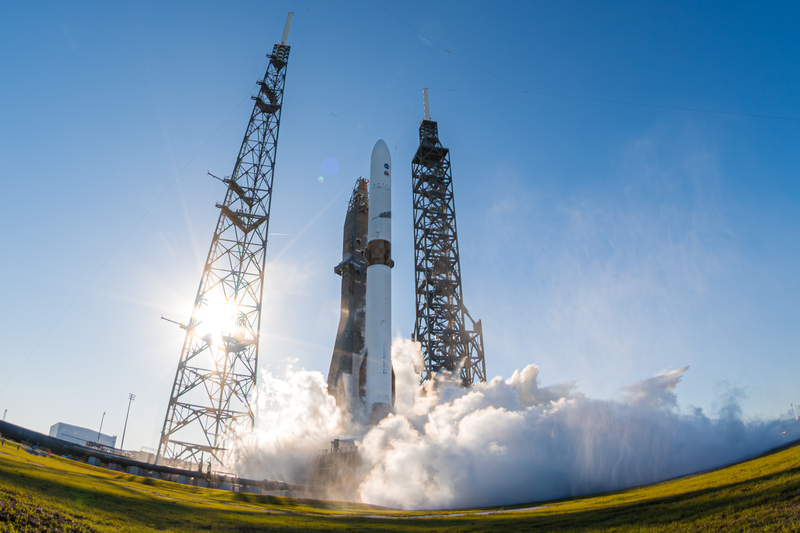
There is a 1.37-million-square-foot factory going up in Cape Canaveral that Blue Origin says will turn out as many as 150 upper stages a year once it opens next summer. There is also a wrecked launch complex four miles north where a New Glenn rocket used to stand, because a pre-launch static fire in May tore the vehicle apart and took much of the pad with it. Both facts landed in the same week. On Friday, 16 October 2026, the company announced the factory, two additional launch pads, two more landing ships for booster recovery and a payload processing building it is putting up with the US Space Force (Blue Origin, 16 October 2026).
The gap between those two stories is the most honest description of the American launch business in 2026. Blue Origin has flown New Glenn three times. The first flight, on 16 January 2025, reached orbit with the Blue Ring Pathfinder test payload. The second, that November, sent NASA’s ESCAPADE probes toward Mars and returned the first stage to a landing ship for the first time. The third, in April 2026, reused a booster for the first time and deposited an AST SpaceMobile satellite into an orbit its owner did not want. The fourth vehicle was sitting on the pad for a static fire when it came apart, and the damage to 36A has pushed the company’s return-to-flight target from the end of this year toward, in Ars Technica’s read, the first months of 2027 (Spaceflight Now, 16 October 2026; Ars Technica, 16 October 2026).
Cadence is the metric that decides whether a rocket is a curiosity or a business, and it is the only one Blue Origin has been talking about publicly for years. The economics are unforgiving in a specific way. A first stage costs hundreds of millions to build and throws away most of its value on a single burn unless it flies again. Refurbishment cost, not manufacturing cost, is what drives price per kilogram down once a vehicle family reaches flight rate. Falcon 9 crossed that line years ago. New Glenn has not crossed it once, and every dollar Blue Origin is spending in Brevard and Orange counties is an argument that it expects to.
The reason to believe the spending is serious is the market underneath it. SpaceX has stopped selling commercial rideshare on Falcon 9 in order to put its capacity behind Starship, and satellite operators are already struggling to buy Falcon launches beyond 2028 (CNBC, 16 October 2026). Venture capital firms counted $92.5 billion going into the commercial space sector in the first three quarters of 2026, and the Air Force has told Congress it faces a surge in demand for heavy lift that it cannot currently meet. Blue Origin is one of very few vehicles in the world that can put 45 metric tonnes into low Earth orbit, and the only American one besides Falcon Heavy.
The announcement was also, underneath the concrete and steel, a bet on a specific vehicle. Blue Origin is not scaling the rocket it has. Two of the new pads are expected to serve the 9×4 variant, which mounts nine first-stage engines instead of seven and is designed to carry more than 70 tonnes to orbit, over 20 tonnes to trans-lunar injection and a payload inside a fairing 8.7 metres across. The Rocket Park expansion exists specifically to build those upper stages, at a rate that implies a fleet of roughly 150 flights a year, which is more launches in a year than the entire United States has flown in the last two decades.
What sets a ceiling on all of this is paperwork rather than metallurgy. Blue Origin’s Federal Aviation Administration launch licence, VOL 24-133, authorises up to 12 New Glenn flights a year from Space Launch Complex 36, a number set by the environmental assessment the Air Force completed in 2016. Blue Origin has asked for 50, and the agency’s draft assessment for the increase, released in September under docket FAA-2026-9841, is now in public comment. The proposed action is broader than a count. It covers the static fire engine testing that precedes each campaign, the downrange landings on ocean platforms, the recovery of payload fairings and the temporary airspace closures that a launch demands (FAA, September 2026). Comments close on 30 October; a virtual public meeting was held on the evening of 22 October.
That is where the engineering gets interesting. New Glenn is a two-stage vehicle with an optional third, burning liquid oxygen and liquid hydrogen, and that propellant choice is what makes the numbers hard. Reaching low Earth orbit takes roughly 9.4 kilometres per second of delta-v, and the rocket equation, Δv = v_e * ln(m_0 / m_f), punishes any attempt to get there with a high exhaust velocity. Hydrogen delivers one of the best specific impulses of any chemical propellant and one of the worst densities, about 71 kilograms per cubic metre against roughly 820 for kerosene, so the tanks are enormous and the vehicle is 98 metres tall. Staging is how the logarithm gets beaten, and recovering the first stage is how you stop paying for it twice.
Adding two engines to the base, from seven to nine, is the other half of the answer. More sea-level thrust does not change the exhaust velocity; it changes how much of the vehicle can be payload before the engines run dry. Between the 7×2 and the 9×4, Blue Origin trades a pair of engines and some structural mass for 25 additional tonnes to orbit. Whether that trade closes depends on what the new engines cost to build and refurbish per flight, which is the number Blue Origin has not published and every customer is quietly modeling for themselves.
The rest of the machinery is ordinary until you count it. Two extra landing ships exist because a downrange stage return cannot be improvised; once the booster commits, the sea platform has to be there. The Space Force payload building, with four bays, exists so that four spacecraft can be processed at once instead of one. Blue Origin says it has now spent more than $3 billion in Florida, employs over 5,000 people there and buys from 500 state suppliers across more than 20 sites, and it is building its own fairings and recovering them for refurbishment (Blue Origin, 16 October 2026). Each of those is a small line item. Together they are the difference between a rocket company and a launch provider.
The honest question is which constraint binds first. Blue Origin could have every pad, ship and factory it has ordered by 2028 and still be flying at single digits if the vehicle keeps having bad days, because the May explosion cost it a rocket, a pad and roughly a year. It could also fly cleanly and still be throttled by an environmental assessment that has to weigh one launch a week against a coastline. The company is betting that both can be solved in parallel, and that whoever is first to fly weekly has the market locked for a decade. In late 2026 that bet is still unproven, and the factory going up in Cape Canaveral is a statement of intent rather than a result.
 Subscribe to our RSS feed









There are no comments.
Add A Comment