


Antares Nuclear, a three-year-old startup in Torrance, California, walked away from a September 14, 2026 award ceremony with what it calls the largest U.S. Department of War contract ever signed specifically for nuclear power in space: $161 million to design, ground-test, and eventually fly a fission reactor on a spacecraft. The Office of the Assistant Secretary of the Air Force for Space Acquisition and Integration structured the Strategic Breakthrough award around two related efforts, a ground demonstration of a reactor called R1-S followed by integration work on an electricity-producing variant called Mark-1 that Antares plans to begin testing in 2027. The company has not yet named a target launch date for R1-S or which mission it would eventually support, but the contract is the clearest signal yet that the U.S. government intends to put a fission reactor in orbit in this decade rather than the next (Defence Blog, September 14, 2026).
The strategic logic is straightforward, and it has very little to do with sending astronauts to Mars. Most satellites today run on solar panels paired with batteries sized for eclipse periods, which sets a hard ceiling on how much power is available onboard and how aggressively a spacecraft can maneuver without draining its reserves. A compact fission reactor gives a satellite continuous high-output power instead of the day-night cycle that solar arrays impose, supporting heavier onboard computers, sustained orbital maneuvers, and payloads such as directed-energy systems or electronic-warfare gear that today’s power budget cannot accommodate at all. Jordan Bramble, Antares’ chief executive and co-founder, framed the award the same way his investors do: “Fission will unlock strategic capabilities that are impossible today.” The Department of War’s appetite for those capabilities is not new, but the budget to actually build toward them has historically been small, scattered across NASA and Defense programs, and constrained by a decades-long absence of any American nuclear reactor actually running in space (Defence Blog, September 14, 2026).
The Antares award is the latest milestone in a sequence that began quietly six years before the contract was signed. On June 4, 2026, the company’s Mark-0 demonstrator reactor completed what is technically known as a zero-power fueled criticality at Idaho National Laboratory’s Reactor and Critical Experiment (RACE) facility, the moment at which a nuclear fission chain reaction becomes self-sustaining. The test, conducted under Department of Energy authorization and with nuclear fuel maker BWX Technologies fabricating the fuel, made Antares the first private company to bring an advanced reactor to criticality under the DOE’s Reactor Pilot Program. It was also the first novel reactor design to achieve criticality at the Idaho site in more than fifty years, according to INL Laboratory Director John Wagner, who emphasized that the Mark-0 test produced essentially no measurable thermal output: proof that the physics worked, not proof that the system could yet generate electricity (Power Magazine, June 2026; U.S. Department of Energy, June 4, 2026).
That single June milestone unlocked everything that followed. Data from the Mark-0 test is being shared with the Department of War’s Project Pele, a long-running program to build a transportable microreactor for forward military bases, and Antares is also a supplier under the U.S. Army’s separate Janus Program, which is installing microreactors at installations including Fort Benning, Georgia. The Space Force award is the third major customer the company has signed, after the Army and the Air Force itself, and Antares says it now holds agreements with NASA and the Defense Innovation Unit as well. Private capital has followed the same trajectory: the company closed a $96 million Series B round in December 2025, raising its total private funding above $600 million by mid-2026 (Defence Blog, September 14, 2026; Power Magazine, June 2026).
The policy backdrop is two documents rather than one. Executive Order 14369, signed in late 2025 and titled “Ensuring American Space Superiority,” directed the federal government to “deploy nuclear reactors on the Moon and in orbit, including a lunar surface reactor ready for launch by 2030” (Executive Order 14369, The American Presidency Project). The implementation memo, National Security and Technology Memorandum-3 (NSTM-3), issued on April 14, 2026, gave NASA and the Department of War thirty days to start parallel reactor competitions: a mid-power fission surface power (FSP) system targeted for the Moon by 2030, and a separate space-based reactor to support nuclear electric propulsion. The Antares award sits inside the second of those two tracks, where the schedule is even tighter: NSTM-3 calls for an American reactor in orbit as early as 2028 (SpaceNews, April 2026).
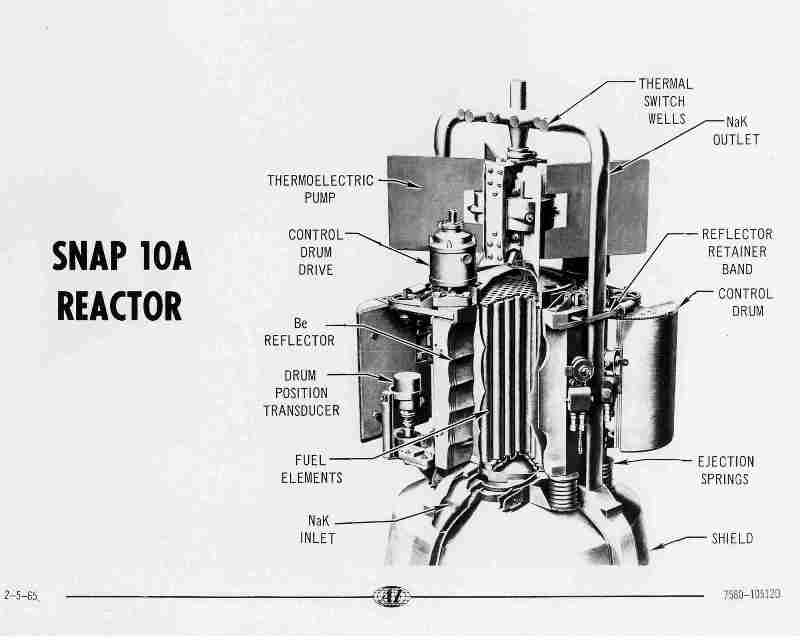
The hardware Antares is building toward looks much more like a 1965 satellite than a 2026 data center. The R1 microreactor, the commercial product the company’s ground-test reactors are iterating toward, uses tri-structural isotropic (TRISO) fuel, particles of high-assay low-enriched uranium (HALEU) coated in layers of carbon and ceramic, embedded in a prismatic graphite core. Passive sodium heat pipes carry heat from the core to a fin-and-tube primary heat exchanger, and a recuperated nitrogen-closed Brayton cycle converts that heat into electricity at outputs between 100 kilowatts and 1 megawatt depending on configuration. The R1 is rated to operate for six or more years between refueling and is designed to run without a connection to the commercial grid, exactly the operating envelope a spacecraft needs (Power Magazine, June 2026). The conceptual lineage runs straight back to SNAP-10A, the only fission reactor the United States has ever placed in orbit, which launched on April 3, 1965 aboard an Atlas-Agena D from Vandenberg and ran for forty-three days before a non-nuclear voltage regulator failed in its thermoelectric pump. The SNAP-10A core used a similar arrangement of uranium fuel elements, a beryllium reflector, sodium-potassium (NaK) coolant loops, and control drums rotated by an electric drive to manage reactivity (Wikipedia, SNAP-10A).
The diagram above, a 1965 U.S. Department of Energy drawing of the SNAP-10A core, illustrates the conceptual continuity. The beryllium reflector wraps the fuel elements and bounces neutrons back into the chain reaction; the control drums rotate to absorb neutrons and throttle reactor power; the NaK loops carry heat from the core to a thermoelectric pump that converts it directly into electricity without moving parts. Antares has replaced the thermoelectric pump with a closed Brayton cycle and swapped the SNAP-era fuel for HALEU TRISO, but the operating principle, a compact, passively cooled, six-year core with no moving coolant pumps, has not changed (Wikimedia Commons, File:SNAP-10A Reactor.jpg).
What has changed is the supply chain. The 1965 program drew on a single nuclear vendor (Atomics International, a division of North American Aviation) and a single satellite integrator; the 2026 program has at least three parallel microreactor vendors (Antares, plus the BWXT-led Project Pele team and at least one other Army Janus participant), HALEU production being stood up at multiple Department of Energy sites, and TRISO fuel fabrication running commercially at BWX Technologies since October 2025. If Antares meets its schedule, the United States will close a sixty-year gap between SNAP-10A and the next American fission reactor in orbit, and the Mark-1 testing campaign starting in 2027 will tell the industry whether the next one after that flies on a lunar lander or a Space Force satellite.
 Subscribe to our RSS feed









There are no comments.
Add A Comment