


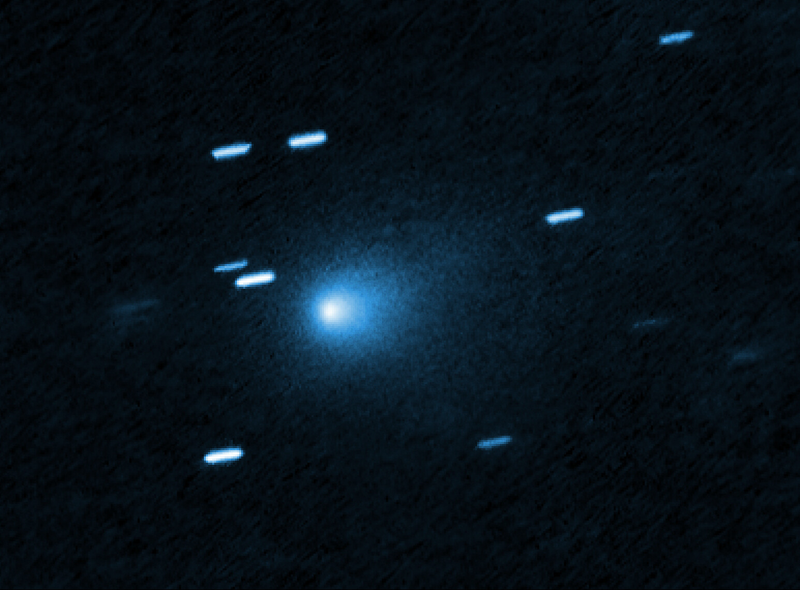
Look at the image above. A teardrop-shaped cocoon of dust drifts against a backdrop of smeared star streaks. The streaks are not an aesthetic choice; they are the signature of a tracking problem. The Hubble Space Telescope was locked onto the comet and the sky slid behind it, smearing every background star into a line. The dust cloud we are looking at has to be tracked because it is moving fast. 3I/ATLAS, the third confirmed interstellar object ever seen passing through the solar system, was discovered on 1 July 2025 by the ATLAS survey telescope in Rio Hurtado, Chile, and was already 365 million kilometers away when Hubble photographed it on 21 July (NASA, ESA; heic2509).
What makes 3I/ATLAS different from its predecessors, 1I/’Oumuamua in 2017 and 2I/Borisov in 2019, is not its speed. At a hyperbolic excess velocity near 57 km/s, it is comparable to Borisov. The difference is that we have had time and the James Webb Space Telescope. A paper led by Martin Cordiner at NASA Goddard, posted to arXiv in March and published in Nature on 22 June 2026, reports JWST spectra that pin down isotopic ratios in the gas around the nucleus, and those ratios say where the object came from (Cordiner et al., 2026, arXiv:2603.06911).
The first two interstellar visitors were case studies in frustration. ‘Oumuamua showed no detectable coma and accelerated away from the Sun with no visible tail, generating a decade of papers arguing about whether it was a hydrogen iceberg, a fragment of nitrogen ice, or a piece of exotic rock. Borisov behaved more like an ordinary comet but was already past perihelion when discovered and faded fast. Both passed through the inner solar system in weeks, neither caught by an instrument capable of high-resolution infrared spectroscopy.
3I/ATLAS was caught early and held for months. Perihelion came on 29 October 2025 at 1.36 AU, deep enough inside the snow line for volatiles to drive an active coma. JWST observed it with NIRSpec on 6 August 2025 while it was still inbound at 3.32 AU, and again on 22–23 December 2025 as it climbed back out. Program 5094 put the integral-field unit on the target with a 0.1-arcsecond pixel scale, resolving structures about 130 kilometers across inside the coma (Cordiner et al., 2026).
The headline numbers are extreme. The CO₂-to-H₂O ratio at ingress is 7.6 ± 0.3, which sits 4.5 sigma above the trendline for solar-system comets. The CO-to-H₂O ratio is 1.65 ± 0.09. Methane was detected for the first time on an interstellar object, but only on the outbound side, which suggests it lives buried deeper than the more volatile CO and CO₂. The dust spectrum shows a strong 10-micrometer amorphous-silicate feature rather than the crystalline silicates that dominate solar-system comets (Cordiner et al., 2026).
What makes the paper worth reading past the abstract is the isotopic table. The deuterium-to-hydrogen ratio in the water coming off the nucleus is (0.95 ± 0.06)%, more than thirty times higher than in typical solar-system comets and comparable to dense interstellar-medium ices. The ¹²C/¹³C ratio runs 141 to 191 in CO₂ and 123 to 172 in CO, both well above the solar value of about 89 (Cordiner et al., 2026).
In astrophysics, isotopes are clocks. Deuterium is fragile: it is destroyed in stars and rebuilt only by spallation and the Big Bang. A high D/H ratio means the water never spent long inside a hot stellar environment. It was locked in cold ice, somewhere below about 30 K, for most of its existence. The ¹²C/¹³C ratio is a slow clock that runs on stellar nucleosynthesis. Older stellar populations in the galactic disk have more ¹²C because ¹³C is produced by hot CNO burning and mixed in over time. A high ¹²C/¹³C ratio points to material that formed before the disk had been stirred by many generations of stars.
Plug those constraints into a simple galactic-chemical-evolution model and 3I/ATLAS dates itself. The numbers are consistent with formation between roughly ten and twelve billion years ago, when the universe was at its peak rate of star formation, what astronomers call cosmic noon (Cordiner et al., 2026). That is almost three times the age of the Sun. The comet we are watching today was already a respectable lump of ice before the disk of gas that would become our solar system had finished collapsing.
There is one caveat, raised by Maggiolo and colleagues in The Astrophysical Journal Letters. Galactic cosmic rays can rewrite the surface chemistry of an interstellar object over billions of years, converting CO into CO₂ and building an organic-rich irradiated crust roughly fifteen to twenty meters thick. The volatiles we see today may sample that processed shell rather than the pristine interior (Maggiolo et al., 2026, ApJL).
The instrument is NIRSpec on JWST, in integral-field-unit mode. The IFU slices the field into a 30-by-30 grid of 0.1-arcsecond spaxels, each a tiny spectrograph feeding a 0.6-to-5.3-micrometer spectrum through crossed dispersers. The high-resolution gratings G235H and G395H deliver a resolving power near 2,700, enough to separate the vibration-rotation lines of H₂O, CO, CO₂, and their rarer isotopologues, including HDO and ¹³CO₂.
To go from line intensity to abundance requires radiative-transfer modeling. For a spherical, expanding coma with constant velocity, the column density of a species is proportional to its production rate divided by its photodissociation rate times its lifetime, scaled by a Haser-model factor of 1/r where r is the projected distance from the nucleus. The Cordiner team used the Planetary Spectrum Generator to fit line fluxes at multiple spaxels simultaneously, then propagated the uncertainties through the production-rate inversion. The 0.95% D/H ratio is the marginalized posterior after fitting both HDO and H₂O lines at multiple offset positions, and the precision is what makes it significant (Cordiner et al., 2026).
The engineering lesson is that an instrument designed to stare at the first galaxies is also a perfectly serviceable high-resolution infrared spectrometer for a faint, fast, mid-plum comet. JWST’s sunshield keeps the telescope cold enough that its own thermal background does not swamp the molecular lines, the IFU’s fine spatial sampling lets the team disentangle nucleus emission from extended coma, and the orbit at L2 means the same target can be re-observed weeks later with the same geometry.
3I/ATLAS is the first object we have ever measured that we can confidently call older than the solar system. Its isotopes tell us it condensed out of interstellar ices near cosmic noon, that it survived a passage through a planetary system without being torn apart, and that it has spent billions of years coasting through the galaxy getting slowly sandblasted by cosmic rays. It is, in a real sense, a piece of archaeology delivered free of charge to the inner solar system.
Two questions now drive the field. How much of the unusual composition is primordial and how much is the irradiated crust, and how thick is that crust? And harder: are there more like it? LSST at the Vera Rubin Observatory is scanning the southern sky in earnest, and its 3.2-gigapixel camera will catch the next interstellar interloper at a much earlier phase. If the JWST spectrum of this comet is representative, future visitors will be obvious from their CO₂ excess long before a big telescope has to swing.
The interstellar comet has already whipped past Jupiter, in March 2026, and is now climbing out of the solar system toward the constellation Gemini on a hyperbolic escape trajectory. It will not come back. We caught it once. The next one will not surprise us.
Sources: Cordiner, M. A. et al., “Isotopic evidence for a cold and distant origin of 3I/ATLAS,” Nature, published 22 June 2026 (arXiv:2603.06911); NASA/ESA Hubble Space Telescope image heic2509, “3I/ATLAS,” NASA, ESA, D. Jewitt (UCLA), image processing J. DePasquale (STScI), 7 August 2025; NASA Science Mission Directorate, “Comet 3I/ATLAS” page, science.nasa.gov/solar-system/comets/3i-atlas/; Maggiolo, R. et al., “Galactic Cosmic Ray Processing of Interstellar Object Volatiles,” The Astrophysical Journal Letters, 2026.
 Subscribe to our RSS feed









There are no comments.
Add A Comment