


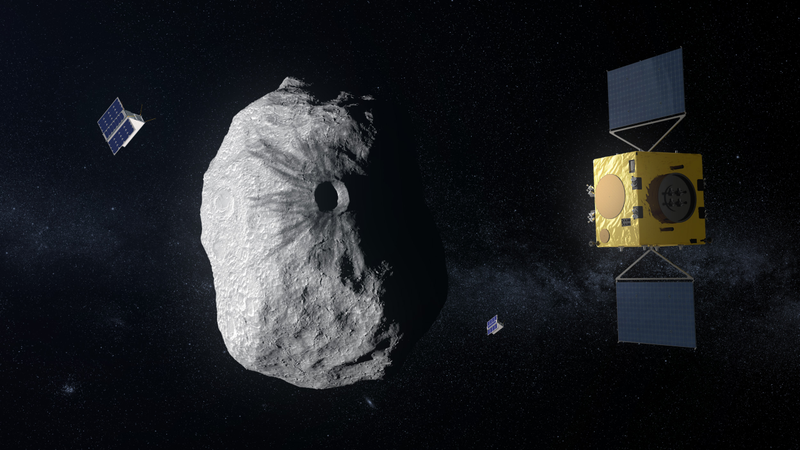
On 17 March 2026, somewhere past the orbit of Mars, a European spacecraft fired its hydrazine thrusters for the second time since launch. The burn lasted long enough to dump 123 kilograms of propellant and shift the probe’s heliocentric velocity by 367 metres per second, the equivalent of accelerating from a standstill to just above the speed of sound (ESA, Hera mission update, 17 March 2026). Two months later, in Thessaloniki, the entire Hera science team gathered for what the project’s own newsletter called “the last time before the probe finally arrives on site” (heramission.space, 17 May 2026). That arrival is now eleven weeks out.
ESA’s Hera, launched 7 October 2024 from Cape Canaveral on a Falcon 9, is closing on the binary asteroid 65803 Didymos. It will reach the system in early November 2026, almost exactly four years after NASA’s Double Asteroid Redirection Test slammed into Dimorphos, the smaller of the two bodies, and changed its orbit by 33 minutes (NASA/APL, 26 September 2022). What Hera will do once it gets there is, in a phrase the mission team keeps using, turn a grand-scale experiment into a repeatable planetary-defence technique. That phrase is doing a lot of work. It is the entire reason a 1,214-kilogram spacecraft is at this moment drifting toward two rocks that, until 2022, almost no one outside planetary science had heard of.
Dimorphos is small. Before DART, its diameter was estimated at roughly 160 metres, the height of a 50-storey building, and its mass was known only to within a factor of two. That uncertainty is the central problem Hera was built to solve. The first measurement of how much momentum DART delivered to the moonlet, the so-called momentum enhancement factor beta, was published by Rivkin and colleagues in 2023. They reported beta = 3.61 with a 1-sigma uncertainty of about 0.2, anchored to an assumed Dimorphos bulk density of 2,400 kilograms per cubic metre (Rivkin et al., Nature 2023). A weaker, more porous asteroid gives a higher beta. A denser, more cohesive one gives a lower beta. Without measuring Dimorphos’s actual mass, every planetary-defence scenario that uses the DART result inherits that uncertainty.
That matters because planetary defence is no longer hypothetical. The 2024 PDC25 exercise at Johns Hopkins Applied Physics Laboratory used beta = 3.61 as its baseline. The number is now embedded in the operating procedures of NASA’s Planetary Defense Coordination Office. A 0.2-point error in beta, applied to a 200-metre asteroid on a 10-year warning, translates into roughly a thousand kilometres of miss distance. That is the difference between a near miss and an ocean impact.
There is a quieter reason to care. Hera is going to make the first internal radar scan ever performed on an asteroid. The instrument is called JuRa, and it sits on a CubeSat the size of a shoebox.
NASA’s DART was the kinetic-impact end of an experiment called AIDA, the Asteroid Impact and Deflection Assessment. ESA’s Hera was always supposed to be the diagnostic half. The architecture is not unusual in physics: you hit something, then you measure what happened. In this case, the impactor flew in 2022. The diagnostician is arriving on time.
Dimorphos is in a 12-hour orbit around Didymos, a roughly 780-metre primary. Both are near-Earth asteroids in the rubble-pile class. DART hit Dimorphos head-on at about 6.6 kilometres per second and shortened its orbital period by 33 minutes, far more than the 7-minute change the spacecraft alone would have produced. The extra came from ejecta, the plume that flew off the surface in the opposite direction and acted as a natural afterburner.
Hera will do the part ground telescopes could not. It will map Dimorphos’s shape from hyperbolic arcs at 20 to 30 kilometres, then closer, down to 1 to 2 kilometres during the experimental phase in April and May 2027 (ESA Hera operations plan, 2026). Two CubeSats will be deployed starting 13 January 2027. Juventas carries JuRa, a 50 to 70 megahertz radar that will sound the asteroid’s interior to a depth of roughly 100 metres with 10 to 15 metres of vertical resolution. Milani carries ASPECT, a hyperspectral imager covering 0.5 to 2.5 micrometres, and VISTA, a dust sensor. Juventas will attempt a soft landing on Dimorphos in late January 2027, the first controlled touchdown on a body this small.
The 367 m/s maneuver tells you what the mission was actually doing during cruise. The full delta-v budget from launch through arrival is on the order of 1.4 kilometres per second, and Hera carries roughly 600 kilograms of hydrazine for chemical propulsion. That is a small budget by interplanetary standards, smaller than OSIRIS-REx’s, smaller than Hayabusa2’s. The reason it works is the Mars gravity assist of 12 March 2025, which bent the trajectory and added, for free, several hundred metres per second. Without that flyby, Hera would not have arrived.
What the chemical system has to do is trim. Each burn is small. The cumulative effect, over five maneuvers across two years, is to align the spacecraft with Didymos’s slow drift around the Sun so that, in late October 2026, the probe can begin hyperbolic approach arcs instead of flying past.
The autonomy stack is the harder problem. At 20 kilometres, Didymos subtends roughly the same angle as a person standing 100 metres away. At 4 kilometres, Dimorphos, at 160 metres across, occupies about 2.3 degrees of sky. Both bodies move visibly against the star background during a single exposure. The Asteroid Framing Camera, two redundant 1020-by-1020 CMOS sensors built by Jena-Optronik, has to track Didymos in one field of view while Dimorphos arcs through the same frame. At 1 kilometre altitude, AFC delivers roughly 10 centimetres per pixel. That is enough to resolve the rim of the DART crater and build a digital terrain model accurate to about half a metre (Jena-Optronik AFC documentation, 2024).
JuRa is the more exotic instrument. Low-frequency radar in deep space is rare because the antenna that works at 50 to 70 megahertz is, by radio-physics standards, large: on Juventas, the antennas deploy to about 1.5 metres tip-to-tip. The bandwidth is wide enough to see the boundary between regolith and a more competent interior, if such a boundary exists. Dimorphos is thought to be a rubble pile, a gravitationally bound aggregate of fragments from centimetres to tens of metres, with bulk porosity between 30 and 50 percent. Until now, no one has measured which kind of object DART actually hit.
The momentum transfer itself is described by an equation that hides a great deal of physics. The change in Dimorphos’s orbital velocity is
Δv = (m_s × v_s + m_e × v_e) / (m_s + m_e + m_t)
For DART, m_s was about 580 kilograms, v_s about 6.6 kilometres per second, giving a momentum of about 3.8 megagram-metres per second. The orbital change was 2.7 millimetres per second, implying an effective momentum delivery roughly 3.6 times larger than the spacecraft alone would have produced. That factor, beta, is what Hera will nail down by weighing Dimorphos.
Hera will not prevent an asteroid impact. That is not the job. The job is to convert the most famous kinetic impact experiment in history from a single dramatic event into a calibrated engineering method. By mid-2027, planetary-defence planners will know, to within a few percent, how much velocity change a given kinetic impactor delivers to a rubble-pile asteroid of a given size and porosity, from direct measurement rather than extrapolation.
The November 2026 arrival is the moment the field stops being theoretical.
 Subscribe to our RSS feed









There are no comments.
Add A Comment